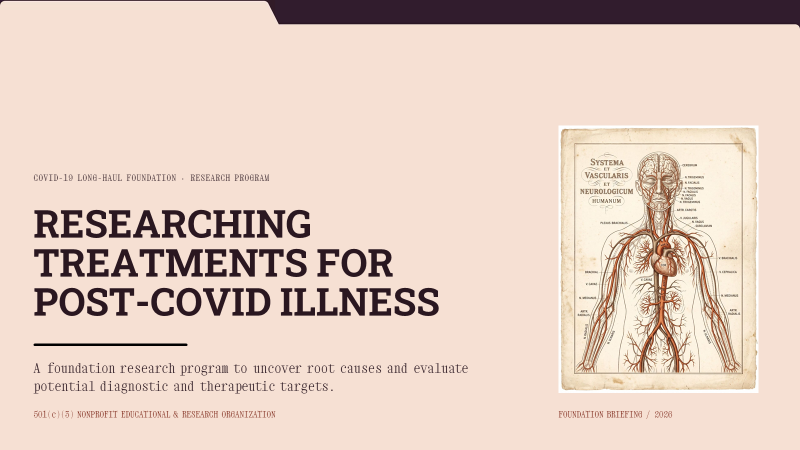
A coordinated research program to identify the causes, consequences, and potential treatments of post-COVID illness
Research program overview and funding
The COVID-19 Long-haul Foundation is advancing a multidisciplinary research program to address one of the most significant unresolved public-health challenges of the COVID-19 pandemic: understanding the causes, clinical manifestations, and long-term consequences of post-COVID conditions.
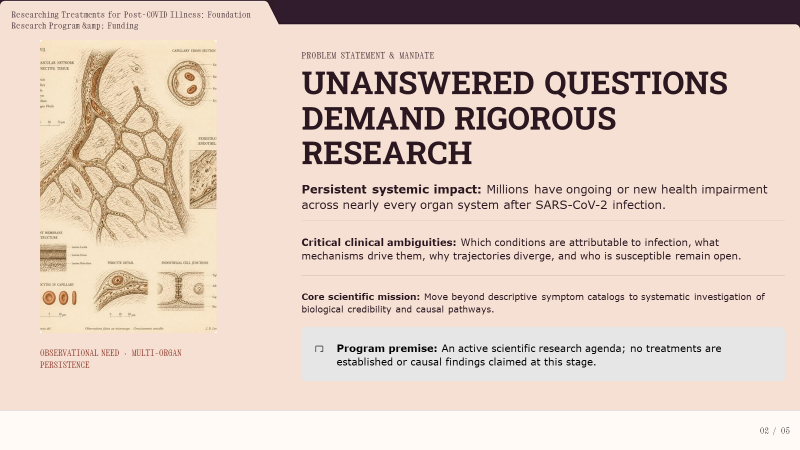
Millions of individuals have experienced persistent or newly emerging health problems following SARS-CoV-2 infection. These conditions can affect virtually every organ system, producing neurological, cardiovascular, renal, immunological, metabolic, musculoskeletal, and autonomic abnormalities. For many affected individuals, illness persists long after the initial infection has resolved. Others experience fluctuating symptoms, progressive functional impairment, or the emergence of conditions that were not previously recognized.
Despite substantial advances in understanding Long COVID, fundamental questions remain unanswered. Which clinical conditions are genuinely attributable to prior infection? What biological mechanisms explain their development? Why do some individuals recover while others experience prolonged or progressive disease? Are there identifiable genetic, immunological, metabolic, or environmental factors that predict susceptibility? Which diagnostic approaches and interventions can improve outcomes?
The Foundation’s research mission is to move beyond symptom documentation and establish the scientific evidence necessary to identify causal relationships between COVID-19 and subsequent clinical disease.
A research agenda spanning multiple disciplines
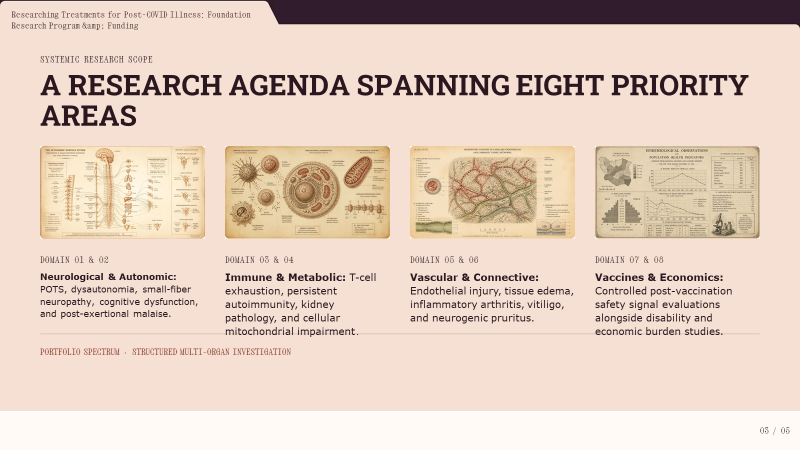
The Foundation has established a broad research portfolio encompassing the following priority areas:
- Autonomic and cardiovascular disease: Orthostatic intolerance, POTS, orthostatic hypotension, dysautonomia, and abnormal cardiovascular regulation.
- Neurological and neuromuscular disease: Small-fiber neuropathy, neuroimmune sensitization, cognitive impairment, neuromuscular weakness, bulbar dysfunction, and post-exertional malaise.
- Immunological dysfunction: Immunosenescence, T-cell exhaustion, clonal hematopoiesis, persistent inflammatory signaling, autoimmunity, and altered antigen-specific immune memory.
- Renal and metabolic disease: Acute kidney injury, chronic kidney disease, impaired renal recovery, mitochondrial dysfunction, and potential therapeutic approaches involving metabolic pathways.
- Microvascular and lymphatic disease: Endothelial injury, impaired tissue perfusion, abnormal vascular permeability, edema, and persistent interstitial inflammation.
- Musculoskeletal and dermatological conditions: Inflammatory arthritis, spinal disease, vitiligo, and neurogenic pruritus.
- Vaccination-related research: Carefully controlled investigation of reported post-vaccination clinical conditions, potential safety signals, biological mechanisms, and differences between infection-associated and post-vaccination phenotypes.
- Population health and economic consequences: Long-term disability, healthcare utilization, mortality, functional impairment, and the economic burden of post-COVID illness.
These priorities are intended to generate focused, independently testable research projects. They also recognize that apparently unrelated clinical conditions may share underlying biological mechanisms.
Establishing causation—not merely association
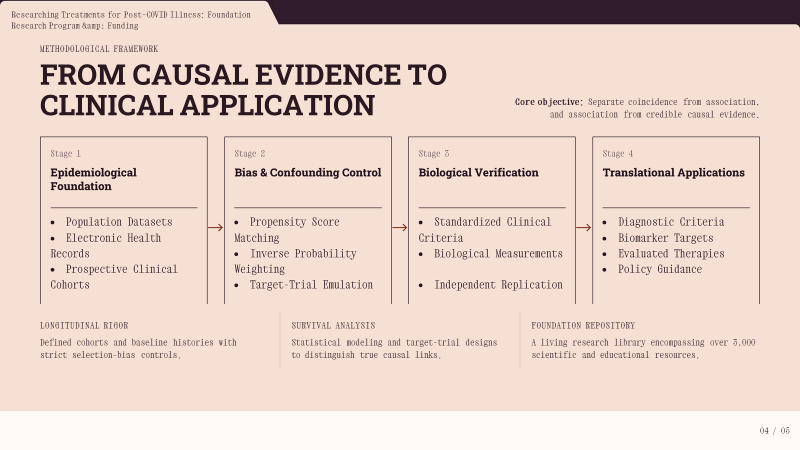
A central deficiency in the current research landscape is the difficulty of determining whether a clinical condition occurring after COVID-19 is causally related to infection or vaccination, reflects a pre-existing vulnerability, or results from an unrelated process.
The Foundation intends to promote research that addresses this problem through:
- Well-defined exposed and comparison populations.
- Baseline medical histories and longitudinal clinical follow-up.
- Standardized diagnostic criteria and objective clinical measurements.
- Epidemiological analyses that account for confounding and selection bias.
- Biological investigations incorporating immunological, genomic, metabolic, and vascular measurements.
- Independent replication and peer-reviewed publication.
The research program will encourage the use of large population datasets, electronic health records, clinical cohorts, and appropriate national surveillance resources. Analytical approaches such as propensity-score matching, inverse probability weighting, survival analysis, and target-trial emulation can strengthen observational evidence when appropriately designed and interpreted.
The goal is to distinguish temporal coincidence from statistical association, and statistical association from credible causal evidence.
From research to clinical application
The Foundation seeks to establish a pathway from epidemiological discovery to clinical translation. Identifying a relationship between infection and a subsequent condition is an important first step; determining its biological basis is essential to developing better diagnostic and therapeutic approaches.
Research findings may ultimately support:
- Earlier identification of individuals at elevated risk.
- More accurate diagnosis and clinical classification.
- Improved understanding of disease progression and recovery.
- Identification of biomarkers and biological treatment targets.
- Development and evaluation of potential therapeutic interventions.
- Better allocation of healthcare resources.
- More informed public-health policy and clinical guidelines.
The Foundation’s research library, containing more than 3,000 educational and scientific resources, provides an expanding knowledge base to support investigators, clinicians, patients, and policymakers.
Funding the research mission: A call to action
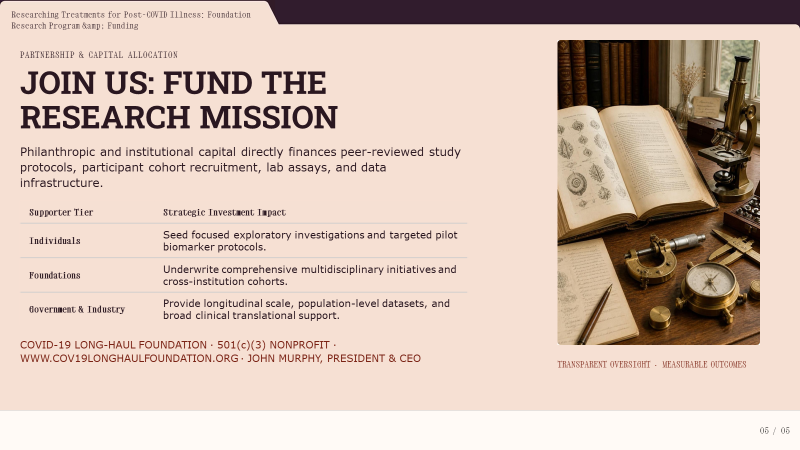
The COVID-19 Long-haul Foundation invites individuals, philanthropic foundations, corporations, academic institutions, and federal, state, and local government programs to support this essential research initiative. The scale and complexity of post-COVID illness exceed what can reasonably be addressed through isolated investigators or limited institutional projects. Sustained funding is needed to develop research protocols, recruit and follow clinical populations, obtain laboratory measurements, access and analyze large datasets, support qualified investigators, establish academic partnerships, and disseminate results through peer-reviewed scientific publications. Contributions from individuals can help initiate focused studies and provide seed funding for promising research. Private foundations and philanthropic organizations can support larger multidisciplinary projects and innovative investigations. Government agencies and public research programs can provide the scale, infrastructure, and longitudinal support necessary for rigorous population-based and translational studies. We encourage prospective funding partners to work with the Foundation to identify projects aligned with their scientific priorities, establish measurable objectives, and support transparent reporting of results. An investment in this research is an investment in scientific discovery, improved healthcare, and the millions of people whose lives have been affected by the long-term consequences of COVID-19.
A shared responsibility
The long-term consequences of COVID-19 represent an enduring challenge for medicine, public health, healthcare systems, and society. The scientific questions are substantial, but so is the opportunity to make meaningful progress.
The Foundation believes that affected populations deserve more than anecdotal explanations and fragmented clinical investigation. They deserve rigorous research, credible evidence, and a sustained commitment to understanding the biological causes of their illnesses.
By bringing together researchers, clinicians, academic institutions, government agencies, philanthropic organizations, and the affected community, the Foundation intends to help build a durable scientific program capable of answering these questions.
The objective is not simply to study Long COVID. It is to understand why these conditions occur, establish which are causally related to prior exposure, and identify what can be done to prevent, diagnose, and treat them.
The COVID-19 Long-haul Foundation
501(c)(3) nonprofit educational and research organization
www.cov19longhaulfoundation.org
Research leadership and program coordination: John Murphy, President & CEO