
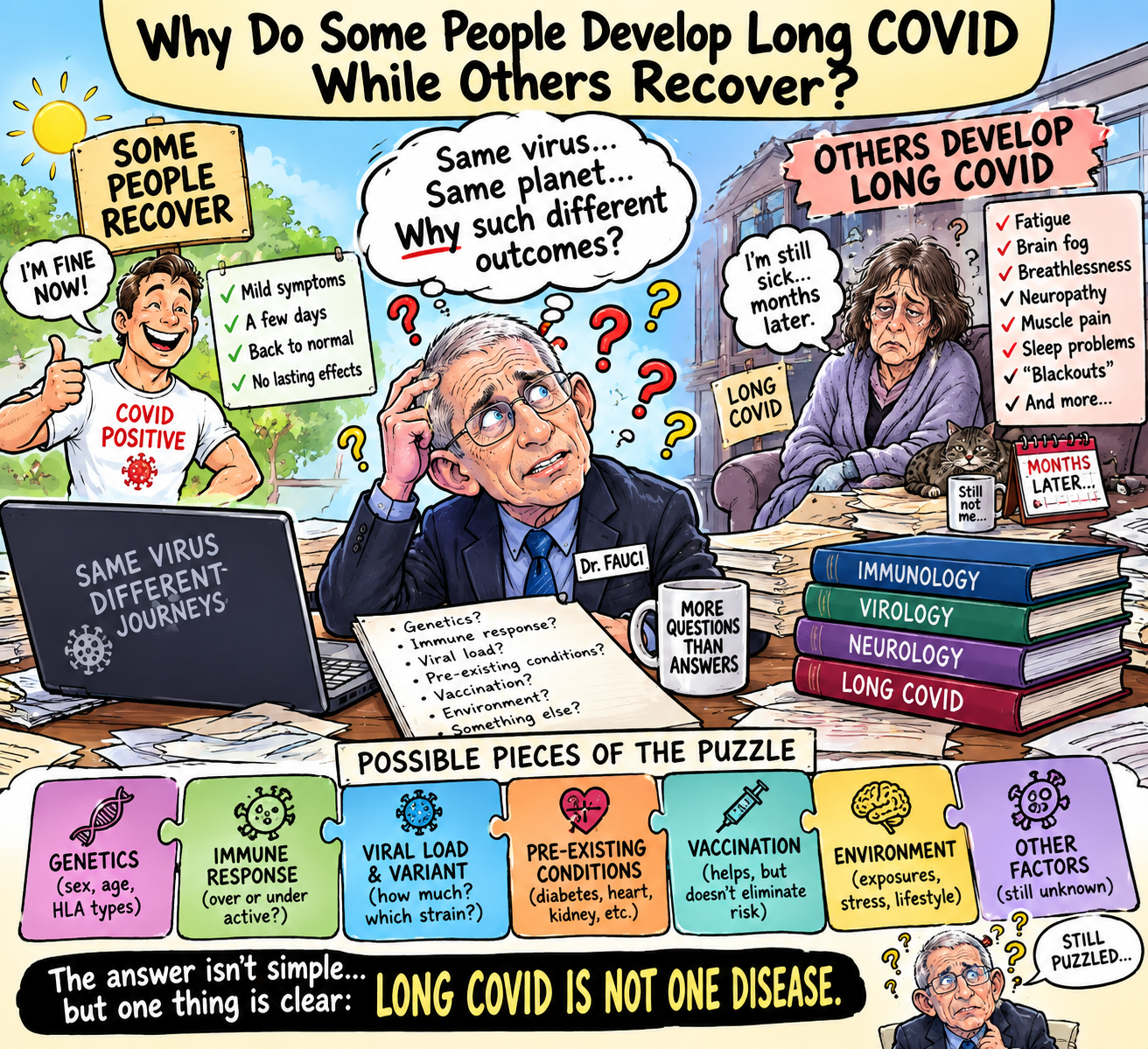
A Multidimensional Analysis of Predictors of Persistent Disease
John Murphy, M.D., M.P.H., D.P.H., COVID-19 Long-haul Foundation
Abstract
Objective
To determine which clinical, demographic, immunological, virological and treatment-related factors are associated with recovery from SARS-CoV-2 infection versus progression to persistent post-COVID-19 condition (Long COVID), and to develop an integrated biological hypothesis explaining divergent recovery trajectories.
Design
Evidence synthesis and comparative analysis of publicly available and published longitudinal cohort studies, electronic health-record datasets, population surveys, prospective biomarker studies, and large-scale clinical research programs, including the US National Institutes of Health RECOVER/N3C program, PCORnet networks, UK Office for National Statistics and COVID-19 Infection Survey datasets, COVID Symptom Study/ZOE cohorts, Veterans Health Administration studies, prospective immunological and proteomic cohorts, and international longitudinal studies.
Main outcome measures
Risk of developing persistent symptoms; duration of symptoms; functional recovery; post-exertional malaise; cognitive dysfunction; autonomic symptoms; multisystem disease; and time to recovery.
Results
Across substantially different populations and study designs, several predictors repeatedly emerge. Greater symptom burden during the first week of acute infection is strongly associated with subsequent persistence. Increasing age, female sex, higher body mass index, selected comorbidities, severe acute disease, and certain metabolic conditions increase risk. Prospective multi-omic studies identify early autoantibodies, circulating SARS-CoV-2 RNA, Epstein-Barr virus reactivation, type 2 diabetes and specific plasma-proteomic abnormalities as candidate biological predictors. Vaccination before infection is consistently associated with lower subsequent risk of Long COVID, while vaccination after infection may be associated with faster recovery in some cohorts, although evidence concerning post-infection vaccination is heterogeneous. Recent large-scale longitudinal data indicate that recovery is neither universal nor necessarily monotonic: fatigue severity, myalgia and dysautonomia are associated with substantially reduced recovery rates. Viral era also matters; cumulative incidence of post-acute sequelae declined from the pre-Delta through Omicron periods, with vaccination accounting for a substantial component of the decline. Reinfection remains an important modifier, although estimates of its effect on persistent disease differ among cohorts.
The evidence supports a model in which Long COVID is not simply the consequence of the severity of the initial infection. Rather, recovery appears to represent one of several biological trajectories determined by the interaction of viral burden, host immune phenotype, metabolic reserve, pre-existing disease, sex, age, vaccination-derived immunity, acute symptom topology and possibly persistent viral or immune perturbation.
Conclusions
The most important unresolved scientific question is no longer simply which factors are associated with Long COVID, but when the trajectory toward recovery or chronic disease becomes biologically determined. The available evidence suggests that this divergence may begin during the acute infection or early convalescent period. Prospective studies combining serial virology, immunology, proteomics, metabolomics, clinical phenotyping and longitudinal outcomes are now required to identify a clinically actionable recovery signature.
Introduction
Most people infected with SARS-CoV-2 recover. A clinically important minority do not. They experience persistent fatigue, post-exertional malaise, cognitive dysfunction, dyspnoea, dysautonomia, sleep disturbance, pain, sensory abnormalities and multisystem disease extending months or years beyond the acute infection.[1]
The central scientific question is deceptively simple:
Why does one person recover while another develops persistent disease after apparently similar SARS-CoV-2 infection?
The answer is unlikely to be contained within a single demographic variable or laboratory measurement. Long COVID is clinically heterogeneous, and current evidence indicates that its determinants span the viral, immunological, metabolic, vascular, neurological and host domains.
The World Health Organization currently estimates that approximately 6% of infected individuals develop post-COVID-19 condition, although estimates vary substantially according to population, definition, variant era and ascertainment method. WHO identifies older age, female sex, smoking, obesity, pre-existing disease, severe infection and repeated infections among risk factors, while also noting evidence of viral persistence, altered immunity, autoimmunity and microvascular abnormalities.[1]
The scientific problem is therefore best conceptualised as a trajectory problem rather than simply a prevalence problem.
There are at least three broad trajectories:
- rapid recovery;
- delayed or fluctuating recovery; and
- persistent or progressive multisystem disease.
The determinants separating these trajectories remain incompletely defined.
Methods
Scope of the evidence synthesis
This analysis examined evidence from publicly available and published sources addressing predictors of Long COVID development, persistence and recovery. Particular emphasis was placed on prospective longitudinal studies because retrospective associations cannot adequately establish temporal precedence.
The evidence base included:
- NIH RECOVER/N3C electronic-health-record studies;
- PCORnet INSIGHT and OneFlorida+ datasets;
- UK Office for National Statistics population studies;
- UK COVID-19 Infection Survey;
- COVID Symptom Study/ZOE longitudinal data;
- Veterans Health Administration studies;
- prospective hospital and community cohorts;
- prospective immune-phenotyping studies;
- plasma-proteomic investigations;
- international longitudinal cohorts;
- vaccination and reinfection studies;
- and recent four-year recovery cohorts.
Where individual-level data were not publicly downloadable, published effect estimates were synthesized rather than re-analysed as though raw participant-level data were available.
This distinction is important: the present manuscript is an integrative evidence analysis, not a de novo individual-participant-data meta-analysis.
Results
1. The strongest early clinical predictor is the number and configuration of acute symptoms
One of the earliest prospective demonstrations came from the COVID Symptom Study.
Among 4,182 individuals with prospectively recorded SARS-CoV-2 infection, 13.3% reported symptoms lasting at least 28 days, 4.5% for at least eight weeks and 2.3% for at least 12 weeks. Increasing age, female sex and BMI were associated with prolonged disease. Most importantly, individuals experiencing more than five symptoms during the first week had substantially increased odds of subsequently developing prolonged illness.
The investigators developed a model using age, sex and early symptom number that achieved an area under the ROC curve of approximately 0.77. The strongest individual predictors included fatigue, headache, dyspnoea, hoarse voice and myalgia.
This observation is conceptually important.
The eventual chronic disease phenotype is not necessarily created months after infection. Instead, the acute illness may contain an early biological signature of the future trajectory.
The hypothesis that follows is:
The greater the number of physiological systems disturbed during the initial infection, the greater the probability that normal post-infectious homeostasis will fail to re-establish.
2. Age and sex are persistent predictors
Age is one of the most reproducible epidemiological predictors.
In the COVID Symptom Study, the prevalence of symptoms lasting at least 28 days increased from approximately 10% among adults aged 18–49 years to approximately 22% among those aged 70 years or older. Female sex was also associated with increased risk in the overall cohort.
These associations are unlikely to represent simple demographic effects.
Age is accompanied by changes in:
- immune responsiveness;
- endothelial function;
- mitochondrial reserve;
- metabolic flexibility;
- vascular integrity;
- tissue repair;
- and immunological memory.
Sex differences may similarly reflect differences in innate and adaptive immune responses, sex hormones and autoimmune susceptibility.
The recurrence of female sex as a risk factor across independent populations therefore warrants biological investigation rather than dismissal as a demographic association.
A 2025 four-year prospective cohort found female sex to be strongly associated with Long COVID and delayed recovery, alongside diabetes, reinfection and hospitalization.
3. Acute disease severity is important—but insufficient
Severe acute COVID-19 increases the probability of persistent disease.
Large EHR analyses demonstrate associations between severe acute infection and subsequent multisystem conditions. In the RECOVER-associated analysis of approximately 2.1 million patients from the INSIGHT and OneFlorida+ networks, severe acute infection and baseline comorbidities were among the factors associated with increased risk of Long COVID conditions. Some outcomes, including dementia, heart failure and acute kidney injury, were relatively predictable from EHR variables, whereas fatigue, anxiety, sleep disorders and depression were substantially less predictable.
Yet severity cannot explain Long COVID by itself.
Long COVID occurs following mild infection, including infections never requiring hospitalization.
This observation fundamentally changes the causal model.
If severe tissue injury were the sole mechanism, persistent disease should be concentrated overwhelmingly among patients with severe acute disease.
It is not.
The more plausible interpretation is that acute severity is one component of a multidimensional risk architecture.
4. Type 2 diabetes and metabolic vulnerability
Metabolic disease is emerging as an important component of the risk profile.
The prospective multi-omic study by Su and colleagues identified pre-existing type 2 diabetes among four early factors associated with subsequent post-acute sequelae, alongside autoantibodies, SARS-CoV-2 RNAemia and EBV reactivation.[2]
A separate four-year prospective cohort found diabetes strongly associated with both Long COVID development and delayed recovery.
These observations raise an important mechanistic possibility.
Metabolic disease may reduce physiological reserve before infection. SARS-CoV-2 then imposes an additional inflammatory, vascular and metabolic burden.
The resulting trajectory could be conceptualised as:
pre-existing metabolic vulnerability → acute viral stress → inflammatory/metabolic dysregulation → incomplete physiological recovery → persistent disease.
This model predicts that metabolic measures obtained during acute infection—not merely diagnostic labels for diabetes—could improve prediction.
5. Viral burden may influence chronicity
One of the most provocative observations from the early multi-omic literature was the association between SARS-CoV-2 RNA detected in blood during acute infection and subsequent PASC.
Su and colleagues analysed two cohorts totalling 309 participants and identified several factors associated with later PASC, including SARS-CoV-2 RNAemia, EBV reactivation, type 2 diabetes and autoantibodies.[2]
This finding supports a biologically intuitive hypothesis:
Greater systemic viral dissemination may increase the probability of persistent biological perturbation after apparent clinical recovery.
The important unanswered question is whether circulating viral RNA is merely a marker of severe or disseminated infection, or whether it identifies individuals in whom viral material persists sufficiently to sustain downstream immune and vascular abnormalities.
This distinction requires serial measurements rather than a single acute sample.
6. Immune dysregulation provides another early biological signal
The immune system appears to be one of the principal determinants separating recovery from persistence.
In a major Nature study employing multidimensional immune profiling, individuals with Long COVID demonstrated differences in circulating myeloid and lymphocyte populations, exaggerated SARS-CoV-2-specific humoral responses and evidence of broader immune perturbation. EBV-associated immune responses were particularly notable, while cortisol levels were lower in participants with Long COVID.[3]
These observations support several non-exclusive mechanisms:
- persistent antigenic stimulation;
- abnormal B-cell responses;
- altered T-cell regulation;
- autoimmunity;
- viral reactivation;
- hypothalamic-pituitary-adrenal dysfunction;
- and chronic inflammatory signalling.
The critical implication is temporal.
If immune abnormalities are detectable near the transition from acute infection to chronic illness, they may be predictors, rather than merely consequences, of Long COVID.
7. Proteomics provides a potentially measurable prediction system
Proteomic investigations strengthen the possibility that recovery trajectories may be identifiable objectively.
In a prospective cohort of healthcare workers, Captur and colleagues followed 54 infected and 102 uninfected participants with serial plasma measurements. Perturbations involving lipid metabolism, atherosclerosis/cholesterol pathways, complement, coagulation, autophagy and lysosomal function persisted for weeks after infection. Most importantly, the plasma proteomic state at seroconversion was associated with persistent symptoms at 12 months.[4]
This is an important conceptual advance.
It suggests that the future clinical trajectory may be encoded in the circulating proteome during the acute infection itself.
The possibility therefore exists of developing a predictive blood test before Long COVID becomes clinically established.
8. Vaccination appears to alter the probability of chronic disease
Vaccination is among the most consistently observed protective factors.
An EHR analysis from the RECOVER/N3C program found that vaccination before infection was associated with lower odds and rates of Long COVID across both clinical and computational definitions.
The effect is also evident in large national datasets.
A Veterans Affairs analysis published in the New England Journal of Medicine found that cumulative PASC incidence declined across pandemic eras. Among unvaccinated individuals, one-year cumulative incidence decreased from 10.42 events per 100 persons in the pre-Delta era to 7.76 during Omicron. Among vaccinated individuals, incidence declined from 5.34 during Delta to 3.50 during Omicron. Decomposition analysis attributed approximately 72% of the decline to vaccination and approximately 28% to era-related factors, including viral evolution and other temporal changes.[5]
This is one of the strongest population-level clues concerning causal structure.
Vaccination does not merely prevent acute hospitalization. It appears to alter the probability that infection will evolve into persistent disease.
9. Post-infection vaccination and recovery remain unresolved
The effect of vaccination after Long COVID has already developed is substantially less certain.
The recent four-year London cohort of 3,590 patients found vaccination before infection associated with faster recovery and also found an association between post-infection vaccination and recovery, although the latter association was considerably smaller.
By contrast, a longitudinal outpatient study following individuals with mild initial disease found no significant difference in recovery at 15 months between vaccinated and unvaccinated participants who received vaccination after infection.[6]
These apparently discordant findings may be explained by:
- different vaccination timing;
- different variants;
- differences in baseline immunity;
- selection bias;
- survivor bias;
- different definitions of recovery;
- and differences in the biological phenotype of Long COVID.
The evidence therefore supports a strong conclusion regarding pre-infection vaccination and risk reduction, but not a similarly strong conclusion regarding vaccination as a treatment for established Long COVID.
10. Reinfection complicates the recovery trajectory
Reinfection presents a particularly important unresolved question.
WHO identifies repeated infections as a risk factor for post-COVID condition.[1]
The 2025 Saudi prospective cohort found reinfection associated with delayed recovery.
However, the magnitude and direction of associations vary across studies because reinfected individuals differ systematically from individuals experiencing a first infection.
The biologically plausible model is cumulative:
infection → partial recovery → reinfection → renewed immune/vascular/metabolic stress → incomplete restoration of homeostasis.
This predicts that cumulative exposure—not simply the number of infections—may ultimately prove more informative.
11. Fatigue severity is a powerful predictor of non-recovery
The newest large prospective evidence is particularly important.
A four-year analysis of 3,590 individuals attending a specialist Long COVID service found that only 33.4% achieved recovery defined as reaching more than 75% of their best pre-illness health. Median time to recovery was 202 days from symptom onset.
Fatigue, breathlessness and brain fog dominated the clinical presentation.
Most importantly, recovery was inversely associated with fatigue severity, myalgia and dysautonomia. Individuals with severe fatigue had dramatically lower recovery hazards.
The reported hazard ratio for fatigue severity was approximately 0.37, indicating a very large association with reduced recovery probability. Dysautonomic symptoms were also strongly associated with non-recovery.
This finding has an important implication:
Long COVID severity is not simply a count of symptoms.
The nature and physiological organization of symptoms may be more informative than their number.
12. Dysautonomia may identify a distinct non-recovery pathway
Autonomic symptoms—orthostatic intolerance, palpitations, dizziness, exercise intolerance and post-exertional deterioration—appear repeatedly within persistent Long COVID phenotypes.
The four-year BMJ Open cohort found dysautonomia associated with markedly reduced recovery probability.
This raises the possibility that a subset of Long COVID represents persistent dysfunction of autonomic regulation rather than residual pulmonary disease alone.
Such a mechanism could plausibly connect:
- cardiovascular symptoms;
- cerebral hypoperfusion;
- exercise intolerance;
- gastrointestinal dysfunction;
- thermoregulatory abnormalities;
- fatigue;
- sleep disturbance;
- and cognitive dysfunction.
If so, autonomic phenotype should become an explicit component of future recovery prediction models.
13. The phenotype of Long COVID itself matters
The 2024 RECOVER research index identified a constellation of symptoms including post-exertional malaise, fatigue, brain fog, dizziness, palpitations, altered smell or taste, thirst, cough, chest pain, dyspnoea and sleep apnoea. Cluster analysis identified five symptom subtypes associated with differences in quality of life.[7]
This finding is crucial because it suggests that Long COVID is not one biological entity.
A person whose dominant phenotype is autonomic dysfunction may not share the same pathophysiology as a person whose dominant phenotype is pulmonary fibrosis or gastrointestinal disease.
Consequently, attempts to identify a universal predictor of “Long COVID” may fail because the outcome itself is heterogeneous.
The appropriate target may instead be:
prediction of specific Long COVID trajectories.
14. A unified model of recovery versus chronic disease
The available evidence supports a multidimensional model.
Stage 1: Host state before infection
Risk is influenced by:
- age;
- sex;
- obesity;
- diabetes;
- cardiovascular disease;
- immune status;
- metabolic reserve;
- prior vaccination;
- and other comorbidities.
Stage 2: Acute viral interaction
Potential determinants include:
- viral burden;
- systemic dissemination;
- tissue tropism;
- acute inflammatory response;
- number of affected physiological systems;
- endothelial injury;
- and early immune phenotype.
Stage 3: Early convalescence
At this point, several trajectories may emerge:
Resolution
→ immune contraction
→ restoration of metabolic and vascular homeostasis
→ symptom disappearance.
Delayed recovery
→ persistent immune activation
→ incomplete physiological restoration
→ fluctuating symptoms.
Persistent disease
→ sustained immune dysregulation
→ autonomic/metabolic dysfunction
→ possible viral persistence or antigen persistence
→ multisystem disease.
The hypothesis can be represented conceptually as:
Host susceptibility × viral burden × acute phenotype × immune response × metabolic reserve × acquired immunity → recovery trajectory.
15. The central hypothesis
The evidence permits formulation of a testable hypothesis:
Long COVID is determined in substantial part by an early divergence in biological recovery after SARS-CoV-2 infection, in which viral burden, host susceptibility, immune dysregulation, metabolic vulnerability and acute multisystem involvement interact to determine whether physiological homeostasis is restored.
This hypothesis generates several predictions.
Prediction 1
Biomarkers obtained during the first days to weeks of infection should predict persistent disease better than biomarkers obtained only after Long COVID has become established.
Prediction 2
A multimarker model should outperform individual biomarkers.
Prediction 3
The optimal model will differ among Long COVID phenotypes.
Prediction 4
Pre-infection vaccination should shift the entire distribution toward recovery.
Prediction 5
Persistent viral antigen or RNA should identify at least a subset of patients with persistent disease.
Prediction 6
Severe acute disease should increase risk but should not fully explain chronic disease.
Prediction 7
Early dysautonomia and post-exertional symptoms should predict particularly persistent trajectories.
16. What the existing databases can now answer
The scientific community possesses sufficient data to move beyond another descriptive epidemiological study.
RECOVER/N3C
Can determine:
- pre-existing risk factors;
- acute disease severity;
- vaccination;
- reinfection;
- medications;
- organ-specific outcomes;
- healthcare utilization;
- longitudinal diagnoses.
The RECOVER predictive analysis already demonstrates that EHR data can predict some Long COVID-associated outcomes substantially better than others.
UK ONS/COVID-19 Infection Survey
Can provide:
- population-level prevalence;
- symptom trajectories;
- duration;
- socioeconomic determinants;
- vaccination associations;
- reinfection effects;
- demographic differences.
COVID Symptom Study/ZOE
Provides unusually granular prospective symptom trajectories and demonstrated that early symptom topology can predict persistent disease.
Veterans Health Administration
Provides a very large longitudinal population in which vaccination, viral-era effects and subsequent outcomes can be examined. The NEJM analysis demonstrated a substantial decline in PASC incidence over successive pandemic eras and quantified the contribution attributable to vaccination.
Prospective immunological cohorts
Provide measurements of:
- autoantibodies;
- T-cell responses;
- B-cell responses;
- cytokines;
- cortisol;
- EBV responses;
- inflammatory pathways.
The Nature immune-phenotyping study demonstrates that these measurements can distinguish Long COVID from recovered controls.
Proteomic cohorts
Provide a potential bridge between acute infection and future disease.
The EBioMedicine study demonstrated that the plasma proteome around seroconversion contained information associated with symptoms persisting to 12 months.
17. The critical methodological problem: prediction is not causation
The existing literature contains an important methodological trap.
A factor can predict Long COVID without causing Long COVID.
For example:
high viral RNA → Long COVID
could mean:
- viral burden causes persistent disease;
- impaired immunity causes both high viral burden and persistent disease; or
- severe acute disease causes both.
Similarly:
autoantibodies → Long COVID
does not establish that the antibodies cause symptoms.
They could instead represent a marker of a broader immune phenotype.
Therefore, the next generation of studies must distinguish:
prediction → mediation → causation.
Longitudinal sampling is essential.
18. The most important unanswered question
The evidence assembled here suggests that the field should shift its principal research question.
Instead of asking:
Who has Long COVID?
the more informative question is:
At what biological point does recovery cease to be the default trajectory?
This distinction is fundamental.
If that transition occurs during acute infection, prevention should focus on:
- rapid antiviral treatment;
- vaccination;
- reduction of viral burden;
- modulation of excessive inflammation;
- and protection of vulnerable patients.
If the transition occurs weeks later, early convalescent intervention becomes the critical therapeutic window.
If the transition occurs months later, entirely different therapeutic strategies may be required.
Discussion
The accumulated evidence does not support a single deterministic cause of Long COVID.
Rather, the data point toward heterogeneous biological trajectories arising from interactions among host susceptibility, acute viral disease, immunity, metabolism, vaccination, reinfection and persistent physiological dysfunction.
Several observations are particularly compelling.
First, early symptom burden predicts later persistence. Second, specific biological abnormalities can be detected during acute infection before chronic symptoms are established. Third, vaccination reduces the probability of developing PASC. Fourth, severe acute disease increases risk but cannot account for all cases. Fifth, persistent disease is associated with measurable immune, hormonal and proteomic abnormalities. Sixth, the severity and phenotype of established Long COVID strongly influence the probability of subsequent recovery.
The convergence of these findings suggests that Long COVID should not be conceptualized solely as a late complication.
It may represent a failure of biological recovery.
That formulation is important because it changes the therapeutic objective.
Instead of treating established Long COVID exclusively as a collection of symptoms, medicine should attempt to identify the mechanisms preventing restoration of physiological equilibrium.
A proposed predictive framework
A clinically useful prediction model should incorporate five domains.
| Domain | Candidate predictors |
|---|---|
| Host | age, sex, BMI, diabetes, comorbidity, genetics |
| Viral | viral burden, RNAemia, variant, reinfection |
| Acute phenotype | symptom number, dyspnoea, fatigue, myalgia, neurological symptoms |
| Immune/metabolic | autoantibodies, EBV activity, cytokines, cortisol, proteomics |
| Acquired immunity | vaccination timing, number of doses, prior infection |
The model should then predict several separate outcomes:
- recovery by 4 weeks;
- recovery by 12 weeks;
- Long COVID at 6 months;
- persistent disease at 12 months;
- persistent disease at 24 months;
- severe functional impairment;
- phenotype-specific outcomes.
A single binary endpoint—Long COVID yes/no—throws away much of the biological information contained in the longitudinal record.
Implications for clinical practice
The evidence suggests that clinicians should recognize high-risk trajectories early.
Patients with:
- extensive acute symptom burden;
- marked fatigue;
- dyspnoea;
- early autonomic symptoms;
- diabetes;
- obesity;
- severe acute disease;
- high-risk comorbidity;
- or other evidence of systemic involvement
may merit structured follow-up after acute infection.
The objective should not be to label every symptomatic patient with Long COVID.
It should be to identify patients whose recovery trajectory is deviating from expected physiological recovery.
This could permit earlier investigation of:
- autonomic dysfunction;
- pulmonary impairment;
- cardiovascular disease;
- metabolic abnormalities;
- neurological disease;
- sleep disorders;
- and other treatable conditions.
Implications for research
The next generation of Long COVID research should move toward prospective trajectory science.
A definitive study would recruit individuals immediately following confirmed SARS-CoV-2 infection and obtain standardized measurements at:
day 0 → day 7 → day 14 → day 28 → 3 months → 6 months → 12 months → 24 months.
At each point, investigators should obtain:
- symptom phenotype;
- functional measures;
- autonomic testing;
- SARS-CoV-2 antigen/RNA measurements;
- cytokines;
- autoantibodies;
- immune-cell phenotyping;
- proteomics;
- metabolomics;
- coagulation/endothelial markers;
- EBV and other viral markers;
- and patient-reported outcomes.
The principal analytical endpoint should be trajectory, not merely disease prevalence.
Machine-learning methods can identify nonlinear interactions, but models should be externally validated and evaluated for calibration, discrimination and clinical utility.
Conclusion
The evidence accumulated since the beginning of the pandemic now permits a more precise formulation of the Long COVID problem.
Most people recover from SARS-CoV-2 infection.
Some do not.
The difference is not adequately explained by age, sex, acute disease severity or any single biomarker. Instead, the available evidence points toward an interaction among host vulnerability, viral burden, early multisystem involvement, immune dysregulation, metabolic reserve, vaccination-derived immunity and subsequent physiological recovery.
The most compelling evidence is that several predictors are detectable before chronic disease is fully established.
Early symptom topology predicts persistence. Acute viral RNAemia predicts subsequent PASC in prospective cohorts. Autoimmune and immune abnormalities appear associated with later disease. Plasma proteomic signatures during seroconversion contain information about symptoms persisting for a year. Vaccination reduces the probability of PASC. Conversely, severe fatigue and dysautonomia are associated with markedly reduced recovery once Long COVID has become established.
These findings converge on a central proposition:
Long COVID may be less a disease that suddenly appears after COVID-19 than a pathological recovery trajectory that begins during acute infection and becomes progressively established when biological homeostasis fails to return.
The most important research objective, therefore, is to identify the moment at which the trajectory becomes modifiable.
If that moment can be identified—and if the biological mechanisms responsible can be distinguished by phenotype—then Long COVID may move from a largely reactive clinical discipline toward one based on prediction, prevention and mechanism-directed intervention.
That transition should now become a central objective of post-pandemic clinical science.
Footnotes and References
1. World Health Organization. Post COVID-19 condition (long COVID). Updated 26 February 2025. WHO summarizes current estimates, risk factors, clinical manifestations, recovery trajectories and evidence concerning viral persistence, altered immunity, autoimmunity and microthrombosis.
2. Su Y, Yuan D, Chen DG, et al. Multiple early factors anticipate post-acute COVID-19 sequelae. Cell. 2022;185:881–895.e20. doi:10.1016/j.cell.2022.01.014. The study identified autoantibodies, type 2 diabetes, EBV reactivation and SARS-CoV-2 RNAemia among early factors associated with subsequent PASC.
3. Klein J, Wood J, Jaycox JR, et al. Distinguishing features of long COVID identified through immune profiling. Nature. 2023. The study identified differences in immune-cell populations, SARS-CoV-2-specific humoral responses, EBV-associated responses and cortisol among individuals with Long COVID.
4. Captur G, Moon JC, Topriceanu CC, et al. Plasma proteomic signature predicts who will get persistent symptoms following SARS-CoV-2 infection. EBioMedicine. 2022;85:104293. doi:10.1016/j.ebiom.2022.104293.
5. Al-Aly Z, et al. Postacute Sequelae of SARS-CoV-2 Infection in the Pre-Delta, Delta, and Omicron Eras. New England Journal of Medicine. 2024. The Veterans Health Administration analysis quantified declining PASC incidence across pandemic eras and estimated the contribution of vaccination and era-related factors.
6. Prospective outpatient cohort study. 15-month post-COVID syndrome in outpatients: Attributes, risk factors, outcomes, and vaccination status. The study found persistent symptoms in a substantial minority but did not identify a significant improvement in recovery associated with post-infection vaccination.
7. RECOVER Adult Cohort Investigators. 2024 Update of the RECOVER-Adult Long COVID Research Index. JAMA. 2024. The study included 13,647 participants from 83 sites and identified an updated symptom-based index and five symptom subtypes.
8. Sudre CH, Murray B, Varsavsky T, et al. Attributes and predictors of long COVID. Nature Medicine. 2021;27:626–631. The prospective COVID Symptom Study demonstrated associations with age, sex, BMI and early symptom burden and developed an early prediction model.
9. Zang C, Hou Y, Schenck EJ, et al. Identification of risk factors of Long COVID and predictive modeling in the RECOVER EHR cohorts. Communications Medicine. 2024;4:130. doi:10.1038/s43856-024-00549-0. The analysis used approximately 1.4 million patients in INSIGHT and 0.7 million in OneFlorida+ and demonstrated heterogeneous predictability across Long COVID-related conditions.
10. Long COVID risk and pre-COVID vaccination in an EHR-based cohort study from the RECOVER program. This N3C analysis found consistently lower odds and rates of Long COVID among vaccinated individuals compared with unvaccinated individuals.
11. Kamal SM, Al Qahtani MS, Al Aseeri A, et al. Long COVID-19: a four-year prospective cohort study of risk factors, recovery, and quality of life. BMC Infectious Diseases. 2025;25:1082. The cohort included 816 adults followed for up to four years and identified female sex, diabetes, reinfection and hospitalization as predictors of delayed recovery.
12. Trajectory, healthcare utilisation and recovery in 3590 individuals with long covid: a 4-year prospective cohort analysis. BMJ Open. 2026;16. This prospective specialist-service cohort found that approximately one-third achieved the prespecified recovery threshold and identified fatigue severity, myalgia and dysautonomia as major predictors of non-recovery.
13. World Health Organization. Clinical management of COVID-19: living guideline. June 2025. WHO identifies natural history, risk factors, pathophysiology, viral persistence, immune dysregulation, thrombosis, vaccination and treatment effects as priority areas for post-COVID research.
Proposed manuscript classification
Article type: Review / Analysis / Perspective
Primary subject: Long COVID / post-COVID-19 condition
Principal hypothesis: Divergent recovery trajectories are established partly during acute and early convalescent SARS-CoV-2 infection through interaction among viral burden, host susceptibility, immune phenotype, metabolic reserve, acquired immunity and early multisystem manifestations.
Strengths
- Integrates prospective, retrospective, population and molecular evidence.
- Gives priority to longitudinal evidence.
- Separates predictors from causal mechanisms.
- Incorporates clinical and biological trajectories rather than symptom prevalence alone.
- Identifies specific hypotheses that can be prospectively tested.
Limitations
The evidence base remains heterogeneous with respect to Long COVID definitions, sampling intervals, vaccination eras, SARS-CoV-2 variants, ascertainment methods and populations. Many EHR studies measure diagnoses rather than biologically confirmed disease. Biomarker studies are generally smaller than epidemiological cohorts and frequently lack independent external validation. Associations involving post-infection vaccination and recovery are particularly vulnerable to confounding and selection effects. The present analysis synthesizes published results and publicly available evidence; it does not constitute a new individual-participant-data meta-analysis of restricted RECOVER, VA or national-survey microdata.
Declarations
Funding: No external funding is reported for this manuscript.
Competing interests: The author declares no financial conflicts of interest relevant to this manuscript.
Patient and public involvement: No new patient-level data were collected for this evidence synthesis.
Data availability: No new primary dataset was generated. The manuscript relies upon published studies and publicly described datasets and research programs.
Ethics approval: Not applicable; no new human participants or identifiable patient-level data were accessed.