
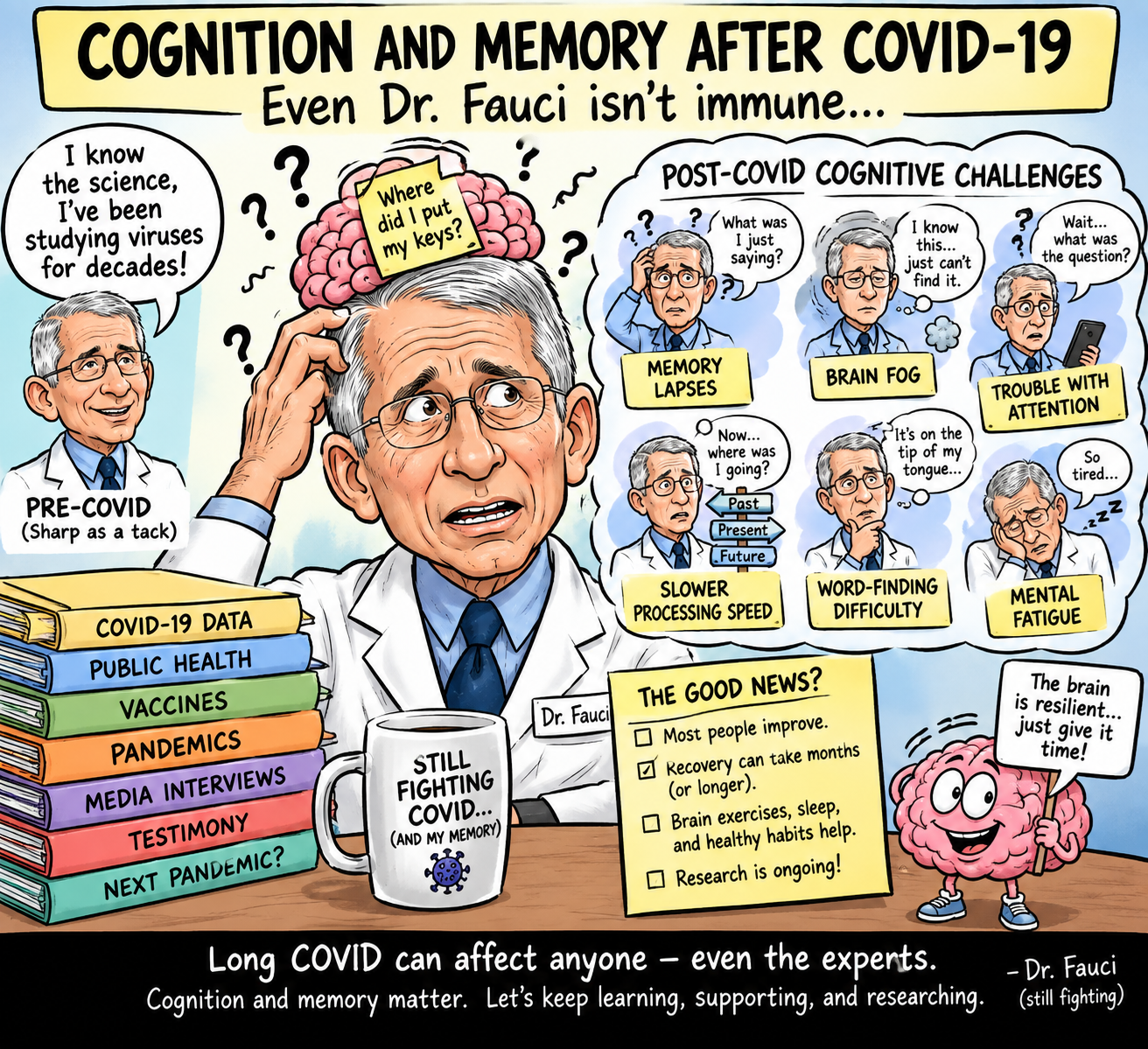
John Murphy, CEO, The COVID-19 Long haul Foundation
Key Points
Question: Does SARS-CoV-2 infection produce persistent, objectively measurable abnormalities in cognition and memory, and what mechanisms and clinical consequences may account for these abnormalities?
Findings: Evidence from large population studies, prospective cohorts, systematic reviews, meta-analyses, and neurobiological investigations indicates that cognitive dysfunction can persist after COVID-19. Deficits have been identified in executive function, learning and memory, attention, processing speed, working memory, and related cognitive domains. In the largest community-based cognitive study to date, persistent unresolved symptoms were associated with a global cognitive deficit of approximately 0.42 SD compared with individuals without COVID-19, with memory, reasoning, and executive tasks among the most affected domains. A 2025 longitudinal cohort of 1553 patients found progressive improvement over 42 months, but processing speed and executive functioning remained, on average, at least 1 SD below normative means. Systematic-review evidence indicates that impairment is broad rather than confined to a single cognitive domain. Biological studies increasingly implicate blood-brain-barrier disruption, systemic inflammation, neurovascular dysfunction, altered brain connectivity, and hippocampal abnormalities.
Meaning: Post-COVID cognitive dysfunction represents a clinically significant and biologically plausible neurological syndrome. Recovery occurs in many patients, but cognitive abnormalities can persist for years. Future studies should use harmonized neuropsychological batteries, longitudinal designs, objective biomarkers, appropriate controls, and prespecified analyses of disease severity, vaccination, reinfection, sex, age, and comorbidity.
Abstract
Importance
Cognitive dysfunction is among the most disabling manifestations of post-COVID-19 illness. Patients frequently describe impaired concentration, slowed thinking, forgetfulness, word-finding difficulty, impaired working memory, reduced mental endurance, and difficulty performing previously routine cognitive tasks. Although these symptoms are often collectively termed “brain fog,” accumulating evidence indicates that at least some patients demonstrate objectively measurable cognitive impairment.
Objective
To review evidence concerning persistent cognitive and memory dysfunction after SARS-CoV-2 infection, characterize affected cognitive domains and longitudinal trajectories, examine potential mechanisms, and consider implications for diagnosis, prognosis, and clinical management.
Evidence Review
Evidence was synthesized from large population-based cognitive studies, prospective longitudinal cohorts, systematic reviews and meta-analyses, neuroimaging investigations, and mechanistic studies published through 2026. Particular attention was given to studies incorporating objective neuropsychological testing rather than relying exclusively on self-reported symptoms.
Findings
A large community-based study of more than 112,000 participants who completed an 8-task cognitive battery found objectively measurable cognitive differences after COVID-19. Participants with unresolved persistent symptoms had a mean global cognitive deficit of −0.42 SD compared with participants without COVID-19; memory, reasoning, and executive tasks showed some of the largest differences. Hospitalization and intensive care were associated with greater deficits. The same study found smaller deficits among participants infected during later variant periods and suggested improvement after persistent symptoms resolved.^1
A 2025 systematic review of 36 studies found persistent alterations across executive function, memory, attention, and processing speed.^2 A separate systematic review and meta-analysis identified moderate impairment across multiple cognitive domains, including executive function, learning and memory, complex attention, language, and perceptual-motor function, although substantial heterogeneity limited direct comparison among studies.^3
Longitudinal evidence provides a more nuanced picture. In a prospective cohort of 1553 individuals followed for as long as 42 months, cognitive performance improved progressively in most domains; nevertheless, processing speed and executive functioning remained substantially below normative means on average.^4
Mechanistic evidence suggests that cognitive dysfunction may involve multiple interacting processes, including blood-brain-barrier disruption, persistent systemic inflammation, endothelial and neurovascular dysfunction, altered functional connectivity, hippocampal abnormalities, immune dysregulation, sleep disturbance, autonomic dysfunction, and the consequences of severe acute illness.^5-9
Conclusions and Relevance
COVID-19 can be followed by persistent, objectively measurable cognitive dysfunction. The syndrome is heterogeneous and should not be conceptualized as either a purely subjective complaint or a uniform neurodegenerative disorder. Many patients improve, but a clinically important subgroup remains impaired for prolonged periods. Research should distinguish subjective cognitive symptoms from objective impairment, characterize individual trajectories, identify biological phenotypes, and develop evidence-based interventions.
Introduction
The COVID-19 pandemic initially focused scientific attention on pulmonary disease, respiratory failure, thrombosis, and mortality. As survival increased, however, it became evident that recovery from the acute infection did not invariably represent recovery of neurological function. Patients who had never been hospitalized began reporting persistent difficulty concentrating, remembering appointments, finding words, reading, calculating, multitasking, or sustaining attention.
The term “brain fog” entered common clinical usage to describe this constellation of symptoms. The term is useful because it reflects patients’ experience, but it is scientifically imprecise. Brain fog can encompass impaired attention, memory, executive function, processing speed, language retrieval, mental fatigue, and subjective cognitive inefficiency. It should therefore not be treated as a single neurological diagnosis.^10
The critical scientific question is whether these complaints correspond to objectively measurable cognitive abnormalities.
The evidence increasingly indicates that they can.
The strongest evidence does not come from isolated case reports or highly selected neurological clinics but from population-based studies and longitudinal cohorts using standardized cognitive measures. In the largest community study, investigators invited 800,000 adults in England to complete cognitive assessments; 112,964 completed the entire 8-task battery. Persistent unresolved COVID-19 symptoms were associated with measurable deficits in global cognition, particularly involving memory, reasoning, and executive functioning.^1
These findings have important implications. If cognitive dysfunction were merely a nonspecific consequence of anxiety about COVID-19, one would not necessarily expect reproducible relationships between illness duration, hospitalization, disease era, and specific neuropsychological measures. Conversely, objective cognitive differences do not establish that SARS-CoV-2 directly infects neurons or that every cognitive complaint after COVID-19 is caused by direct viral injury.
The emerging evidence instead supports a multifactorial neurological model.
What Is Post-COVID Cognitive Dysfunction?
Post-COVID cognitive dysfunction is best conceptualized as a heterogeneous syndrome rather than a single disease entity.
Potential manifestations include:
- impaired attention;
- reduced processing speed;
- impaired working memory;
- difficulty learning new information;
- impaired delayed recall;
- executive dysfunction;
- reduced verbal fluency;
- word-finding difficulty;
- impaired multitasking;
- diminished cognitive endurance;
- subjective memory failure;
- difficulty organizing complex activities;
- cognitive deterioration after physical or mental exertion.
The distinction between cognitive symptoms and cognitive impairment is essential.
A person may report severe memory problems while performing within normal limits on a brief test. Conversely, an individual may demonstrate measurable slowing or executive dysfunction without perceiving substantial cognitive difficulty.
Both phenomena are clinically important.
Evidence From the Largest Community-Based Study
The Hampshire et al. study
The landmark study by Hampshire and colleagues, published in The New England Journal of Medicine in 2024, provided unusually strong evidence that COVID-19 can be associated with measurable cognitive differences in a large community population.^1
The investigators drew participants from the REACT study and invited 800,000 adults to complete a cognitive assessment. Of the 141,583 participants who initiated the assessment, 112,964 completed all 8 cognitive tasks.^1
This scale is important because many earlier studies were limited by small samples, clinical referral bias, absence of controls, and inconsistent cognitive instruments.
The study generated a global cognitive score and examined relationships with:
- infection;
- duration of symptoms;
- hospitalization;
- intensive care;
- viral variant period;
- vaccination;
- persistent symptoms;
- subjective memory complaints;
- brain fog.
Magnitude of impairment
Compared with participants without COVID-19, individuals whose symptoms had resolved had small but measurable deficits:
- less than 4 weeks of symptoms: approximately −0.23 SD;
- symptoms lasting at least 12 weeks but subsequently resolved: approximately −0.24 SD;
- unresolved persistent symptoms: approximately −0.42 SD.^1
The unresolved-symptom group therefore showed a substantially larger cognitive difference.
Among participants with persistent symptoms, memory, reasoning, and executive-function tasks were particularly affected, with differences approximately −0.33 to −0.20 SD compared with the no-COVID-19 group.^1
These effects are not equivalent to profound dementia. The average effect was relatively modest. The clinical importance lies partly in the population scale and partly in the distribution: even a modest mean shift can result in a substantial increase in the number of people whose performance falls into clinically concerning ranges.
The investigators estimated that the probability of scoring below −2 SD on global cognitive performance was approximately 2.4 times higher in participants with unresolved persistent symptoms than in the no-COVID-19 group.^1
Cognitive Domains Affected
Memory
Memory complaints are among the most characteristic manifestations of post-COVID cognitive dysfunction.
Patients may describe:
- forgetting conversations;
- losing track of tasks;
- difficulty recalling names;
- inability to retain recently read material;
- repeatedly checking information;
- difficulty remembering appointments;
- reduced ability to learn new procedures.
Objective studies have identified abnormalities in learning, immediate recall, delayed recall, and working memory.
The systematic review by Panagea and colleagues identified memory as one of the domains most consistently affected across studies of long COVID.^2
The meta-analysis by Fanshawe and colleagues similarly identified learning and memory impairment, with a pooled standardized mean difference of approximately −0.55 in higher-quality studies.^3
These results should not be interpreted as demonstrating a uniform “memory disorder.” Memory is a multistage process involving encoding, attention, consolidation, storage, and retrieval. An apparent memory deficit may therefore originate from impaired attention or processing speed rather than isolated hippocampal dysfunction.
This distinction is clinically important.
A patient who cannot remember what was said during a conversation may have failed to encode the information because of impaired attention. A patient who encoded information normally but cannot retrieve it later may have a different neurological phenotype.
Executive Function
Executive functions include:
- planning;
- inhibition;
- cognitive flexibility;
- organization;
- problem solving;
- sequencing;
- multitasking;
- monitoring errors.
Executive dysfunction is especially disabling because it affects complex activities of daily living.
The NEJM community study found executive tasks among the domains with relatively large differences in participants with unresolved symptoms.^1
The 2025 longitudinal Mount Sinai study likewise found persistent abnormalities in executive functioning despite improvement over time.^4
Executive dysfunction may explain why some patients can perform adequately on simple cognitive tests but struggle with complex real-world tasks such as:
- managing medications;
- completing financial forms;
- driving;
- navigating unfamiliar environments;
- maintaining professional productivity;
- simultaneously monitoring several sources of information.
Processing Speed
Processing speed is frequently overlooked in discussions of memory.
A patient may know the answer to a question but require substantially more time to produce it. This can be experienced as “thinking through molasses.”
Processing-speed impairment is important because it can impair:
- reading comprehension;
- conversation;
- driving;
- professional work;
- multitasking;
- response to unexpected situations.
The Mount Sinai longitudinal cohort provides particularly important evidence. Among 1553 participants followed for up to 42 months, processing speed improved progressively, but average performance remained at least 1 SD below normative means.^4
This finding provides evidence for partial recovery without complete normalization in an important subgroup.
Attention and Working Memory
Attention represents the gateway through which information enters working memory.
Disruption of sustained attention can produce secondary problems with:
- memory;
- learning;
- reading;
- reasoning;
- conversation;
- executive functioning.
The systematic review and meta-analysis by Fanshawe et al found moderate impairment in complex attention, with a pooled standardized mean difference of approximately −0.54 in higher-quality studies.^3
Working memory is particularly vulnerable because it requires simultaneous maintenance and manipulation of information.
Patients may therefore report that they can remember information when presented slowly but lose track when:
- multiple instructions are given;
- conversations become rapid;
- they are interrupted;
- they must switch between tasks.
Is the Cognitive Dysfunction Real?
This question is now substantially less controversial than it was early in the pandemic.
The evidence consists of several independent levels.
Level 1: Patient-reported symptoms
Large studies consistently identify memory and concentration problems after COVID-19.^1,2,10
Level 2: Standardized cognitive testing
Multiple studies identify measurable differences in memory, executive function, attention, processing speed, and related domains.^1-4
Level 3: Longitudinal persistence
Cognitive differences can persist for many months and, in some cohorts, years.^4
Level 4: Neuroimaging
Studies have identified alterations involving functional connectivity, cortical structures, and medial temporal regions.^7,8
Level 5: Biological abnormalities
Blood-brain-barrier disruption and persistent inflammatory abnormalities have been demonstrated in patients with long-COVID cognitive symptoms.^5
Together these observations make it increasingly difficult to explain post-COVID cognitive dysfunction as a purely subjective phenomenon.
However, this does not imply that every cognitive complaint after COVID-19 is directly caused by SARS-CoV-2.
Longitudinal Recovery
One of the most clinically important developments has been recognition that cognitive trajectories are not static.
The 2025 Mount Sinai prospective cohort followed 1553 individuals and assessed cognition over as long as 42 months.^4
The investigators observed progressive improvement in:
- attention;
- working memory;
- verbal learning;
- memory recall;
- memory retention;
- language;
- processing speed;
- executive function.
Nevertheless, processing speed and executive function remained, on average, at least 1 SD below normative means at the end of follow-up.^4
This suggests at least 3 broad trajectories:
Recovery
Cognitive function gradually returns toward premorbid or normative levels.
Persistent impairment
Cognitive function improves but remains measurably abnormal.
Prolonged or fluctuating dysfunction
Symptoms and cognitive performance remain impaired or fluctuate over extended periods.
The existence of these trajectories argues against describing long COVID as either invariably permanent or invariably self-limited.
Severity of Acute COVID-19
Acute disease severity appears to influence subsequent cognition.
In the NEJM study, hospitalization was associated with larger cognitive differences, while ICU admission was associated with still greater deficits.^1
Participants admitted to intensive care had particularly substantial cognitive differences, consistent with what is known about cognitive impairment following critical illness.
This distinction is important.
There are probably at least 2 partially overlapping pathways:
Severe acute COVID pathway
SARS-CoV-2 infection → systemic inflammation → hypoxemia → vascular injury → critical illness → ICU-related neurological injury → persistent cognitive impairment.
Nonhospitalized long-COVID pathway
SARS-CoV-2 infection → immune dysregulation → endothelial/neurovascular dysfunction → blood-brain-barrier abnormalities → autonomic dysfunction/inflammation → persistent cognitive dysfunction.
These pathways may converge clinically while differing biologically.
Viral Variants and the Pandemic Era
The Hampshire study identified smaller cognitive differences among individuals infected during later variant periods than among those infected with the original virus or the Alpha variant.^1
Several explanations are possible:
- lower average acute disease severity;
- greater population immunity;
- vaccination;
- improved clinical management;
- differences in viral biology;
- changes in testing and ascertainment;
- differences in hospitalization;
- survivor selection.
The observational design prevents assigning the improvement to a single cause.
Nevertheless, the finding suggests that post-COVID cognitive risk is not biologically fixed across all phases of the pandemic.
Vaccination and Cognitive Outcomes
The Hampshire study found a small cognitive advantage among participants who had received 2 or more vaccinations.^1
More broadly, a large multinational staggered-cohort study involving the United Kingdom, Spain, and Estonia found that vaccination was associated with a lower risk of long-COVID symptoms.^11
These findings are consistent with the possibility that prevention of infection or reduction of acute disease severity may reduce the subsequent neurological burden.
They do not prove that vaccination directly treats established cognitive dysfunction.
That distinction is essential.
Brain Imaging and the Biological Substrate
Blood-Brain-Barrier Dysfunction
One of the most important mechanistic observations came from Greene and colleagues in Nature Neuroscience in 2024.^5
Using dynamic contrast-enhanced MRI and complementary biological measurements, the investigators reported blood-brain-barrier disruption in patients with long COVID and cognitive impairment.
The blood-brain barrier normally regulates movement of substances between the circulation and central nervous system.
Its dysfunction could theoretically permit:
- inflammatory mediators;
- immune cells;
- altered plasma proteins;
- coagulation-related molecules;
to influence neural tissue more readily.
Barrier dysfunction could also interfere with neurovascular signaling and brain homeostasis.
Importantly, the finding does not prove that blood-brain-barrier disruption is the primary cause of cognitive dysfunction. It provides evidence for a plausible biological pathway.
Neuroinflammation
Inflammation represents another candidate mechanism.
COVID-19 can produce systemic immune activation, and persistent abnormalities in inflammatory signaling have been reported in people with long COVID.
A study of COVID-19 survivors 15 months after hospitalization reported subjective cognitive decline accompanied by altered brain activity and elevated inflammatory markers, including MIP-1α, MIP-1β, TNF-α, and IL-8.^8
The associations are intriguing but require caution because cross-sectional inflammatory measurements cannot determine whether inflammation causes cognitive impairment, results from it, or represents a parallel process.
The Hippocampus and Memory
The hippocampus is central to learning and memory.
A systematic review of 24 clinical, animal, and postmortem studies identified hippocampal alterations after SARS-CoV-2 infection.^9
Reported abnormalities included:
- altered hippocampal connectivity;
- metabolic changes;
- changes in gray matter;
- altered neurogenesis in experimental models;
- neuroinflammatory changes;
- altered dendritic structure.
Some clinical studies found relationships between memory abnormalities and altered hippocampal metabolism or gray-matter measurements.^9
The hippocampus should therefore be considered an important candidate structure in post-COVID memory dysfunction.
But the evidence does not establish that long COVID is primarily a hippocampal disease. Cognition depends upon distributed neural networks involving frontal, parietal, temporal, limbic, subcortical, and cerebellar systems.
Neurovascular Dysfunction
The brain consumes a disproportionately large fraction of the body’s metabolic resources and depends upon tightly regulated cerebral blood flow.
COVID-19 may disrupt:
- endothelial function;
- microvascular regulation;
- coagulation;
- oxygen delivery;
- autonomic vascular control;
- blood-brain-barrier integrity.
Such abnormalities could produce cognitive symptoms without causing a conventional ischemic stroke.
This model may help explain patients who experience:
- mental slowing;
- dizziness;
- headache;
- cognitive deterioration while standing;
- exertional cognitive worsening;
- autonomic symptoms.
The neurovascular and autonomic systems are closely interconnected.
Autonomic Dysfunction and Cognition
Long COVID may include orthostatic intolerance and other forms of dysautonomia.
Orthostatic stress can produce:
- reduced cerebral perfusion;
- tachycardia;
- dizziness;
- visual disturbance;
- fatigue;
- difficulty concentrating.
A patient may therefore experience cognitive dysfunction that varies according to:
- posture;
- hydration;
- temperature;
- exertion;
- sleep;
- heart rate.
This raises the possibility that some forms of “brain fog” are dynamic physiological states rather than fixed structural brain injury.
Sleep as a Mediator
Sleep disorders can substantially impair cognition.
Patients with long COVID may experience:
- insomnia;
- fragmented sleep;
- hypersomnia;
- circadian disruption;
- restless legs;
- sleep-disordered breathing;
- abnormal sleep architecture.
Sleep deprivation itself can impair:
- attention;
- working memory;
- processing speed;
- executive function;
- memory consolidation.
Consequently, sleep should be considered a potential mediator rather than a peripheral symptom.
A patient with cognitive complaints should therefore be evaluated for sleep disorders before cognitive dysfunction is attributed entirely to postviral neurological injury.
Fatigue and Post-Exertional Cognitive Dysfunction
Cognitive dysfunction frequently coexists with severe fatigue.
The relationship is probably bidirectional.
Cognitive work requires metabolic resources. Sustained attention and executive control may become disproportionately difficult when patients have limited physiological reserve.
Some patients report post-exertional cognitive worsening, in which prolonged concentration or physical exertion is followed by deterioration in:
- memory;
- concentration;
- speech fluency;
- sensory tolerance;
- executive function.
This phenomenon has implications for rehabilitation.
A simplistic recommendation to “exercise more” may be inappropriate for patients whose symptoms reliably worsen after exertion.
Mental Health: Cause, Consequence, or Comorbidity?
Depression and anxiety occur frequently in long COVID and can influence cognition.
However, the evidence argues against reducing cognitive dysfunction to psychiatric disease.
The large NEJM study found cognitive associations with mood symptoms but also with multiple nonpsychiatric symptoms.^1
The systematic review by van der Feltz-Cornelis and colleagues found that brain fog and mental-health conditions were common in long COVID, with a pooled prevalence of approximately 20.4% across the included studies, although estimates varied substantially by population and measurement method.^10
The correct interpretation is therefore not:
“The cognitive symptoms are psychological.”
Nor is it:
“Psychological factors have nothing to do with cognitive symptoms.”
Rather, cognitive dysfunction, sleep disturbance, fatigue, autonomic dysfunction, pain, depression, and anxiety may interact in a reinforcing network.
Sex Differences
Sex appears to modify the risk of long-COVID neurological symptoms, but the relationship with objective cognitive performance remains incompletely characterized.
Women have been overrepresented in many long-COVID cohorts and have frequently reported greater symptom burdens.
Potential explanations include:
- sex-dependent immune responses;
- autoimmune susceptibility;
- endocrine factors;
- autonomic dysfunction;
- migraine;
- differences in symptom reporting;
- health-care access;
- occupational and caregiving exposures.
However, sex should not be treated as a surrogate for disease mechanism.
Future cognitive studies should report:
- sex;
- age;
- reproductive stage;
- hormone therapy;
- vaccination;
- acute disease severity;
- comorbidities;
- socioeconomic variables.
This is particularly important because cognitive aging itself differs according to sex, hormonal status, educational attainment, and vascular risk.
Age and Cognitive Reserve
Age is among the most important determinants of cognitive recovery.
Older adults generally have:
- lower cognitive reserve;
- greater vascular burden;
- higher prevalence of neurodegenerative disease;
- greater susceptibility to delirium during acute illness;
- greater risk of hospitalization.
Yet long COVID can affect younger adults who have no previous neurological disease.
Educational attainment and occupational complexity may provide cognitive reserve that partially compensates for neurological injury.
Consequently, a standardized cognitive score should never be interpreted without considering premorbid function.
Differential Diagnosis
A diagnosis of long-COVID cognitive dysfunction should not prevent clinicians from identifying other treatable causes.
Potential contributors include:
- anemia;
- thyroid disease;
- vitamin B12 deficiency;
- folate deficiency;
- diabetes or glucose variability;
- renal dysfunction;
- hepatic dysfunction;
- medication effects;
- sleep apnea;
- depression;
- anxiety;
- seizure disorders;
- cerebrovascular disease;
- neurodegenerative disease;
- migraine;
- vestibular disease;
- autonomic dysfunction;
- inflammatory or autoimmune disorders.
In older patients, particularly, clinicians should avoid assuming that all cognitive decline after COVID-19 is long COVID.
COVID-19 may unmask previously compensated neurological disease rather than create every subsequent abnormality de novo.
Clinical Evaluation
History
The clinician should establish:
- cognitive symptoms before infection;
- date and severity of infection;
- hospitalization;
- hypoxemia;
- ICU admission;
- vaccination status;
- reinfections;
- onset of cognitive symptoms;
- trajectory;
- relationship to exertion;
- sleep;
- mood;
- medications;
- occupational and functional effects.
Cognitive Testing
Testing should include, where clinically appropriate:
- attention;
- processing speed;
- working memory;
- verbal learning;
- delayed recall;
- executive function;
- language;
- visuospatial ability.
Brief screening instruments can identify obvious impairment but may miss subtle deficits.
Formal neuropsychological testing is preferable when:
- symptoms persist;
- occupational function is impaired;
- driving safety is questioned;
- disability determination is required;
- differential diagnosis remains uncertain.
Neuroimaging
Routine MRI may be normal.
That does not invalidate symptoms.
Nevertheless, MRI can be useful when symptoms are:
- focal;
- progressive;
- associated with seizures;
- associated with gait disturbance;
- associated with severe or atypical headache;
- associated with focal weakness or sensory loss;
- accompanied by other neurological red flags.
Research imaging should not be confused with routine clinical diagnosis.
Advanced functional MRI, diffusion imaging, perfusion imaging, spectroscopy, PET, and other modalities remain research tools for most patients with long COVID.
Treatment and Rehabilitation
There is currently no universally established pharmacological treatment that reverses post-COVID cognitive dysfunction.
Management should therefore be individualized.
Cognitive rehabilitation
Useful approaches may include:
- structured routines;
- external memory aids;
- written instructions;
- reduction of multitasking;
- task prioritization;
- scheduled rest;
- occupational therapy;
- speech-language therapy;
- cognitive rehabilitation;
- gradual return to cognitively demanding work.
Pacing
Patients with post-exertional symptom exacerbation may require pacing rather than forced progression.
The objective should be to increase functional capacity without repeatedly provoking substantial symptom deterioration.
Sleep
Sleep disorders should be actively evaluated and treated.
Autonomic dysfunction
Patients with orthostatic symptoms may benefit from evaluation for dysautonomia.
Mood
Depression and anxiety should be treated when present, while making clear that their treatment does not imply that the cognitive syndrome is merely psychological.
Prognosis
The available evidence supports neither universal recovery nor universal permanence.
Instead, long-COVID cognition appears to follow multiple trajectories.
Some patients recover rapidly.
Some improve slowly over months.
Some remain impaired for years.
Some experience fluctuating symptoms.
The 42-month Mount Sinai study is particularly important because it demonstrates substantial improvement without complete normalization in important cognitive domains.^4
The most clinically relevant prognostic question may therefore be:
Which biological and clinical factors determine whether an individual patient recovers, partially recovers, or develops persistent cognitive dysfunction?
Current evidence suggests that important variables include:
- acute disease severity;
- hospitalization;
- ICU exposure;
- fatigue;
- depression;
- comorbidity;
- premorbid cognitive function;
- body mass index;
- vaccination;
- age;
- potentially sex and hormonal status.
Research Priorities
1. Harmonized cognitive batteries
Different studies currently use different tests.
Future research should establish a common battery assessing:
- attention;
- processing speed;
- working memory;
- learning;
- delayed recall;
- executive function;
- language;
- visuospatial function.
This would allow meaningful meta-analysis.
2. Longitudinal measurement
Studies should measure cognition at:
- baseline;
- 3 months;
- 6 months;
- 12 months;
- 24 months;
- longer intervals when impairment persists.
Repeated measurements are essential because a single cross-sectional score cannot distinguish static impairment from recovery.
3. Objective biomarkers
Future cohorts should integrate:
- inflammatory markers;
- endothelial markers;
- autoantibodies;
- coagulation markers;
- neurofilament light;
- glial fibrillary acidic protein;
- blood-brain-barrier markers;
- metabolomics;
- proteomics.
4. Neuroimaging
Multimodal imaging should investigate:
- hippocampus;
- default-mode network;
- salience network;
- frontoparietal network;
- white matter;
- cerebral perfusion;
- neurovascular reactivity.
5. Digital phenotyping
Smartphones and wearable devices may provide continuous measurements of:
- activity;
- sleep;
- heart rate;
- heart-rate variability;
- orthostatic responses;
- cognitive reaction time;
- typing behavior;
- speech characteristics.
Such measurements could reveal fluctuations invisible during a brief clinic visit.
6. Mechanism-based clinical trials
Future therapeutic trials should stratify participants according to biological phenotype rather than treating long COVID as a single disorder.
Potential phenotypes include:
- neuroinflammatory;
- autonomic;
- vascular;
- sleep-related;
- metabolic;
- post-ICU;
- predominantly cognitive;
- mixed multisystem disease.
Limitations of the Current Evidence
Several limitations should temper interpretation.
First, long COVID remains heterogeneously defined.
Second, many studies rely partly on self-reported symptoms.
Third, cognitive tests differ substantially among investigations.
Fourth, premorbid cognitive function is often unknown.
Fifth, selection bias can be substantial in specialty clinics.
Sixth, individuals with severe acute COVID-19 are biologically different from community-managed cases.
Seventh, vaccination and variant period are highly confounded with calendar time.
Eighth, socioeconomic status, education, sleep, depression, and occupational complexity are not uniformly measured.
Ninth, many biological studies are small and cross-sectional.
Tenth, association between a biological marker and cognitive impairment does not establish causality.
These limitations do not invalidate the evidence for post-COVID cognitive dysfunction. They define the work required to determine its mechanisms and treatment.
Discussion
The cumulative evidence has moved the field beyond the question of whether patients’ cognitive complaints are “real.”
The more important question is what type of neurological disorder produces them.
The available evidence is inconsistent with a single explanation.
Some patients appear to have cognitive impairment related to severe acute illness and critical care. Others develop substantial symptoms after nonhospitalized infection. Some improve almost completely. Others remain impaired for years.
This heterogeneity suggests that “long COVID cognition” is probably a collection of overlapping biological phenotypes.
The strongest population-level evidence demonstrates a measurable association between persistent COVID-19 symptoms and cognitive performance.^1 Systematic reviews demonstrate impairment across multiple cognitive domains rather than a single selective deficit.^2,3 Longitudinal evidence demonstrates substantial improvement but incomplete recovery in some domains.^4
Mechanistic evidence provides a plausible biological framework. Blood-brain-barrier disruption, persistent inflammation, neurovascular abnormalities, hippocampal alterations, and altered neural function could interact with sleep, autonomic dysfunction, mood, metabolic disease, and the consequences of severe acute illness.^5-9
This model also explains why patients can have profound functional impairment despite normal conventional MRI.
The brain is not simply a collection of anatomical lesions.
Cognition depends upon dynamic interactions among neural networks, vascular supply, metabolic resources, immune signaling, endocrine regulation, sleep, and autonomic physiology.
A disturbance at any of these levels may produce cognitive dysfunction without a large structural lesion.
Conclusions
COVID-19 can be followed by persistent, objectively measurable cognitive and memory dysfunction.
The most convincing evidence demonstrates abnormalities in:
- memory;
- learning;
- attention;
- working memory;
- processing speed;
- executive function;
- language;
- complex cognition.
The largest community study identified measurable cognitive deficits associated with persistent unresolved symptoms, while longitudinal evidence demonstrates improvement over time but persistent impairment in important domains among some patients.^1,4
The current evidence therefore supports five principal conclusions.
First, cognitive dysfunction after COVID-19 is not solely a subjective phenomenon.
Second, it is heterogeneous rather than a single stereotyped syndrome.
Third, recovery is common but may be incomplete and prolonged.
Fourth, the biological mechanisms are likely multifactorial and may include blood-brain-barrier disruption, inflammation, neurovascular dysfunction, altered brain connectivity, hippocampal abnormalities, autonomic dysfunction, sleep disturbance, and consequences of severe acute illness.
Fifth, future research must move from simply documenting “brain fog” toward identifying biologically defined cognitive phenotypes that can be measured longitudinally and treated.
The clinical challenge is consequently not merely to establish that cognition can be affected after COVID-19. It is to determine which patients are at risk, which neural systems are affected, why some patients recover while others remain impaired, and which interventions can restore cognitive function.
Footnotes
1. Definition of brain fog. “Brain fog” is a patient-derived clinical term rather than a formal neurological diagnosis. It may include impaired attention, memory, executive function, processing speed, language retrieval, or subjective cognitive inefficiency.
2. Standard-deviation effects. A difference of 0.2 to 0.4 SD represents a relatively modest average shift. However, population-level shifts can produce clinically important increases in the number of individuals falling into the extreme tail of a cognitive distribution.
3. Subjective versus objective cognition. Subjective cognitive complaints and neuropsychological performance are related but distinct outcomes. A patient can have severe functional cognitive impairment with relatively normal brief testing and, conversely, measurable deficits with limited subjective awareness.
4. ICU-associated cognitive impairment. Cognitive impairment after critical illness is a well-established phenomenon and can arise from hypoxemia, systemic inflammation, delirium, sedation, vascular injury, metabolic disturbances, and prolonged hospitalization. Therefore, cognitive abnormalities in patients who experienced severe COVID-19 cannot automatically be attributed specifically to SARS-CoV-2.
5. Blood-brain-barrier disruption. Demonstration of altered barrier permeability provides biological evidence of central nervous system involvement but does not establish that barrier dysfunction is the initiating cause of long-COVID cognitive impairment.
6. Neuroinflammation. Elevated inflammatory markers are not specific to long COVID and may be influenced by obesity, diabetes, autoimmune disease, infection, medications, and other chronic conditions.
7. Hippocampal abnormalities. The hippocampus is important for memory but is part of a distributed neural system. Hippocampal findings should not be interpreted as proof that long COVID represents a focal hippocampal disease.
8. Vaccination. Observational studies associating vaccination with lower long-COVID risk are subject to confounding, although large multinational analyses have attempted to reduce this bias statistically.
9. Cognitive recovery. Improvement in test performance does not necessarily mean complete functional recovery. Conversely, persistent subjective symptoms do not necessarily imply progressive neurological degeneration.
10. Neurodegenerative disease. Current evidence does not justify describing long COVID as a universal neurodegenerative disorder. Some studies identify neurodegeneration-related molecular or imaging signals, but their long-term clinical significance remains uncertain.
11. Clinical diagnosis. Long-COVID cognitive dysfunction remains a clinical diagnosis supported by history, examination, and exclusion of alternative causes. No single blood test, MRI finding, or neuropsychological score currently establishes the diagnosis.
12. Research standards. Future studies should distinguish infection status, acute severity, vaccination, reinfection, variant period, age, sex, education, premorbid cognitive function, socioeconomic status, sleep, psychiatric comorbidity, and medications.
References
- Hampshire A, Azor A, Atchison C, et al. Cognition and Memory after Covid-19 in a Large Community Sample. N Engl J Med. 2024;390(9):806-818. doi:10.1056/NEJMoa2311330.
- Panagea E, Messinis L, Petri MC, et al. Neurocognitive Impairment in Long COVID: A Systematic Review. Arch Clin Neuropsychol. 2025;40(1):125-149. doi:10.1093/arclin/acae042. The review identified 36 eligible studies and reported persistent abnormalities particularly involving executive function, memory, attention, and processing speed.
- Fanshawe JB, Sargent BF, Badenoch JB, et al. Cognitive domains affected post-COVID-19; a systematic review and meta-analysis. Eur J Neurol. 2025;32(1). doi:10.1111/ene.16181.
- Becker JH, Li J, Lin JJ, et al. Neurocognitive trajectories in long COVID: Evidence from longitudinal analyses. Brain Behav Immun Health. 2025;48:101093. doi:10.1016/j.bbih.2025.101093.
- Greene C, et al. Blood-brain barrier disruption and sustained systemic inflammation in individuals with long COVID-associated cognitive impairment. Nat Neurosci. 2024;27(3):421-432. doi:10.1038/s41593-024-01576-9.
- Becker JH, Lin JJ, Doernberg M, et al. Assessment of cognitive function in patients after COVID-19 infection. JAMA Netw Open. 2021;4(10). doi:10.1001/jamanetworkopen.2021.30645. This study is also cited in the longitudinal Mount Sinai analysis as an important early assessment of post-COVID cognition.
- Zorzo C, Solares L, Mendez M, Mendez-Lopez M. Hippocampal alterations after SARS-CoV-2 infection: A systematic review. Behav Brain Res. 2023;455:114662. doi:10.1016/j.bbr.2023.114662.
- Long-term follow-up of brain regional changes and the association with cognitive impairment in quarantined COVID-19 survivors. 2024. Study of 51 COVID-19 survivors and 74 controls examining cognition, brain structure/function, and inflammatory markers 15 months after discharge.
- Additional hippocampal and neurobiological evidence is summarized in the systematic review by Zorzo et al, which identified 24 clinical, preclinical, and postmortem studies examining hippocampal alterations after SARS-CoV-2 infection.
- van der Feltz-Cornelis C, Turk F, Sweetman J, et al. Prevalence of mental health conditions and brain fog in people with long COVID: A systematic review and meta-analysis. Gen Hosp Psychiatry. 2024;88:10-22. doi:10.1016/j.genhosppsych.2024.02.009.
- Català M, Mercadé-Besora N, Kolde R, et al. The effectiveness of COVID-19 vaccines to prevent long COVID symptoms: staggered cohort study of data from the UK, Spain, and Estonia. Lancet Respir Med. 2024;12(3):225-236. doi:10.1016/S2213-2600(23)00414-9.