We’re only scratching the surface on the damage done by efforts to mitigate COVID, but what we do know is tragic.
The failures of the legacy media, the Left, and the experts during COVID carried enormous consequences. We’re only beginning to understand just how harmful shutting down the country for months on end to combat a virus with a 98% survival rate was. I can’t possibly cover all the consequences of lockdowns and beyond here. But I think it’s important to try to capture what we’re already seeing.
And of course that isn’t to say that all the damage inflicted on American life in recent years was attributable to lockdowns. A global pandemic caused plenty of damage, too, and it can be hard to unwind specific causality from the multicausal calamity. I’ve tried to delineate where harm stemmed from as a result of mitigation efforts – versus consequences of COVID directly – as much as possible.
Perhaps most depressing of all is we knew – or should have known – so many of the consequences of shelter-in-place restrictions and other harsh attempts at mitigation before the decisions were made to extend the lockdowns beyond the initial 15 days; before schools were closed (and in some cases, re-closed); before social isolation, rather than a virus, destroyed so many lives.
In December 2020, in a piece titled “What Has Lockdown Done to Us?” for the New York Times, I tried to raise some of the reasons why the instinct to reinflict severe mitigation efforts was misguided. From the health and social consequences of shelter-in-place restrictions to the downsides of remote learning, we had every reason, early in 2020, to be wary of just how much harm lockdowns could do. Even so, as I was writing the piece five and a half years ago, states were considering – and in some cases, reanimating – lockdowns all over again.
My attempt at caution was an uphill battle to a skeptical audience. It can be easy to forget, with the hindsight of over half a decade, that even suggesting in polite company that the harms of lockdown – rather than of a global pandemic – were worth talking about. As I wrote then: “Even suggesting that the negative effects of lockdowns can be measured on the same scale as those of the virus itself has been consigned to the fringes of public opinion.” But six years on, that fringe was clearly on to something.
Nowhere is the harm more immediately clear – and statistically apparent – than with the youngest Americans, deprived by force of a meaningful childhood, and the learning – educational, social, cultural, and beyond – that comes with it.
Kids As A Sacrifice
One of the earliest visible consequences of COVID and lockdowns on kids was learning loss. Despite Randi Weingarten, the head of the American Teachers Federation, claiming that kids would be resilient, the lack of in-class education was devastating. A seminal report from Harvard’s Graduate School of Education found that students lost, on average, six-months worth of education during forced remote learning. In some states, and in subjects like math and reading, the numbers were even more pronounced – as much as a year and a half of learning loss in places that aren’t usually negative educational bellweathers like Connecticut and Virginia.
But it was a global pandemic! I hear a well-intentioned defender of COVID mitigation efforts mutter in protest, Of course there were bad outcomes to something like education! But a stark – if underreported – reality from a careful look at the data, like this one in Education Next by Michael Hartney and Paul E. Peterson, is that left-leaning states – who, on the whole, had much longer lockdowns – saw their students suffer the most from remote learning: despite these states often having better educational programs otherwise.
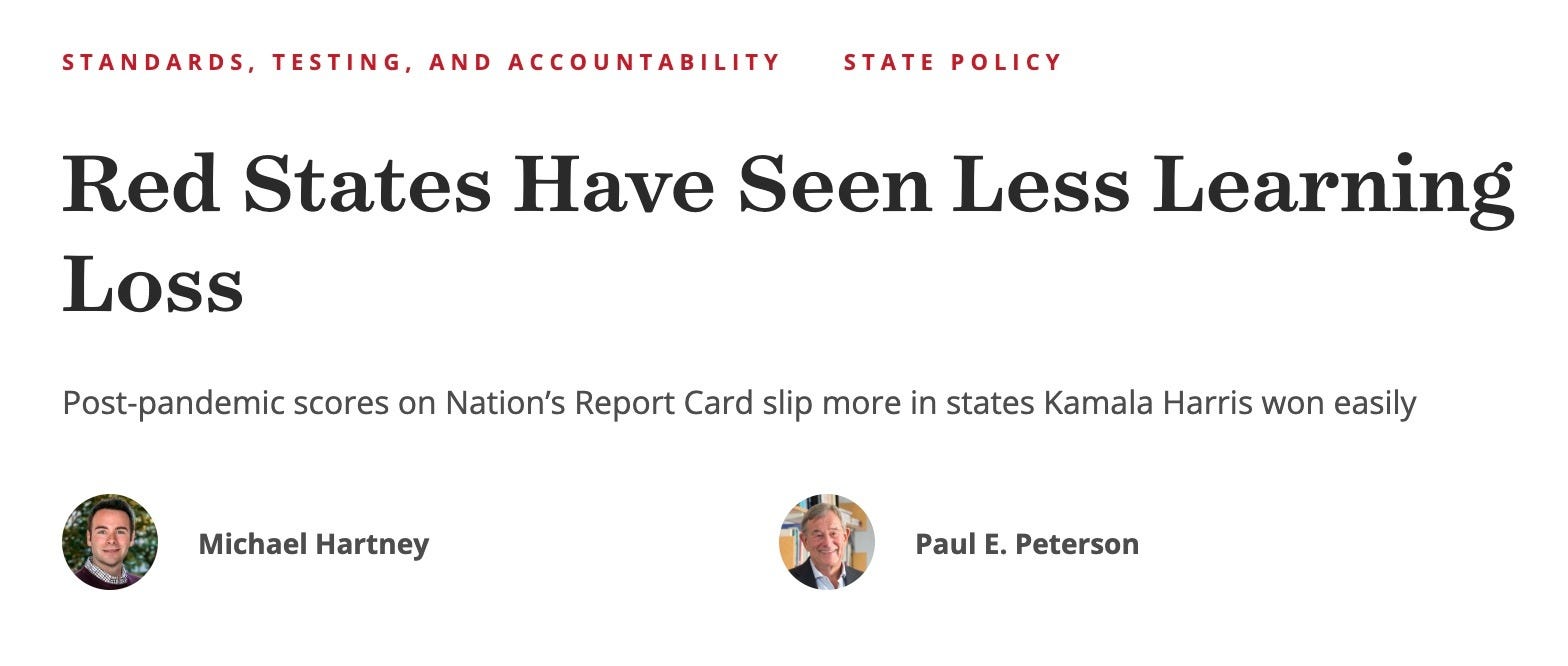
These findings add additional research heft to observations from researcher Emily Oster in 2022, which found that the longer districts relied on remote learning, the more learning loss students experienced. The math was clear: “Our estimates suggest that in-person schooling was very protective against test score declines, with fully remote districts predicted to decline by 13 percentage points more than fully in-person ones.”
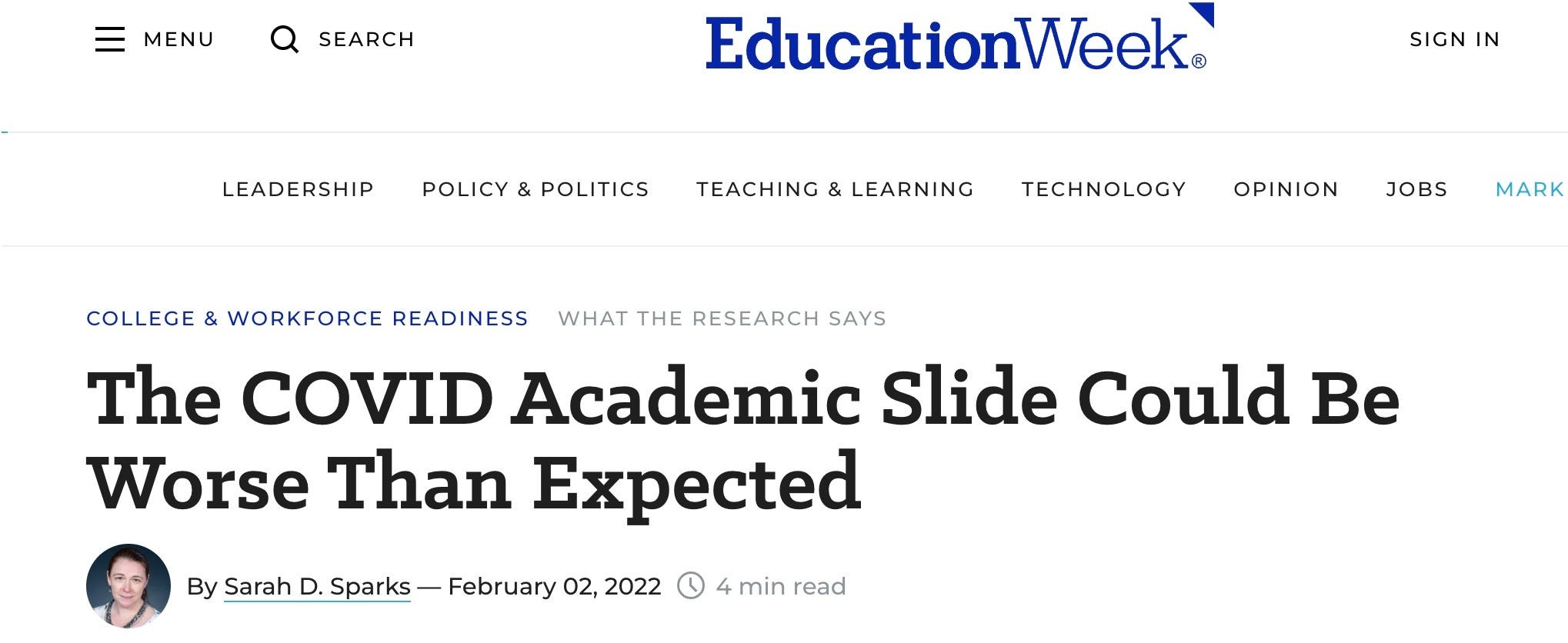
Even the legacy media had to acknowledge that their initial assertions about remote learning were wrong. One study, highlighted by CNN in January 2023 found that kids “lost about 35% of a normal school year’s worth of learning during the pandemic.” Another analysis, shared with the Associated Press, found that students lost six months of math learning, and three months of reading learning, even while nominally going to school. In 2022, ACT scores – a college entrance exam – fell to the lowest performance level in 30 years, as high school students struggled to reach a level of academic performance once seen as necessary for higher education. “The COVID Academic Slide Could Be Worse Than Expected,” a headline at Education Week helpfully declared in February 2022.
These findings weren’t only on display in the United States. A systematic review of nearly 1,800 research studies on remote learning during COVID from around the world, published in June 2023, found sharp declines across subjects:
Remote learning has also negatively affected children’s cognitive and academic performance throughout all age groups (Colvin et al., 2022). Standardized assessments during and after obligatory confinement have revealed students’ difficulties meeting grade expectations, particularly in schools with less in-person class time (Colvin et al., 2022). Specific academic difficulties have been reported in mathematics, language, and reading skills. More than 1.5 million students from across the United States exhibited worse performance in mathematics and reading scores compared with the previous academic year.
A New York Times newsletter in May 2022 titled “‘Not Good for Learning’: New research is showing the high costs of long school closures in some communities” captures what really happened. Despite pronouncements from experts and the legacy media (as I revisited last week in Part 5 of A COVID Autopsy), remote learning didn’t work. The missive, authored by David Leonhardt, opens (emphasis mine):
When Covid-19 began to sweep across the country in March 2020, schools in every state closed their doors. Remote instruction effectively became a national policy for the rest of that spring.
A few months later, however, school districts began to make different decisions about whether to reopen. Across much of the South and the Great Plains as well as some pockets of the Northeast, schools resumed in-person classes in the fall of 2020. Across much of the Northeast, Midwest and West Coast, school buildings stayed closed and classes remained online for months.
These differences created a huge experiment, testing how well remote learning worked during the pandemic. Academic researchers have since been studying the subject, and they have come to a consistent conclusion: Remote learning was a failure.
And it wasn’t just educational achievement that suffered. Lockdowns caused a surge in ADHD risk for kids, as well as an increase in distress, worry, and anxiety. Kids whose schools stayed shut longer experienced higher levels of depression and anxiety, as well as other mood disorders, researchers discovered in 2025. Mental-health visits for kids spiked during lockdowns, as CDC data revealed late in 2020. “Compared with 2019, the proportion of mental health-related visits for children aged 5–11 and 12–17 years increased approximately 24% and 31%, respectively,” a report found, adding that “monitoring indicators of children’s mental health, promoting coping and resilience, and expanding access to services to support children’s mental health are critical during the COVID-19 pandemic.” Temper tantrums, behavioral issues, and loneliness were more pronounced for kids in areas where remote learning requirements lasted longer.
Hundreds of thousands of kids simply disappeared from public schools during the pandemic, according to a report from the Associated Press, For areas with the longest mandated remote learning, students dropped out at higher rates.
The effects have been tragically stubborn. As I write this in June 2026, depression and anxiety rates among young Americans have both more than doubled since 2019.
And kids’ physical health suffered, too. The shift to remote learning and lockdowns spurred a shift to a more sedentary lifestyle for young people, leading to widespread weight gain and a range of other physical consequences.
It’s impossible to calculate the more nebulous consequences for kids who were robbed of a critical learning and developmental period of their life. Soft skills are far harder to develop through a screen, or even behind a mask. Key moments for social exploration and growth were snuffed out by a life behind screens. Major events and milestones – school dances, high-school graduation ceremonies – were snubbed up by social distancing restrictions and online learning. And perhaps most amorphous of all, a generation of young people were infected by a sense of safetyism, that the world outside, and the people in it, are both threats.
So much of that damage done was to protect adults; a jarring inversion of intergenerational ethics that society, I think, has failed to reckon with.