John Murphy, CEO The COVID-19 Long haul Foundation
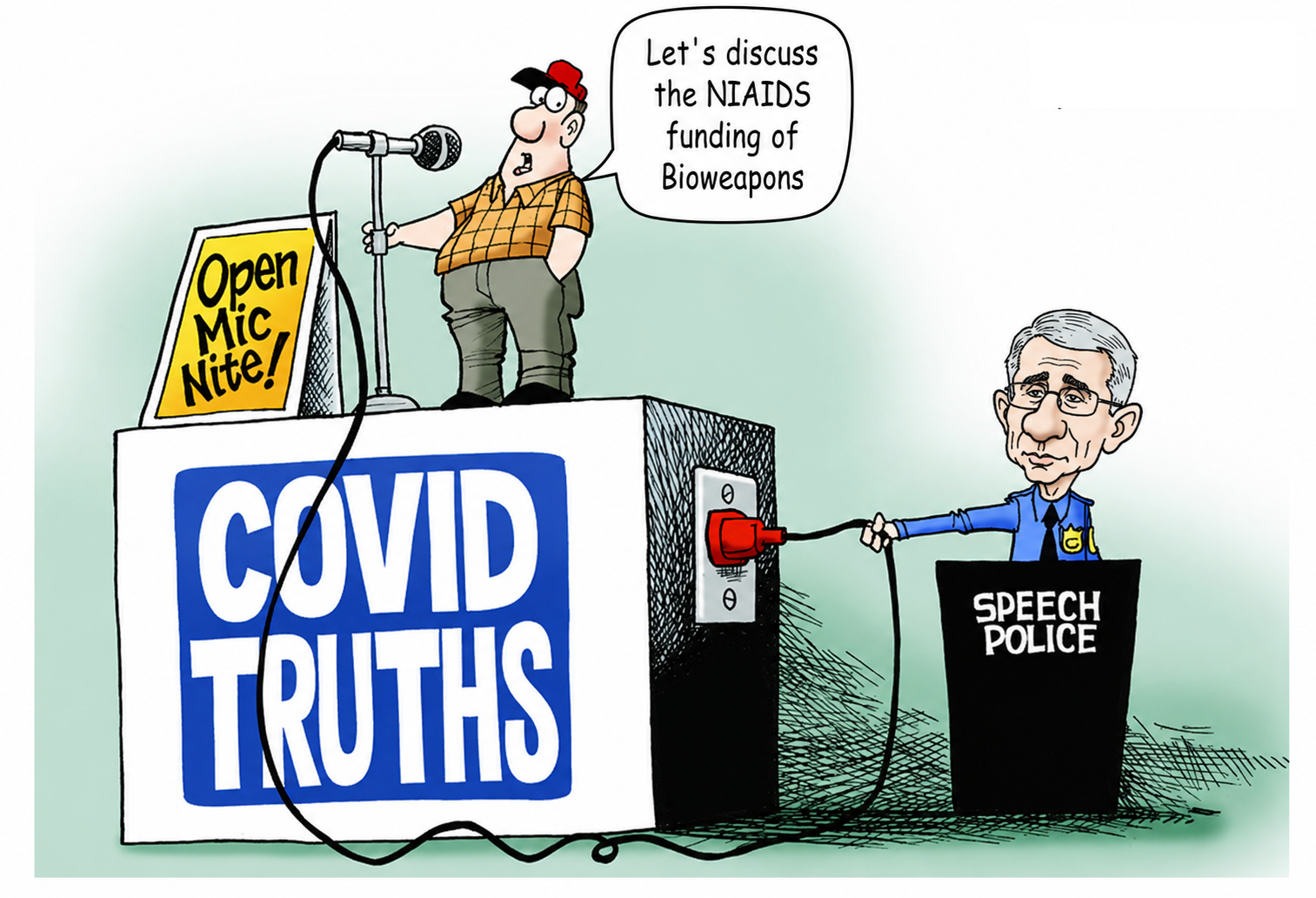
The COVID-19 pandemic produced a legitimate public-health emergency. It also produced something far more troubling: a test of whether the federal government could use its enormous institutional power to determine which scientific opinions Americans were permitted to hear.
The record now available suggests that, during the Biden administration, federal officials crossed that line.
This is not an argument that every criticism of COVID vaccines was correct, or that every vaccine was “dangerous.” COVID-19 vaccines provided meaningful protection against severe disease, particularly for older and medically vulnerable Americans. But government officials repeatedly presented evolving scientific judgments as settled truth—and, more troublingly, sought to suppress competing views while simultaneously spending enormous sums promoting vaccination.
That combination deserves scrutiny from Congress, the courts and the American public.
Government advocacy became something more
The administration openly conducted an extraordinary campaign to increase vaccination.
The White House recruited celebrities and social-media personalities, including Olivia Rodrigo, to encourage younger Americans to get vaccinated. HHS and the White House also worked with celebrities, athletes, community organizations and social-media influencers. The administration’s campaign was not clandestine: officials openly described vaccination outreach as a national priority.
The House Energy and Commerce Committee later reported that approximately $900 million in taxpayer funds had been used for COVID-19 public-relations and messaging efforts.
Government-funded public-health advertising is not inherently objectionable. Governments routinely communicate about health risks. The constitutional problem begins when government persuasion is paired with efforts to suppress Americans who challenge the government’s preferred message.
And that is precisely the question raised by the evidence surrounding the Biden administration’s relationship with social-media companies.
The censorship machinery
The litigation originally known as Missouri v. Biden exposed extensive communications between federal officials and social-media platforms concerning COVID-19 information.
In 2024, the Supreme Court renamed the case Murthy v. Missouri. The Court ultimately held that the plaintiffs had not established the Article III standing necessary to obtain an injunction. That decision did not hold that the government’s conduct was constitutional. It resolved the case on standing.
That distinction matters.
Before the Supreme Court decision, a federal district judge reviewed extensive evidence and concluded that the plaintiffs were likely to succeed in showing that government officials had used their authority to suppress protected speech. The Fifth Circuit subsequently found evidence that government officials had coerced or significantly encouraged social-media platforms to moderate certain speech.
Among the subjects caught in this controversy were COVID vaccines, masks, lockdowns and the laboratory-leak hypothesis.
The government’s defenders correctly point out that officials have a right to speak. They can hold press conferences, publish scientific opinions and tell Americans what they believe.
But government speech is fundamentally different from government pressure on private companies to silence citizens.
The First Amendment does not give Washington a special license to decide which scientific controversies Americans may debate.
Fauci, Collins and the Great Barrington Declaration
Perhaps the clearest example involves the Great Barrington Declaration, written in October 2020 by epidemiologists Jay Bhattacharya, Martin Kulldorff and Sunetra Gupta.
The declaration challenged prolonged lockdowns and advocated a strategy of protecting people at high risk while allowing lower-risk populations to resume more normal lives.
Reasonable scientists could—and did—disagree with it.
But disagreement is not the same thing as suppression.
Documents produced during the litigation show that then-NIH Director Francis Collins emailed NIAID Director Anthony Fauci in October 2020 concerning the declaration and called for a “quick and devastating takedown.” Fauci subsequently provided material intended to rebut the declaration, and both men publicly criticized it.
The significance is not that Fauci and Collins disagreed with three epidemiologists. They had every right to disagree.
The significance is that the nation’s most powerful public-health institutions treated an alternative scientific position as something requiring a coordinated political and communications response.
That should trouble anyone who believes science advances through open argument.
The Gateway Pundit and the broader information ecosystem
The Gateway Pundit, a conservative publication, became one of the plaintiffs associated with the censorship litigation. Its publisher, Jim Hoft, alleged that his publication was subjected to government-influenced suppression of COVID-related speech.
The broader litigation documented communications involving federal agencies and social-media platforms concerning content that officials considered misinformation.
It is important, however, to distinguish evidence from allegation. It would be irresponsible to say that every restriction imposed on The Gateway Pundit was ordered by the Biden administration. The evidence establishes extensive government-platform communications; the precise causal relationship between those communications and every individual moderation decision remains a matter of dispute.
That distinction actually strengthens the First Amendment argument.
The government should not be able to accomplish indirectly, through private intermediaries, what it could not lawfully accomplish directly.
What about the vaccines?
Here the public debate has become needlessly binary.
Calling COVID vaccines universally “dangerous and ineffective” is not supported by the evidence. Nor is portraying them as risk-free.
The CDC itself acknowledges that myocarditis and pericarditis can occur after COVID vaccination, particularly in adolescent and young adult males following mRNA vaccination.
The question that should have been asked in 2021—and should still be asked—is whether the government communicated these risks with sufficient candor and whether vaccination recommendations appropriately reflected differences in age, sex, previous infection, medical risk and the changing ability of vaccines to prevent infection and transmission.
Science should permit those questions.
Instead, dissenters were frequently characterized as “anti-vaxxers,” “misinformers” or threats to public health.
That rhetorical strategy had consequences.
The human cost of dissent
Doctors and nurses who questioned vaccination policies faced professional and economic consequences.
Federal vaccination requirements applied to federal employees and contractors, while federal rules also affected healthcare workers at facilities participating in Medicare and Medicaid. Health-care workers who refused vaccination sometimes lost their positions or resigned. Congressional testimony documented cases in which rural hospitals lost personnel as a result of vaccination requirements.
That does not mean every vaccine mandate was unlawful or that every person who opposed vaccination was professionally correct.
It means that a physician’s disagreement with federal policy could become an existential career decision.
A doctor who asked whether a young, previously infected, low-risk patient needed another dose should have been able to ask the question without being treated as a public-health enemy.
A scientist who questioned lockdowns should have been able to publish the argument.
A journalist who questioned vaccine policy should have been able to do so without fearing that government officials might pressure the platforms on which his publication depended.
That is how scientific debate works.
The officials at the center
The controversy cannot be reduced to one person.
The relevant federal ecosystem included senior figures at the White House, HHS, NIH and NIAID, CDC leadership and other government officials involved in public-health communications and social-media outreach.
Anthony Fauci, as NIAID director and presidential medical adviser, became the most recognizable face of federal COVID policy.
Francis Collins, then NIH director, was involved in the response to the Great Barrington Declaration.
Rochelle Walensky, then CDC director, presided over an institution responsible for vaccine recommendations, public-health messaging and COVID guidance.
Vivek Murthy, the surgeon general, became one of the administration’s principal public voices concerning COVID misinformation.
White House officials including Rob Flaherty, the administration’s director of digital strategy, also communicated extensively with social-media companies.
The evidence does not establish that all of these officials participated in an illegal censorship conspiracy. Nor should an opinion page pretend that it does.
But it does establish something important: the federal government developed an unusually intimate relationship with the private platforms that controlled much of America’s information environment.
That relationship deserves permanent congressional oversight.
The danger is larger than COVID
The most important lesson is not whether a particular vaccine policy was right or wrong.
It is whether Americans should trust the government to identify “misinformation” and then pressure private companies to suppress it.
Today the target may be a COVID skeptic.
Tomorrow it could be a climate scientist, an economist, a physician questioning a pharmaceutical policy, a journalist challenging a war policy—or an ordinary citizen who possesses information that government officials would prefer not to see circulated.
The First Amendment was designed precisely because government officials cannot be trusted with that power.
Public health needs credibility. Credibility does not come from suppressing disagreement. It comes from acknowledging uncertainty, publishing contradictory evidence, correcting mistakes and allowing competing hypotheses to survive long enough to be tested.
The COVID experience should therefore produce a simple bipartisan rule:
Government may persuade. Government may inform. Government may argue. Government may publish its evidence. But government should never become the hidden editor of America’s public conversation.
The Biden administration’s campaign to increase vaccination may have been motivated by sincere public-health concerns. Many of the officials involved undoubtedly believed they were saving lives.
That does not answer the constitutional question.
In a free society, even officials who believe they are saving lives must be restrained from deciding which Americans may speak.
Science cannot be protected by silencing scientists.
And public health cannot be restored by destroying public trust.
The ultimate casualty of the COVID censorship controversy may therefore not have been a particular social-media post or a particular vaccine argument.
It may have been Americans’ confidence that their government will tell them the truth—and allow them to hear the arguments necessary to decide for themselves.