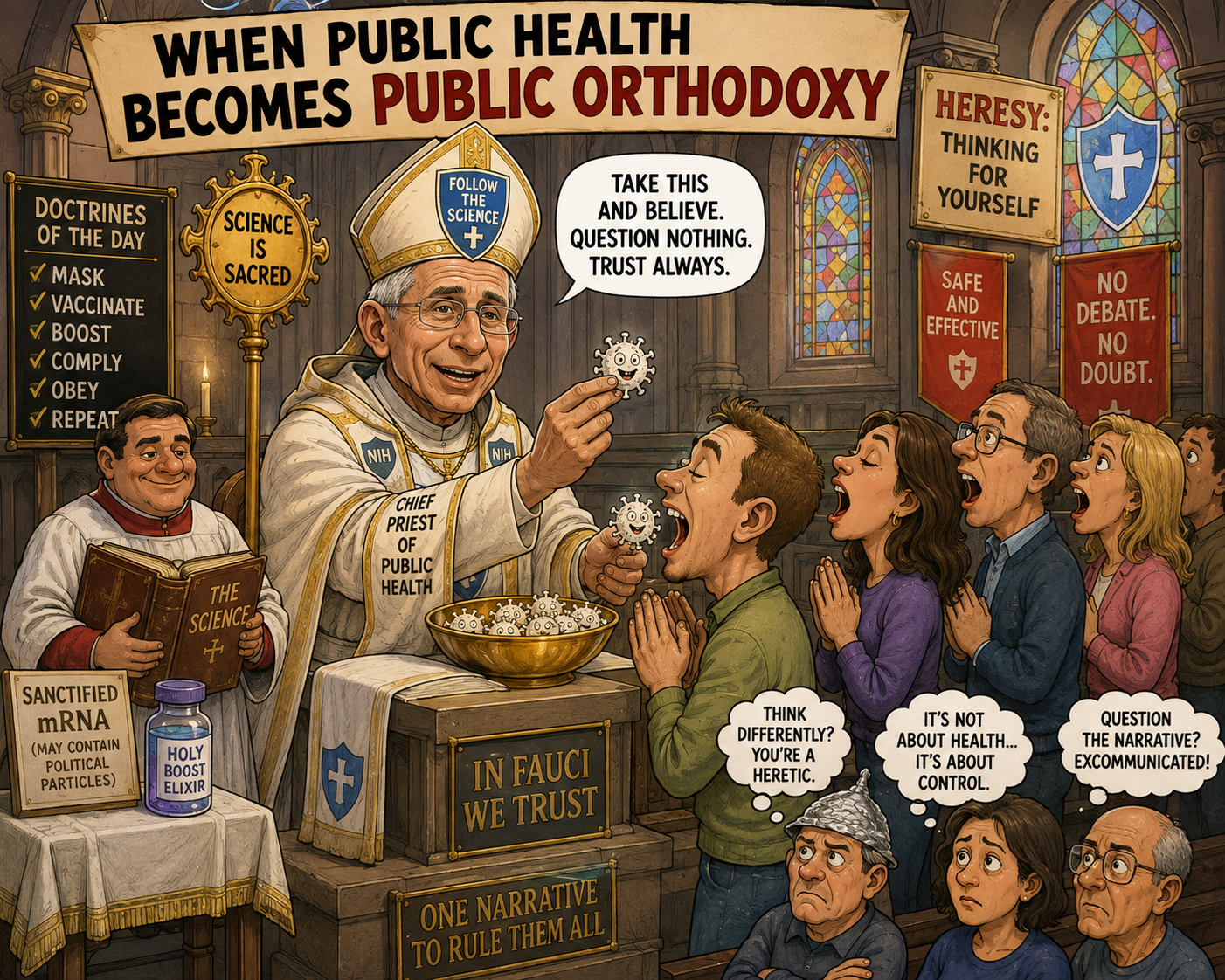
The First Amendment, COVID policy, scientific dissent, and what the record says about vaccines, natural immunity and the actual burden of the disease
John Murphy, CEO The COVID-19 Long haul Foundation
The COVID-19 pandemic produced two different controversies that are often conflated.
The first was scientific: How dangerous was SARS-CoV-2? How effective were vaccines? How long did protection last? What role should infection-acquired immunity play?
The second was constitutional: How far may government officials go in persuading private technology companies to suppress speech by doctors, scientists and journalists with whom the government disagrees?
The second question became a First Amendment issue because the federal government did not merely publish its own scientific conclusions. Court records show that federal officials communicated repeatedly with social-media companies about COVID-related content and, in some instances, pressed platforms to change or remove material. The Supreme Court ultimately decided Murthy v. Missouri in 2024 on standing grounds; it did not decide whether the government’s conduct violated the First Amendment.
That unresolved constitutional question deserves considerably more attention than it has received.
The government was entitled to argue. It was not entitled to manufacture unanimity.
During the pandemic, government officials had an obvious and legitimate responsibility to communicate information about a dangerous new pathogen.
There is nothing unconstitutional about the CDC saying that vaccination reduces severe COVID-19, or NIH officials arguing that a particular treatment lacks evidence.
The constitutional line becomes much more complicated when government officials use their influence over private platforms to suppress the speech of Americans who disagree.
The Supreme Court’s record in Murthy v. Missouri documents extensive communications between federal officials and social-media companies concerning COVID-19 content. The Court noted that White House officials, the Surgeon General’s Office and CDC officials communicated with platforms about COVID misinformation. The White House specifically pressured Facebook concerning vaccine misinformation and questioned the company’s policies and enforcement decisions.
The distinction matters.
Government speech is protected government speech. Government-directed suppression of private speech is something else entirely.
The Supreme Court did not resolve that distinction in Murthy. Instead, it concluded that the plaintiffs had not demonstrated standing sufficient to obtain the injunction they sought.
That decision should not be misrepresented as a finding that government censorship did or did not violate the First Amendment.
The Great Barrington Declaration
Perhaps the clearest example involving scientists concerned the Great Barrington Declaration.
In October 2020, Harvard epidemiologist Martin Kulldorff, Stanford professor Jay Bhattacharya and Oxford epidemiologist Sunetra Gupta argued for a strategy they called “Focused Protection,” emphasizing protection of people at high risk while reducing restrictions on lower-risk populations.
One can disagree with that strategy. Many scientists did.
But disagreement is not censorship.
An extraordinary piece of evidence subsequently emerged through FOIA litigation.
On October 8, 2020, then-NIH Director Francis Collins wrote to Anthony Fauci concerning the declaration. Collins described its authors as “fringe epidemiologists” and called for a “quick and devastating published takedown.”
That email is not an allegation. It is a contemporaneous government document.
Whether the subsequent social-media restrictions were caused by that particular communication is a separate factual question. But the episode demonstrates something important: senior federal health officials were actively interested in defeating a scientific position that challenged prevailing COVID policy.
The declaration’s authors subsequently testified about restrictions placed on their social-media communications. Congressional materials contain testimony describing suppression of their posts and accounts on Twitter, Facebook and YouTube.
Again, the constitutional question is not whether the declaration was correct.
The First Amendment does not say that only correct scientists have freedom of speech.
Science does not advance by unanimous agreement
Scientific knowledge advances through competing hypotheses.
During COVID, however, disagreement over several questions was frequently characterized as “misinformation” rather than treated as legitimate scientific disagreement.
Some of those questions included:
- the duration and importance of natural immunity;
- whether vaccination prevented infection;
- whether vaccinated individuals could transmit SARS-CoV-2;
- the appropriate age threshold for vaccination;
- the effectiveness of masking;
- school closures;
- lockdowns;
- laboratory origin hypotheses;
- vaccine adverse effects;
- booster frequency; and
- the appropriate balance between COVID risks and collateral harms.
The subsequent evidence demonstrated that several questions were considerably more complicated than early public messaging suggested.
That is precisely why scientific dissent should be protected.
COVID was not influenza
The comparison with influenza is important because public discussion sometimes moved between two extremes: treating COVID as essentially ordinary influenza, or treating it as a disease fundamentally unlike anything previously encountered.
The mortality data show that neither characterization is adequate.
Before COVID, CDC estimated that the 2019–20 influenza season produced approximately 38 million illnesses, 18 million medical visits, 400,000 hospitalizations and 22,000 deaths in the United States.
COVID produced substantially greater mortality.
The National Center for Health Statistics recorded approximately:
| Year | U.S. deaths with COVID as underlying cause |
|---|---|
| 2020 | ~385,000 |
| 2021 | 416,893 |
| 2022 | 186,552 |
| 2023 | 49,932 |
| 2024 | 31,426 |
CDC’s final mortality statistics show 416,893 COVID deaths in 2021 and 186,552 in 2022.
In 2023, COVID deaths fell to 49,932.
In 2024, they fell another 37.1%, to 31,426. COVID consequently dropped out of the ten leading causes of death.
The contrast with ordinary influenza is substantial.
CDC estimates that annual influenza mortality has generally ranged from approximately 6,300 to 52,000 deaths per year from 2010 through 2025, depending heavily on season severity.
There were exceptions during the pandemic years because influenza circulation nearly disappeared.
For example, CDC estimated only approximately 5,000 influenza deaths in 2021–22 and 21,000 in 2022–23.
The appropriate conclusion is therefore straightforward:
COVID was substantially more lethal than seasonal influenza during the acute pandemic years, although the difference narrowed considerably as population immunity increased and SARS-CoV-2 evolved.
That conclusion does not require exaggeration in either direction.
Mortality changed dramatically over time
The trajectory is more revealing than any single number.
COVID deaths peaked during the first years of the pandemic, then declined sharply.
CDC reported approximately 244,986 COVID-associated deaths in 2022, compared with 462,193 in 2021 when underlying and contributing causes were included in the mortality analysis.
By 2023, the official underlying-cause figure was 49,932.
By 2024, it was 31,426.
This decline reflects multiple factors, including acquired immunity, vaccination, improved treatment, changes in the virus and changes in the population at risk.
It also demonstrates why policies based upon the epidemiological conditions of 2020 cannot automatically be justified years later.
Vaccination did work—but not in the way early public discussion sometimes implied
The evidence does not support the proposition that COVID vaccines were useless.
That would be inconsistent with CDC’s own effectiveness studies.
For example, during September 2023–January 2024, CDC found that the updated XBB.1.5 vaccine provided approximately:
- 51% protection against emergency-department/urgent-care encounters during the first 7–59 days;
- 39% at 60–119 days;
- approximately 53% protection against hospitalization in the VISION network during the first 7–59 days; and
- approximately 50% protection against hospitalization at 60–119 days.
But the same CDC evidence also documents substantial waning.
For the 2023–24 vaccine, CDC estimated approximately 49% effectiveness against hospitalization at 7–59 days but only 14% at 120–179 days. Protection against critical illness was more durable but also declined—from approximately 69% to 32%.
CDC subsequently summarized the pattern even more explicitly: approximately 50% additional protection against hospitalization initially, declining to negligible additional protection by about four to six months; protection against critical illness persisted longer.
That is a legitimate scientific finding.
It should have been possible to state it publicly without either declaring the vaccines miraculous or dismissing them as worthless.
The distinction between infection and severe disease
One of the most consequential changes in COVID vaccine policy was the distinction between preventing infection and preventing serious disease.
Vaccination became substantially less reliable at preventing infection as SARS-CoV-2 evolved, particularly with Omicron.
Yet protection against hospitalization and critical illness persisted longer.
That is why statements such as “the vaccine is effective” are incomplete.
The scientifically meaningful question is:
Effective against what—and for how long?
Against symptomatic infection, effectiveness declined relatively rapidly.
Against hospitalization, it was greater.
Against critical illness and death, protection was generally more durable.
This distinction should have been communicated clearly from the beginning.
Natural immunity was real
Another controversial issue was infection-acquired immunity.
The existence of natural immunity was never scientifically mysterious. Following SARS-CoV-2 infection, the immune system generates antibodies, T-cell responses and other components of immune memory.
CDC itself acknowledges that infection can provide protection against reinfection for several months, although protection declines over time.
The question was not whether natural immunity existed.
It did.
The important questions were:
How strong was it? How durable was it? How much did it vary by age and severity of infection? How did it compare with vaccination? And what happened when the two were combined?
Those were legitimate scientific questions.
What the published literature says about natural immunity
A major systematic review and meta-analysis published in The Lancet Infectious Diseases found that previous SARS-CoV-2 infection provided substantial protection against reinfection and severe disease, although protection against reinfection declined with time.
The strongest protection was against severe outcomes.
This is consistent with CDC’s current description of reinfection: infection provides protection for several months, but that protection decreases over time.
Natural immunity therefore should not be portrayed as permanent or perfect.
But neither should it have been treated as nonexistent.
Hybrid immunity complicates the argument further
The evidence ultimately showed that people who had both prior infection and vaccination generally developed hybrid immunity, which was stronger than immunity from either exposure alone for many outcomes.
This matters because the population entering later phases of the pandemic was no longer divided cleanly into “vaccinated” and “unvaccinated.”
Millions had experienced infection before, after or between vaccine doses.
By the Omicron era, prior infection had become a major determinant of immune status.
Consequently, vaccine effectiveness estimates depended increasingly upon whether subjects had previously been infected.
This is one reason why simple comparisons of vaccinated versus unvaccinated populations became progressively more difficult to interpret.
But natural immunity was not risk-free
There is an important point that should not be lost in the argument over censorship.
Obtaining natural immunity requires becoming infected.
During the pandemic’s most dangerous phases, infection carried meaningful risks of hospitalization, death and persistent illness.
Therefore, the existence of natural immunity does not establish that deliberately seeking infection was an appropriate public-health strategy.
The scientific point is narrower:
Once infection had occurred, the resulting immunity was a biological fact that deserved to be incorporated into subsequent risk calculations.
That proposition should not have been politically controversial.
Vaccine safety also required open discussion
The strongest example is myocarditis.
The National Academies of Sciences, Engineering, and Medicine concluded in 2024 that evidence established a causal relationship between both Pfizer-BioNTech’s and Moderna’s mRNA vaccines and myocarditis.
The risk is concentrated particularly among adolescent and young adult males.
That finding does not establish that the vaccines were net harmful to the population.
It establishes something more important for science:
a genuine vaccine adverse effect was identified, studied and ultimately acknowledged.
The appropriate response to such evidence is not suppression.
It is investigation, quantification, disclosure and informed consent.
The cost of suppressing dissent
Suppose a physician incorrectly claims that a vaccine is dangerous.
The answer should be evidence.
Publish the counterevidence.
Show the statistical error.
Show the confounding.
Show the better study.
Let readers compare the arguments.
If the government instead pressures a platform to remove the physician, the government has changed the nature of the dispute.
It is no longer simply:
science versus bad science.
It becomes:
government authority versus an individual’s right to speak.
That distinction is fundamental to the First Amendment.
The First Amendment does not protect scientific correctness
This point deserves emphasis.
The Constitution does not contain an exception saying:
Speech loses constitutional protection when CDC officials believe it is medically incorrect.
Nor does it say:
Scientists may speak freely only when their conclusions agree with the prevailing federal consensus.
Government officials can publish rebuttals.
They can hold press conferences.
They can fund competing research.
They can criticize doctors.
They can warn citizens about false claims.
But when government actors use the power of their offices to induce private platforms to suppress particular viewpoints, constitutional scrutiny becomes unavoidable.
The Supreme Court’s Murthy decision left that issue unresolved because the plaintiffs lacked standing.
That is not the same thing as judicial approval.
The danger of institutional certainty
The deeper problem is institutional.
During a rapidly evolving pandemic, scientific conclusions necessarily changed.
The virus changed.
Treatments changed.
Mortality changed.
Vaccine effectiveness changed.
Natural immunity became increasingly prevalent.
The meaning of “vaccinated” changed as additional doses became recommended.
And the epidemiological consequences of infection changed.
A healthy scientific system should therefore be characterized by uncertainty, debate and correction.
Instead, government agencies sometimes communicated conclusions as though they were settled beyond reasonable dispute.
That was a mistake—not because every dissenting claim was correct, but because scientific certainty is not created by suppressing disagreement.
COVID taught us two lessons
The first lesson is epidemiological.
COVID was substantially more lethal than seasonal influenza during the initial pandemic years. Its mortality burden subsequently declined dramatically as immunity accumulated, treatments improved and the virus evolved. Influenza remains a significant annual pathogen, but its typical mortality burden is much lower than the COVID burden experienced in 2020–21.
The second lesson is constitutional.
The government cannot be permitted to define scientific truth by controlling the information environment in which scientific disagreement occurs.
COVID vaccination produced real benefits against severe disease. Those benefits waned over time and varied substantially by age, previous infection and circulating variant. Natural immunity provided meaningful protection after infection, while hybrid immunity frequently provided still greater protection. Vaccine-associated myocarditis is a real causal adverse effect.
None of these statements is inherently “misinformation.”
They are pieces of a complicated scientific record.
The principle that should govern the next pandemic
The next pandemic will inevitably produce uncertainty.
Scientists will disagree.
Some will be wrong.
Some minority views will eventually prove correct.
Others will prove disastrously wrong.
That is precisely why government should not be the final arbiter of permissible scientific speech.
The proper hierarchy should be:
Evidence → debate → replication → correction → consensus.
Not:
Consensus → censorship → compliance.
The First Amendment exists in part because governments are fallible.
Public-health agencies are no exception.
The COVID experience demonstrated the extraordinary power of federal health institutions. It also demonstrated why that power must remain bounded by constitutional protections.
Doctors and scientists should be free to challenge CDC, NIH, FDA and the White House—even when those agencies believe the dissent is dangerous.
The answer to bad science is better science.
The answer to bad arguments is better arguments.
And the answer to scientific uncertainty is more evidence—not less speech.