
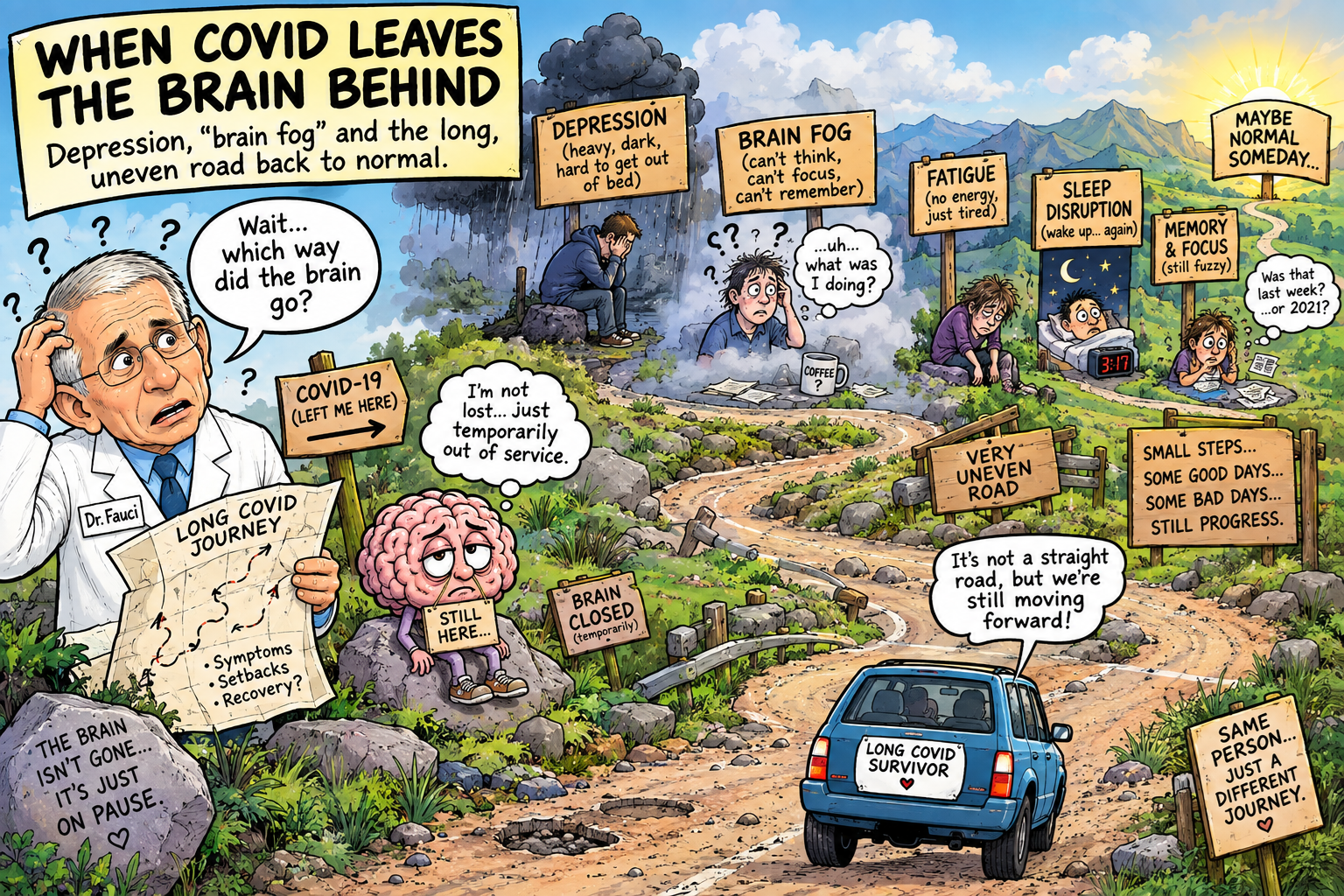
Depression, “brain fog” and the long, uneven road back to normal
John Murphy, CEO The COVID-19 Long haul Foundation
For millions of Americans, recovering from COVID-19 did not end when the fever broke, the cough disappeared or the test turned negative.
For some, the aftermath was stranger and more difficult to explain: words that seemed to disappear in mid-sentence, appointments forgotten minutes after they were made, books that could no longer be followed, familiar tasks that suddenly required extraordinary concentration. Alongside those cognitive problems came exhaustion, insomnia, anxiety—and, for some patients, depression.
The experience has frequently been misunderstood because depression and cognitive impairment can look deceptively similar. A person who cannot concentrate may appear depressed. A person who has become depressed after months of cognitive dysfunction may genuinely have both conditions. And a patient whose brain is struggling to process information may be told that the problem is psychological when the underlying illness is neurological, inflammatory, vascular, metabolic—or some combination of these.
The medical community now recognizes that this is not simply a matter of patients “having a hard time getting over COVID.” The Centers for Disease Control and Prevention lists difficulty thinking or concentrating, memory changes, fatigue, sleep problems, anxiety and depression among recognized manifestations of Long COVID. The agency also acknowledges that symptoms can emerge, disappear, recur and change over months or years, and that patients with difficult-to-explain symptoms may be misunderstood or stigmatized, sometimes delaying diagnosis and treatment.
That recognition represents a significant change from the early pandemic.
The patient who could no longer trust her own mind
Consider the experience described in a published case report of a 72-year-old woman. She had no previous psychiatric or major medical history of the sort that would readily explain what happened next.
After COVID-19, she developed profound weakness, weight loss, impaired concentration and depression. Months later, her depressive symptoms eventually improved following psychiatric treatment and a broader program that included psychotherapy and occupational, physical and creative therapies.
But something remained.
Her “brain fog”—particularly her memory and concentration difficulties—persisted even after her depression had substantially improved.
That distinction is medically important.
If depression alone were responsible for the cognitive symptoms, improvement in depression might reasonably be expected to produce substantial improvement in concentration and memory. Instead, this patient illustrates a phenomenon increasingly reported in Long COVID: psychiatric and cognitive symptoms can travel together, but they are not necessarily the same disease.
Her physicians also investigated neurological abnormalities, including brain microhemorrhages. The authors did not claim that these findings proved a single mechanism for her symptoms, but the case demonstrates why the simplistic equation—“brain fog equals depression”—can be inadequate.
Brain fog is not merely forgetfulness
“Brain fog” is an informal term, not a single neurological diagnosis.
It can encompass impaired attention, slowed information processing, difficulty retrieving words, impaired working memory, executive dysfunction, confusion and an inability to manage several streams of information simultaneously.
Patients describe it in remarkably concrete ways.
In a qualitative study published in BMJ Open, researchers interviewed 50 people experiencing post-COVID cognitive symptoms. Participants described difficulties handling multiple inputs, problems performing ordinary tasks and frustration when they could not make physicians understand what was happening. Some reported that healthcare professionals minimized the symptoms or attributed them to anxiety or depression.
Perhaps most importantly, several participants described feeling relief when a clinician finally believed them.
Another study of patients attending a post-COVID clinic found that fatigue and brain fog affected virtually every domain of life—employment, relationships, daily activities and self-perception. Patients described relapsing and unpredictable symptoms, difficulty multitasking and fear of losing their jobs.
One participant in a separate qualitative study described having to write everything down because memory and concentration had deteriorated so badly that even written reminders did not always solve the problem.
These are not abstract neurological test results. They are descriptions of people losing confidence in abilities they had taken for granted.
Why depression and brain fog become entangled
Depression can impair attention, motivation, processing speed and memory. Severe fatigue and insomnia can do the same.
But the relationship can run in the opposite direction.
Imagine a person who once managed a business, drove independently, handled finances, maintained a household and read extensively. After COVID, that person can no longer sustain concentration for 20 minutes. A familiar computer task takes twice as long. Names are forgotten. Conversations become difficult to follow. Work becomes exhausting.
Eventually the consequences themselves become depressing.
The person loses employment, independence, social interaction and confidence. Sleep deteriorates. Physical activity decreases. Relationships become strained. The individual begins to withdraw.
Depression can therefore become both a consequence of neurological dysfunction and a contributor to further cognitive dysfunction.
Modern research increasingly describes this relationship as bidirectional rather than an either/or proposition. A 2026 review in Nature Reviews Neurology concluded that neurological symptoms such as cognitive impairment and headache can interact bidirectionally with traditionally psychiatric symptoms such as anxiety and depression. The review discusses several possible biological contributors to Long COVID, including immune dysregulation, neuroinflammation, microvascular dysfunction, viral persistence and changes in brain structure and function.
This does not mean every case of post-COVID depression is caused by brain inflammation, nor does it mean every case of brain fog represents structural brain damage. Long COVID is heterogeneous.
It does mean that physicians should resist forcing patients into a false choice between “physical” and “psychological.”
The biology is becoming harder to dismiss
Researchers are investigating several overlapping mechanisms.
One possibility is persistent or dysregulated immune activation. Another involves inflammation affecting the neurovascular unit—the intricate relationship among blood vessels, endothelial cells, neurons and glial cells.
Other research has examined microvascular dysfunction, abnormal coagulation, impaired oxygen delivery, autonomic dysfunction, mitochondrial abnormalities and changes in neurotransmission.
Recent experimental work has reported microglial dysfunction, neurovascular inflammation, gliosis, demyelination, neuronal and glial injury and other neuropathological changes following SARS-CoV-2 infection. These findings remain an active area of research rather than a single established explanation for every patient’s symptoms.
Depression itself is also increasingly studied through an immunological lens. Contemporary neuroscience recognizes that inflammation can influence neurotransmitter metabolism, synaptic signaling, neuroplasticity and the hypothalamic-pituitary-adrenal system. A 2026 review in Translational Psychiatry described neuroinflammation as an important mechanism in a substantial subgroup of patients with depression, while emphasizing that depression remains biologically heterogeneous.
The implication is subtle but important: depression can be a brain disorder with biological consequences, not merely a reaction to unpleasant circumstances.
Recovery is real—but it is rarely a straight line
There is encouraging news.
Many people improve.
But improvement can take months, and recovery does not necessarily occur simultaneously across every symptom.
A prospective study of more than 600 people hospitalized with COVID found significant cognitive and psychological recovery during the first six months. Yet at 12 months, cognitive deficits remained in about one-fifth of those assessed, while psychological problems remained in approximately 15%. Depression and anxiety improved in some rehabilitation groups, but did not disappear universally.
Another longitudinal study of people with neuro-PASC found that the proportion meeting a screening threshold for mild cognitive impairment fell from 38.8% at baseline to 20% one year later. The investigators concluded that neuropsychiatric symptoms can improve over time but may persist beyond a year.
A 2026 longitudinal study provides another reason for optimism: participants with post-COVID conditions reported lower levels of fatigue, depression, anxiety and post-traumatic stress symptoms at follow-up 9–16 months after recovery from the acute infection.
In other words, recovery is possible even after a prolonged period of illness.
But patients should not interpret improvement as evidence that their original symptoms were imaginary.
A broken bone can heal. The fracture was still real.
The diagnostic problem
The medical profession faces an uncomfortable problem: there is still no single laboratory test that definitively diagnoses or excludes Long COVID.
The CDC explicitly states that diagnosis remains clinical and is based on history, examination and directed testing when appropriate. Routine laboratory tests, imaging studies and other investigations can be normal despite substantial disability.
This creates an unfortunate paradox.
The patient says, “My brain does not work the way it used to.”
The physician orders routine blood tests.
The results are normal.
The patient is told there is nothing seriously wrong.
But a normal basic laboratory panel does not demonstrate normal cognition.
Neuropsychological testing can be useful. Cognitive screening can identify abnormalities. Sleep disorders, medication effects, thyroid disease, anemia, nutritional deficiencies, mood disorders, substance use, vascular disease and other neurological conditions should be considered and treated when appropriate.
And sometimes the most valuable diagnostic instrument remains a careful history.
When did the problem begin?
Did it follow SARS-CoV-2 infection?
Was there a clear change from the patient’s pre-COVID baseline?
Does exertion worsen symptoms?
Are sleep and fatigue involved?
Are memory, attention, processing speed or executive functions affected?
Does treatment of depression improve mood but leave substantial cognitive impairment behind?
Those questions can separate overlapping conditions.
Where medicine failed—and where it is improving
It would be unfair to say that every physician ignored Long COVID.
Thousands of clinicians recognized the syndrome early, established multidisciplinary clinics, documented patient experiences and began developing rehabilitation programs.
But it would be equally misleading to pretend that every patient was heard.
The qualitative literature documents patients whose cognitive complaints were minimized, attributed to psychological causes or simply deprioritized. Some reported that doctors failed to connect their new symptoms with their previous COVID infection even when the temporal relationship was striking.
One published account described a patient whose physicians repeatedly found normal examinations and laboratory tests. After multiple medical consultations failed to produce an explanation, he was ultimately diagnosed with depression and conversion disorder. The authors presented the story as an example of the diagnostic challenge surrounding Long COVID—not proof that the psychiatric diagnosis itself was necessarily wrong.
This distinction matters.
Sometimes depression really is depression.
Sometimes depression coexists with Long COVID.
Sometimes cognitive dysfunction contributes to depression.
And sometimes the patient has all three.
The danger lies in assuming the answer before listening carefully.
The CDC now explicitly acknowledges that patients with Long COVID can be misunderstood, not taken seriously or stigmatized—even by healthcare providers—and that this can delay diagnosis and treatment.
That is not a condemnation of medicine. It is an acknowledgment of a medical problem that the profession is still learning to solve.
What doctors can actually do
There is no universally effective Long COVID drug, and treatment remains largely symptom-directed.
The CDC recommends identifying the patient’s most burdensome symptoms, optimizing underlying medical conditions, creating individualized rehabilitation plans and using shared decision-making.
For cognitive symptoms, clinicians may consider:
- formal cognitive or neuropsychological assessment;
- evaluation for sleep disorders;
- review of medications that impair cognition;
- screening for depression and anxiety;
- evaluation for anemia, thyroid dysfunction, nutritional deficiencies and other treatable conditions;
- occupational therapy and cognitive rehabilitation;
- strategies to reduce cognitive overload;
- careful management of physical and mental exertion;
- treatment of associated migraine, autonomic dysfunction or other neurological conditions when present.
For depression, standard evidence-based psychiatric treatment remains appropriate when indicated: psychotherapy, antidepressant medication, behavioral interventions, sleep treatment and treatment of contributing medical conditions.
But treatment should be individualized.
A patient with depression and brain fog should not necessarily receive an antidepressant and be sent away with the assumption that the entire problem has been solved.
Likewise, someone with cognitive symptoms should not automatically reject psychiatric treatment because the symptoms began after COVID.
The two approaches are not mutually exclusive.
The lesson from the patients
Perhaps the most important development in Long COVID is not a new laboratory marker or experimental drug.
It is the growing willingness to listen.
A patient who says, “I am not myself anymore,” may be describing depression.
He or she may be describing brain fog.
The patient may have both.
Or the depression may be the emotional consequence of months of neurological and physical illness.
A sophisticated medical response does not require choosing one explanation prematurely.
It requires investigating the whole person.
The evidence now shows that some people recover rapidly, while others experience neurological and psychiatric symptoms for a year or considerably longer. Brain fog can improve even after prolonged illness. Depression can improve. Quality of life can return. But recovery is often uneven, and improvement in one domain does not guarantee recovery in another.
For patients still waiting to feel like themselves again, that may be the most important message of all.
The brain can heal. Depression can lift. Cognitive function can improve. But recovery should not be confused with denial of the illness that came before it.
And when a patient says, “Something changed after COVID,” the first responsibility of medicine is not to decide whether the patient is right.
It is to listen carefully enough to find out what changed.
Selected sources
Centers for Disease Control and Prevention, Long COVID Clinical Guidance and Clinical Symptoms of Long COVID, updated March 9, 2026.
Matthews R, et al. “Understanding the long-term neurological effects of SARS-CoV-2 infection.” Nature Reviews Neurology, 2026.
Callan C, et al. “‘I can’t cope with multiple inputs’: a qualitative study of the lived experience of ‘brain fog’ after COVID-19.” BMJ Open.
Taube M, et al. “Depression and brain fog as long-COVID mental health consequences.” Frontiers in Psychiatry.
Bek LM, et al. “Cognitive and psychological recovery patterns … 12 months after hospitalization for COVID-19.” Annals of Physical and Rehabilitation Medicine.
VanderFeltz-Cornelis CM, et al. “Prevalence of mental health conditions and brain fog in people with long COVID.” General Hospital Psychiatry.
Santerre M, Shcherbik N, Sawaya BE. “Neuroinflammation and depression.” Translational Psychiatry, 2026.
Benfante A, et al. “Psychological and medical outcomes of post-COVID-19 patients.” Journal of Psychosomatic Research, 2026.