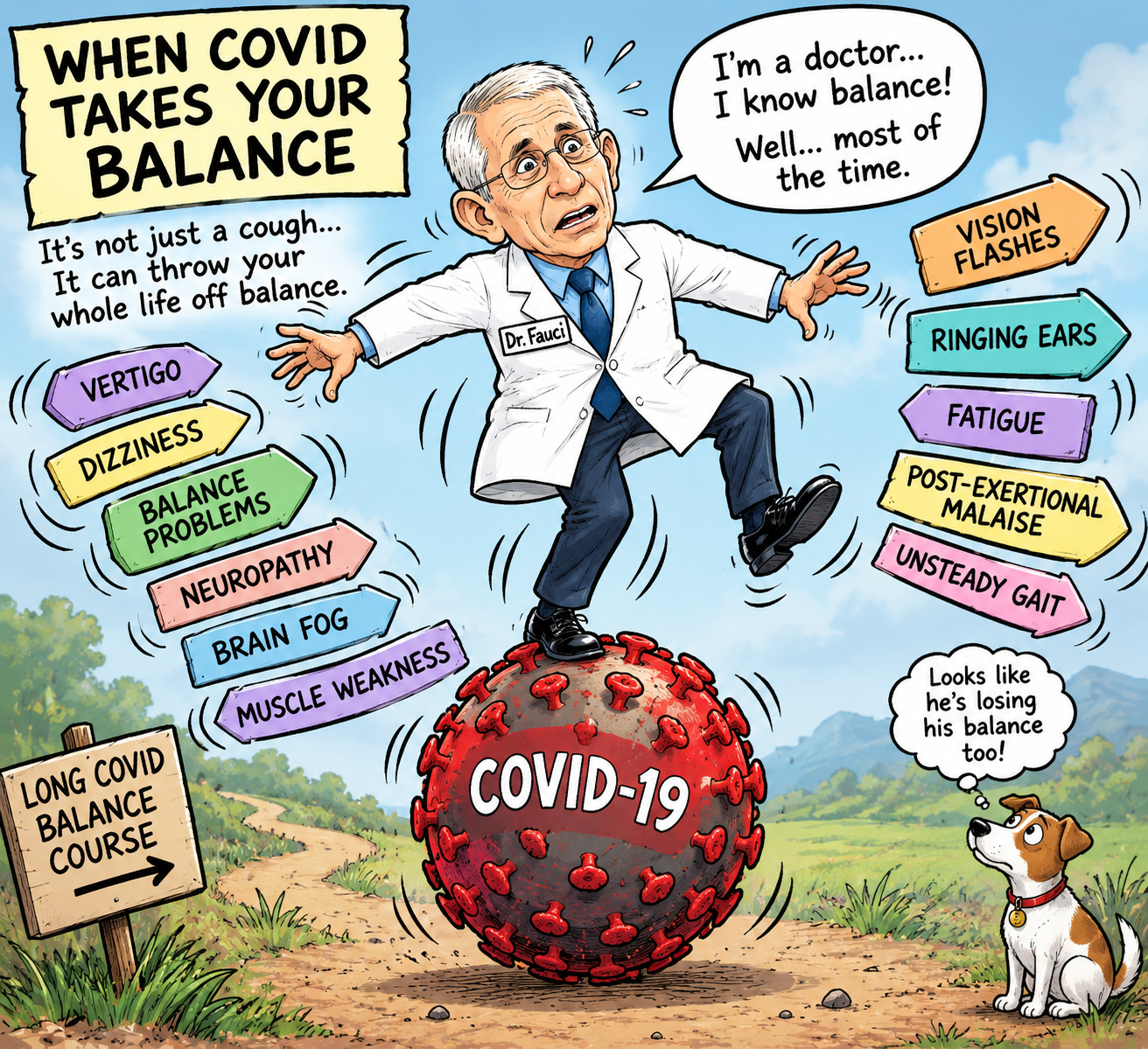
Falls among older Americans were already a public-health crisis. Then came a virus capable of disturbing oxygenation, blood pressure, cognition, muscle function and balance — and a vaccination campaign in which fainting was a recognized, if uncommon, complication.
John Murphy, CEO The COVID-19 Long haul Foundation
The fall seemed almost too ordinary to be important.
An 83-year-old woman in Toronto got up at home, became dizzy and fell.
She had hypertension, diabetes and osteoporosis. There was no fever. She was not short of breath. At the emergency department she did not initially look like a person with a dangerous respiratory infection.
But the physicians investigated the possibility that her fall had been caused by syncope.
A CT scan showed no stroke or brain hemorrhage. Cardiac monitoring showed normal sinus rhythm. A pulmonary CT scan, however, revealed ground-glass abnormalities in both lungs. A SARS-CoV-2 test came back positive.
The next day, her oxygen saturation fell to 87 percent and she required supplemental oxygen.
Her fall had been the first conspicuous sign of COVID-19.
That case, published early in the pandemic in the Journal of the American Geriatrics Society, helped expose a problem that became increasingly apparent: in an older person, COVID-19 does not necessarily announce itself with fever and coughing. Sometimes it begins with a fall.
The distinction matters because falls are not trivial events.
They are among the most consequential hazards of aging in America.
The Centers for Disease Control and Prevention estimates that more than 14 million Americans 65 and older — more than one in four — fall each year. About 3 million older adults visit emergency departments annually because of falls, approximately 1 million are hospitalized, and nearly 319,000 are hospitalized with hip fractures. Falls are also the leading cause of traumatic brain injury.
In 2023 alone, approximately 41,400 Americans 65 and older died from unintentional falls. The death rate was 69.9 per 100,000 older adults. Among people 85 and older, it was 339.5 per 100,000.
By 2024, the age-adjusted fall-death rate had risen to 78.4 per 100,000, a 21 percent increase from 2018.
Against that background, COVID-19 introduced another potential threat to balance.
It could weaken an older person.
It could lower oxygen levels.
It could produce dizziness and delirium.
It could disturb blood pressure.
It could provoke arrhythmias.
It could damage the patient’s ability to walk.
And in some patients, it could turn an otherwise manageable illness into the event that caused the fall.
The oldest patients sometimes fell before anyone knew they had COVID
The Toronto case was not an isolated curiosity.
A published series of 76 patients age 85 and older with COVID-19 found that 19 patients — 25 percent — had an initial fall at the onset of illness or as the reason for hospital admission. Confusion or delirium occurred in 71.1 percent, while 59.2 percent were already experiencing oxygen desaturation at admission.
That is a remarkable number.
One out of every four of these very elderly COVID patients presented with a fall.
The implication is not that COVID caused every one of those falls. Older adults fall for many reasons, and frailty itself is a major risk factor.
The implication is more practical:
A sudden unexplained fall can be a presenting symptom of infection.
That possibility is particularly important when the patient lacks the classic symptoms that clinicians have been trained to recognize.
An elderly woman who kept falling
In another published report, an African American woman in her early 90s was brought to a hospital from a nursing facility after experiencing repeated falls.
She had never previously experienced this degree of dizziness.
She described becoming lightheaded when she got out of bed. On one occasion she walked toward the bathroom, became lightheaded and fell. She did not lose consciousness.
She had no fever.
No cough.
No shortness of breath.
No chest pain.
No palpitations.
Her only recent clues were poor appetite and loose stools.
The eventual diagnosis was COVID-19.
The case was published specifically to warn clinicians that older adults can present with COVID-19 in profoundly atypical ways.
The story illustrates a recurring geriatric problem.
A younger patient who develops respiratory infection may complain about the lungs.
An older patient may complain about the consequences.
Weakness.
Confusion.
Dizziness.
Loss of appetite.
A fall.
The disease may be hiding behind the injury.
The physiology of a COVID fall
There is no single mechanism.
COVID can produce hypoxemia, reducing the oxygen available to the brain and muscles.
It can cause dehydration through fever, poor intake, vomiting or diarrhea.
Blood pressure may fall.
Medications used for hypertension or diuresis can magnify the effect.
Muscle weakness and deconditioning can make standing and walking more difficult.
Neurological involvement can disturb balance.
Delirium can impair judgment and spatial awareness.
Autonomic dysfunction can interfere with the body’s ability to maintain blood pressure when a person stands.
Cardiac complications can produce dizziness or syncope.
And the combination can be more dangerous than any individual abnormality.
Consider an 84-year-old woman described by geriatricians in Hong Kong.
She had hypertension, diabetes, ischemic heart disease, atrial fibrillation and a previous stroke. She had been vaccinated once.
After developing COVID-19, she became dizzy, sleepy, confused and less mobile. After bathing, she became so unsteady that her caregivers had to put her in bed.
Her blood pressure fell to approximately 99 mmHg systolic while sitting. She lost three kilograms in a single day because of reduced intake and fluid loss. Her physicians concluded that postural hypotension, cerebral hypoperfusion and hypoglycemia — amplified by medications, dehydration and illness — explained her near-fall and delirium.
After medication adjustment, hydration and nutritional support, she recovered toward her previous level of function.
This is a lesson in the complexity of geriatric medicine.
The virus did not have to directly injure the brain to produce a fall.
It could initiate a chain:
infection → poor intake → dehydration → medication effect → hypotension → cerebral hypoperfusion → dizziness → fall.
In an 84-year-old, that chain can be enough to change the rest of a life.
Balance can remain abnormal after recovery
The danger does not necessarily end when the viral test becomes negative.
Researchers in Egypt compared 31 adults over 60 who had recovered from SARS-CoV-2 infection with 33 controls.
The previously infected group demonstrated significantly poorer performance on objective measures of postural stability and balance and a significantly greater calculated fall risk. Their scores on the Berg Balance Scale were also significantly lower.
Another study of 86 adults ages 60 to 75 found that 47.6 percent of participants who had experienced COVID-19 were classified as having a high fall risk, compared with 18.2 percent of uninfected participants.
The studies are relatively small.
Neither proves that COVID permanently damages the balance system.
But together with the clinical reports, they raise an important possibility: post-COVID physical and neurological changes may leave some older adults more vulnerable to falling even after the acute infection has resolved.
A larger study finds a worrying connection
More compelling evidence comes from a prospective cohort of 1,019 people who survived hospitalization for COVID-19.
The mean age was 65.
Researchers followed them for a year and found that 32 percent had persistent symptoms.
Those with two or more persistent symptoms had more than twice the risk of falls compared with those without persistent symptoms: an incidence-rate ratio of 2.56.
They also had more functional decline and more emergency-department visits.
The most common persistent symptoms included fatigue, muscle pain and shortness of breath.
This does not prove that COVID itself mechanically causes a fall.
But it establishes something clinically important:
Persistent post-COVID symptom burden is associated with substantially greater fall risk.
That should change how physicians think about recovery.
A patient who says, six months after COVID, “I am still weak, dizzy and short of breath,” is not merely reporting discomfort.
The patient may be describing a future fall.
Then came the pandemic itself
There is an important complication in any analysis of COVID and falls.
The pandemic changed human behavior.
Millions of older people stopped leaving their homes.
Exercise programs disappeared.
Physical therapy appointments were canceled.
Adult day programs closed.
Family members stayed away.
People became less active.
Some became weaker.
Others became more isolated and afraid to seek medical care.
In one prospective Los Angeles cohort of 250 adults 65 and older, researchers collected 2,795 monthly fall calendars. The overall fall rate varied substantially during the pandemic, illustrating that changes in mobility and social restrictions themselves affected fall patterns.
In another study of 135 high-risk older adults participating in a PACE program, falls actually decreased when the day-health center closed — probably because participants were moving around less. But the researchers warned that prolonged inactivity could have adverse consequences for strength and function.
This produces an apparent paradox.
Staying home may prevent today’s fall.
But prolonged inactivity can increase tomorrow’s frailty.
The pandemic therefore changed fall risk through pathways that had nothing to do with infection.
The trauma centers saw the difference
Researchers examining 1,598 older adults admitted for traumatic falls before and during the pandemic found that the frequency of fall-related admissions was broadly similar between periods.
But the patients were not identical.
Those admitted during the pandemic were more likely to have hypoxia, respiratory failure and delirium.
A separate Level I trauma center examined 807 older adults admitted after falls during the first pandemic year.
Only 128 were tested for COVID, but 22 of those tested positive; after exclusions, 21 patients remained in the analysis.
Among them, 62 percent had respiratory symptoms, approximately 24 percent were asymptomatic for COVID at presentation, 67 percent developed acute hypoxic respiratory failure and 19 percent died during hospitalization.
These numbers should not be interpreted as evidence that COVID caused all of the falls.
They demonstrate something different and equally important:
COVID infection could coexist with a traumatic fall and substantially complicate the patient’s subsequent course.
What about vaccination?
The vaccine story is more complicated.
Vaccination and infection should not be treated as interchangeable exposures.
The COVID vaccines have substantially reduced severe COVID outcomes, especially during periods when immunity and vaccine effectiveness against severe disease were favorable. For older adults, preventing severe infection can itself reduce many of the pathways through which COVID might contribute to falls.
At the same time, vaccines can have adverse effects, and syncope — fainting — is a recognized risk around vaccination.
The CDC explicitly warns vaccine providers about syncope and the possibility of injury from falls. It notes that 80 percent of reported post-vaccination syncope episodes occur within 15 minutes of administration and recommends precautions to prevent injury.
That is not a theoretical concern.
People faint.
People fall.
People get hurt.
But the existence of post-vaccination syncope does not establish that the vaccine ingredient itself caused the episode. Vasovagal reactions can be triggered by needles, pain, anxiety and the vaccination process.
An older woman collapsed three days after Pfizer
A particularly striking case was reported in a 66-year-old woman with diabetes and hyperlipidemia.
Three days after her second Pfizer-BioNTech COVID-19 vaccine dose, she experienced syncope and an unwitnessed fall.
When she regained consciousness, she had experienced urinary and fecal incontinence.
Her blood pressure in the emergency department was only 74/40 mmHg. She had widespread urticaria and bullous skin lesions.
The physicians diagnosed a suspected severe allergic reaction associated with the vaccination.
This was not an ordinary faint.
It was a medical emergency involving hypotension and an apparent systemic allergic reaction.
The fall was one consequence.
But the case should not be generalized to millions of vaccine recipients. It is a case report, not a population estimate.
A man hit his head after a Moderna booster
Another case is even more complicated.
A 56-year-old man with no known cardiac history received a Moderna booster.
During the following night, he developed nausea followed by loss of consciousness while walking to his kitchen.
He fell and struck his head against a wall.
After standing, he fell backward again.
He was subsequently found to have a type-1 Brugada ECG pattern, a potentially dangerous electrical abnormality associated with arrhythmias.
The investigators considered the vaccine a possible precipitating factor, but the patient had also taken several medications and a THC-containing edible. The authors therefore could not establish the vaccine as the cause.
This is precisely why vaccine safety research requires discipline.
A case occurring after vaccination deserves investigation.
It does not automatically prove that vaccination caused it.
The federal surveillance system also recorded falls
CDC surveillance after second COVID mRNA booster doses in adults 50 and older identified reports of both syncope and falls among adverse-event reports.
In the surveillance table, nine reports involved syncope and eight involved falls among 439 reports reviewed for the second-booster safety monitoring period.
These numbers are reports, not incidence rates.
That distinction is essential.
VAERS and similar passive surveillance systems are designed to detect possible safety signals. They cannot determine from the report alone whether a vaccine caused an event.
A person can have a stroke, heart attack, fall or cancer after vaccination without the vaccine being responsible.
Conversely, passive surveillance can identify unusual patterns that deserve formal epidemiological investigation.
The correct response is neither dismissal nor assumption.
It is investigation.
The greater danger may be what happens after the fall
For an older adult, the consequences of a fall can extend far beyond the original injury.
A broken hip may lead to surgery, hospitalization and prolonged immobility.
A traumatic brain injury may produce cognitive impairment.
Fear of falling can cause a person to stop walking.
Less walking causes muscle loss.
Muscle loss increases fall risk.
The patient becomes trapped in a downward spiral.
That is why the CDC estimates that about 37 million falls occur among older adults every year and roughly 9 million result in injuries requiring medical treatment or activity restriction.
A fall is therefore not an isolated event.
It can be the beginning of disability.
The medical mistake is sometimes looking only at the floor
When an elderly person falls, the instinctive question is often:
What did they trip over?
That is not always the most important question.
A better question may be:
Why did they fall?
Was the patient dizzy?
Did they lose consciousness?
Did their blood pressure collapse?
Were they dehydrated?
Was their blood sugar low?
Were they hypoxic?
Did a new medication cause orthostatic hypotension?
Was there an arrhythmia?
Was there delirium?
Had the patient recently had COVID?
Had they recently received a vaccine?
Were they already experiencing post-COVID weakness?
These questions can distinguish an environmental accident from a medical event.
The patient may not remember
This is particularly important when syncope is involved.
An older adult who briefly loses consciousness may awaken on the floor without knowing how they got there.
Family members may assume they tripped.
The patient may agree.
But an unexplained fall with loss of consciousness should prompt a different evaluation.
The distinction between a mechanical fall and syncope can determine whether the next intervention is a better handrail — or a cardiac monitor.
COVID can also expose previously hidden vulnerability
A viral infection can push an older person across a physiological threshold.
An individual may have compensated for mild autonomic dysfunction, borderline blood pressure, reduced cardiac reserve or early frailty for years.
Then COVID arrives.
The patient eats less.
Drinks less.
Develops fever.
Takes additional medication.
Becomes weaker.
The compensation disappears.
The fall follows.
This does not mean the virus directly damaged the balance system.
It means the illness destabilized a physiological system that had little reserve.
For geriatric medicine, that distinction is less important than recognizing the risk.
What physicians should do differently
Every older adult with a new fall should have a medication review.
Blood pressure should be considered in both supine and standing positions when appropriate.
Glucose abnormalities should be considered.
Oxygenation matters.
Vision and hearing matter.
Gait and balance should be examined.
Neurological symptoms should be assessed.
Cardiac causes should be considered when syncope or palpitations are present.
And in the post-COVID patient, persistent weakness, dizziness, shortness of breath, cognitive impairment and exercise intolerance should not simply be dismissed as “getting older.”
They may be modifiable risk factors.
The CDC’s STEADI program — Stopping Elderly Accidents, Deaths & Injuries — already provides clinicians with a framework for screening and intervention.
The pandemic did not create the science of fall prevention.
It demonstrated how badly we need to apply it.
The larger lesson
There is a temptation, after years of COVID arguments, to divide every medical observation into two camps.
Either COVID caused it.
Or COVID had nothing to do with it.
Older adults demonstrate why that binary is inadequate.
An 83-year-old woman can fall because COVID produced dizziness before anyone recognized the infection.
An 84-year-old can nearly fall because infection, dehydration, antihypertensive medication and hypoglycemia converge.
A previously healthy older adult can have persistent weakness after COVID that increases fall risk months later.
A person can faint after vaccination and sustain an injury without the vaccine necessarily being the underlying cause.
And an entirely unrelated cardiac disorder can reveal itself coincidentally after either infection or vaccination.
All of those things can be true.
The job of medicine is to distinguish them.
The statistic that should command attention
There is, however, one number that does not require an argument about causality.
41,400.
That was the number of Americans 65 and older who died from unintentional falls in 2023.
And the death rate has continued upward.
Against that enormous background risk, even a modest increase in fall susceptibility after infection could matter at the population level.
That hypothesis deserves serious study.
So does the question of whether particular COVID-related complications — autonomic dysfunction, hypoxia, neurological impairment, muscle weakness and delirium — contribute disproportionately to falls.
And vaccine-related syncope deserves continued surveillance precisely because the consequences of a faint can be serious even when the underlying physiological reaction is transient.
The question physicians should ask
An older patient enters the office months after COVID.
She says she is tired.
He says he is dizzy.
She says her legs feel weak.
He says he has fallen twice.
It is easy to treat those as separate complaints.
They may not be.
The better question is:
“What happened immediately before you fell?”
If the answer is dizziness, the investigation changes.
If the answer is sudden weakness, it changes again.
If the patient says, “I don’t remember falling,” the medical stakes rise sharply.
And if the answer is, “I had COVID two weeks ago and haven’t been steady since,” the infection belongs in the history.
The same is true after vaccination when a sudden episode of weakness or fainting occurs.
The answer should neither be reflexive reassurance nor reflexive attribution.
It should be investigation.
Because for an older adult, the difference between a temporary illness and permanent disability can be only a few seconds of lost balance.
And sometimes the most important symptom of COVID is not the cough.
It is the moment when an older person suddenly finds the floor coming toward them.