
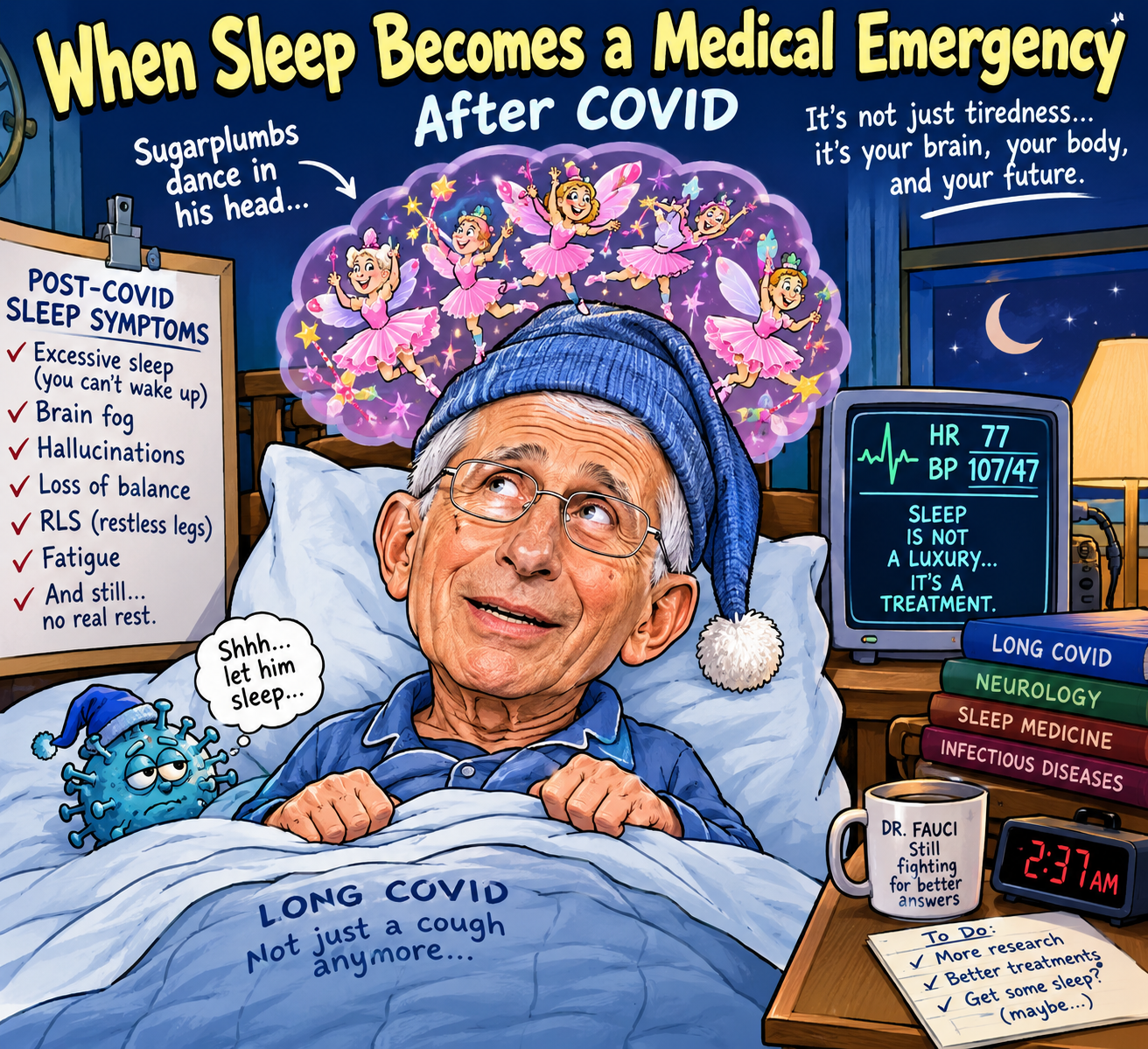
COVID-19 has been followed by reports of narcolepsy, overwhelming daytime sleepiness and episodes of lost consciousness. Some patients have crashed cars or been injured. Vaccination has also been followed by documented episodes of syncope. What medicine knows — and what it still does not know — may be equally important.
John Murphy, CEO The COVID-19 Long haul Foundation
There is a particular kind of fear associated with falling asleep when one does not intend to.
It is not ordinary tiredness.
It is the realization that consciousness may no longer be entirely under one’s control.
A person can be speaking to another human being and suddenly feel an irresistible neurological pressure to sleep. A driver can be traveling down a highway and discover that several seconds of the journey have disappeared. Someone laughing at dinner can experience a sudden loss of muscle tone and collapse to the floor.
For people with narcolepsy, these are not metaphors.
They are manifestations of a neurological disorder in which the normal boundaries between wakefulness and sleep become unstable.
COVID-19 has added a troubling question: Can an infection that has already been associated with neurological, autonomic and immune abnormalities trigger narcolepsy or related disorders in susceptible people?
The evidence is not yet sufficient to answer yes with certainty.
But it is sufficient to make the question impossible to dismiss.
The woman whose life changed after COVID
In 2023, researchers reported the case of a previously healthy 33-year-old woman who developed the full clinical picture of narcolepsy shortly after recovering from COVID-19.
Her symptoms began approximately two weeks after the infection.
She developed excessive daytime sleepiness, cataplexy — sudden loss of muscle tone frequently triggered by emotion — sleep paralysis and hallucinations associated with the transition between wakefulness and sleep.
Formal sleep testing demonstrated multiple sleep-onset REM periods, findings compatible with narcolepsy with cataplexy. The investigators proposed that immune activation associated with COVID-19 might have triggered the disease in a susceptible individual.
One case is not proof of causation.
But it is the sort of case that tells physicians something important:
If a patient develops profound sleepiness after COVID, the correct response is not necessarily to call it “post-viral fatigue.”
It may be a sleep disorder.
Another patient, another pattern
The evidence has continued to accumulate.
A 2024 report described four patients who developed central hypersomnia after COVID-19. Three fulfilled diagnostic criteria for idiopathic hypersomnia and one for type-2 narcolepsy. Three patients improved with methylphenidate, while one recovered spontaneously.
That distinction is clinically important.
Narcolepsy and idiopathic hypersomnia are not interchangeable diagnoses. Neither is synonymous with fatigue.
A patient with Long COVID may feel exhausted because of inflammation, autonomic dysfunction, post-exertional malaise, pain or poor sleep.
But another patient may have a neurological disorder producing pathological sleepiness.
The treatments can be entirely different.
A new case in 2026
The question has not disappeared.
In May 2026, researchers reported another previously healthy 42-year-old woman who developed excessive daytime sleepiness, cataplexy and hypnagogic and hypnopompic hallucinations within three months of confirmed SARS-CoV-2 infection.
Her overnight sleep study showed disturbed sleep, while multiple sleep-latency testing demonstrated a mean sleep latency of approximately one minute and sleep-onset REM periods in every nap — findings strongly compatible with narcolepsy.
The temporal relationship is striking.
But temporal relationship is not the same thing as causality.
Narcolepsy occurs naturally.
People develop it without COVID.
And because millions of people have been infected with SARS-CoV-2, some cases of narcolepsy will inevitably occur after infection by coincidence.
The scientific challenge is therefore to determine whether the incidence is higher than would ordinarily be expected.
That requires epidemiology, not anecdotes.
What is narcolepsy?
Narcolepsy is fundamentally a disorder of sleep-wake regulation.
The most characteristic form, narcolepsy type 1, is associated with loss or dysfunction of neurons producing hypocretin, also known as orexin — a neuropeptide system critical for maintaining stable wakefulness.
When that system is damaged, the brain’s boundary between sleep and wakefulness becomes unstable.
The classic symptoms include:
- irresistible daytime sleepiness;
- cataplexy;
- sleep paralysis;
- hallucinations when falling asleep or waking;
- fragmented nighttime sleep; and
- abnormal intrusion of REM sleep into wakefulness.
Cataplexy is particularly distinctive.
A patient may remain conscious while suddenly losing control of the muscles of the face, neck, arms or legs, often in response to laughter, excitement, anger or surprise.
A person can therefore be awake and simultaneously unable to stand.
For someone driving, that is potentially catastrophic.
When the sleep disorder becomes a traffic problem
The medical literature on syncope and driving predates COVID.
Researchers have long recognized that loss of consciousness behind the wheel creates obvious risks to the driver and everyone nearby. In one study of patients with syncope, investigators specifically examined episodes occurring while driving and the causes of those events.
The distinction between syncope and narcolepsy matters.
Syncope is generally a temporary loss of consciousness caused by inadequate cerebral perfusion.
Narcolepsy is a disorder of sleep-wake regulation.
Neither should automatically be classified as the other.
Yet to the motorist traveling at 60 miles per hour, the practical problem can be similar:
conscious control of the automobile has disappeared.
A COVID patient who said he blacked out at the wheel
An Iowa court record provides one of the clearest publicly documented accounts of a driver who associated his loss of consciousness with COVID.
David Jackson testified that after contracting COVID he had experienced several previous blackouts.
He had quarantined after the episodes.
On August 9, 2020, he was driving toward a medical center when he developed chest tightness and restricted breathing.
Then, according to his testimony, he “passed out, blacked out at the wheel.”
His next memory was the collision.
The case ultimately resulted in a criminal proceeding, and the evidence did not establish that COVID was responsible for the fatal crash. The prosecution presented evidence that drug impairment was the cause, making this a particularly important example of why temporal association cannot simply be converted into medical causation.
But the testimony remains significant.
The driver reported recurrent blackouts after COVID and ultimately lost consciousness while driving.
That is a clinical event demanding explanation, regardless of whether SARS-CoV-2 was ultimately responsible.
The hidden danger: not every blackout is narcolepsy
This distinction is essential.
A person who loses consciousness after COVID could have:
- narcolepsy;
- orthostatic hypotension;
- POTS;
- an abnormal heart rhythm;
- myocarditis;
- dehydration;
- hypoxemia;
- seizure;
- medication effects;
- metabolic abnormalities;
- vasovagal syncope; or
- an unrelated cardiac or neurological disorder.
COVID can potentially intersect with several of these pathways.
That is why “COVID blackout” is not a diagnosis.
It is a starting point for an investigation.
COVID and the autonomic nervous system
One of the most interesting possibilities involves the autonomic nervous system.
The autonomic system regulates functions that normally occur without conscious thought: heart rate, vascular tone, blood pressure, digestion, temperature regulation and other physiological processes.
After COVID, some patients develop persistent autonomic abnormalities.
Orthostatic intolerance is one manifestation.
A patient may feel reasonably well while lying down but become profoundly dizzy, tachycardic, weak or presyncopal after standing.
In severe cases, consciousness can be lost.
This provides another possible pathway between COVID and accidents — one having nothing directly to do with narcolepsy.
And then there are the vaccines
The vaccine question requires equal precision.
There is incontrovertible evidence that people have fainted after vaccination.
But fainting after vaccination is not synonymous with a vaccine causing neurological disease.
The CDC explains that syncope can occur after vaccination and is particularly common among adolescents. Its surveillance information emphasizes that VAERS reports cannot determine how frequently vaccination itself causes fainting because the system is passive.
During the early COVID vaccination campaign, however, something unusual became visible.
At five mass-vaccination sites, CDC investigators identified 64 anxiety-related events among 8,624 recipients of the Janssen vaccine, including 17 episodes of syncope. CDC calculated a VAERS reporting rate of 8.2 syncope reports per 100,000 Janssen doses compared with 0.05 per 100,000 influenza vaccine doses during the comparison period.
The CDC interpreted these episodes primarily as anxiety-related immunization events rather than evidence of a toxic neurological effect of the vaccine.
That distinction matters.
But so does the physical consequence.
A person who faints can fall.
And a fall can produce a concussion, laceration, fracture or other injury.
A teenager who hit her head
Public vaccine-safety records contain individual accounts illustrating this danger.
One report describes a 15-year-old girl who fainted shortly after receiving a Pfizer COVID-19 vaccine. She fell and struck the back of her head. Emergency medical services were called, and she regained consciousness within approximately a minute.
Another report describes a vaccine recipient who fainted and fell from a chair, losing consciousness for approximately a minute.
These reports do not prove that the vaccine ingredient caused the syncope.
Indeed, vasovagal fainting can occur after needles, injections, blood draws and other medical procedures.
But the injury is real even when the mechanism is benign.
That is why vaccination sites routinely observe patients after administration.
A man who struck his head after a Moderna booster
A more medically complicated case was published involving a 56-year-old man who developed recurrent syncope after receiving a Moderna booster.
He experienced nausea followed by loss of consciousness, fell and struck his head against a wall, then fell again.
His subsequent evaluation revealed a type-I Brugada electrocardiographic pattern, a potentially dangerous electrical abnormality associated with ventricular arrhythmias.
The authors considered the vaccine a possible precipitating factor but also identified multiple potential confounders, including medications and an edible containing tetrahydrocannabinol.
This is precisely the kind of case that should be reported — and precisely the kind that should not be oversimplified.
A temporal association may be clinically important without proving causation.
There is another important vaccine signal — POTS
A published case series described five patients who developed POTS after mRNA COVID vaccination.
One was a previously healthy 17-year-old girl who developed syncope, fatigue, chest tightness, nausea and heat intolerance approximately three weeks after her second Pfizer dose. Testing demonstrated orthostatic tachycardia, and treatment with salt and propranolol improved her symptoms.
Again, a case series cannot establish that vaccination caused the disorder.
But it illustrates an important clinical possibility:
A patient presenting with fainting after vaccination may require evaluation of the cardiovascular and autonomic systems rather than simply reassurance.
What about vaccine-induced narcolepsy?
Here the evidence is considerably weaker.
A 2025 analysis of more than five decades of international pharmacovigilance data identified thousands of vaccine-associated narcolepsy reports across multiple vaccines. But the strongest signal was associated with certain influenza vaccines, particularly the 2009 pandemic influenza vaccine experience.
The investigators found no evidence of a narcolepsy signal with COVID-19 mRNA vaccines, despite substantial reporting. They explicitly cautioned that spontaneous-report data cannot establish causation.
That conclusion is important enough to state plainly:
Current evidence does not justify saying that COVID-19 mRNA vaccination causes narcolepsy.
There is, however, one intriguing development.
A 2025 self-controlled case-series study examining the XBB.1.5-containing COVID-19 vaccines found fewer than 20 narcolepsy/cataplexy events during the risk period after Pfizer vaccination, but calculated an elevated incidence-risk ratio of 2.92. The Moderna analysis did not show a significant association. The very small number of events means the finding requires replication before it can be interpreted as causal.
That is how safety science should work.
A signal is not a verdict.
It is a reason to investigate.
Why infection may be biologically different
There is a plausible biological reason researchers are interested in infection-associated narcolepsy.
Narcolepsy type 1 appears to involve immune-mediated destruction or dysfunction of hypocretin-producing neurons in genetically susceptible individuals.
COVID-19 can produce intense immune activation.
It can also affect the central nervous system indirectly through inflammatory signaling, vascular dysfunction and autonomic disturbances.
Researchers reporting post-COVID narcolepsy have therefore proposed an autoimmune or inflammatory mechanism.
But “plausible” is not “proven.”
The crucial experiment would be demonstrating that SARS-CoV-2 infection increases the incidence of narcolepsy beyond the background rate and identifying the biological pathway responsible.
That research remains incomplete.
The diagnostic problem
Perhaps the most important lesson is not about COVID or vaccines at all.
It is about diagnosis.
Patients with Long COVID frequently describe overwhelming sleepiness.
Physicians may label it fatigue.
Patients may then receive advice to rest.
But excessive daytime sleepiness and fatigue are not the same physiological phenomenon.
A patient who falls asleep unintentionally during conversations, meals or passive activities deserves a different evaluation from someone who is awake but lacks the energy to exercise.
If cataplexy, sleep paralysis or hypnagogic hallucinations are present, the possibility of narcolepsy becomes much more important.
Formal testing can include overnight polysomnography and a multiple sleep latency test.
In selected cases, cerebrospinal-fluid hypocretin measurement may provide additional diagnostic information.
The point is not to diagnose everyone with Long COVID with narcolepsy.
It is to avoid missing the minority who actually have it.
The patient is often the first person to notice
People know when their sleep has changed.
They know when they suddenly cannot stay awake.
They know when laughter makes their knees buckle.
They know when a drive that used to be routine becomes frightening because they cannot remember several seconds of it.
Yet patients with unexplained neurological symptoms have historically encountered a familiar problem: their symptoms are dispersed among specialties.
The cardiologist sees the tachycardia.
The neurologist sees the blackout.
The sleep specialist sees the hypersomnolence.
The psychiatrist sees the anxiety.
The primary-care physician sees the fatigue.
The patient experiences all five simultaneously.
That fragmentation can delay diagnosis.
The consequences extend beyond the patient
Consider the automobile.
A person who suddenly loses consciousness while driving does not have a private medical event.
The vehicle continues moving.
A blackout of only a few seconds can carry a car hundreds of feet.
The consequences can include a collision, traumatic brain injury, paralysis or death.
For that reason, unexplained loss of consciousness should trigger explicit counseling about driving until the cause has been evaluated and recurrence risk assessed.
This principle existed before COVID.
COVID simply adds another possible cause to an already complicated medical problem.
What should physicians ask?
Perhaps the most useful questions are remarkably simple.
Are you falling asleep unintentionally?
Do you ever suddenly lose muscle strength when laughing or becoming emotional?
Have you experienced sleep paralysis?
Have you had vivid hallucinations as you fall asleep or awaken?
Have you ever lost consciousness?
Did it happen while standing, exercising or driving?
Did you experience palpitations?
Did you recently have COVID?
Did the symptoms begin after vaccination?
What medications, stimulants, sedatives or recreational substances are you taking?
These questions can separate several very different disorders that otherwise get compressed into one word:
fatigue.
What patients can do
The first rule is safety.
Anyone experiencing unexplained episodes of loss of consciousness, irresistible sleep attacks or episodes of sudden muscle weakness should avoid driving until the cause has been evaluated.
Patients should keep a precise chronology:
when the infection or vaccination occurred;
when symptoms began;
how long episodes last;
whether there is a warning;
whether the person remains conscious;
whether there are palpitations;
whether there is cataplexy;
whether sleep attacks occur;
what medications are being taken;
and whether anyone witnessed the event.
A sleep diary can be surprisingly valuable.
So can a witness’s description.
A patient may describe “blacking out.”
A spouse may describe 20 seconds of staring, limpness or abnormal movements.
Those are different clinical clues.
Medicine needs better surveillance
The COVID era demonstrated the value and the limitations of passive adverse-event reporting.
Systems such as VAERS can identify unusual clusters.
They cannot, by themselves, establish causality.
The same is true of international pharmacovigilance databases.
The next generation of research needs linked longitudinal data:
infection status;
vaccination history;
sleep diagnoses;
medications;
electrocardiograms;
emergency visits;
driving accidents;
hospitalizations;
and objective sleep studies.
Only then can researchers answer the question that matters:
Does SARS-CoV-2 infection increase the incidence of narcolepsy, syncope or dangerous sleep-wake instability — and by how much?
And separately:
Do any COVID-19 vaccines increase the risk of these conditions beyond background rates?
Those are empirical questions.
They should not be answered by ideology.
The lesson from the people who lost control
The stories are compelling precisely because they do not all point to the same conclusion.
One person developed narcolepsy after COVID.
Another developed hypersomnia.
Another blacked out while driving but ultimately had competing evidence for drug impairment.
Another fainted after vaccination and struck her head.
Another developed orthostatic tachycardia and syncope after vaccination.
Another experienced recurrent syncope in the setting of a newly recognized electrical heart abnormality.
These are not one disease.
They are different medical phenomena occurring in the enormous biological experiment created by a pandemic and mass vaccination campaign.
The responsible conclusion is therefore neither “COVID causes narcolepsy” nor “vaccines cause blackouts.”
The more useful conclusion is harder:
COVID can be followed by serious disturbances of sleep, consciousness and autonomic function. Vaccination can be followed by syncope, usually through mechanisms such as vasovagal reactions, and rare neurological or cardiovascular events continue to warrant surveillance. The causal relationships for narcolepsy remain uncertain.
What is certain is what happens when consciousness disappears behind the wheel.
The automobile does not wait for the diagnosis.
The road continues.
And for a patient who has suddenly lost control of wakefulness, the difference between a strange symptom and a medical emergency may be measured in seconds.