
John Murphy, CEO The COVID-19 Long haul Foundation
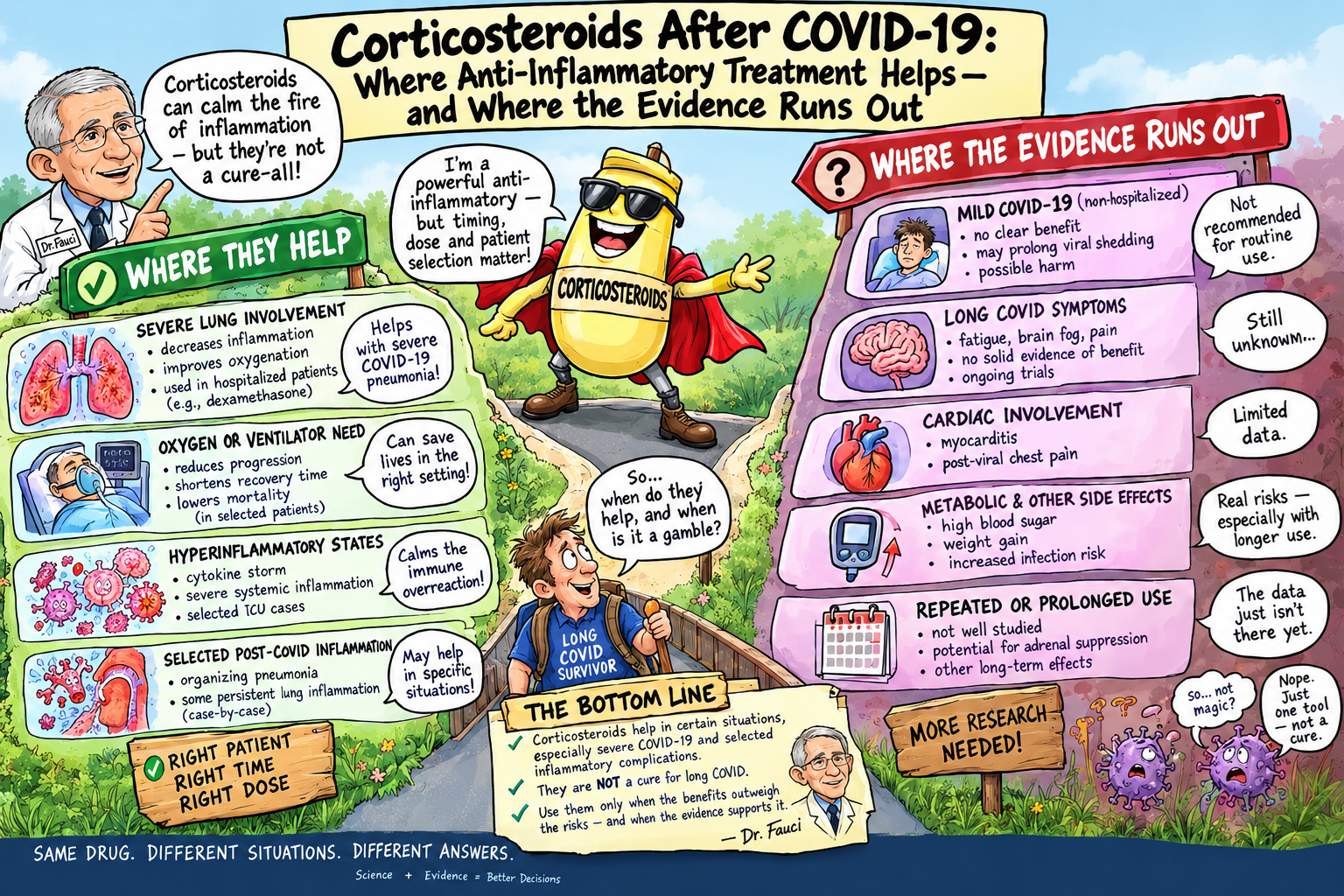
The history of COVID-19 treatment contains few therapeutic successes as clear as the discovery that corticosteroids could save the lives of patients with severe disease. Yet the same class of drugs that became indispensable in the treatment of severe COVID-19 has subsequently occupied a far more ambiguous position in the care of survivors. Corticosteroids have been used to treat persistent pulmonary inflammation, organizing pneumonia, inflammatory arthritis, myositis and several other post-infectious inflammatory syndromes. At the same time, there is insufficient evidence to justify prescribing steroids indiscriminately for the constellation of symptoms commonly called Long COVID.
The distinction matters. COVID-19 is not a single pathological process. SARS-CoV-2 can produce direct viral injury, dysregulated innate and adaptive immunity, endothelial dysfunction, thrombosis, autonomic disturbance, mitochondrial abnormalities and persistent inflammatory or autoimmune phenomena. Corticosteroids can suppress some of these processes extraordinarily well. They cannot, however, be expected to repair every form of tissue injury left behind by infection.
The central therapeutic question therefore is not whether steroids “work for COVID,” but which pathological phenotype is being treated, at what stage of disease, and whether inflammation remains an active driver of tissue injury.
The landmark discovery: steroids can save lives in severe COVID-19
The strongest evidence for corticosteroid therapy came from the randomized RECOVERY trial. Investigators assigned hospitalized patients with COVID-19 to dexamethasone, 6 mg daily for up to 10 days, or usual care.
The results were striking. Twenty-eight-day mortality was 22.9% among patients receiving dexamethasone compared with 25.7% receiving usual care. The benefit was concentrated among patients with substantial respiratory disease. Among mechanically ventilated patients, mortality was 29.3% with dexamethasone compared with 41.4% with usual care—a relative rate ratio of 0.64. Among patients receiving oxygen without mechanical ventilation, mortality was 23.3% versus 26.2%, respectively. By contrast, among patients requiring no respiratory support, mortality was actually numerically higher with dexamethasone: 17.8% versus 14.0%.
This produced one of the most important lessons of the pandemic: an anti-inflammatory drug can be lifesaving when inflammation is causing organ injury but potentially harmful when the immune response is still serving a useful antiviral function.
The World Health Organization continues to recommend systemic corticosteroids for patients with severe or critical COVID-19 and recommends against their routine use in non-severe disease.
The biological explanation is straightforward. In advanced COVID-19 pneumonia, the problem is no longer simply the presence of virus. A dysregulated inflammatory response contributes to alveolar injury, endothelial damage, capillary leakage and acute respiratory distress syndrome. Suppressing that inflammation can prevent additional tissue destruction.
The same principle helps explain why timing is so important.
Why steroids can be harmful early in uncomplicated infection
A steroid is not an antiviral drug. It does not eliminate SARS-CoV-2. Instead, it suppresses immune activity.
During the early phase of infection, immune activation is part of the body’s defense against the virus. Suppressing that response before inflammatory pathology becomes dominant can therefore theoretically impair viral clearance while providing little therapeutic benefit.
This is not merely theoretical. The RECOVERY trial found no mortality benefit among patients who did not require respiratory support, and current WHO guidance advises against corticosteroids for non-severe COVID-19.
Corticosteroids also have familiar metabolic and infectious consequences. Hyperglycemia is particularly important. WHO’s evidence review found an increased incidence of hyperglycemia among corticosteroid-treated patients, while clinicians must also consider secondary infections, fluid and electrolyte abnormalities, muscle weakness, osteoporosis, gastrointestinal complications, psychiatric effects and adrenal suppression when treatment becomes prolonged.
Consequently, the clinical rationale changes dramatically when treatment extends from approximately a week of dexamethasone during severe pneumonia to months of prednisone for a post-COVID inflammatory disorder.
The important second chapter: persistent lung disease
One of the most compelling uses of corticosteroids after COVID-19 involves patients whose lungs do not return to normal after the acute infection.
Some survivors develop persistent inflammatory interstitial lung disease, frequently exhibiting an organizing-pneumonia pattern. Organizing pneumonia is not simply “long COVID cough.” It represents a recognizable pathological response in which inflammatory and fibroblastic tissue obstructs portions of the distal airways and alveolar spaces.
A particularly important observational study from the United Kingdom followed 837 survivors of COVID-19 hospitalization. At four weeks, 39% reported continuing symptoms. Thirty-five patients—4.8% of the entire cohort—were found to have persistent interstitial lung disease with significant functional impairment. Thirty patients with persistent disease were treated with corticosteroids. After treatment, forced vital capacity increased by an average relative 9.6%, while transfer factor increased by approximately 31.5%. Patients also experienced significant improvement in breathlessness, functional capacity and radiographic abnormalities.
These findings are important, but their interpretation requires discipline. The study was observational rather than randomized. There was no untreated randomized control group demonstrating that steroids, rather than spontaneous recovery, produced the improvement. Nevertheless, the magnitude of physiological and clinical improvement, coupled with the radiographic phenotype, provided a compelling basis for further investigation.
Subsequent case reports strengthened the biological argument. In a 2023 series, three patients with histologically confirmed post-COVID organizing pneumonia received prolonged corticosteroid treatment ranging from 86 to 166 days, with excellent recovery reported in all three.
Another report described a patient with extensive organizing pneumonia after prolonged mechanical ventilation. Prednisone at 40 mg daily was continued for six months, with resolution of pulmonary functional and imaging abnormalities.
These cases illustrate an important principle: persistent pulmonary inflammation after COVID-19 may be a specific steroid-responsive disease rather than merely an unexplained Long COVID symptom.
That distinction should influence diagnosis.
A patient with continuing dyspnea six months after infection should not automatically receive prednisone. The clinician should first determine whether there is an identifiable inflammatory pulmonary lesion using oxygen measurements, pulmonary-function testing, diffusion capacity, high-resolution CT and, when clinically appropriate, multidisciplinary interstitial-lung-disease assessment.
Organizing pneumonia may be the hidden diagnosis
Organizing pneumonia deserves particular attention because its symptoms can be deceptively nonspecific.
Patients may report continuing shortness of breath, exercise intolerance, cough, fatigue and reduced oxygen saturation. Those symptoms can easily be attributed to “post-COVID syndrome.”
But the patient may actually have an identifiable inflammatory lung disorder.
The imaging pattern can include ground-glass opacities, consolidation, peribronchovascular abnormalities and characteristic patterns such as the reversed halo sign. Histology can demonstrate fibroblastic plugs within alveolar spaces.
This raises a larger question about Long COVID medicine: How many patients labeled with a nonspecific syndrome actually have identifiable inflammatory phenotypes that require conventional diagnoses?
The answer remains unknown.
Steroids and inflammatory arthritis after COVID
SARS-CoV-2 infection has also been followed by inflammatory arthritis, reactive arthritis and flares of preexisting rheumatologic disease.
A systematic review identified 95 patients with arthritis following COVID-19. Corticosteroids and nonsteroidal anti-inflammatory drugs were among the most frequently used therapies, with corticosteroids administered orally, intramuscularly or intra-articularly in different cases. Many patients experienced substantial improvement or remission.
Another systematic review similarly found that treatment commonly consisted of NSAIDs and corticosteroids and that some patients failed to improve until corticosteroids were introduced.
But these reports are predominantly case reports and small observational series. They establish plausibility, not a universal treatment protocol.
A patient with persistent joint pain after COVID therefore warrants an actual rheumatologic diagnosis rather than an assumption that every symptom represents Long COVID. Laboratory evidence, imaging, synovial examination when indicated and evaluation for rheumatoid arthritis, psoriatic arthritis, crystal disease and infection remain important.
Post-COVID myositis and muscle inflammation
Another intriguing area is inflammatory muscle disease.
A published case described a 58-year-old man who developed weakness, myalgias and arthralgias six months after a COVID-like illness. After other autoimmune and myopathic causes were investigated, he was treated with prednisone and reported moderate improvement. The authors considered the presentation compatible with post-COVID polymyositis, although the patient declined muscle biopsy and electromyography.
This case demonstrates both the promise and the limitations of the evidence.
Steroids are an established treatment for autoimmune inflammatory myopathies. Therefore, if SARS-CoV-2 appears to have precipitated a genuine inflammatory myopathy, treatment with corticosteroids is biologically and clinically plausible.
But the converse does not follow: unexplained post-COVID fatigue and muscle weakness should not automatically be treated with prednisone.
Fatigue is extraordinarily nonspecific. It may arise from sleep disruption, autonomic dysfunction, anemia, endocrine disease, deconditioning, medication effects, cardiopulmonary limitation, renal disease, mitochondrial dysfunction or persistent inflammation. Treating every form of fatigue with immunosuppression risks treating the wrong disease.
What about neurological Long COVID?
This is where the evidence becomes substantially weaker.
COVID-19 has been associated with numerous neurological manifestations, including peripheral neuropathy, dysautonomia, cognitive dysfunction, encephalopathy, headaches, altered sensory processing and other neurological syndromes. Some neurological disorders occurring after infection have inflammatory or autoimmune mechanisms for which corticosteroids or other immunotherapies may be appropriate.
But evidence is insufficient to recommend systemic corticosteroids simply because a patient has “brain fog,” fatigue, neuropathy or cognitive dysfunction following COVID-19.
This is an area in which medicine must resist an understandable temptation. The discovery that inflammation contributes to some post-COVID disease does not mean that inflammation explains every post-COVID symptom.
The appropriate question is whether objective evidence points toward an immune-mediated neurological disorder.
When such evidence exists—for example, a defined autoimmune neurological syndrome—the patient may warrant treatment according to the established disorder, which can include corticosteroids, intravenous immunoglobulin, plasma exchange or other immunomodulatory therapy.
When objective evidence is absent, prolonged empiric prednisone is considerably harder to justify.
The unanswered question: can steroids prevent Long COVID?
Perhaps the most consequential unanswered question concerns corticosteroid treatment during the acute infection itself.
Could suppressing severe inflammation during acute COVID prevent some of the pathological processes that later become Long COVID?
The answer remains uncertain.
A 2024 systematic review and meta-analysis examined 32 studies qualitatively and 25 quantitatively concerning acute COVID treatments and subsequent Long COVID. Antiviral treatment was associated with a reduced risk of Long COVID, with a pooled odds ratio of 0.61. Corticosteroids, however, did not demonstrate a statistically significant protective association: pooled OR 1.57, 95% confidence interval 0.80–3.09, P=.19.
This result is particularly revealing.
It means that the fact that dexamethasone saves the lives of severely ill patients does not establish that corticosteroids prevent the subsequent development of Long COVID.
Indeed, the meta-analysis raised the possibility that corticosteroids could have adverse effects on post-acute outcomes, although the available observational evidence cannot establish that corticosteroids cause Long COVID.
The distinction between these questions is often lost in public discussion:
Steroids can reduce mortality in severe acute COVID-19.
That does not mean steroids prevent Long COVID.
And it certainly does not mean steroids are an established treatment for every manifestation of Long COVID.
The danger of prolonged steroid therapy
The attractiveness of corticosteroids is obvious. They are inexpensive, widely available and often produce dramatic symptomatic improvement when inflammation is genuinely responsible for disease.
But the same pharmacology that makes prednisone powerful makes prolonged treatment dangerous.
Systemic corticosteroids can increase blood glucose, suppress the hypothalamic-pituitary-adrenal axis, increase susceptibility to infection, accelerate bone loss, produce muscle wasting, cause fluid retention and hypertension, worsen mood and sleep, provoke psychiatric symptoms and produce cataracts and other ocular complications with prolonged exposure.
The metabolic consequences can be particularly consequential for older patients and people with diabetes.
A short course of dexamethasone for severe COVID-19 is therefore fundamentally different from months of prednisone for presumed Long COVID.
This distinction is sometimes obscured when a patient reports that “steroids made me feel better.” Symptomatic improvement is clinically important, but it is not necessarily diagnostic. Corticosteroids can produce a temporary sense of increased energy and appetite and reduce pain and inflammation even when the underlying pathology remains unidentified.
The proper endpoint should therefore be objective improvement in the disease being treated—not merely a transient improvement in how the patient feels.
A better framework for steroid treatment after COVID
The most rational approach is phenotype-based.
For severe or critical acute COVID-19 requiring oxygen or ventilatory support, systemic corticosteroids are established therapy and can be lifesaving.
For non-severe acute COVID-19 in patients who do not require oxygen, systemic corticosteroids should generally not be used solely to treat COVID-19.
For persistent post-COVID inflammatory interstitial lung disease or organizing pneumonia, corticosteroids may be highly effective in appropriately selected patients, but diagnosis should precede prolonged treatment whenever possible.
For post-COVID inflammatory arthritis, corticosteroids can be useful when an inflammatory rheumatologic diagnosis is established, although NSAIDs, intra-articular treatment and disease-modifying therapies may be more appropriate depending on the diagnosis.
For post-COVID inflammatory myopathy, steroids may be appropriate when objective evidence supports inflammatory muscle disease.
For neurological or autoimmune post-COVID disease, treatment should be directed toward the specific neurological diagnosis rather than the label of Long COVID itself.
For nonspecific fatigue, brain fog, sleep disturbance, generalized pain or post-exertional malaise, evidence does not currently justify routine systemic corticosteroid therapy. The 2024 BMJ living systematic review of interventions for Long COVID underscores the broader problem: evidence for pharmacological treatment of post-COVID condition remains limited and heterogeneous.
The larger lesson
The steroid story of COVID-19 is ultimately a story about precision medicine.
Early in the pandemic, physicians faced a disease for which the distinction between viral replication and immune-mediated tissue injury was poorly understood. The discovery that dexamethasone could reduce mortality in patients requiring oxygen transformed treatment of severe disease.
The subsequent experience has been more complicated.
COVID-19 does not end when the PCR test becomes negative. In some survivors, inflammation persists. In others, the dominant problem may be vascular injury, autonomic dysfunction, neurological dysfunction, altered metabolism, tissue damage, deconditioning or a combination of mechanisms.
Corticosteroids are extraordinarily effective against some inflammatory diseases and remarkably ineffective against diseases that are not primarily inflammatory.
The challenge for post-COVID medicine is therefore not to decide whether steroids are “good” or “bad.” It is to determine which patient has a steroid-responsive disease.
That requires better phenotyping, better biomarkers, better imaging, longer follow-up and randomized trials directed at specific post-COVID syndromes.
The most important therapeutic lesson from the pandemic may ultimately be this: a patient’s symptoms should lead to a search for the underlying pathology, not simply to a prescription for an anti-inflammatory drug.
For the patient with organizing pneumonia, corticosteroids may restore lung function. For the patient with inflammatory arthritis, they may extinguish an autoimmune inflammatory process. For the critically ill patient with COVID-19 pneumonia, they can be lifesaving.
But for the millions of people living with Long COVID, the central scientific challenge remains unsolved: determining which biological mechanism is responsible for which symptom—and matching treatment to mechanism rather than treating the name of the syndrome.
Until that distinction becomes routine, corticosteroids will remain both one of the great therapeutic successes of COVID-19 and one of the drugs most vulnerable to being used beyond the limits of the evidence.