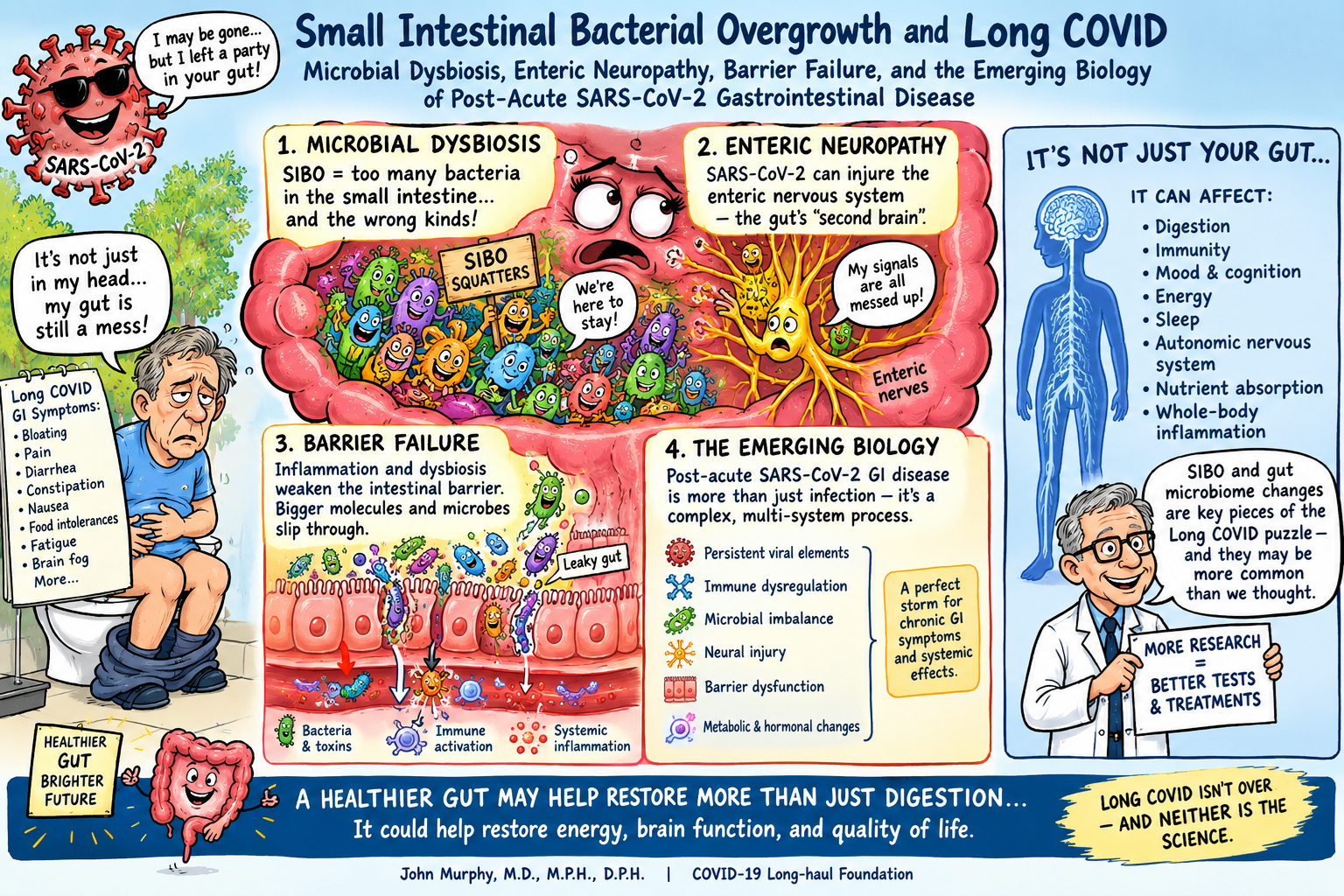
John Murphy, CEO The COVID Long haul Foundation
Abstract
Small intestinal bacterial overgrowth (SIBO) is a disorder characteried by an abnormal increase in the quantity and/or composition of microorganisms within the small intestine. Although traditionally regarded as a consequence of structural abnormalities, impaired intestinal motility, altered gastric acid secretion, pancreatic insufficiency, or postsurgical anatomy, contemporary understanding increasingly recognises SIBO as a disorder of the intestinal ecosystem involving microbial ecology, host immunity, bile-acid metabolism, epithelial integrity, enteric neuromuscular function, and the migrating motor complex. Long COVID, or post-acute sequelae of SARS-CoV-2 infection (PASC), similarly represents a multisystem condition in which gastrointestinal dysfunction has emerged as an important but incompletely characterised phenotype.
The intersection of these disorders is biologically compelling. SARS-CoV-2 can infect intestinal epithelial cells, intestinal ACE2 signalling participates in nutrient and amino-acid homeostasis, acute infection can perturb the intestinal microbiome and epithelial barrier, and persistent viral antigen has been detected in gastrointestinal tissues in subsets of patients. Longitudinal studies have identified persistent alterations in gut microbial composition after COVID-19, including depletion of short-chain-fatty-acid-producing organisms and enrichment of taxa associated with inflammation. Such changes may interact with autonomic dysfunction, vagal impairment, altered enteric nervous-system activity, impaired intestinal motility, bile-acid disturbances, immune dysregulation, and post-infectious visceral hypersensitivity. The resulting ecological environment could favour excessive microbial colonisation of the proximal small intestine.
Nevertheless, the hypothesis that SIBO is a major driver of Long COVID remains unproven. Most microbiome studies have relied on stool rather than small-bowel samples, whereas SIBO is fundamentally a spatial disorder of the small-intestinal microbiome. Breath tests have imperfect sensitivity and specificity, and methane production represents a related but distinct entity—intestinal methanogen overgrowth. Consequently, extrapolation from faecal dysbiosis to SIBO is inappropriate without direct physiological or microbiological evidence.
This review examines the potential relationship between SIBO and Long COVID from the perspectives of aetiology, pathology, microbial and host genomics, intestinal physiology, clinical presentation, history and physical examination, differential diagnosis, diagnostic testing, treatment, recurrence, nutritional consequences, and long-term prognosis. A proposed model is advanced in which SARS-CoV-2 may create a permissive environment for small-bowel microbial overgrowth through interacting abnormalities of motility, mucosal immunity, epithelial barrier function, bile-acid metabolism, autonomic regulation, and microbial ecology. Prospective studies incorporating regional intestinal metagenomics, metabolomics, breath testing, motility measurements, immune profiling, and longitudinal clinical phenotyping are required to determine whether SIBO represents a treatable mechanistic subtype of Long COVID.
Keywords: Long COVID; post-acute sequelae of SARS-CoV-2 infection; PASC; SIBO; small intestinal bacterial overgrowth; intestinal methanogen overgrowth; microbiome; dysbiosis; enteric nervous system; autonomic dysfunction; intestinal permeability; ACE2; gut-brain axis; mitochondrial dysfunction; bile acids; microbial translocation.
Introduction
The gastrointestinal tract is increasingly recognised as an important component of the biology of COVID-19 and its post-acute sequelae. SARS-CoV-2 is not exclusively a respiratory pathogen. The intestinal epithelium expresses the viral entry machinery required for infection, including ACE2 and transmembrane serine proteases, and viral RNA and antigen have been detected in gastrointestinal tissues and faecal material. Gastrointestinal symptoms—including abdominal pain, diarrhoea, nausea, altered appetite, vomiting, dysgeusia, constipation, and bloating—may occur during acute infection and may persist after the respiratory phase has resolved.
Long COVID introduces a second level of complexity. The persistence of gastrointestinal symptoms in some patients is accompanied by changes in microbial composition, intestinal permeability, immune signalling, bile-acid metabolism, serotonin biology, and gut-brain communication. The gut therefore cannot be viewed merely as a passive target of SARS-CoV-2. It may constitute an active immunological, metabolic, neurological, and microbial compartment capable of influencing systemic disease.
SIBO occupies a potentially important position within this network. The normal small intestine contains substantially fewer microorganisms than the colon. This relative microbial restraint is maintained by gastric acid, bile and pancreatic secretions, intestinal peristalsis, the migrating motor complex, mucosal immune mechanisms, mucus, and the ileocaecal valve. When these protective mechanisms fail, bacteria originating from the proximal gastrointestinal tract or migrating retrogradely from the colon may proliferate within the small bowel.
The clinical consequences are heterogeneous. Bacteria can ferment carbohydrates before normal absorption is completed, generate hydrogen and other gases, consume nutrients, deconjugate bile acids, interfere with enterohepatic circulation, compete for vitamin B12, alter epithelial signalling, and generate microbial products capable of activating innate and adaptive immune responses.
The central hypothesis of this review is not that SARS-CoV-2 directly causes SIBO in every patient with Long COVID. Rather, SARS-CoV-2 may produce a constellation of disturbances that increase susceptibility to small-intestinal microbial overgrowth in a subset of patients. These disturbances could include autonomic and enteric dysfunction, impaired migrating motor complex activity, post-infectious dysmotility, altered bile-acid signalling, epithelial barrier disruption, changes in mucosal immunity, altered intestinal microbial ecology, and medication-associated changes in the gastrointestinal environment.
The distinction is important. Dysbiosis, intestinal permeability, post-infectious irritable bowel syndrome, and SIBO are overlapping but non-identical phenomena. Stool microbiome abnormalities cannot by themselves establish SIBO, because stool represents predominantly colonic microbial ecology rather than the spatial microbial environment of the proximal small intestine.
SIBO: Definition and Conceptual Framework
SIBO has historically been defined by excessive numbers of bacteria in the small intestine, traditionally using quantitative culture of jejunal aspirates. Contemporary clinical practice more frequently employs hydrogen and methane breath testing because direct small-bowel sampling is invasive.
The clinical concept is broader than a numerical bacterial count. SIBO is best understood as a disruption of the normal spatial organisation of the gastrointestinal microbiome in which microorganisms become sufficiently abundant or compositionally abnormal within the small bowel to alter physiology and produce symptoms.
This distinction is increasingly important because the intestinal microbiome is not homogeneous along the gastrointestinal tract. The stomach, duodenum, jejunum, ileum and colon possess distinct microbial, metabolic, oxygen, pH, bile-acid and nutrient environments. A stool sample therefore cannot determine directly whether the proximal small intestine contains excessive bacterial populations.
The American College of Gastroenterology guideline recognises SIBO as a clinical disorder involving excessive bacterial populations in the small intestine and identifies bloating, diarrhoea, abdominal discomfort and, in severe cases, steatorrhoea as characteristic manifestations. Laboratory abnormalities may include vitamin deficiencies, particularly vitamin B12 deficiency.
In Long COVID, this diagnostic distinction becomes particularly consequential because many patients have bloating, diarrhoea, constipation, abdominal pain, nausea and altered bowel habits without demonstrable SIBO. These symptoms may instead arise from post-infectious irritable bowel syndrome, autonomic dysfunction, visceral hypersensitivity, bile-acid abnormalities, pancreatic dysfunction, altered serotonin signalling, or persistent intestinal inflammation.
Aetiology: Why Might Long COVID Predispose to SIBO?
Impaired intestinal motility
The most compelling mechanistic connection between Long COVID and SIBO is gastrointestinal dysmotility.
The small intestine possesses an elaborate system for preventing prolonged bacterial residence. During fasting, the migrating motor complex periodically generates propagated contractions that sweep luminal contents distally. This physiological “housekeeping” mechanism limits bacterial accumulation.
Autonomic dysfunction, enteric neuropathy, smooth-muscle dysfunction, inflammation and altered neuroimmune signalling could impair this process.
Long COVID has been associated with autonomic abnormalities affecting multiple organ systems. If similar dysfunction occurs within the enteric nervous system, intestinal propulsion may become irregular. Slower transit creates ecological conditions favourable to bacterial proliferation.
The relationship may therefore be represented conceptually as:
SARS-CoV-2 infection → immune/autonomic disturbance → impaired intestinal motility → prolonged small-bowel residence time → altered microbial ecology → microbial overgrowth → fermentation, gas production, mucosal signalling and malabsorption.
This is a hypothesis requiring direct physiological confirmation, but it is consistent with established SIBO biology.
Vagal and enteric nervous-system dysfunction
The enteric nervous system contains millions of neurons organised into interconnected plexuses that regulate propulsion, secretion, absorption, vascular tone and mucosal immunity.
The vagus nerve provides major bidirectional communication between the gastrointestinal tract and central nervous system. Long COVID-associated autonomic dysfunction could alter this circuitry.
A reduction in effective parasympathetic signalling could influence gastric emptying, intestinal motility, pancreatic secretion, bile flow and the migrating motor complex.
The resulting physiological disturbance could be particularly important in patients whose Long COVID includes early satiety, nausea, constipation alternating with diarrhoea, abdominal distension, postprandial discomfort, orthostatic symptoms or other manifestations of autonomic dysfunction.
Altered gastric acid and antimicrobial defence
Gastric acid constitutes an important barrier to microbial migration into the small intestine. Hypochlorhydria can increase the number and variety of microorganisms reaching the duodenum.
Proton-pump inhibitors are therefore a recognised clinical consideration in SIBO evaluation, although the magnitude and independence of this association vary between studies.
In a patient with Long COVID, chronic PPI exposure may become one additional factor superimposed on post-infectious dysmotility. The presence of PPI therapy should therefore be considered in the clinical history without assuming that it is causative.
Bile acids
Bile acids possess antimicrobial properties and regulate intestinal microbial composition through signalling pathways involving FXR and TGR5.
Microorganisms within the small intestine can deconjugate bile acids prematurely. This may reduce the bile-acid pool available for normal lipid absorption and contribute to diarrhoea and steatorrhoea.
Conversely, disruption of bile-acid synthesis, transport or enterohepatic circulation may alter the microbial ecosystem.
The relationship is thus bidirectional:
bile-acid disruption → microbial ecological change → bacterial deconjugation → altered bile-acid signalling and absorption.
Because bile acids also participate in metabolic, immune and neurological signalling, this pathway represents a potentially important intersection between SIBO and systemic manifestations of Long COVID.
Pathophysiology
SIBO is not simply an accumulation of bacteria. Its clinical consequences arise from interactions among microorganisms, nutrients, host epithelium, immune cells, metabolites and the enteric nervous system.
Carbohydrate fermentation
Excess microorganisms metabolise carbohydrates that would ordinarily be absorbed before reaching heavily colonised intestinal segments.
Hydrogen-producing bacteria generate hydrogen gas, whereas methanogenic archaea consume hydrogen and generate methane.
Hydrogen production can cause:
- abdominal distension;
- bloating;
- belching;
- abdominal discomfort;
- increased flatus.
Methane production has a different physiological association and is particularly associated with slowed intestinal transit and constipation.
Thus the simplistic terminology of “SIBO” can obscure two different physiological phenotypes:
hydrogen-predominant overgrowth, often associated with diarrhoeal symptoms, and
intestinal methanogen overgrowth (IMO), which may occur throughout the gastrointestinal tract and is particularly associated with constipation.
Nutrient competition
Bacteria can consume nutrients before they become available to the host.
Vitamin B12 deficiency is particularly characteristic of clinically significant bacterial overgrowth because certain bacteria consume cobalamin or interfere with its absorption.
Folate can behave differently because bacterial synthesis may result in normal or even elevated serum folate concentrations.
More severe disease can produce deficiencies involving fat-soluble vitamins, iron and other nutrients, particularly when bile-acid disruption and malabsorption coexist.
Fat malabsorption
Bacterial deconjugation of bile acids can interfere with micelle formation and lipid absorption.
The result may include:
- steatorrhoea;
- weight loss;
- deficiencies of vitamins A, D, E and K;
- reduced nutritional reserve.
In a patient with Long COVID, these abnormalities may compound pre-existing fatigue, weakness, neuropathy, cognitive symptoms and exercise intolerance.
The Microbiome of Long COVID
Multiple studies have demonstrated persistent alterations in the gut microbiome following SARS-CoV-2 infection.
Important observations include reductions in microbial diversity and alterations involving short-chain-fatty-acid-producing organisms. Studies have reported reductions in organisms such as Faecalibacterium prausnitzii and Bifidobacterium species, together with increases in taxa including Ruminococcus gnavus, Bacteroides vulgatus and Veillonella.
These findings are intriguing but should not be interpreted as synonymous with SIBO.
A stool microbiome signature describes microbial ecology predominantly in the colon. SIBO concerns microbial abundance and composition within the small intestine.
The two phenomena may nevertheless be mechanistically connected.
Long COVID may produce:
- intestinal epithelial injury;
- altered ACE2-dependent physiology;
- altered nutrient availability;
- impaired motility;
- altered bile-acid metabolism;
- mucosal immune activation;
- changes in microbial metabolites;
- altered intestinal permeability;
- altered gut-brain signalling.
Together these abnormalities could shift the small intestinal ecosystem toward overgrowth.
Genomics and Metagenomics
The genomic dimension of SIBO and Long COVID remains one of the least developed areas of research.
Traditional SIBO studies largely relied on culture and breath testing. Modern metagenomics offers substantially greater resolution.
Whole-genome shotgun sequencing can potentially determine:
- microbial species;
- strain-level variation;
- functional metabolic pathways;
- antibiotic-resistance genes;
- virulence-associated genes;
- bacteriophage populations;
- microbial pathways for bile-acid metabolism;
- short-chain-fatty-acid production;
- tryptophan metabolism;
- hydrogen production;
- methane-associated ecological networks.
This approach is particularly relevant because microbial function may be more important than taxonomy.
Two individuals could harbour apparently similar bacterial communities but possess markedly different metabolic capacities.
Host genetics
Host genomic variation may also influence susceptibility to post-infectious gastrointestinal disease.
Potential pathways include genes regulating:
- ACE2;
- innate antiviral immunity;
- interferon responses;
- mucosal immunity;
- epithelial tight junctions;
- inflammatory signalling;
- bile-acid transport;
- serotonin metabolism;
- autonomic regulation.
However, no specific host genetic signature has yet been established as a validated predictor of SIBO in Long COVID.
Future research should therefore integrate host genome, epigenome, transcriptome, microbiome and metabolome data rather than examining bacterial abundance alone.
Intestinal Barrier Dysfunction
The intestinal epithelium forms a selectively permeable barrier between the luminal microbial environment and systemic circulation.
Tight-junction proteins including claudins, occludin and zonula occludens proteins regulate paracellular permeability.
COVID-19 has been associated with intestinal epithelial injury and increased permeability. Long COVID studies have subsequently implicated persistent barrier dysfunction and microbial translocation in systemic immune activation.
Potential consequences include entry into the circulation of microbial products such as:
- lipopolysaccharide;
- peptidoglycan;
- microbial DNA;
- fungal components;
- bacterial metabolites.
These molecules can activate innate immune pathways and contribute to chronic inflammatory signalling.
The resulting model is therefore not simply:
SIBO → gastrointestinal symptoms.
It may instead be:
SIBO → altered microbial metabolites and epithelial signalling → barrier dysfunction → microbial translocation → immune activation → systemic symptoms.
Such a pathway could theoretically connect gastrointestinal microbial abnormalities with extraintestinal manifestations of Long COVID.
The Gut-Brain Axis
The gastrointestinal tract communicates continuously with the brain through:
- the vagus nerve;
- spinal afferents;
- immune mediators;
- microbial metabolites;
- serotonin;
- tryptophan metabolites;
- bile acids;
- short-chain fatty acids.
Long COVID frequently includes cognitive dysfunction, fatigue, sleep disturbance, anxiety, depression, dizziness and autonomic symptoms.
Altered gut microbial metabolism could theoretically influence these processes.
Short-chain fatty acids, particularly butyrate, influence epithelial integrity, immune regulation and neuroimmune signalling. Microbial alterations affecting tryptophan metabolism may influence serotonin and kynurenine pathways.
This provides a plausible bridge between intestinal microbial dysfunction and systemic symptoms.
However, mechanistic plausibility should not be confused with clinical proof. At present, no evidence demonstrates that treating SIBO reliably reverses cognitive impairment, post-exertional malaise or other systemic manifestations of Long COVID.
Clinical Presentation
A patient with suspected SIBO associated with Long COVID may present with a broad spectrum of symptoms.
Gastrointestinal manifestations
Typical symptoms include:
- abdominal bloating;
- visible abdominal distension;
- excessive gas;
- abdominal discomfort;
- diarrhoea;
- loose stools;
- constipation;
- alternating diarrhoea and constipation;
- early satiety;
- nausea;
- belching;
- food intolerance.
More severe disease can cause:
- weight loss;
- steatorrhoea;
- nutritional deficiencies;
- fatigue;
- weakness.
Extraintestinal manifestations
Severe or chronic malabsorption can produce:
- iron deficiency;
- vitamin B12 deficiency;
- folate abnormalities;
- vitamin D deficiency;
- hypoalbuminaemia in advanced disease;
- peripheral neuropathic symptoms;
- weakness;
- reduced exercise capacity.
These findings overlap substantially with Long COVID and therefore create a major diagnostic challenge.
History and Physical Examination
A detailed history should establish the temporal relationship between SARS-CoV-2 infection and gastrointestinal symptoms.
The clinician should determine:
Before COVID-19
- baseline bowel pattern;
- prior IBS;
- inflammatory bowel disease;
- celiac disease;
- abdominal surgery;
- pancreatic disease;
- diabetes;
- connective-tissue disease;
- motility disorders;
- previous SIBO.
During acute COVID-19
- diarrhoea;
- nausea;
- abdominal pain;
- vomiting;
- appetite loss;
- antibiotic exposure;
- hospitalisation;
- intensive-care treatment.
After COVID-19
- onset of bloating;
- changes in bowel frequency;
- postprandial symptoms;
- food-associated symptoms;
- weight change;
- fatigue;
- orthostatic symptoms;
- neuropathy;
- cognitive dysfunction;
- sleep abnormalities.
Medication history should specifically include:
- proton-pump inhibitors;
- H2 blockers;
- opioids;
- anticholinergic drugs;
- GLP-1 receptor agonists;
- antibiotics;
- metformin;
- laxatives;
- antidiarrhoeal agents.
Opioids and anticholinergic drugs are particularly relevant because they can impair gastrointestinal motility.
The physical examination should assess:
- abdominal distension;
- tenderness;
- bowel sounds;
- surgical scars;
- signs of malnutrition;
- weight and BMI;
- muscle wasting;
- oedema;
- orthostatic blood-pressure changes;
- peripheral neuropathy.
In Long COVID, orthostatic vital signs may be especially informative because gastrointestinal dysmotility and autonomic dysfunction can coexist.
Differential Diagnosis
SIBO should never be diagnosed solely because a patient with Long COVID has bloating.
The differential diagnosis includes:
Post-infectious irritable bowel syndrome
Probably one of the most important competing diagnoses.
Celiac disease
Serological testing with tissue-transglutaminase IgA and total IgA should be considered when clinically appropriate.
Inflammatory bowel disease
Faecal calprotectin, inflammatory markers, imaging and endoscopy may be indicated depending on presentation.
Pancreatic exocrine insufficiency
Consider particularly with steatorrhoea, weight loss and nutritional deficiency.
Bile-acid diarrhea
A major cause of chronic diarrhea that can mimic SIBO.
Carbohydrate malabsorption
Lactose, fructose and other carbohydrate intolerances can produce bloating and diarrhoea.
Gastroparesis
Especially relevant in patients with diabetes, autonomic dysfunction or post-viral gastrointestinal dysmotility.
Intestinal methanogen overgrowth
Methane-associated constipation should be distinguished from conventional bacterial overgrowth.
Medication-induced gastrointestinal dysfunction
GLP-1 receptor agonists, opioids, metformin and several other drugs can substantially alter gastrointestinal motility or stool consistency.
Microscopic colitis
Particularly in older adults with chronic watery diarrhoea.
Colorectal malignancy
New bowel-pattern changes, bleeding, iron deficiency anaemia or unexplained weight loss require appropriate evaluation.
Chronic infection
Giardia and other infectious causes should be considered in the appropriate epidemiological setting.
Diagnosis
Breath testing
Hydrogen and methane breath testing remains the most practical non-invasive approach.
The patient ingests a fermentable carbohydrate substrate—usually glucose or lactulose—and exhaled hydrogen and methane are measured serially.
A rise in hydrogen within the accepted diagnostic time window is interpreted as evidence supporting SIBO, while elevated methane supports intestinal methanogen overgrowth.
However, breath testing has substantial limitations.
False-positive results can occur because of rapid intestinal transit, allowing substrate to reach colonic bacteria earlier than expected.
False-negative results can occur when relevant organisms produce little hydrogen or when methane-producing organisms consume hydrogen.
Recent consensus work has attempted to standardise breath-test preparation, substrate selection, interpretation and reporting, but important diagnostic uncertainty remains.
Jejunal aspirate culture
Small-bowel aspirate culture historically provided a more direct microbiological approach.
Its disadvantages include:
- invasiveness;
- sampling error;
- contamination;
- inability to capture the entire small intestine;
- limitations of conventional culture.
Nevertheless, direct sampling remains valuable in research.
A future diagnostic paradigm
The ideal future diagnostic approach may combine:
breath testing + small-bowel metagenomics + metabolomics + intestinal motility measurement + clinical phenotype.
Such an approach would move the field from an imprecise binary label toward mechanistic phenotyping.
Treatment
Treatment should be directed at both the microbial overgrowth and the underlying physiological abnormality.
Correct the precipitating disorder
The most important therapeutic principle is to identify why overgrowth occurred.
Potentially reversible factors include:
- impaired motility;
- medication effects;
- anatomical abnormalities;
- strictures;
- adhesions;
- blind loops;
- chronic intestinal pseudo-obstruction;
- severe constipation;
- pancreatic insufficiency;
- malnutrition.
If the underlying cause persists, microbial eradication alone is frequently temporary.
Antibiotic Therapy
Rifaximin is the most extensively used antibiotic for SIBO in clinical practice because of its limited systemic absorption and intestinal activity.
Other antibiotics have been used, depending on clinical circumstances and local practice.
The evidence base is heterogeneous, and there is no universally accepted antibiotic regimen that reliably cures all forms of SIBO.
Antibiotic therapy should therefore be viewed as a targeted intervention rather than a substitute for determining the underlying mechanism.
Repeated empiric antibiotic courses without objective reassessment may expose patients to:
- antimicrobial resistance;
- adverse effects;
- alteration of the broader microbiome;
- Clostridioides difficile infection;
- diagnostic delay.
In patients with renal impairment or multiple comorbidities, antibiotic selection and dosing require particular care.
Treatment of Motility
Because intestinal stasis is a major driver of SIBO, restoration of intestinal propulsion is potentially as important as antimicrobial treatment.
Potential approaches include:
- withdrawal of motility-inhibiting medications when clinically appropriate;
- treatment of constipation;
- management of autonomic dysfunction;
- correction of hypothyroidism;
- treatment of diabetes-related gastroparesis;
- prokinetic therapy in selected patients.
The evidence for prokinetic therapy specifically in Long COVID-associated SIBO remains inadequate.
Diet
Dietary therapy must be approached cautiously.
A temporary reduction in highly fermentable carbohydrates may decrease gas production and bloating.
A low-FODMAP diet can improve symptoms in some patients with IBS-type disorders, but symptom improvement does not establish eradication of SIBO.
Long-term severe carbohydrate restriction may also reduce intake of fermentable substrates that support beneficial microbial communities.
Accordingly, restrictive diets should generally be structured as therapeutic trials rather than indefinite nutritional strategies.
Adequate protein, micronutrients and total caloric intake are particularly important in Long COVID patients with weight loss or muscle wasting.
Probiotics and Microbiome Restoration
Probiotics remain controversial.
Some studies report symptomatic benefit, while others demonstrate limited or inconsistent effects.
The conceptual difficulty is that the goal should not necessarily be to add more bacteria to a dysregulated intestinal ecosystem. The desired endpoint is restoration of appropriate microbial spatial distribution and metabolic function.
Future treatment may therefore involve:
- precision probiotics;
- defined microbial consortia;
- postbiotics;
- bacteriophage therapy;
- microbial metabolites;
- targeted prebiotics;
- faecal microbiota-based interventions.
These approaches remain investigational for Long COVID-associated SIBO.
Nutritional Therapy
Nutritional assessment is essential in persistent disease.
Recommended laboratory assessment should be individualised but may include:
- complete blood count;
- ferritin and iron studies;
- vitamin B12;
- folate;
- vitamin D;
- albumin;
- comprehensive metabolic panel;
- magnesium;
- zinc when clinically indicated;
- fat-soluble vitamins in severe malabsorption.
Weight loss, anaemia, neuropathy, muscle wasting or hypoalbuminaemia should trigger a more comprehensive investigation.
Long-Term Prognosis
The prognosis of SIBO is highly dependent upon its underlying cause.
Patients whose precipitating abnormality is reversible may achieve sustained remission.
Patients with persistent motility disorders, structural abnormalities, systemic disease or chronic autonomic dysfunction may experience recurrent disease.
Recurrence is common. Published consensus literature reports recurrence following successful treatment, particularly when predisposing factors remain untreated.
This observation has major implications for Long COVID.
If SARS-CoV-2 has initiated persistent autonomic or enteric dysfunction, simply suppressing bacterial populations may provide transient symptomatic improvement without eliminating the underlying predisposition.
A more durable therapeutic model therefore requires:
eradication or suppression of excessive microorganisms + restoration of intestinal motility + correction of nutritional deficits + treatment of the underlying Long COVID phenotype.
SIBO and Long COVID: A Proposed Integrated Model
The emerging evidence permits construction of a mechanistic model:
SARS-CoV-2 infection
↓
intestinal epithelial infection and/or inflammatory injury
↓
ACE2-associated physiological disruption + mucosal immune activation
↓
altered epithelial barrier + altered microbial ecology
↓
autonomic/enteric dysfunction
↓
impaired migrating motor complex and intestinal transit
↓
small-intestinal stasis
↓
microbial expansion and altered microbial composition
↓
increased fermentation + gas production + bile-acid modification + nutrient competition
↓
intestinal symptoms and malabsorption
↓
microbial products and metabolites interact with the intestinal immune system
↓
systemic inflammatory and neuroimmune signalling
↓
potential amplification of fatigue, cognitive symptoms, autonomic dysfunction and other Long COVID manifestations.
This model is biologically coherent but remains a hypothesis.
The critical unanswered question is whether SIBO is:
- a direct consequence of SARS-CoV-2 infection;
- a secondary consequence of Long COVID-associated dysmotility;
- a consequence of medications and altered lifestyle during chronic illness;
- an epiphenomenon accompanying post-infectious IBS;
- or a clinically important mechanistic subtype of Long COVID.
The answer may ultimately be “all of the above,” with different mechanisms dominating in different patients.
Research Priorities
The field requires prospective studies specifically designed to distinguish SIBO from generalized dysbiosis.
A definitive Long COVID-SIBO research programme should include:
1. Phenotypically defined cohorts
Patients should be classified according to gastrointestinal phenotype rather than simply by the presence of Long COVID.
2. Healthy and non-COVID controls
Appropriate controls should include both healthy individuals and patients with post-infectious gastrointestinal syndromes unrelated to SARS-CoV-2.
3. Hydrogen and methane testing
Both gases should be measured because methane-producing organisms can materially alter interpretation.
4. Direct intestinal sampling
Where ethically feasible, duodenal and jejunal aspirates should undergo quantitative culture and whole-genome sequencing.
5. Regional microbiome analysis
Future studies should recognise that stool is not a proxy for the proximal small-intestinal microbiome.
6. Motility assessment
Wireless motility capsules, scintigraphy, antroduodenal manometry and other validated physiological measurements could determine whether Long COVID patients with SIBO have demonstrable intestinal transit abnormalities.
7. Metabolomics
Measurement of:
- short-chain fatty acids;
- bile acids;
- tryptophan metabolites;
- indoles;
- microbial gases;
- inflammatory metabolites
could identify biologically meaningful subgroups.
8. Immune profiling
Studies should measure microbial translocation markers, cytokines, T-cell phenotypes, immunoglobulins and markers of epithelial injury.
9. Interventional trials
Patients should be randomised to:
- antimicrobial therapy;
- antimicrobial therapy plus prokinetic therapy;
- microbiome-directed therapy;
- dietary intervention;
- placebo.
The critical endpoint should not merely be a change in breath-test positivity.
Trials should measure:
- abdominal symptoms;
- stool frequency;
- nutritional status;
- fatigue;
- post-exertional malaise;
- cognitive function;
- autonomic symptoms;
- quality of life;
- microbiome composition;
- metabolomic changes;
- recurrence.
Conclusion
The relationship between SIBO and Long COVID represents an important frontier at the intersection of gastroenterology, infectious disease, microbiology, neurogastroenterology and systems immunology.
SARS-CoV-2 can affect the gastrointestinal tract, and post-COVID states are associated with persistent alterations in intestinal microbial ecology, epithelial integrity, immune signalling and gut-brain communication. SIBO provides a plausible mechanistic bridge between these abnormalities because the small-intestinal microbial ecosystem is exquisitely dependent upon motility, gastric acid, bile, pancreatic secretion, mucosal immunity and epithelial integrity.
The strongest current hypothesis is therefore not that every patient with Long COVID has SIBO, but that a subset of patients may develop a post-COVID small-intestinal microbial overgrowth phenotype as a consequence of persistent dysmotility, autonomic dysfunction, altered mucosal defence, medication exposure and microbial ecological disruption.
This distinction has immediate clinical significance. Bloating, diarrhoea, constipation and abdominal discomfort should not automatically be labelled SIBO, and stool microbiome abnormalities should not be equated with small-intestinal overgrowth. Conversely, SIBO should not be dismissed merely because gastrointestinal symptoms occur within a multisystem Long COVID syndrome.
The future of this field will depend upon moving beyond nonspecific symptoms and stool-based associations toward direct examination of the small intestine. Regional metagenomics, metabolomics, breath physiology, intestinal motility testing, epithelial-barrier measurements and immune profiling could reveal distinct biological subtypes of post-COVID gastrointestinal disease.
If such studies confirm that impaired intestinal motility and microbial overgrowth constitute a reproducible Long COVID phenotype, SIBO would become more than a coincidental gastrointestinal diagnosis. It could represent a potentially treatable component of a larger post-viral disorder of the gut-brain-immune axis.
For now, the evidence supports a compelling biological hypothesis, but not yet a definitive causal chain. The distinction between what is demonstrated, what is strongly plausible, and what remains conjectural should remain central to clinical care and future research.
References
- Pimentel M, Saad RJ, Long MD, Rao SSC. ACG Clinical Guideline: Small Intestinal Bacterial Overgrowth. Am J Gastroenterol. 2020;115:165–178.
- Quigley EMM, Murray JA, Pimentel M. Diagnosis and management of small intestinal bacterial overgrowth: an American Gastroenterological Association Clinical Practice Update. Gastroenterology. 2020.
- Zhang F, Lau RI, Liu Q, et al. Gut microbiota in COVID-19: key microbial changes, potential mechanisms and clinical applications. Nat Rev Gastroenterol Hepatol. 2023;20:323–337.
- Xu E, Xie Y, Al-Aly Z. Long-term gastrointestinal outcomes of COVID-19. Nat Commun. 2023;14:983.
- Yu LCH. Gastrointestinal pathophysiology in long COVID: exploring roles of microbiota dysbiosis and serotonin dysregulation in post-infectious bowel symptoms. Life Sci. 2024;358:123153.
- Microbiome and intestinal pathophysiology in post-acute sequelae of COVID-19. Genes Dis. 2024;11:100978.
- The intestine in acute and Long COVID: pathophysiological insights and key lessons. Review. 2024.
- Davis HE, McCorkell L, Vogel JM, et al. Long COVID: major findings, mechanisms and recommendations. Nat Rev Microbiol. 2023.
- Shah A, et al. Small intestinal bacterial overgrowth complicating gastrointestinal manifestations of systemic sclerosis: a systematic review and meta-analysis. J Neurogastroenterol Motil. 2023.
- Jiang Z, et al. Prevalence and predictors of small intestinal bacterial overgrowth in systemic sclerosis: a systematic review and meta-analysis. Clin Rheumatol. 2021.
- Aetiology, diagnosis and management of small intestinal bacterial overgrowth. Review. 2023.
- Asian-Pacific consensus on small intestinal bacterial overgrowth in gastrointestinal disorders. Indian J Gastroenterol. 2022.
- Profiling the human intestinal environment under physiological conditions. Nature. 2023;617:581–591.
- Chronic inflammation in post-acute sequelae of COVID-19 modulates gut microbiome: a review of literature on COVID-19 sequelae and gut dysbiosis. Mol Med. 2024.
- The impact of gut microbiome and diet on post-acute sequelae of SARS-CoV-2 infection. J Neurol Sci. 2024.
- Gastrointestinal manifestations of Long COVID. Life Sci. 2024.