
By John Murphy, President & CEO, The COVID-19 Long-haul Foundation
An examination of adverse effects, scientific uncertainty, regulatory oversight, and the public institutions entrusted with protecting Americans.
In the history of public health, few interventions have been introduced with the speed, scale, and political urgency of the COVID-19 vaccines. Developed under extraordinary circumstances, the mRNA vaccines represented a remarkable achievement in biomedical engineering. They offered a means of reducing the burden of a devastating infectious disease, and evidence accumulated that vaccination reduced the risk of severe illness and death, particularly among older adults and people with underlying medical conditions.
But scientific achievement does not confer immunity from scientific scrutiny. Nor does the public-health value of an intervention relieve its manufacturers, regulators, or political sponsors of the obligation to identify adverse effects, disclose uncertainty, and correct mistakes.
The debate over COVID-19 vaccination has too often been conducted as though there were only two permissible conclusions: that the vaccines were an unqualified success, or that they were an unqualified failure. Neither proposition withstands serious examination. The more consequential questions lie between those poles: What injuries have been established? Which suspected injuries remain unresolved? Were the surveillance systems adequate? Did government officials respond appropriately to emerging evidence? And did public-health authorities preserve the public’s confidence by communicating honestly about what was known, what was not known, and what was changing?
These questions are not an indictment of vaccination as a public-health practice. They are the foundation of responsible medicine.
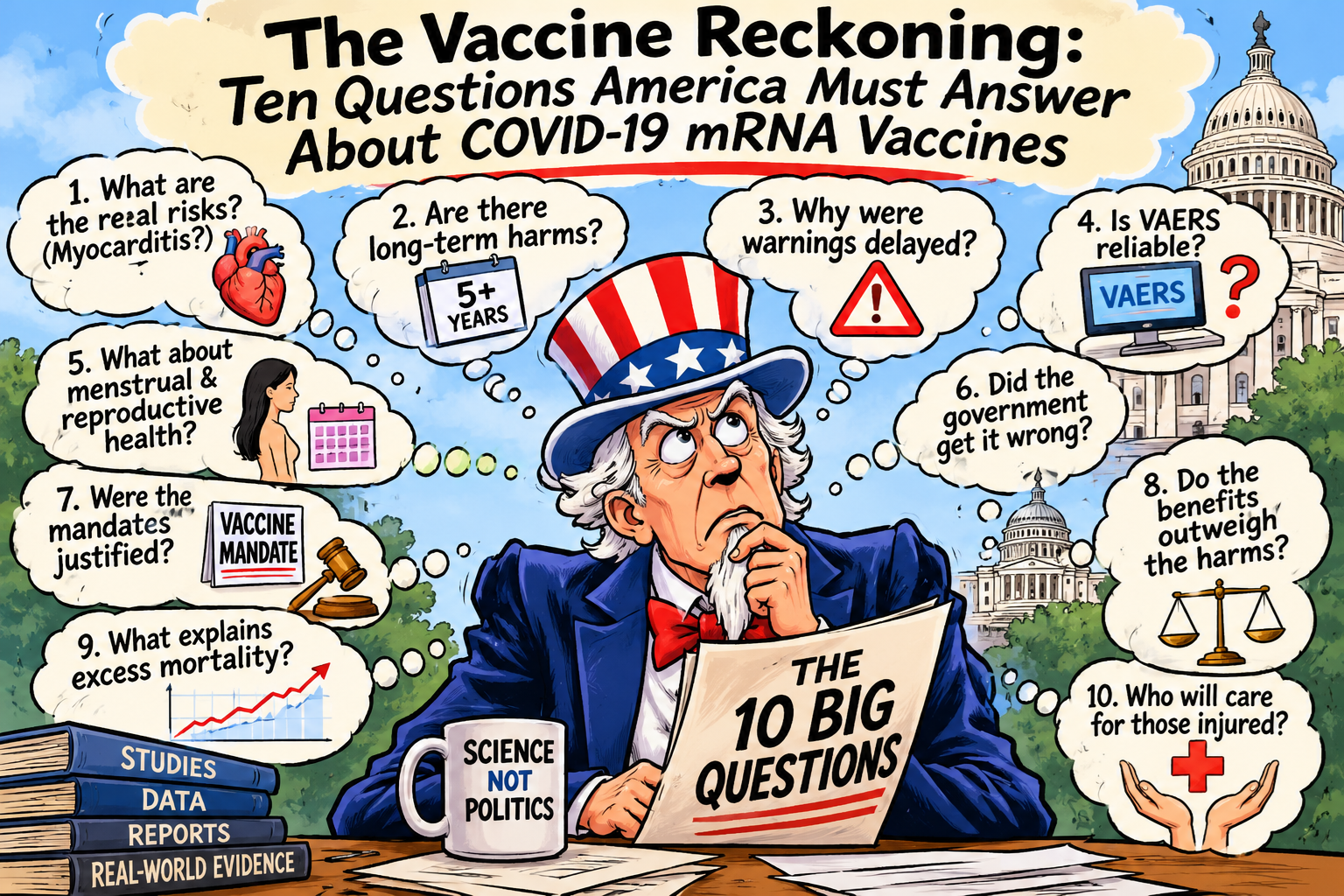
A review of peer-reviewed research, regulatory documents, government surveillance records, investigative journalism, and policy analysis reveals ten recurring themes. They do not carry equal evidentiary weight. Some describe established adverse reactions; others identify gaps in knowledge or institutional performance that require further investigation. Together, however, they expose a larger problem: the United States was better prepared to administer a novel vaccine at extraordinary scale than it was to explain, independently evaluate, and transparently communicate every consequence of doing so.
1. Myocarditis: the adverse effect that could no longer be explained away
The clearest serious safety signal associated with mRNA COVID-19 vaccination is myocarditis, inflammation of the heart muscle, and its related condition, pericarditis. The association is particularly evident among adolescent and young adult males, with risk influenced by age, sex, dose, and vaccine formulation.
The Centers for Disease Control and Prevention and the Food and Drug Administration recognized this association during 2021. Yet the public conversation often reduced the issue to a single adjective: rare. That description, while statistically defensible in a broad population, was insufficiently informative for individuals whose risk was appreciably higher than the population average.
In June 2025, the FDA required updated prescribing information for Pfizer’s Comirnaty and Moderna’s Spikevax. The revised warning estimated approximately eight cases of myocarditis or pericarditis per million doses of the 2023–2024 formulation among individuals aged six months through 64 years, and approximately 27 cases per million doses among males aged 12 through 24, during the first seven days following vaccination. The agency also disclosed that cardiac magnetic resonance imaging abnormalities remained common in a follow-up study of patients diagnosed with vaccine-associated myocarditis approximately five months after vaccination. The long-term prognostic significance of those findings remains unknown.[1]
That last qualification deserves attention. Persistent imaging abnormalities are not synonymous with permanent disability, but neither should they be dismissed as clinically meaningless without adequate longitudinal evidence.
A nationwide French cohort published in JAMA followed 4,635 patients hospitalized with myocarditis, including 558 whose myocarditis occurred within seven days of mRNA vaccination. Over 18 months, patients with post-vaccination myocarditis experienced fewer subsequent cardiovascular complications than patients with conventional myocarditis after statistical standardization. Nevertheless, the investigators concluded that some affected patients required medical management for months after discharge.[2]
The appropriate conclusion is neither alarmism nor reassurance without qualification. Vaccine-associated myocarditis is real; its prognosis is often favorable relative to other forms of myocarditis, but long-term outcomes require continued study.
The unanswered question is why the original public messaging did not more consistently explain the concentration of risk among young males and the need for follow-up after diagnosis.
2. Neurological and immune-mediated conditions: the obligation to investigate without overclaiming
Reports of neurological symptoms following vaccination have included facial paralysis, seizures, neuropathic complaints, inflammatory neurological disorders, and Guillain–Barré syndrome. Some of these conditions have established relationships with particular vaccines, but evidence concerning COVID-19 vaccine products must be evaluated separately rather than treated as a single category.
This distinction matters. A large English self-controlled case-series study found an increased risk of Guillain–Barré syndrome and Bell’s palsy following the first dose of the adenoviral-vector ChAdOx1 vaccine. The same analysis did not establish comparable associations for Pfizer’s mRNA vaccine.[3] It would therefore be misleading to attribute the findings indiscriminately to mRNA products.
Other studies have investigated autoimmune disease following mRNA vaccination, with mixed results. Observational associations require replication, careful control for confounding, and consideration of the possibility that infection itself may influence autoimmune outcomes.
There is also a practical problem that receives less attention than it deserves. Patients with new neurological symptoms may encounter a fragmented diagnostic process in which the temporal relationship to vaccination is either presumed causal or dismissed as coincidental before a complete assessment is undertaken.
A responsible surveillance system must accommodate both possibilities. It must investigate a plausible association without converting every subsequent diagnosis into a vaccine injury.
The research imperative is clear: linked electronic health records, validated diagnostic criteria, longitudinal neurological examinations, and study designs capable of distinguishing new disease from exacerbation of pre-existing illness. Until such evidence is available, claims of widespread mRNA-induced neurological or autoimmune disease should not be presented as established fact.
3. Menstrual and reproductive health: an omission that should have been anticipated
The experience of women exposed an avoidable weakness in the original clinical-trial framework: menstrual health was not systematically incorporated as a prospective outcome.
Reports of changes in menstrual timing and bleeding emerged during the vaccine rollout. Rather than treating these reports as an opportunity for prompt investigation, public discussion frequently characterized them as anecdotal or insufficiently credible.
Subsequent research provided a more measured picture.
A global study published in BMJ Medicine analyzed prospectively collected menstrual-cycle data from 19,622 individuals, including 14,936 vaccinated participants and 4,686 unvaccinated participants. The investigators found a small adjusted increase in menstrual-cycle length following vaccination—less than one day after either of the first two doses for those receiving one dose per cycle. The changes generally resolved by the subsequent cycle. Individuals receiving two doses within one menstrual cycle experienced a larger temporary increase. Menstrual bleeding duration was not affected.[4]
A separate prospective cohort study published in Vaccine found an approximately one-day increase in cycle length after vaccination, with the association attenuating in the subsequent cycle. It found no strong association with cycle regularity, bleeding duration, bleeding heaviness, or menstrual pain.[5]
These findings do not support claims that mRNA vaccines caused widespread infertility or permanent reproductive damage. They do, however, establish that menstrual-cycle changes were a legitimate research question and that the absence of prospective menstrual-health measures in the original trials limited the ability to address public concerns promptly.
The broader lesson extends beyond COVID-19: clinical trials should measure outcomes that matter to patients, not merely those most convenient to regulatory analysis. Menstrual health, sexual function, fertility-related concerns, and other patient-reported outcomes deserve systematic attention in future vaccine development.
4. Long-term injury: the difference between recovery and the absence of residual disease
The duration of follow-up in an initial clinical trial is not necessarily sufficient to characterize rare or delayed adverse outcomes. That limitation is particularly important when an intervention is administered to hundreds of millions of people.
Myocarditis provides a concrete example. The FDA’s 2025 label revision acknowledged persistent cardiac MRI abnormalities in some patients several months after diagnosis, while explicitly stating that their long-term clinical significance was unknown.[1] The French JAMA cohort demonstrated that the subsequent clinical course of hospitalized patients could be followed for 18 months, but it did not settle the question of outcomes over five or ten years.[2]
The distinction between symptomatic recovery and biological recovery is important. A patient may return to work, resume ordinary activities, and experience improvement in symptoms while retaining an imaging abnormality or physiological limitation. Conversely, an abnormal imaging result does not automatically imply a poor prognosis.
The evidence demands neither assumption. It demands measurement.
A national longitudinal research program should follow patients with clinically adjudicated adverse events, including myocarditis, through standardized cardiac imaging, functional assessment, laboratory testing, and clinical outcomes. Comparable programs should be developed for other serious conditions where a credible association has been established or remains under investigation.
The failure to collect sufficiently long follow-up data should not be confused with evidence that no long-term consequences exist. Equally, the absence of definitive long-term evidence cannot be used to claim that permanent injury is widespread.
5. VAERS and the architecture of safety surveillance: when an early-warning system becomes a central controversy
The Vaccine Adverse Event Reporting System, jointly administered by the CDC and FDA, is often invoked in arguments about vaccine injury. Its proper interpretation is essential.
VAERS is a passive reporting system. Reports can be submitted by clinicians, manufacturers, patients, and others. A report following vaccination does not establish that vaccination caused the event. Reports may be incomplete, duplicated, stimulated by publicity, or associated with illnesses that would have occurred independently.
VAERS cannot, by itself, provide a reliable incidence rate or establish causation. Its proper function is to identify potential signals that require evaluation through other methods.
But the limitations of passive surveillance do not diminish the importance of the system. They make the quality of its signal-detection methods, follow-up procedures, and links to active surveillance especially consequential.
In September 2026, The BMJ published an investigation by David Willman reporting that FDA officials had been warned about potential weaknesses in an empirical Bayesian method used to identify vaccine safety signals. The investigation described concerns that the extraordinary volume of COVID-19 vaccine reports could mask signals when one product was compared against a reference population dominated by reports associated with other mRNA products. It further reported that an FDA physician raised concerns and sought changes to the analytical approach.[6]
These are serious allegations, but their status must be stated accurately. An investigative article is not a judicial finding, nor does it independently prove that a specific injury was concealed or that a particular official deliberately suppressed evidence. The claims warrant examination of the underlying correspondence, code, analytical decisions, and agency records.
The CDC’s Vaccine Safety Datalink provides a useful complementary perspective. In a June 2025 presentation, CDC investigators reported eight statistical signals detected through rapid-cycle analyses between 2020 and 2025. These included myocarditis, acute myocardial infarction, immune thrombocytopenic purpura, seizure, Bell’s palsy, venous thromboembolism, ischemic stroke, and Guillain–Barré syndrome. The presentation stated that further investigations, including chart reviews and additional epidemiological analyses, found increased risk for myocarditis but no clear or consistent evidence of a safety concern for the other listed outcomes.[7]
That is precisely how surveillance should work: detect, investigate, validate, and communicate.
The question raised by the 2026 BMJ investigation is whether the systems used to detect signals were sufficiently robust and whether internal warnings were handled appropriately. The answer should be established through independent technical review, not partisan argument.
6. Clinical-trial transparency: public confidence requires reproducible evidence
The speed of vaccine development was extraordinary. The scale of public administration was even more extraordinary. Yet the public’s ability to independently scrutinize the underlying clinical-trial and postmarketing evidence did not always match the magnitude of the intervention.
In 2022, an article in BMJ Evidence-Based Medicine titled “Transparency of COVID-19 vaccine trials: decisions without data” criticized limitations in public access to trial protocols, clinical study reports, and participant-level information. The authors argued that decisions affecting populations on an unprecedented scale required more transparent access to the evidence supporting them.[8]
The issue is not whether every patient’s medical record should be made public. Privacy must be protected. Rather, properly de-identified participant-level data, complete protocols, adverse-event definitions, statistical analysis plans, and regulatory assessments should be accessible to qualified independent researchers under appropriate safeguards.
Transparency also requires a distinction between initial trial results and postauthorization evidence. A vaccine may perform well against severe disease in a trial population while rare adverse effects become apparent only after much broader exposure. That is not necessarily a failure of the trial; it is a reason why postmarketing surveillance exists.
The public should not be asked to choose between trust and scrutiny. Reproducibility is how trust is earned.
7. Risk communication: the cost of speaking with more certainty than the evidence permits
Public-health communication during an emergency is difficult. Evidence changes, variants emerge, and recommendations must sometimes be revised. The problem is not that guidance evolves. The problem arises when uncertainty is presented as certainty and subsequent changes are not explained with sufficient candor.
The myocarditis experience illustrates the difficulty. As evidence accumulated, regulators and public-health agencies recognized a product-associated risk concentrated in particular demographic groups. The FDA’s June 2025 label revision formalized updated estimates and disclosed uncertainty surrounding persistent MRI abnormalities.[1]
Such updates are an appropriate part of scientific governance. But they also invite a legitimate question: could the public have been better informed earlier about the groups at greatest risk, the limitations of the evidence, and the uncertainties surrounding longer-term outcomes?
Trust is damaged when people believe that officials have withheld important qualifications or treated inconvenient questions as illegitimate. It is not restored by dismissing criticism as misinformation without examining its factual basis.
The 2026 BMJ investigation adds a more specific dimension to this issue by reporting that internal concerns about signal detection were raised within the regulatory system.[6] If those concerns are substantiated, the public deserves to know when they were raised, how they were evaluated, and why particular decisions were made.
An honest public-health message should contain three elements: what the evidence demonstrates, what remains uncertain, and what new evidence would change the recommendation. This is not a concession of weakness. It is the discipline that distinguishes science from advocacy.
8. Mandates and passports: when a medical recommendation became a test of citizenship
The debate over vaccine mandates cannot be separated from the changing effectiveness of vaccination against infection and transmission.
Vaccines that reduce the risk of severe disease may still provide substantial public-health value even when their ability to prevent infection or transmission is incomplete or wanes over time. But policies that condition employment, education, travel, or access to public life on vaccination status require a careful assessment of their expected benefits, proportionality, and unintended consequences.
In 2022, Bardosh and colleagues published an analysis in BMJ Global Health examining the potential unintended consequences of mandates, vaccine passports, and differential restrictions. Their framework considered behavioral, legal, socioeconomic, and public-health effects, including polarization, stigma, inequality, and loss of institutional trust.[9]
Their article was a policy analysis, not a definitive empirical demonstration that every mandate caused net harm. Indeed, a subsequent BMJ Global Health commentary challenged aspects of their reasoning and argued that potential unintended consequences must be evaluated rather than assumed.[10] That exchange illustrates the proper role of scientific debate.
The essential question is whether particular mandates were justified by the evidence available at the time and whether they were revised as evidence changed.
Policies that impose substantial restrictions on liberty should not become permanent by administrative inertia. They require periodic reassessment against measurable public-health benefits, alternatives, and the burdens imposed on different populations.
9. Excess mortality: why neither raw death counts nor reassuring averages are sufficient
Few subjects have generated more political heat than claims that COVID-19 vaccination caused widespread excess mortality.
The challenge is methodological. Excess mortality is influenced by infection waves, delayed medical care, demographic changes, cardiovascular disease, substance use, and many other factors. A death occurring after vaccination is not necessarily a death caused by vaccination. Nor does an aggregate decline in mortality among vaccinated people rule out a rare fatal adverse reaction in a susceptible subgroup.
The appropriate evidence must link individual vaccination records with clinical histories and death records, account for age and comorbidity, and examine cause-specific outcomes over time.
A large French nationwide cohort published in JAMA Network Open in December 2025 examined long-term all-cause mortality among adults aged 18–59 according to vaccination status. Its findings did not support an increase in four-year all-cause mortality among vaccinated individuals.[11] The result is important and should be included in any balanced assessment. It does not, however, eliminate the need to investigate specific adverse outcomes or establish that every subgroup experienced identical risks.
This is where public debate has often gone wrong. Raw counts from passive reporting systems have been presented as proof of mass vaccine mortality, while favorable population averages have sometimes been treated as proof that no serious vaccine-related deaths occurred.
Both are errors of inference.
The proper research agenda is cause-specific mortality, stratified by age, sex, product, dose, interval, and relevant medical history, using linked records and independent replication.
10. Accountability, treatment, and compensation: what happens after a suspected injury?
A public-health system’s responsibilities do not end when a vaccination campaign is complete. They extend to the people who experience serious adverse events and need medical evaluation, rehabilitation, long-term follow-up, or compensation.
For patients with a plausible vaccine-associated injury, the practical experience can be bewildering. Symptoms may be complex; diagnostic findings may be equivocal; clinicians may disagree about causation; and the patient may be left navigating a fragmented health system.
The appropriate response is not to presume that every reported condition was caused by vaccination. It is to provide a fair and clinically competent process for evaluating the possibility.
That requires standardized diagnostic criteria, access to specialists, a national registry of clinically adjudicated injuries, transparent reporting of outcomes, and a compensation system that can assess claims consistently.
The distinction between temporal association and causation must be preserved, but it should not become an excuse for refusing to investigate.
There is also a broader institutional responsibility. If regulators identify a safety signal, they should publish the evidence and explain the response. If an analytical method proves inadequate, it should be corrected and the consequences of its use evaluated. If a policy was disproportionate, officials should be prepared to acknowledge that conclusion.
The integrity of public health depends not on the assertion that institutions are infallible, but on their capacity to recognize and correct error.
The larger lesson: scientific credibility is an obligation, not a privilege
The ten themes reveal a complicated record.
The association between mRNA vaccination and myocarditis is established. Menstrual-cycle changes, generally small and temporary in the best-characterized cohorts, have also been documented. Other neurological and immune-mediated outcomes require product-specific, methodologically rigorous evaluation rather than sweeping attribution. Long-term outcomes following certain adverse reactions remain incompletely characterized.
At the institutional level, questions about passive surveillance, statistical signal detection, clinical-trial transparency, public communication, and the proportionality of mandates deserve independent review. The 2026 BMJ investigation makes the question of regulatory signal detection particularly urgent. Its allegations should be tested against the underlying documents and analytical code, not accepted or rejected on political grounds.
The COVID-19 vaccines were developed in response to an extraordinary public-health emergency. Their benefits against severe disease should be recognized. But public-health success cannot be measured solely by doses administered or deaths averted. It must also be measured by the quality of surveillance, the speed with which adverse effects are recognized, the fairness with which injured patients are treated, and the willingness of institutions to disclose uncertainty.
For the COVID-19 Long-haul Foundation, these are not abstract questions. The experience of people living with persistent illness after infection, and of people who report serious symptoms after vaccination, underscores the need for research that is clinically serious, methodologically independent, and free of ideological preconditions.
The task is not to vindicate or condemn a vaccine. It is to establish what happened, to whom, under what circumstances, and with what consequences.
That requires a public-health culture in which a safety concern is neither a political weapon nor a forbidden subject; in which a reassuring study is welcomed but not treated as the final word; and in which every credible signal is investigated with the same rigor, regardless of whether the result is convenient.
The most important lesson of the pandemic may therefore be institutional rather than technological. Scientific credibility is not secured by demanding public trust. It is earned by making the evidence visible, acknowledging the limits of knowledge, correcting mistakes, and treating the people affected by medical decisions with dignity.
America should expect nothing less.
Notes and References
1. U.S. Food and Drug Administration. “FDA Approves Required Updated Warning in Labeling of mRNA COVID-19 Vaccines Regarding Myocarditis and Pericarditis Following Vaccination.” June 25, 2025. The FDA provides the estimated incidence figures, the age- and sex-specific risk description, and the discussion of persistent cardiac MRI findings and their uncertain prognostic significance. FDA official safety communication.
2. Semenzato L, Le Vu S, Botton J, et al. “Long-Term Prognosis of Patients With Myocarditis Attributed to COVID-19 mRNA Vaccination, SARS-CoV-2 Infection, or Conventional Etiologies.” JAMA. 2024;332(16):1367–1377. doi:10.1001/jama.2024.16380. Full article.
3. Patone M, Handunnetthi L, Saatci D, et al. “Neurological complications after first dose of COVID-19 vaccines and SARS-CoV-2 infection.” Nature Medicine. 2021;27:2144–2153. doi:10.1038/s41591-021-01556-7. Article.
4. Edelman A, Boniface ER, Male V, et al. “Association between menstrual cycle length and covid-19 vaccination: global, retrospective cohort study of prospectively collected data.” BMJ Medicine. 2022;1:e000297. doi:10.1136/bmjmed-2022-000297. Full article.
5. Wesselink AK, Lovett SM, Weinberg J, et al. “COVID-19 vaccination and menstrual cycle characteristics: A prospective cohort study.” Vaccine. 2023;41(29):4327–4334. doi:10.1016/j.vaccine.2023.06.012. PubMed record.
6. Willman D. “US officials knew covid vaccine safety system was flawed—but turned aside the FDA doctor who alerted them.” The BMJ. September 16, 2026;394:e100806. doi:10.1136/bmj-2026-100806. This is investigative journalism reporting on internal regulatory concerns; it should not be represented as a peer-reviewed epidemiological study or a final legal finding. BMJ investigation.
7. Centers for Disease Control and Prevention. “Evaluation of Statistical Signals Detected for mRNA COVID-19 Vaccines through VSD’s Rapid Cycle Analyses—2020–2025.” ACIP presentation, June 25–26, 2025. CDC presentation PDF.
8. Doshi P, et al. “Transparency of COVID-19 vaccine trials: decisions without data.” BMJ Evidence-Based Medicine. 2022. BMJ search and article record.
9. Bardosh K, de Figueiredo A, Gur-Arie R, et al. “The unintended consequences of COVID-19 vaccine policy: why mandates, passports and restrictions may cause more harm than good.” BMJ Global Health. 2022;7:e008684. doi:10.1136/bmjgh-2022-008684. Full article.
10. Smith MJ. “Evaluating potential unintended consequences of COVID-19 vaccine mandates and passports.” BMJ Global Health. 2022;7:e009759. doi:10.1136/bmjgh-2022-009759. Full article.
11. “COVID-19 mRNA Vaccination and 4-Year All-Cause Mortality Among Adults Aged 18 to 59 Years in France.” JAMA Network Open. 2025. Article record and study details.
Editorial and evidentiary note: This manuscript is an evidence-informed narrative review, not a registered systematic review.