
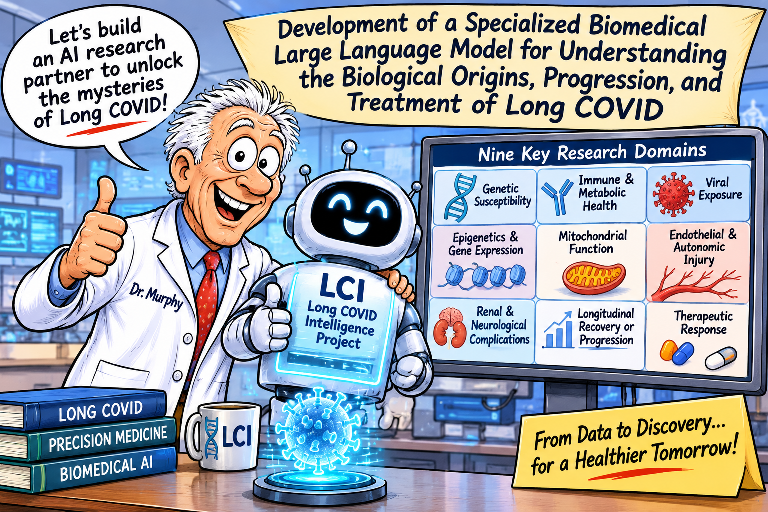
Development of a Specialized Biomedical Large Language Model for Understanding the Biological Origins, Progression, and Treatment of Long COVID
John Murphy, President & CEO, The COVID-19 Long-haul Foundation
Biomedical AI / Precision Medicine
1. Executive vision
A specialized biomedical artificial intelligence system designed to investigate Long COVID across the entire biological continuum—from genetic susceptibility before infection through acute SARS-CoV-2 exposure, molecular injury, clinical manifestations, disease progression, and eventual recovery or therapeutic response.
The system will go substantially beyond a conventional Large Language Model (LLM).
It will combine a domain-trained or domain-adapted language model with a continuously updated scientific knowledge repository, longitudinal clinical databases, genomic and molecular datasets, statistical modeling, and specialized machine-learning applications.
Its purpose would be to help researchers answer a fundamental question:
Why does SARS-CoV-2 produce complete recovery in some individuals, prolonged multisystem illness in others, and progressive or persistent organ dysfunction in still others?
The system will investigate this question through nine interconnected biological domains.
The proposed name is:
LONG COVID INTELLIGENCE
LCI Research Platform
The COVID-19 Long-haul Foundation
From genetic susceptibility to biological injury, disease progression, and precision therapeutics.
This should be conceived as a research intelligence platform, not simply a chatbot that answers questions about Long COVID.
2. The nine biological research domains
The architecture should follow the biological progression of disease.
Domain 1 — Pre-infection genetic susceptibility
Identify inherited genetic variants associated with susceptibility to infection, severe acute disease, immune dysregulation, and persistent post-infectious complications.
Research: genome-wide association studies, HLA variation, interferon signaling, immune regulation, ACE2-related pathways, and polygenic risk.
Domain 2 — Baseline immune and metabolic characteristics
Characterize pre-existing immune status, metabolic health, inflammatory profiles, insulin resistance, obesity, cardiovascular risk, and renal function.
Research: cytokines, T-cell and B-cell populations, autoantibodies, metabolic biomarkers, and baseline organ function.
Domain 3 — Acute infection and viral exposure
Examine infection severity, viral load, duration of viral replication, reinfection, vaccination history, and acute inflammatory response.
Research: viral sequencing, viral persistence, antigen detection, acute clinical records, and exposure characteristics.
Placental Epigenome Impacts Fetal Development: Effects of Maternal Nutrients and Gut Microbiota
Domain 4 — Epigenetic and transcriptional changes
Investigate changes in gene expression and regulation following infection.
Research: DNA methylation, chromatin accessibility, histone modifications, RNA sequencing, microRNAs, and single-cell transcriptomics.
Mitochondria Diagram | Labeled & Unlabeled Free – ConceptViz
Domain 5 — Mitochondrial dysfunction
Investigate impaired cellular energy production, oxidative stress, altered mitochondrial dynamics, and metabolic abnormalities.
Research: oxidative phosphorylation, mitochondrial DNA, ATP production, reactive oxygen species, and metabolomics.
Domain 6 — Endothelial and autonomic injury
Examine vascular dysfunction, microcirculatory abnormalities, dysautonomia, POTS, orthostatic hypotension, and impaired cerebral perfusion.
Research: endothelial biomarkers, vascular reactivity, autonomic testing, baroreflex function, and small-fiber neuropathy.
Why High Blood Pressure Damages Your Body | Authentic Reviews
Domain 7 — Renal and neurological complications
Investigate acute kidney injury, chronic kidney disease, neuroinflammation, neuropathy, cognitive impairment, cerebrovascular abnormalities, and neuromuscular complications.
Research: eGFR trajectories, albuminuria, imaging, neurological examinations, cognitive testing, and clinical outcomes.
Domain 8 — Longitudinal recovery and disease progression
Establish how biological and clinical abnormalities evolve over months and years.
Research: repeated laboratory measurements, symptom trajectories, functional outcomes, organ recovery, and disease phenotypes.
SunforestX Therapeutics | Personalised therapy for rare congenital disease
Domain 9 — Therapeutic response
Determine which treatments benefit which biological subgroups, which interventions fail, and which biomarkers predict treatment response.
Research: comparative effectiveness, clinical trials, treatment safety, pharmacogenomics, and causal inference.
3. The technical architecture: What we actually are building
This is the most important design decision.
We will not be training an entirely new LLM from scratch. That would be extraordinarily expensive, require enormous computational resources, and duplicate much of the language capability already available in existing models.
Instead, the Foundation will construct a hybrid biomedical AI architecture consisting of six components.
Component A — The language model
The LLM provides the conversational and scientific reasoning interface.
Its responsibilities include:
- Understanding complex biomedical questions.
- Reading and interpreting scientific publications.
- Explaining biological mechanisms.
- Comparing competing hypotheses.
- Generating research protocols.
- Synthesizing results from multiple research domains.
- Producing scientific reports and manuscripts.
The underlying model could be an existing capable general-purpose model adapted for biomedical research through domain-specific instructions, evaluation, and possibly fine-tuning.
The model will become the interface to the scientific evidence and analytical systems.
Component B — Scientific literature repository
This will be the system’s scientific knowledge base.
The Foundation model for ingesting and indexing:
| Source | Purpose |
|---|---|
| PubMed / MEDLINE | Peer-reviewed biomedical literature |
| PubMed Central | Full-text open-access publications |
| ClinicalTrials.gov | Clinical trials and interventions |
| NIH RePORTER | Federally funded research |
| WHO | International clinical and epidemiological research |
| CDC | Surveillance and population data |
| FDA | Safety information and regulatory evidence |
| GEO | Gene Expression Omnibus molecular datasets |
| SRA | Sequence Read Archive |
| ENCODE | Gene regulation and epigenomics |
| GWAS Catalog | Genetic association studies |
| dbGaP | Controlled-access genomic research |
The Foundation’s existing library of more than 3,000 resources provides an important initial collection.
Each publication is indexed by:
- Biological domain.
- Disease phenotype.
- Study population.
- Study design.
- Sample size.
- Biomarkers.
- Genes and pathways.
- Clinical outcomes.
- Treatment interventions.
- Strength and limitations of evidence.
This allows the system to answer not simply what has been published, but what the accumulated research actually demonstrates.
Component C — Longitudinal biomedical database
This is the most valuable component for the Foundation’s original research.
The LLM is built upon structured data, not just scientific publications.
The Foundation will establish a relational research database with nine major data domains and a common patient-level research identifier.
Proposed database organization
| Database | Principal contents |
|---|---|
| LCI-01 | Genomics |
| LCI-02 | Baseline immune and metabolic status |
| LCI-03 | Acute infection and viral exposure |
| LCI-04 | Epigenomics and transcriptomics |
| LCI-05 | Mitochondrial and metabolic function |
| LCI-06 | Endothelial and autonomic function |
| LCI-07 | Renal and neurological outcomes |
| LCI-08 | Longitudinal clinical trajectories |
| LCI-09 | Therapeutic exposure and outcomes |
A critical requirement is temporal organization.
Every measurement must be associated with its collection date, biological context, assay methodology, units, and relationship to the infection timeline.
For example, a creatinine measurement taken before COVID-19 must be distinguishable from one taken during acute infection and one taken 18 months afterward.
Without this temporal structure, the system may confuse pre-existing disease with post-infectious injury.
Component D — Biomedical knowledge graph
This is where the system becomes particularly interesting.
A conventional database stores information.
A knowledge graph connects information.
Consider a hypothetical chain of biological relationships:
#chatgpt-mermaid-_r_v8_{font-family:-apple-system-body,ui-sans-serif,-apple-system,system-ui,”Segoe UI”,Helvetica,”Apple Color Emoji”,Arial,sans-serif,”Segoe UI Emoji”,”Segoe UI Symbol”;font-size:16px;fill:rgb(237, 237, 237);}@keyframes edge-animation-frame{from{stroke-dashoffset:0;}}@keyframes dash{to{stroke-dashoffset:0;}}#chatgpt-mermaid-_r_v8_ .edge-animation-slow{stroke-dasharray:9,5!important;stroke-dashoffset:900;animation:dash 50s linear infinite;stroke-linecap:round;}#chatgpt-mermaid-_r_v8_ .edge-animation-fast{stroke-dasharray:9,5!important;stroke-dashoffset:900;animation:dash 20s linear infinite;stroke-linecap:round;}#chatgpt-mermaid-_r_v8_ .error-icon{fill:rgb(48, 48, 48);}#chatgpt-mermaid-_r_v8_ .error-text{fill:rgb(237, 237, 237);stroke:rgb(237, 237, 237);}#chatgpt-mermaid-_r_v8_ .edge-thickness-normal{stroke-width:1px;}#chatgpt-mermaid-_r_v8_ .edge-thickness-thick{stroke-width:3.5px;}#chatgpt-mermaid-_r_v8_ .edge-pattern-solid{stroke-dasharray:0;}#chatgpt-mermaid-_r_v8_ .edge-thickness-invisible{stroke-width:0;fill:none;}#chatgpt-mermaid-_r_v8_ .edge-pattern-dashed{stroke-dasharray:3;}#chatgpt-mermaid-_r_v8_ .edge-pattern-dotted{stroke-dasharray:2;}#chatgpt-mermaid-_r_v8_ .marker{fill:rgb(175, 175, 175);stroke:rgb(175, 175, 175);}#chatgpt-mermaid-_r_v8_ .marker.cross{stroke:rgb(175, 175, 175);}#chatgpt-mermaid-_r_v8_ svg{font-family:-apple-system-body,ui-sans-serif,-apple-system,system-ui,”Segoe UI”,Helvetica,”Apple Color Emoji”,Arial,sans-serif,”Segoe UI Emoji”,”Segoe UI Symbol”;font-size:16px;}#chatgpt-mermaid-_r_v8_ p{margin:0;}#chatgpt-mermaid-_r_v8_ .label{font-family:-apple-system-body,ui-sans-serif,-apple-system,system-ui,”Segoe UI”,Helvetica,”Apple Color Emoji”,Arial,sans-serif,”Segoe UI Emoji”,”Segoe UI Symbol”;color:rgb(237, 237, 237);}#chatgpt-mermaid-_r_v8_ .cluster-label text{fill:rgb(237, 237, 237);}#chatgpt-mermaid-_r_v8_ .cluster-label span{color:rgb(237, 237, 237);}#chatgpt-mermaid-_r_v8_ .cluster-label span p{background-color:transparent;}#chatgpt-mermaid-_r_v8_ .label text,#chatgpt-mermaid-_r_v8_ span{fill:rgb(237, 237, 237);color:rgb(237, 237, 237);}#chatgpt-mermaid-_r_v8_ .node rect,#chatgpt-mermaid-_r_v8_ .node circle,#chatgpt-mermaid-_r_v8_ .node ellipse,#chatgpt-mermaid-_r_v8_ .node polygon,#chatgpt-mermaid-_r_v8_ .node path{fill:rgb(9, 23, 44);stroke:rgb(31, 78, 148);stroke-width:1px;}#chatgpt-mermaid-_r_v8_ .rough-node .label text,#chatgpt-mermaid-_r_v8_ .node .label text,#chatgpt-mermaid-_r_v8_ .image-shape .label,#chatgpt-mermaid-_r_v8_ .icon-shape .label{text-anchor:middle;}#chatgpt-mermaid-_r_v8_ .node .katex path{fill:#000;stroke:#000;stroke-width:1px;}#chatgpt-mermaid-_r_v8_ .rough-node .label,#chatgpt-mermaid-_r_v8_ .node .label,#chatgpt-mermaid-_r_v8_ .image-shape .label,#chatgpt-mermaid-_r_v8_ .icon-shape .label{text-align:center;}#chatgpt-mermaid-_r_v8_ .node.clickable{cursor:pointer;}#chatgpt-mermaid-_r_v8_ .root .anchor path{fill:rgb(175, 175, 175)!important;stroke-width:0;stroke:rgb(175, 175, 175);}#chatgpt-mermaid-_r_v8_ .arrowheadPath{fill:rgb(175, 175, 175);}#chatgpt-mermaid-_r_v8_ .edgePath .path{stroke:rgb(175, 175, 175);stroke-width:1px;}#chatgpt-mermaid-_r_v8_ .flowchart-link{stroke:rgb(175, 175, 175);fill:none;}#chatgpt-mermaid-_r_v8_ .edgeLabel{background-color:rgb(0, 0, 0);text-align:center;}#chatgpt-mermaid-_r_v8_ .edgeLabel p{background-color:rgb(0, 0, 0);}#chatgpt-mermaid-_r_v8_ .edgeLabel rect{opacity:0.5;background-color:rgb(0, 0, 0);fill:rgb(0, 0, 0);}#chatgpt-mermaid-_r_v8_ .labelBkg{background-color:rgba(0, 0, 0, 0.5);}#chatgpt-mermaid-_r_v8_ .cluster rect{fill:rgb(48, 48, 48);stroke:rgba(255, 255, 255, 0.15);stroke-width:1px;}#chatgpt-mermaid-_r_v8_ .cluster text{fill:rgb(237, 237, 237);}#chatgpt-mermaid-_r_v8_ .cluster span{color:rgb(237, 237, 237);}#chatgpt-mermaid-_r_v8_ div.mermaidTooltip{position:absolute;text-align:center;max-width:200px;padding:2px;font-family:-apple-system-body,ui-sans-serif,-apple-system,system-ui,”Segoe UI”,Helvetica,”Apple Color Emoji”,Arial,sans-serif,”Segoe UI Emoji”,”Segoe UI Symbol”;font-size:12px;background:rgb(48, 48, 48);border:1px solid rgba(255, 255, 255, 0.15);border-radius:2px;pointer-events:none;z-index:100;}#chatgpt-mermaid-_r_v8_ .flowchartTitleText{text-anchor:middle;font-size:18px;fill:rgb(237, 237, 237);}#chatgpt-mermaid-_r_v8_ rect.text{fill:none;stroke-width:0;}#chatgpt-mermaid-_r_v8_ .icon-shape,#chatgpt-mermaid-_r_v8_ .image-shape{background-color:rgb(0, 0, 0);text-align:center;}#chatgpt-mermaid-_r_v8_ .icon-shape p,#chatgpt-mermaid-_r_v8_ .image-shape p{background-color:rgb(0, 0, 0);padding:2px;}#chatgpt-mermaid-_r_v8_ .icon-shape .label rect,#chatgpt-mermaid-_r_v8_ .image-shape .label rect{opacity:0.5;background-color:rgb(0, 0, 0);fill:rgb(0, 0, 0);}#chatgpt-mermaid-_r_v8_ .label-icon{display:inline-block;height:1em;overflow:visible;vertical-align:-0.125em;}#chatgpt-mermaid-_r_v8_ .node .label-icon path{fill:currentColor;stroke:revert;stroke-width:revert;}#chatgpt-mermaid-_r_v8_ .node .neo-node{stroke:rgb(31, 78, 148);}#chatgpt-mermaid-_r_v8_ [data-look=”neo”].node rect,#chatgpt-mermaid-_r_v8_ [data-look=”neo”].cluster rect,#chatgpt-mermaid-_r_v8_ [data-look=”neo”].node polygon{stroke:url(#chatgpt-mermaid-_r_v8_-gradient);filter:drop-shadow( 1px 2px 2px rgba(185,185,185,1));}#chatgpt-mermaid-_r_v8_ [data-look=”neo”].swimlane.cluster rect{filter:none;}#chatgpt-mermaid-_r_v8_ [data-look=”neo”].node path{stroke:url(#chatgpt-mermaid-_r_v8_-gradient);stroke-width:1px;}#chatgpt-mermaid-_r_v8_ [data-look=”neo”].node .outer-path{filter:drop-shadow( 1px 2px 2px rgba(185,185,185,1));}#chatgpt-mermaid-_r_v8_ [data-look=”neo”].node .neo-line path{stroke:rgb(31, 78, 148);filter:none;}#chatgpt-mermaid-_r_v8_ [data-look=”neo”].node circle{stroke:url(#chatgpt-mermaid-_r_v8_-gradient);filter:drop-shadow( 1px 2px 2px rgba(185,185,185,1));}#chatgpt-mermaid-_r_v8_ [data-look=”neo”].node circle .state-start{fill:#000000;}#chatgpt-mermaid-_r_v8_ [data-look=”neo”].icon-shape .icon{fill:url(#chatgpt-mermaid-_r_v8_-gradient);filter:drop-shadow( 1px 2px 2px rgba(185,185,185,1));}#chatgpt-mermaid-_r_v8_ [data-look=”neo”].icon-shape .icon-neo path{stroke:url(#chatgpt-mermaid-_r_v8_-gradient);filter:drop-shadow( 1px 2px 2px rgba(185,185,185,1));}#chatgpt-mermaid-_r_v8_ .node text{font-size:14px;font-weight:600;letter-spacing:normal;fill:rgb(153, 206, 255);}#chatgpt-mermaid-_r_v8_ .edgeLabels text{font-size:13px;font-weight:600;letter-spacing:-0.08px;fill:rgb(153, 206, 255);}#chatgpt-mermaid-_r_v8_ .node tspan[font-weight=”normal”],#chatgpt-mermaid-_r_v8_ .edgeLabels tspan[font-weight=”normal”]{font-weight:600;}#chatgpt-mermaid-_r_v8_ .edgeLabel .label rect{opacity:1;rx:13px;ry:13px;fill:rgb(0, 14, 26);stroke:rgb(26, 62, 95);stroke-width:1px;}#chatgpt-mermaid-_r_v8_ .node rect,#chatgpt-mermaid-_r_v8_ .node circle,#chatgpt-mermaid-_r_v8_ .node ellipse,#chatgpt-mermaid-_r_v8_ .node polygon,#chatgpt-mermaid-_r_v8_ .node path{fill:rgb(0, 40, 77);stroke:rgba(255, 255, 255, 0.1);stroke-width:1px;}#chatgpt-mermaid-_r_v8_ .node rect{rx:16px;ry:16px;}#chatgpt-mermaid-_r_v8_ .mermaid-decision .label-container{fill:rgb(0, 14, 26);stroke:rgb(26, 62, 95);stroke-dasharray:2,2;}#chatgpt-mermaid-_r_v8_ .edgePaths .flowchart-link{stroke:rgb(175, 175, 175);stroke-width:1px;stroke-linecap:round;stroke-linejoin:round;}#chatgpt-mermaid-_r_v8_ .marker{fill:rgb(175, 175, 175);stroke:rgb(175, 175, 175);}#chatgpt-mermaid-_r_v8_ :root{–mermaid-font-family:-apple-system-body,ui-sans-serif,-apple-system,system-ui,”Segoe UI”,Helvetica,”Apple Color Emoji”,Arial,sans-serif,”Segoe UI Emoji”,”Segoe UI Symbol”;}SARS-CoV-2 infectionImmune dysregulationAltered gene expressionMitochondrial dysfunctionEndothelial injuryMicrovascular dysfunctionReduced tissue perfusionAutonomic dysfunctionPOTS / Orthostatic intoleranceRenal injuryNeurological manifestationsFunctional impairmentRecovery or persistent disease
This is an illustrative hypothesis map, not an established universal causal pathway.
The knowledge graph would connect:
- Genes to proteins.
- Proteins to biological pathways.
- Pathways to cellular abnormalities.
- Cellular abnormalities to organ dysfunction.
- Organ dysfunction to clinical manifestations.
- Clinical manifestations to treatment responses.
Each relationship will have an evidence record indicating whether it is experimentally established, supported by observational evidence, hypothesized, or contradicted.
This is essential to prevent the AI from presenting speculation as scientific fact.
Component E — Statistical and machine-learning engine
The LLM should not perform every scientific calculation itself.
Dedicated analytical models should handle:
- Genome-wide association analysis.
- Differential gene expression.
- DNA methylation analysis.
- Single-cell RNA sequencing.
- Proteomic and metabolomic analysis.
- Longitudinal trajectory modeling.
- Survival analysis.
- Causal inference.
- Treatment-effect estimation.
- Predictive modeling.
For example, if we want to determine whether a particular inflammatory profile predicts persistent kidney dysfunction, the statistical engine would perform the analysis and report the estimates, confidence intervals, covariates, and limitations.
The LLM will then explain the findings in understandable scientific language.
Component F — Evidence verification and scientific quality control
This component is indispensable.
The system must distinguish among:
- Established scientific facts.
- Replicated research findings.
- Preliminary observational findings.
- Experimental findings.
- Hypotheses.
- Unsubstantiated claims.
Every important scientific assertion should have a traceable source.
The system will also identify conflicting research, publication bias, inadequate sample sizes, and possible confounding.
The Foundation will require it to say insufficient evidence when that is the scientifically correct answer.
4. How the system would actually answer research questions
Consider a question:
Why does one patient develop POTS following COVID-19 while another patient with apparently similar infection recovers completely?
The LCI platform would execute a coordinated investigation.
Example research workflow
Question
Why does post-COVID POTS develop in some patients?
Step 1 — Literature review
Retrieve studies involving post-COVID POTS, autonomic neuropathy, autoantibodies, and endothelial dysfunction.
Step 2 — Genetic analysis
Compare relevant genetic variants and immune-regulatory pathways in affected and unaffected groups.
Step 3 — Molecular analysis
Evaluate transcriptomic, epigenetic, mitochondrial, and immune signatures.
Step 4 — Physiological analysis
Compare orthostatic heart-rate responses, blood pressure, autonomic testing, and vascular measurements.
Step 5 — Longitudinal analysis
Determine which abnormalities preceded infection, appeared afterward, and persisted over time.
Step 6 — Statistical modeling
Identify independent associations, potential mediators, confounders, and candidate predictive biomarkers.
Research output
A biologically informed explanation
Identify candidate mechanisms, quantify the strength of evidence, characterize patient subgroups, and propose experiments to test the findings.
Importantly, the system should not assume that a genetic variant, autoantibody, or inflammatory marker causes POTS merely because it is associated with the condition.
Causal claims would require appropriate experimental or observational evidence.
5. The most important research capability: Patient phenotyping
This should be one of the central functions of the Foundation’s LCI system.
Rather than treating Long COVID as one disease with one clinical presentation, the platform identifies biologically distinct patient subgroups.
For example, it will discover or validate the following research phenotypes:
| Candidate phenotype | Dominant biological features |
|---|---|
| Immune-inflammatory | Persistent immune activation |
| Autonomic-neuropathic | POTS, small-fiber neuropathy, abnormal autonomic testing |
| Mitochondrial-metabolic | Impaired energy metabolism and exercise intolerance |
| Endothelial-microvascular | Vascular dysfunction and impaired perfusion |
| Renal | Persistent or recurrent kidney dysfunction |
| Neuromuscular | Weakness, neuropathy, and neuromuscular abnormalities |
| Multisystem | Overlapping abnormalities across several domains |
These categories are proposed research classifications, not validated diagnostic entities.
A patient could belong to more than one category.
The AI could then examine whether specific combinations of biological abnormalities predict:
- Disease severity.
- Duration of illness.
- Risk of progression.
- Likelihood of recovery.
- Therapeutic response.
This is the foundation of precision medicine.
6. Data acquisition: Where will the information come from?
The Foundation does not have to create all the data itself.
A substantial amount of useful information already exists in public, academic, and government research repositories.
There are three levels of data acquisition.
Level 1 — Public scientific data
These are the initial sources:
- PubMed and PubMed Central.
- NIH RECOVER publications and available datasets.
- CDC COVID surveillance datasets.
- VAERS, with appropriate limitations concerning passive reporting and causality.
- GEO and SRA molecular datasets.
- GWAS Catalog.
- ClinicalTrials.gov.
- UK Biobank publications and appropriately accessible research datasets.
- Published electronic health-record cohort studies.
Level 2 — Controlled-access research data
The next step are applications for access to appropriately governed datasets, including:
- NIH dbGaP genomic datasets.
- RECOVER research datasets subject to applicable access requirements.
- All of Us Research Program data, subject to its access and use requirements.
- Academic medical-center longitudinal clinical records.
- Institutional biobanks and molecular research cohorts.
Level 3 — Foundation research cohort
Eventually, the Foundation will sponsor or coordinate its own longitudinal research cohort.
The ideal cohort would include:
- Individuals with Long COVID.
- Individuals who recovered from COVID-19.
- Appropriate uninfected controls.
- Patients with different Long COVID phenotypes.
- Patients with documented pre-infection medical histories.
Repeated measurements will be especially valuable.
A single blood sample taken two years after infection cannot establish what happened during the acute infection. Historical baseline specimens and longitudinal measurements are therefore particularly important.
A critical issue: Data quality
The platform must not combine incompatible measurements without adjustment.
For example:
- Different laboratories may use different assay platforms.
- Hormone and cytokine concentrations may have different reference ranges.
- Sequencing methods may produce different results.
- Kidney function estimates may use different equations.
- Clinical records may have missing or inaccurate dates.
The data engineering system must standardize units, preserve original measurements, document assay methodology, and record missingness.
It must also distinguish between a measurement that was not performed and a measurement that was performed but produced a negative result.
7. The proposed technical infrastructure
Th Foundation will use established, interoperable technologies rather than commission an entirely new software infrastructure.
| Function | Recommended technology |
|---|---|
| Language model | Existing advanced LLM with biomedical adaptation |
| Literature retrieval | PubMed API, Europe PMC, OpenAlex |
| Document indexing | PostgreSQL and vector search |
| Research database | PostgreSQL |
| Biomedical knowledge graph | Neo4j |
| Data exchange | FHIR and OMOP Common Data Model |
| Genomics | PLINK, Hail, Nextflow |
| Transcriptomics | Scanpy, Seurat |
| Statistical analysis | R and Python |
| Machine learning | PyTorch, scikit-learn |
| Analytical reporting | Jupyter and reproducible pipelines |
| Security | Encryption, role-based access, audit logging |
These are candidate technologies, not mandatory vendor commitments.
The advantage of this approach is that the Foundation will build a modular system. Individual components can therefore be upgraded without rebuilding the entire platform.
Privacy and governance
This system will eventually involve extremely sensitive genomic and medical information.
The Foundation will establish the following safeguards from the beginning:
- De-identification and pseudonymous research identifiers.
- HIPAA-compliant handling where applicable.
- Encryption in transit and at rest.
- Role-based access restrictions.
- Audit trails for every data access.
- Separate storage of identifying information.
- Institutional Review Board oversight where required.
- Appropriate informed consent and data-use agreements.
- Prohibition on using identifiable patient information for general LLM training without appropriate authorization.
A further distinction is important: de-identified genomic information can sometimes remain re-identifiable. Genomic privacy requires special protection.
The Foundation’s existing policy of not collecting or sharing patient-level information should be preserved unless a separately governed research program is established with appropriate consent and oversight.
8. Development roadmap
The Foundation will employ a phased development program rather than attempting to construct the entire system at once.
12-month initial development program
- Months 1–2: Scientific architecture and requirements
- Define the nine research domains.
- Establish scientific advisory oversight.
- Inventory Foundation resources.
- Develop the evidence classification system.
- Select the initial LLM and infrastructure.Deliverable: LCI blueprint
- Months 3–4: Scientific knowledge repository
- Index Foundation publications.
- Connect PubMed and other research sources.
- Extract genes, biomarkers, pathways, and outcomes.
- Build searchable scientific evidence records.Deliverable: Research knowledge engine
- Months 5–6: Biomedical database and knowledge graph
- Establish the nine data domains.
- Create common data definitions.
- Build biological relationship maps.
- Integrate available public datasets.Deliverable: Biomedical data infrastructure
- Months 7–8: Analytical capabilities
- Add genomic and transcriptomic analysis pipelines.
- Develop longitudinal statistical models.
- Incorporate immune and metabolic data.
- Establish phenotype classification methods.Deliverable: Analytical research engine
- Months 9–10: LLM integration
- Connect the LLM to the evidence repository.
- Implement scientific citations.
- Add structured research-question workflows.
- Establish hallucination and accuracy testing.Deliverable: LCI research assistant
- Months 11–12: Validation and pilot research
- Test against known scientific findings.
- Evaluate conflicting evidence.
- Conduct retrospective pilot analyses.
- Prepare initial research publications.Deliverable: LCI pilot release
9. Initial research projects to demonstrate the system
Rather than launch with all nine domains simultaneously, the Foundation proposes three initial demonstration projects.
Project A — Immune and mitochondrial dysfunction in Long COVID
Examine the relationships among persistent immune activation, mitochondrial dysfunction, oxidative stress, and post-exertional malaise.
Key question: Can molecular signatures identify patients with persistent metabolic impairment?
Thread by @EricTopol on Thread Reader App – Thread Reader App
Project B — Autonomic and endothelial dysfunction
Examine POTS, orthostatic hypotension, small-fiber neuropathy, vascular dysfunction, and cerebral perfusion.
Key question: Are there distinct post-COVID autonomic phenotypes with different underlying mechanisms?
Focal Segmental Glomerulosclerosis (FSGS) | National Kidney Foundation
Project C — Renal injury and recovery following COVID-19
Examine acute kidney injury, persistent reduction in eGFR, proteinuria, inflammatory markers, and longitudinal renal recovery.
Key question: Which pre-infection and post-infection characteristics predict persistent kidney dysfunction?
These projects will test whether the platform can integrate multiple scientific disciplines and generate reproducible research findings.
10. How we measure success
The project will not be evaluated merely by how impressive its answers sound.
It will be evaluated by scientific performance.
For this to occur the Foundation will establish the following metrics:
| Performance measure | Objective |
|---|---|
| Citation accuracy | Every important research claim traceable to its source |
| Evidence fidelity | Correct distinction between association and causation |
| Literature coverage | Relevant studies retrieved across all nine domains |
| Data integrity | Reproducible and traceable data transformations |
| Analytical reproducibility | Independent replication of statistical results |
| Phenotype validity | Independent validation of proposed patient subgroups |
| Predictive performance | External validation of risk and outcome models |
| Research productivity | Peer-reviewed publications and testable hypotheses |
One particularly important requirement: the system must be tested against scientific questions for which the answers are already established, as well as questions for which the scientific answer remains unknown.
It must demonstrate that it knows the difference.
11. Organizational structure and funding
The Foundation recommend establishing LCI as a separate Foundation research initiative, with academic collaborators responsible for specialized scientific and computational work.
The proposed team would include:
- Scientific Director: Biomedical research strategy and scientific oversight.
- AI/LLM Architect: Model selection, integration, and evaluation.
- Bioinformatics Director: Genomic, transcriptomic, and molecular data.
- Clinical Research Director: Phenotyping and clinical validation.
- Data Engineering Lead: Databases, interoperability, and security.
- Biostatistician: Epidemiology, longitudinal analysis, and causal inference.
- Scientific Advisory Board: Independent experts in immunology, neurology, nephrology, genetics, endocrinology, and infectious disease.
Academic partnerships with institutions such as Emory University, The University of Georgia, Columbia, Mt. Sinai and other biomedical research centers could provide access to specialized expertise and research infrastructure.
Preliminary funding framework
These are planning estimates, not vendor quotations.
| Development component | Preliminary budget |
|---|---|
| Architecture and project management | $140,000 |
| Scientific literature repository | $85,000 |
| Database and knowledge graph | $265,000 |
| LLM integration and development | $365,000 |
| Genomic and analytical pipelines | $275,000 |
| Validation and pilot research | $370,000 |
| Security and infrastructure | $225,000 |
| Total | $1,725,000 |
This will support a lean initial development program using existing models, public datasets, and contracted specialist expertise. It would not finance a large prospective patient cohort, extensive genomic sequencing, or a new foundational LLM trained from scratch.
A larger second phase could support academic research partnerships, controlled-access datasets, and prospective clinical investigations.
12. The ultimate objective: A Long COVID biological intelligence system
The Hormonal Blueprint | LongevityPlan Articles
The most important opportunity is to develop something that does not currently exist as an integrated, validated research resource: a system that connects the entire biological progression of Long COVID.
The Foundation already has a substantial scientific resource collection. The proposed platform would turn that collection into an interactive research intelligence capability rather than simply another searchable library.
It will allow researchers to ask questions such as:
- Which genetic characteristics are associated with persistent Long COVID?
- Which immune abnormalities precede or accompany mitochondrial dysfunction?
- Does endothelial injury contribute to autonomic dysfunction?
- Which molecular signatures distinguish patients who recover from those with persistent illness?
- Why do some patients develop renal complications?
- Can genomic and molecular profiles predict therapeutic response?
- Are there identifiable biological subgroups that require different treatments?
Ultimately, it will help move Long COVID research from describing symptoms toward identifying biological mechanisms and developing targeted interventions.
13. Recommendation for the Foundation
- Establish the Long COVID Intelligence (LCI) project as a formal Foundation research initiative.
- Build the initial scientific knowledge engine around the Foundation’s existing research collection of more than 3,000 resources.
- Develop a working prototype using three initial research domains: mitochondrial dysfunction, autonomic/endothelial injury, and renal complications.
The first release should be capable of answering complex scientific questions, retrieving original research, displaying supporting evidence, identifying conflicting findings, and generating research hypotheses.
The larger vision is to create an AI research environment that understands Long COVID not as nine separate medical problems, but as an interconnected biological process.
That is the distinction between a conventional medical chatbot and a genuine biomedical research intelligence platform.
14. The next development deliverable
The Foundation has begun with a technical specification and plans to develop an actual working prototype, rather than spend months writing a theoretical proposal.
The first prototype contains:
- A searchable scientific knowledge base.
- A Long COVID-specific LLM research interface.
- The nine-domain biological classification system.
- A genomic and molecular pathway knowledge graph.
- Automatic scientific citations.
- A research-question generator.
- An evidence assessment and hypothesis development module.
Proposed first deliverable
LCI Version 1.0 — Long COVID Research Intelligence
A working demonstration that allows Foundation researchers, Medical Center clinicians and pharmaceutical discovery scientists to enter a scientific question and receive a structured, cited analysis across the nine biological domains.
Recommended starting point
The first version should be a research assistant, not a diagnostic system or a tool that recommends treatments to individual patients. Clinical prediction and treatment-response modeling should follow only after appropriate datasets and independent validation become available.
The Foundation plan is to build this as a reusable biomedical AI architecture. Once developed for Long COVID, the same framework will eventually be adapted to other post-infectious illnesses, autoimmune disorders, neurodegenerative diseases, and chronic multisystem conditions.
The Foundation will thereby establish a research capability with applications well beyond COVID-19.