Abstract
Background: Eye engagement is among the most recognizable abnormalities associated with autism spectrum disorder (ASD), yet the conventional description of autism as a disorder of “poor eye contact” is scientifically incomplete. Contemporary research indicates that the relevant phenotype encompasses a broader system of visual-social engagement that includes spontaneous orientation toward faces, attention to the eyes, gaze following, coordination of gaze with gesture and facial expression, social referencing, initiation and response to joint attention, and the use of gaze to establish reciprocal social interaction. Eye-tracking research has demonstrated group-level differences in these processes from infancy through childhood and adulthood, although findings are heterogeneous and no single gaze metric is sufficiently specific or sensitive to diagnose autism in isolation.[1–5]
Objective: To review the developmental, genetic, neurobiological, clinical, diagnostic, therapeutic, and prognostic literature concerning eye engagement in autistic children, with particular attention to the distinction between simple eye contact and socially meaningful gaze.
Methods: The literature was synthesized from peer-reviewed investigations and systematic reviews addressing autism genetics, neurodevelopment, social visual attention, eye tracking, joint attention, diagnostic assessment, early intervention, naturalistic developmental behavioral interventions, and longitudinal outcome. Particular emphasis was placed on contemporary eye-tracking studies and recent systematic reviews and meta-analyses. The resulting synthesis is interpretive rather than a formal PRISMA systematic review.
Results: Autism is genetically heterogeneous and biologically multifactorial. Hundreds of susceptibility genes and genomic variants converge upon pathways involving chromatin remodeling, transcriptional regulation, neuronal differentiation, synaptic development and plasticity, intracellular signaling, and excitation–inhibition balance.[6–10] These biological perturbations appear to influence distributed neural systems involved in social perception and orienting, including the amygdala, superior temporal sulcus, temporal and fusiform cortices, medial prefrontal networks, posterior parietal systems, and broader salience and reward networks. Eye engagement therefore represents an emergent behavioral phenotype rather than a single-gene or single-circuit disorder.
Eye-tracking studies generally demonstrate atypical allocation of visual attention to social information in autistic children, but the simplistic hypothesis that autism universally causes avoidance of eyes is unsupported. Context, developmental stage, cognitive load, language ability, sensory characteristics, anxiety, stimulus complexity, and individual phenotype substantially modify gaze behavior.[1,2] Recent multisite research involving 475 children aged 16–30 months found that an eye-tracking measure of social visual engagement achieved 71.0% sensitivity and 80.7% specificity against expert clinical diagnosis, illustrating substantial promise while also demonstrating why eye tracking cannot yet replace comprehensive clinical assessment.[3]
Joint attention may be more clinically informative than eye contact alone. The capacity to coordinate attention among oneself, another person, and an external object or event—especially to initiate shared attention—constitutes a fundamental component of social communication. Intervention studies indicate that joint-attention and naturalistic developmental behavioral interventions can improve social communication, although effects vary and the evidence base remains heterogeneous.[11–16]
Conclusions: Eye engagement should be conceptualized as a multidimensional developmental phenotype of social attention rather than as an isolated deficit in eye contact. Its clinical significance lies in the manner in which gaze is integrated with affect, gesture, language, reciprocity, and shared intentionality. Early recognition of atypical social visual engagement may facilitate earlier autism evaluation and intervention, but forced eye contact is neither an appropriate therapeutic endpoint nor a valid surrogate for social competence. The most promising future approach is likely to combine quantitative gaze measures with developmental history, behavioral observation, genetic information, language assessment, sensory profiling, and longitudinal measures of adaptive functioning.
Keywords: autism spectrum disorder; autism; eye engagement; eye contact; social gaze; joint attention; eye tracking; visual attention; social communication; genomics; neurodevelopment; early intervention; prognosis.
1. Introduction
Few behaviors are as immediately associated with autism as atypical eye contact. Parents, pediatricians, teachers, and clinicians may describe a young child as “not looking at people,” “looking through people,” “avoiding eye contact,” or “not looking when spoken to.” Such observations can be important early clues, but they are insufficiently precise to describe the underlying phenomenon.
The central problem is semantic as much as clinical. Eye contact implies a relatively simple event: two individuals look into each other’s eyes. Eye engagement, by contrast, describes a dynamic process in which visual attention is integrated with social cognition, emotional signaling, communication, anticipation, shared attention, and reciprocal interaction.
A child may therefore have little conventional eye contact while nevertheless demonstrating considerable social engagement. Conversely, a child may look directly into another person’s eyes while having substantial impairment in reciprocal social communication. The distinction is clinically consequential.
Autism spectrum disorder is defined not by an isolated abnormality of gaze but by persistent differences in social communication and social interaction accompanied by restricted or repetitive behaviors or interests.[17] Abnormalities of eye contact fall within the broader domain of nonverbal social communication.[17,18] Current diagnostic standards explicitly recognize abnormalities of eye contact and body language but require assessment of the entire developmental phenotype.
Modern research consequently treats gaze as one component of a larger social-attentional system. Eye tracking has made it possible to quantify where children look, when they look, how long they remain fixated, whether they follow another person’s gaze, and whether they alternate gaze between a social partner and an object. These measurements have transformed the field from subjective descriptions of “poor eye contact” toward quantitative study of social visual engagement.
Yet this progress has also revealed the complexity of the phenotype. A major review of eye-tracking studies concluded that neither a generalized failure of social orienting nor a universal excess of attention to mouths with diminished attention to eyes adequately explains autism.[1] Rather, gaze behavior varies according to context, developmental age, task demands, stimulus characteristics, language, symptom severity, and individual neurobiology.
The objective of this article is therefore not to defend the proposition that autistic children simply “avoid eye contact.” It is to examine the substantially more sophisticated proposition that autism can alter the development and deployment of visual mechanisms through which children engage other people socially.
2. Defining Eye Engagement
2.1 Eye contact
Eye contact is the mutual alignment of gaze between two individuals. In ordinary social interaction it communicates attention, availability, recognition, emotional connection, turn-taking, and conversational coordination.
In autism, eye contact may be:
- reduced in frequency;
- unusually brief;
- delayed;
- poorly synchronized with speech;
- more apparent when the child is requesting something;
- less apparent during spontaneous social sharing;
- difficult to maintain while speaking;
- uncomfortable or distracting;
- absent in situations in which social gaze would ordinarily be expected.
These observations are clinically meaningful but nonspecific.
2.2 Social gaze
Social gaze is broader. It refers to visual attention directed toward socially informative stimuli, including faces, eyes, gestures, body movement, and interpersonal interactions.
A child who watches two adults interacting may be displaying social gaze even without making eye contact with either adult.
2.3 Joint attention
Joint attention is the coordinated sharing of attention between individuals concerning an object, event, or activity.
Consider the following sequence:
A child sees an airplane, looks at the airplane, looks at the parent, points toward the airplane, and then looks back at the airplane.
The child is not merely observing an airplane. The child is communicating:
“I want you to know what I am seeing.”
This is a profound developmental achievement because it involves an understanding that another person possesses an independent attentional state that can be coordinated with one’s own.
Joint attention is frequently divided into responding to joint attention (RJA) and initiating joint attention (IJA). RJA occurs when a child follows another person’s gaze or pointing. IJA occurs when the child deliberately directs another person’s attention toward an object or event.
The distinction is important. A child may learn to follow pointing through relatively explicit instruction yet continue to have difficulty spontaneously sharing experiences.
A substantial literature identifies joint attention as an important developmental feature of autism and a predictor of later language and social communication.[11,12]
3. Development of Social Visual Engagement
Human infants are not born with the mature social-cognitive system used by older children. Social visual engagement develops progressively.
During infancy, children increasingly orient toward:
- human faces;
- eyes and facial expressions;
- biological motion;
- voices paired with faces;
- caregivers’ emotional expressions;
- gestures and pointing;
- gaze direction;
- socially meaningful objects and events.
The developmental sequence is not simply visual. It represents the gradual integration of perception, attention, affect, memory, learning, and social motivation.
A normally developing toddler may observe a novel object and then look toward a caregiver to determine whether the caregiver considers the object safe, interesting, amusing, or frightening. This process, termed social referencing, converts another person’s emotional state into information about the environment.
Autistic children may show differences in this process.
The most important point, however, is that these differences are probabilistic rather than absolute. Some autistic children exhibit strikingly reduced social visual attention; others show near-typical gaze patterns in particular circumstances; still others demonstrate unusual but not simply diminished patterns of gaze.
A recent meta-analysis of eye-tracking studies reported group-level reductions in social fixation and atypical gaze-following patterns among children later diagnosed with autism, while also emphasizing substantial methodological heterogeneity.[4]
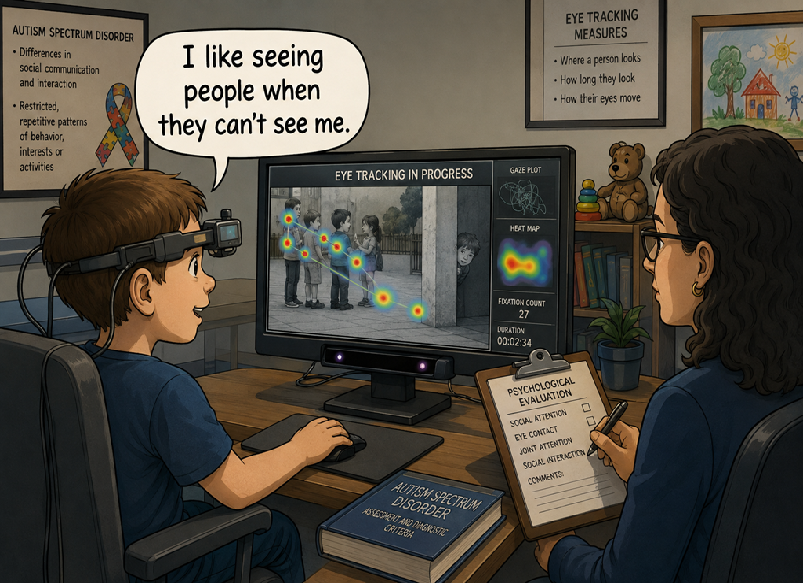
4. Eye Tracking and the Quantification of Eye Engagement
Eye tracking uses infrared or related optical methods to measure gaze position and movement.
Common variables include:
Fixation duration
How long the child remains focused on a defined region.
Fixation frequency
How often a region is visually sampled.
Saccades
Rapid movements of the eyes between fixation points.
Latency to orient
The time required to shift attention toward a social stimulus.
Disengagement
The ability to shift attention away from one stimulus toward another.
Scan paths
The sequence through which the child visually explores a scene.
Gaze alternation
The frequency with which the child shifts gaze between two social or social-object targets.
Area of interest
A predefined region such as the eyes, mouth, face, hands, or object.
These measurements permit experimental questions that would be impossible to answer reliably through ordinary observation.
For example:
Does an autistic toddler look at a mother’s eyes less frequently?
is different from:
Does an autistic toddler look at the mother’s eyes less frequently when she is speaking, but normally when she is displaying an emotionally salient expression?
The second question reveals the importance of context.
5. What Eye-Tracking Studies Actually Show
Early literature frequently described autism as involving diminished attention to eyes and faces. Subsequent research has complicated that conclusion.
A major review by Guillon and colleagues found that the literature did not support a generalized deficit in social orienting or a universal preference for mouths over eyes.[1] Instead, gaze abnormalities depended heavily on context and developmental stage.
This is an important correction.
The autistic phenotype is not adequately described as:
“eyes are aversive.”
Rather, one may observe:
altered allocation of visual attention to socially informative signals.
This may include difficulty extracting the meaning of gaze direction, coordinating gaze with gesture, integrating facial expression with speech, or determining where another person is attending.
The distinction between looking at eyes and understanding what eyes communicate is therefore fundamental.
6. Gaze Following
Gaze following requires the child to recognize that another individual’s gaze provides information about the external world.
A parent looks toward a toy. The child follows the parent’s gaze.
In ordinary development, gaze following becomes increasingly sophisticated and eventually supports shared attention and social learning.
Autistic children may exhibit reduced or atypical gaze following. However, the abnormality is not necessarily a failure of visual perception. Rather, the child may process another person’s gaze direction differently or assign less social significance to it.
Recent work using eye-tracking joint-attention paradigms suggests that atypical gaze-following and gaze alternation can be detected in young autistic children, although effects vary by task and age.[2,4]
7. The Central Importance of Initiating Joint Attention
Among the most informative behaviors is spontaneous initiation of joint attention.
Imagine two children observing a bird.
Child A points to the bird, looks at the parent, smiles, and returns gaze to the bird.
Child B silently watches the bird.
Both children have visually attended to the same object.
But Child A has transformed perception into shared intentionality.
This distinction may be particularly important in autism.
The child with autism may be highly interested in the bird but fail to spontaneously communicate the experience to another person.
That does not imply emotional indifference. It means that the mechanism by which private perception becomes socially shared may develop differently.
The literature on joint attention has consequently become one of the most important bridges between eye-tracking research and clinical developmental psychology.
8. Eye Engagement and Language Development
The relationship between gaze and language is bidirectional.
Children learn language partly by observing where caregivers look, what they point toward, what they name, and how their facial expressions correspond to events.
Joint attention therefore creates a platform for language learning.
If the parent looks at a dog and says:
“Dog!”
while the child is looking at the same dog, the linguistic label is anchored to a shared perceptual reference.
A child who does not reliably coordinate attention with caregivers may receive fewer naturally synchronized opportunities for this type of language learning.
Joint attention is consequently associated with later language development in autism and related developmental conditions.[12,19]
This does not mean that poor eye contact causes language delay. Rather, atypical social attention, language development, and social learning may influence one another in a developmental cascade.
9. Neurobiology of Eye Engagement
Eye engagement is generated by a distributed neural system rather than a single “eye-contact center.”
Important structures include:
- superior temporal sulcus;
- fusiform cortex;
- amygdala;
- medial prefrontal cortex;
- orbitofrontal cortex;
- anterior cingulate cortex;
- temporoparietal junction;
- posterior parietal cortex;
- hippocampal and memory systems;
- basal ganglia;
- thalamic systems;
- neuromodulatory systems involving dopamine, serotonin, oxytocin, and related pathways.
These structures participate in partially overlapping networks concerned with face perception, biological motion, gaze direction, emotional significance, reward, salience, prediction, and social cognition.
Modern neuroimaging literature suggests that autism is associated with altered structural and functional organization of several of these systems, but there is no single neuropathological lesion that defines autism.[20,21]
10. The Amygdala
The amygdala is central to emotional salience and social relevance.
It contributes to the interpretation of facial expressions, gaze, threat, novelty, and emotionally significant stimuli.
Some autism studies have reported altered amygdala structure or activation, although findings have varied substantially by age, methodology, and phenotype.
A simplistic interpretation would be:
autism = amygdala dysfunction = avoidance of eye contact.
That model is inadequate.
The amygdala interacts with cortical networks and sensory systems. Atypical amygdala responses may influence the perceived salience of social stimuli without necessarily producing a fixed aversion to eyes.
The more plausible contemporary model is that atypical social salience can influence the developmental trajectory of visual attention, learning, and social motivation.
11. Superior Temporal Sulcus and Gaze Interpretation
The superior temporal sulcus (STS) is especially important because it responds to socially meaningful biological signals.
These include:
- gaze direction;
- facial movement;
- mouth movement;
- biological motion;
- gestures;
- interpersonal action.
A child must determine not merely that someone is looking but what the gaze means.
If a father looks toward a door, the child may infer:
“Dad heard something.”
If he looks toward a toy:
“Dad wants me to see it.”
If he looks toward the child’s face with a smile:
“Dad is engaging with me.”
These interpretations involve integrating gaze with context.
Differences in STS and related networks have therefore been investigated as possible contributors to atypical social perception in autism.[20,21]
12. Face Processing
The fusiform face area and related temporal regions participate in face processing.
Autistic individuals can recognize faces, often very well, but may process facial information differently.
Importantly:
face recognition ≠ social face processing.
A child can recognize that a person is the mother while failing to use the mother’s facial expression or eye direction to infer her current intentions.
This distinction explains why some autistic children demonstrate competent face recognition while still having substantial difficulty with reciprocal social communication.
13. Reward and Social Motivation
One influential hypothesis proposes that differences in social motivation contribute to atypical social gaze.
In typical development, a caregiver’s face can be highly rewarding.
Smiling, eye contact, vocalization, and reciprocal interaction generate reinforcement.
If social stimuli carry reduced reward value—or if the reward signal is delayed, inconsistent, or overwhelmed by other sensory information—the child may spend less spontaneous attention on people.
Dopaminergic reward circuits are therefore relevant.
However, the “social motivation theory” should not be interpreted as meaning that autistic children do not care about other people.
Many autistic people demonstrate deep attachment, empathy, affection, and concern for others.
The issue is more accurately described as differences in how social information is selected, prioritized, predicted, and rewarded.
14. Sensory Processing and Eye Contact
One of the most clinically important explanations for atypical eye contact is sensory load.
A face contains an enormous amount of information:
- eye movement;
- pupil position;
- facial expression;
- mouth movement;
- voice;
- head movement;
- emotional tone;
- linguistic content.
For some autistic children, looking directly into someone’s eyes may compete with processing spoken language.
Thus a child may look away while listening because looking away makes comprehension easier.
This phenomenon has major implications for therapy.
Forcing eye contact can be counterproductive.
The therapeutic goal should not be to make the child stare into another person’s eyes. The goal should be to increase functional social engagement and communication.
15. Genetics and Genomics
Autism is among the most genetically heterogeneous neurodevelopmental conditions known.
No single gene accounts for autism.
Instead, risk arises through combinations of:
- rare pathogenic variants;
- de novo variants;
- inherited variants;
- copy-number variants;
- common polygenic variants;
- regulatory variants;
- gene–environment interactions.
Large-scale genomic studies have identified hundreds of genes associated with autism or neurodevelopmental phenotypes.[6–10]
A major review concluded that more than 100 genes can confer relatively large autism risk when disrupted, while many additional common variants contribute smaller effects.[6]
Large GWAS investigations have demonstrated polygenic heterogeneity involving neuronal function and corticogenesis.[7]
16. De Novo Mutations
De novo variants are particularly important.
These mutations arise in the child rather than being inherited from either parent.
Genes repeatedly implicated include:
- CHD8
- SCN2A
- SCN1A
- SYNGAP1
- SHANK3
- ADNP
- ARID1B
- DYRK1A
- CTNNB1
- MECP2
- PTEN
These genes do not all perform the same biological function.
Rather, they converge on developmental processes involving chromatin regulation, transcription, neuronal differentiation, synaptic formation, signaling, and network development.[8–10]
17. CHD8 and Social Development
CHD8 is one of the most extensively studied autism-associated genes.
It encodes a chromatin-remodeling protein involved in regulation of gene expression during development.
CHD8 disruption can alter developmental trajectories involving neuronal proliferation, differentiation, and synaptic organization.
The importance of CHD8 is conceptually significant because it demonstrates how an abnormality occurring at the level of chromatin regulation can ultimately produce changes in brain networks involved in social behavior.
Recent work continues to investigate CHD8-associated mechanisms in neurodevelopment and autism.[22]
18. Synaptic Biology
A major convergence point in autism genomics is the synapse.
Genes involving:
- neurexins;
- neuroligins;
- SHANK proteins;
- synaptic scaffolding;
- ion channels;
- intracellular signaling;
- mTOR pathways;
have all been implicated.
A recent review emphasizes synaptic dysfunction and excitation–inhibition regulation as important convergent mechanisms across diverse genetic forms of autism.[23]
This is particularly relevant to eye engagement because social perception depends upon the rapid integration of information across widely distributed neural networks.
A synaptic abnormality need not damage a particular brain region. It may instead alter the timing, gain, synchronization, or plasticity of communication among regions.
19. Copy-Number Variants
Copy-number variants (CNVs) can delete or duplicate stretches of DNA.
Examples associated with autism include abnormalities involving:
- 16p11.2;
- 15q11–q13;
- 22q11.2;
- 1q21.1;
- 7q;
- other genomic regions.
CNVs can affect multiple genes simultaneously and frequently produce phenotypes extending beyond social communication.
This helps explain why autism can coexist with:
- intellectual disability;
- epilepsy;
- motor abnormalities;
- language impairment;
- congenital anomalies;
- psychiatric symptoms.
20. Noncoding Genomic Variation
Autism genetics cannot be reduced to protein-coding mutations.
Whole-genome studies have identified potentially important de novo mutations in noncoding regulatory regions affecting transcription and neuronal development.[24]
This is particularly important because brain development depends upon highly regulated temporal and spatial gene expression.
A mutation need not destroy a protein.
It may instead change:
when, where, and how much of the protein is produced.
Such changes could influence the developmental timing of social brain circuits and therefore indirectly influence eye engagement.
21. Environmental and Prenatal Factors
Genetic susceptibility does not imply genetic determinism.
Multiple prenatal and perinatal factors have been associated with altered autism risk, including certain maternal medical conditions, extreme prematurity, and specific prenatal exposures.
These associations should be interpreted cautiously.
Most are neither necessary nor sufficient to produce autism.
The best current conceptual framework is one in which genetic susceptibility interacts with developmental and environmental influences during critical periods of brain maturation.
Importantly, there is no credible evidence that parental behavior or inadequate affection causes autism.
22. Neuropathology
Autism does not have a single microscopic lesion.
Postmortem studies have described abnormalities involving:
- neuronal density;
- cortical organization;
- dendritic structure;
- synaptic development;
- cerebellar Purkinje cells;
- glial and immune signaling;
- white-matter organization.
Findings have not been sufficiently uniform to constitute a diagnostic neuropathological signature.
Modern neurobiology therefore favors a model of developmental network dysregulation rather than focal structural injury.
Neuroimaging studies similarly report differences in connectivity and activation across social and cognitive networks rather than one universal structural lesion.[20]
23. Excitation–Inhibition Balance
One influential mechanistic hypothesis concerns the balance between excitatory and inhibitory neurotransmission.
Glutamatergic systems generally promote neuronal excitation, while GABAergic systems provide inhibition.
Altered balance may affect:
- sensory processing;
- cortical gain;
- network synchronization;
- attention;
- learning;
- neural plasticity.
This hypothesis is biologically plausible but should not be regarded as a universally established explanation for autism.
Autism is too heterogeneous for a single neurotransmitter model to account for the entire spectrum.
24. Clinical Phenotype
Atypical eye engagement can manifest in several ways.
Reduced spontaneous gaze
The child seldom looks toward people without prompting.
Reduced eye fixation
The child spends less time looking toward eyes or faces.
Reduced gaze alternation
The child does not naturally shift:
object → person → object.
Poor gaze following
The child may not reliably follow another person’s gaze.
Reduced social referencing
The child may not look toward caregivers for emotional information.
Reduced initiation of joint attention
The child rarely points, shows, or looks back to share experiences.
Poor integration
The child may make eye contact but fail to integrate it with:
- gesture;
- facial expression;
- vocalization;
- speech;
- emotional reciprocity.
The last category is particularly important.
25. The Child Who Makes Eye Contact but Still Has Autism
This is frequently misunderstood.
Autism does not require an absence of eye contact.
A child may:
- make excellent eye contact;
- be verbally fluent;
- appear socially interested;
- smile appropriately;
yet have substantial difficulties with:
- reciprocal conversation;
- reading subtle social cues;
- flexible interaction;
- understanding another person’s perspective;
- social inference;
- restricted interests;
- repetitive behavior.
Eye contact is therefore neither necessary nor sufficient for an autism diagnosis.
26. Differential Diagnosis
Atypical eye engagement has a broad differential diagnosis.
26.1 Social communication disorder
Social (pragmatic) communication disorder can produce difficulty with reciprocal communication, conversation, and pragmatic language without the restricted/repetitive behavior required for ASD.[17,25]
A child with isolated pragmatic language difficulty may still use gaze, pointing, showing, gesture, and shared attention relatively effectively.
This distinction can be diagnostically useful.[25]
26.2 Intellectual disability
A child with significant developmental delay may have reduced social communication simply because the child is functioning at a younger developmental level.
Autism requires social-communication deficits that exceed what would be expected from the child’s general developmental level.[17,18]
26.3 Language disorder
Severe receptive or expressive language impairment can produce apparent social disengagement.
A child who cannot understand a question may look away.
A child who cannot express an answer may fail to participate conversationally.
The distinction is whether nonverbal social communication—showing, pointing, gaze coordination, facial expression, imitation, and reciprocal engagement—is also impaired.[25]
26.4 ADHD
Children with ADHD may appear not to attend to speakers.
However, their difficulty may reflect:
- distractibility;
- impulsivity;
- inconsistent sustained attention.
They may nevertheless demonstrate normal social reciprocity and joint attention when adequately engaged.
ADHD can also coexist with autism.[26]
26.5 Anxiety
An anxious child may avoid eye contact because direct gaze is socially threatening.
The history is critical.
In anxiety, the child may demonstrate intact social reciprocity when anxiety is reduced.
26.6 Selective mutism
A child with selective mutism may appear socially withdrawn in certain settings but communicate normally elsewhere.
Eye engagement may vary according to anxiety and environmental context.
26.7 Hearing impairment
Hearing loss must be considered carefully.
A child who does not respond to name or spoken language may have a sensory deficit rather than—or in addition to—autism.
Formal audiological evaluation is therefore essential when there is uncertainty.
26.8 Visual impairment
Visual abnormalities can obviously alter gaze behavior.
A comprehensive developmental assessment should therefore distinguish social visual behavior from visual sensory capacity.
26.9 Reactive attachment and psychosocial disorders
Severe psychosocial deprivation can produce social abnormalities that resemble aspects of autism.
Developmental history is essential.
26.10 Neurological disease
Conditions such as:
- epilepsy;
- cerebral palsy;
- genetic syndromes;
- Rett syndrome;
- Landau–Kleffner syndrome;
- mitochondrial disorders;
may affect communication and gaze.
Clinical guidelines specifically recommend considering these conditions during autism assessment.[18,27]
27. Clinical Assessment
There is no blood test for eye engagement.
There is no MRI that independently diagnoses autism.
There is no eye-tracking measurement that currently substitutes for clinical diagnosis.
Instead, assessment should combine:
- developmental history;
- direct observation;
- caregiver report;
- language assessment;
- cognitive/developmental assessment;
- adaptive-function assessment;
- hearing and vision evaluation;
- behavioral assessment;
- autism-specific standardized instruments;
- genetic evaluation when indicated.
28. Autism Diagnostic Observation
The clinician should observe the child in several conditions.
Unstructured interaction
Does the child spontaneously approach the examiner?
Structured play
Does the child share objects?
Communication opportunity
Does the child point, show, gesture, or seek assistance?
Social reciprocity
Does the child respond to the examiner’s attempts at interaction?
Joint attention
Does the child follow gaze or pointing?
Initiation
Does the child spontaneously attempt to share an experience?
Emotional reciprocity
Does the child smile, laugh, or show affect in response to another person?
These observations are substantially more informative than asking a child to “look at me.”
29. Eye Tracking as a Diagnostic Biomarker
Eye tracking has considerable potential.
A major prospective multisite JAMA study evaluated 475 children aged 16–30 months across six specialty clinics. Social visual engagement measured by eye tracking achieved 71.0% sensitivity and 80.7% specificity relative to expert clinical diagnosis; among children whose diagnosis was considered certain, sensitivity reached 78.0% and specificity 85.4%.[3]
These results are impressive but insufficient for eye tracking to become a stand-alone diagnostic test.
Why?
Because a screening tool must perform well across:
- different ages;
- languages;
- ethnic populations;
- developmental levels;
- intellectual abilities;
- sensory profiles;
- comorbidities;
- clinical settings.
Furthermore, false positives and false negatives have important consequences.
The most defensible current position is:
Eye tracking is a promising adjunctive biomarker, not an autonomous diagnostic test.
30. Eye Tracking in Infancy
Research in infants at elevated familial likelihood has demonstrated atypical gaze patterns before many conventional autism symptoms are fully recognizable.
Such studies have investigated:
- preferential attention to faces;
- attention to eyes;
- disengagement from stimuli;
- gaze following;
- response to biological motion;
- social versus nonsocial stimuli.
A recent meta-analysis found that dynamic and socially relevant eye-tracking paradigms may have value in identifying infants at elevated likelihood of later autism, while emphasizing variability between experimental designs.[12]
The distinction between risk marker and diagnostic marker is essential.
A gaze pattern can increase probability without determining outcome.
31. Why Eye Tracking Cannot Yet Diagnose Autism Alone
The heterogeneity of autism is the central obstacle.
Some autistic children:
- look frequently at eyes;
- enjoy faces;
- show strong social motivation.
Others:
- rarely look toward eyes;
- preferentially attend to objects;
- show profound social-attentional differences.
Still others exhibit context-dependent patterns.
The same child may look at eyes normally in one environment and avoid them in another.
Consequently, the future of eye tracking is likely to involve multimodal phenotyping, combining gaze with:
- speech;
- facial expression;
- gesture;
- movement;
- physiology;
- developmental history;
- genetic information;
- machine learning.
32. Clinical Care
The primary therapeutic objective should be functional communication and social participation, not normalization of eye contact.
A clinician should never assume that an autistic child must be trained to maintain prolonged direct eye contact.
Instead, therapy should increase the child’s ability to:
- notice relevant social cues;
- communicate wants and interests;
- share attention;
- respond to others;
- initiate interactions;
- coordinate gaze and gesture;
- participate in reciprocal activities;
- regulate sensory load;
- understand social meaning.
This distinction is ethically and clinically important.
33. Joint-Attention Therapy
Joint-attention interventions attempt to teach children to:
- follow another person’s gaze;
- follow pointing;
- point themselves;
- show objects;
- coordinate attention;
- share enjoyment;
- alternate gaze between people and objects.
Systematic reviews have found evidence that joint-attention interventions can improve targeted social-communication behaviors, although study quality and generalization vary.[11,13,14]
A 2026 meta-analysis identified 18 randomized controlled trials involving 1,165 young autistic children and specifically examined joint-attention interventions and their effects on joint attention and related outcomes.[14]
34. Naturalistic Developmental Behavioral Interventions
Naturalistic developmental behavioral interventions (NDBIs) are particularly relevant to eye engagement because they teach social communication in ordinary activities rather than artificial drill-based environments.
Examples include:
- Early Start Denver Model;
- Pivotal Response Treatment;
- JASPER;
- Enhanced Milieu Teaching;
- SCERTS;
- related parent-mediated developmental approaches.
The common principle is that intervention occurs during meaningful interaction and uses the child’s interests to establish reciprocal communication.
A meta-analysis found positive effects of NDBIs on social engagement, expressive language, play, and some measures of autism characteristics, although effects on joint attention itself were more modest.[16]
The updated Project AIM meta-analysis similarly found evidence for developmental and naturalistic developmental behavioral interventions, particularly for social communication.[15]
35. Parent-Mediated Intervention
Parents are extraordinarily important because they provide thousands of natural social interactions each year.
Parent-mediated intervention may teach caregivers to:
- follow the child’s attention;
- imitate the child’s actions;
- create opportunities for shared attention;
- pause to encourage communication;
- respond to pointing;
- expand the child’s interests;
- model social reciprocity.
This approach is particularly appropriate for eye engagement because social communication occurs continuously outside the therapy room.
36. Speech and Language Therapy
Speech-language therapy should address more than vocabulary.
Important targets include:
- pragmatic language;
- conversational reciprocity;
- turn-taking;
- gesture;
- symbolic communication;
- requesting;
- commenting;
- showing;
- social initiation;
- joint attention.
For minimally verbal children, augmentative and alternative communication (AAC) may be extremely valuable.
AAC does not prevent speech development and may provide an essential route into social communication.
37. Occupational Therapy and Sensory Regulation
Occupational therapy may be appropriate when sensory processing difficulties interfere with social participation.
Examples include:
- hypersensitivity to sound;
- visual overload;
- tactile defensiveness;
- difficulty regulating arousal;
- motor-planning difficulties.
The objective should be functional participation rather than simply suppressing autistic behavior.
38. Behavioral Intervention
Applied behavior analytic approaches have contributed substantially to the evidence base for autism intervention.
However, contemporary practice increasingly emphasizes naturalistic, developmental, child-centered approaches.
The relevant outcome should be:
increased functional communication and quality of life,
rather than:
increased compliance or forced eye contact.
Evidence reviews indicate benefits in selected domains but also identify methodological limitations and inadequate adverse-event reporting.[15]
39. Pharmacological Treatment
There is currently no medication that specifically “treats eye contact.”
Medication may nevertheless be useful for co-occurring problems such as:
- severe irritability;
- aggression;
- ADHD symptoms;
- anxiety;
- sleep disturbance;
- seizures.
Medication should therefore be directed toward clinically meaningful comorbidities rather than toward normalization of gaze.
40. The Problem with Forced Eye Contact
The instruction:
“Look me in the eyes.”
may seem harmless.
For some autistic children, however, it increases anxiety or cognitive load.
If the child must concentrate intensely on maintaining eye contact, the child may process less of what the speaker is saying.
A more appropriate instruction is:
“Show me that you are listening.”
Listening can be demonstrated through many behaviors:
- turning toward the speaker;
- orienting the body;
- responding verbally;
- gesturing;
- looking toward the speaker intermittently;
- responding appropriately.
The therapeutic target should therefore be social engagement, not ocular compliance.
41. Measuring Treatment Response
Eye tracking is potentially valuable as an objective outcome measure.
A 2025 systematic review of eye tracking in autism intervention trials identified nine unique randomized controlled trials and found that six intervention approaches produced improvements in some visual-attention measures.[28]
Nevertheless, not every eye-tracking paradigm reliably detected change.
This is important because an intervention can improve social communication without producing a measurable increase in eye fixation.
For example, a child may become much better at:
- initiating conversation;
- pointing;
- sharing enjoyment;
- using AAC;
- responding to another person’s emotions;
without dramatically increasing raw eye-contact duration.
Thus eye tracking should remain an outcome measure, not the definition of therapeutic success.
42. Long-Term Outcomes
Autism is lifelong, but developmental trajectories vary enormously.
Some children experience major improvements in:
- language;
- social engagement;
- adaptive behavior;
- independence.
Others continue to require substantial support.
Longitudinal studies indicate that early cognitive and language abilities are important predictors of adult outcomes, although individual variability is considerable.[29]
Eye engagement itself is likely to change developmentally.
A toddler who initially demonstrates very limited social gaze may acquire considerably greater social communication skills during childhood.
Conversely, a child who learns socially appropriate eye contact may continue to experience deeper difficulties with social inference.
Thus eye contact is not a reliable proxy for adult social outcome.
43. Developmental Plasticity
The developing brain is highly plastic.
Repeated social experiences can modify neural networks.
Early intervention may therefore influence not merely learned behavior but the developmental trajectory through which social information is processed.
This does not mean that autism is “cured.”
Rather, developmental plasticity allows children to acquire compensatory strategies and more efficient ways of communicating.
The possibility of plasticity is one reason early recognition is so important.
44. Does Early Eye Engagement Predict Outcome?
Early gaze patterns have been associated with later developmental outcomes in some cohorts.
However, prediction is probabilistic.
A child with reduced eye fixation does not necessarily have a poor prognosis.
Likewise, a child with apparently normal eye contact does not necessarily have mild autism.
Predictive models are likely to become more accurate when they integrate:
- gaze;
- language;
- cognition;
- adaptive behavior;
- repetitive behavior;
- social motivation;
- sensory processing;
- genetics;
- developmental trajectory.
45. The Heterogeneity Problem
Perhaps the greatest lesson from modern autism research is that there is no single autistic gaze pattern.
There are likely multiple developmental pathways leading to similar clinical diagnoses.
One child may have:
sensory hypersensitivity → reduced gaze → reduced social learning.
Another may have:
altered social reward → reduced spontaneous orientation → fewer opportunities for joint attention.
Another may have:
language impairment → increased cognitive load → gaze disengagement during conversation.
Another may have:
severe anxiety → avoidance of direct gaze.
Another may have:
strong social interest but atypical interpretation of gaze cues.
All may ultimately satisfy diagnostic criteria for autism.
This heterogeneity explains why attempts to identify one universal eye-tracking biomarker have been difficult.
46. Toward a New Conceptual Model
A more comprehensive model can be represented as:
Genetic susceptibility
↓
Altered neurodevelopment
↓
Differences in sensory processing / salience / reward / prediction
↓
Atypical social visual attention
↓
Altered face and gaze processing
↓
Differences in joint attention
↓
Differences in social learning
↓
Differences in language and reciprocal communication
↓
Emergence of the broader autistic phenotype
This is not a single linear pathway.
The arrows operate in both directions.
Language affects social attention.
Social experience affects neural development.
Learning alters attention.
Attention alters learning.
This is a developmental system rather than a simple causal chain.
47. Eye Engagement as a Developmental Biomarker
The greatest potential of eye tracking may not ultimately be diagnosis.
It may be developmental phenotyping.
Suppose two children receive the same autism diagnosis.
Child A has:
- strong social motivation;
- normal gaze following;
- reduced eye fixation;
- high sensory sensitivity.
Child B has:
- reduced social initiation;
- impaired gaze following;
- impaired joint attention;
- severe language delay.
They may require very different interventions.
Eye tracking could help identify such phenotypic subgroups.
The future may therefore involve a shift from:
“Does this child have autism?”
toward:
“What developmental mechanism is most prominent in this particular child?”
48. Genetics Plus Gaze
Genomic medicine could eventually make this approach even more powerful.
For example, a child with a pathogenic variant affecting chromatin remodeling may have a different neurodevelopmental trajectory from one with a synaptic scaffolding mutation.
A child with a syndromic form of autism may display:
- intellectual disability;
- epilepsy;
- motor abnormalities;
- distinctive developmental timing.
Another child may have predominantly social-communication differences with average cognition.
Eye engagement could become one quantitative component of a broader genotype–phenotype map.
At present, however, it would be premature to claim that specific gaze profiles can reliably identify individual autism genes.
49. Clinical Genetic Testing
Genetic evaluation is increasingly important in children with autism, especially when accompanied by:
- intellectual disability;
- developmental delay;
- epilepsy;
- dysmorphic features;
- congenital anomalies;
- microcephaly or macrocephaly;
- family history of neurodevelopmental disorders.
Chromosomal microarray and other genomic approaches can identify clinically relevant variants.
Exome or genome sequencing may be considered depending upon the clinical setting.
Importantly, a negative genetic test does not exclude autism.
Autism remains a clinically defined neurodevelopmental condition with substantial polygenic and genomic heterogeneity.
50. Ethical Considerations
Eye tracking creates an unusual ethical issue.
A technology capable of quantifying a child’s gaze could be used constructively—to identify developmental differences—or destructively—to judge children against an arbitrary standard of normality.
The latter would be a mistake.
Autistic people can have different but valid methods of social engagement.
The purpose of assessment should be to identify disability, facilitate communication, and improve quality of life.
It should not be to force every child into an identical behavioral phenotype.
51. Eye Contact Versus Communication
The distinction deserves explicit emphasis.
A child may look at a parent but not communicate.
Another may look briefly away while communicating very effectively.
Consequently:
eye contact is behavior; communication is function.
The clinically relevant question is whether gaze contributes to communication.
Examples of functional gaze include:
- looking toward a parent before pointing;
- checking the parent’s emotional reaction;
- shifting gaze between an object and a person;
- looking toward a speaker during a conversation;
- using gaze to request assistance;
- looking toward someone to share amusement.
These are fundamentally different from simply staring into another person’s eyes.
52. Eye Engagement and Empathy
Atypical eye contact is sometimes mistakenly interpreted as evidence of low empathy.
That inference is scientifically unjustified.
Empathy consists of multiple components, including:
- emotional responsiveness;
- affective resonance;
- perspective taking;
- compassion;
- social learning.
Eye gaze is only one input into these systems.
Many autistic individuals report strong emotional responses to others while finding direct gaze uncomfortable or difficult.
Therefore reduced eye contact should never be equated with lack of empathy.
53. Eye Engagement and Social Anxiety
Social anxiety may coexist with autism and can amplify gaze avoidance.
The clinician should ask:
- Does the child avoid eyes with everyone?
- Does avoidance increase with unfamiliar people?
- Does the child behave differently at home?
- Does the child initiate interaction with trusted caregivers?
- Is avoidance associated with fear?
- Does the child appear overwhelmed by sensory stimulation?
These questions distinguish social anxiety from broader developmental differences.
54. Eye Engagement and Intellectual Development
Cognitive level strongly influences social gaze.
A developmentally younger child may have immature joint attention.
The clinician must therefore compare social communication with the child’s developmental level rather than chronological age alone.
This is especially important in children with intellectual disability.
Autism is diagnosed when social-communication impairment is greater than expected from the child’s general developmental abilities.[17]
55. Eye Engagement and Language Level
Language can alter apparent eye engagement.
A child with expressive language impairment may look away when asked a difficult question.
A child with receptive language impairment may fail to respond because the instruction was not understood.
Therefore assessment should use:
- nonverbal tasks;
- gestures;
- pointing;
- object sharing;
- play;
- imitation;
in addition to spoken language.
56. Eye Engagement During Play
Play is among the best naturalistic settings for evaluating eye engagement.
Clinicians should observe whether a child:
- brings toys to another person;
- seeks assistance;
- shares enjoyment;
- imitates;
- follows another person’s actions;
- looks back and forth between toy and adult;
- incorporates another person into play;
- engages in pretend play.
A child absorbed entirely in a mechanical property of a toy may show a different developmental profile from a child who uses the toy as a means of reciprocal interaction.
57. The Importance of “Showing”
Showing is particularly informative.
A child who brings a toy to a parent and holds it up without wanting anything demonstrates:
“I want you to experience this with me.”
This is fundamentally different from requesting.
Requesting is instrumental.
Showing is social.
The distinction helps explain why joint attention is so central to autism assessment.
58. Prognostic Significance of Joint Attention
Joint attention is associated with language development and social outcomes.
However, it is not deterministic.
Children can acquire compensatory communication strategies.
Some children with initially severe social-communication impairment make substantial developmental gains.
Others with apparently mild early symptoms encounter increasing difficulties as social expectations become more complex.
Therefore prognosis should be expressed in terms of developmental trajectories rather than fixed predictions.
59. Adolescence and Adulthood
As autistic children mature, eye engagement often changes.
Adolescents may learn socially conventional eye contact.
They may also consciously imitate social behaviors.
This can create a phenomenon sometimes called camouflaging or masking, in which individuals consciously compensate for underlying social-processing differences.
A young person may therefore appear to have normal eye contact while experiencing:
- exhaustion;
- anxiety;
- cognitive overload;
- difficulty following rapid social interaction.
Clinical assessment should therefore not assume that apparently normal eye contact proves normal social processing.
60. Longer-Term Clinical Goals
The optimal developmental endpoint is not:
“The child makes normal eye contact.”
It is:
“The child can participate meaningfully in reciprocal communication.”
That may include:
- communicating needs;
- sharing interests;
- forming relationships;
- understanding social context;
- regulating sensory challenges;
- developing autonomy;
- participating in education;
- obtaining employment where appropriate;
- maintaining meaningful relationships.
Eye engagement is important because it can facilitate these outcomes, but it is not the outcome itself.
61. Future Research
Several developments are likely to transform the field.
Multimodal eye tracking
Combining gaze with:
- pupil diameter;
- heart rate;
- facial expression;
- vocalization;
- EEG;
- movement.
Artificial intelligence
Machine-learning systems may detect multidimensional gaze signatures invisible to conventional analysis.
Genotype–phenotype studies
Genomic information may identify biologically meaningful subgroups.
Naturalistic environments
Future studies increasingly need to examine children during real social interactions rather than passive viewing of laboratory stimuli.
Longitudinal studies
Repeated measurement from infancy through school age may reveal developmental trajectories rather than isolated snapshots.
Treatment-response biomarkers
Eye tracking may eventually identify which children respond to particular interventions.
62. Limitations of the Existing Evidence
Several limitations recur throughout the literature.
First, many studies have relatively small samples.
Second, autism is heterogeneous.
Third, eye-tracking hardware and analytic procedures vary.
Fourth, laboratory stimuli do not always resemble real social interaction.
Fifth, children with intellectual disability, language impairment, anxiety, or sensory abnormalities may be underrepresented.
Sixth, many studies are cross-sectional.
Seventh, group-level differences do not automatically translate into individual diagnostic accuracy.
Finally, the field has historically focused heavily on deficits rather than adaptive strategies.
These limitations should temper enthusiasm about eye tracking as a clinical biomarker.
63. A Practical Clinical Framework
When evaluating an autistic child, the following hierarchy is more useful than simply asking whether the child makes eye contact.
Level 1: Orientation
Does the child spontaneously orient toward people?
Level 2: Social attention
Does the child attend to faces, voices, gestures, and interpersonal events?
Level 3: Gaze coordination
Does the child use gaze to coordinate interaction?
Level 4: Joint attention
Does the child follow and initiate shared attention?
Level 5: Social referencing
Does the child use another person’s emotional response as information?
Level 6: Reciprocal communication
Does gaze integrate with speech, gesture, facial expression, and affect?
Level 7: Social understanding
Does the child infer intentions, emotions, and perspectives?
This hierarchy is considerably more informative than the binary question:
“Does the child make eye contact?”
64. Conclusions
The scientific understanding of autism and eye engagement has moved far beyond the traditional concept of “poor eye contact.”
The evidence supports a more sophisticated model in which some autistic children exhibit atypical development of social visual engagement—the ability to allocate attention to socially relevant information and integrate gaze with gesture, emotion, language, shared attention, and reciprocal interaction.
Eye tracking has demonstrated measurable group-level differences in social visual behavior, sometimes detectable in infancy and early childhood.[1–5] Contemporary multisite research indicates that eye tracking can contribute meaningfully to early autism assessment, but current sensitivity and specificity are insufficient to replace comprehensive clinical diagnosis.[3]
The underlying biology is similarly multidimensional. Autism arises from a highly heterogeneous combination of genetic and developmental influences. Rare de novo variants, inherited variation, copy-number changes, polygenic risk, and regulatory mutations converge upon processes involving chromatin regulation, neuronal differentiation, synaptic development, network organization, and neural plasticity.[6–10]
These biological influences affect distributed neural systems involved in social perception and salience rather than producing a single lesion. Consequently, the phenotype varies markedly among individuals.
The most clinically significant component of eye engagement may ultimately prove to be joint attention rather than direct eye contact. A child who spontaneously looks from an object to another person, points, and returns gaze is demonstrating an ability to transform private perception into shared experience. That capacity provides an important foundation for language, learning, and reciprocal social development.
Therapy should therefore seek to strengthen functional social communication rather than compel prolonged eye contact. Parent-mediated interventions, naturalistic developmental behavioral interventions, speech-language therapy, joint-attention interventions, and appropriately selected behavioral and developmental approaches can improve aspects of social communication.[11,14–16]
Perhaps the most important clinical principle is that eye contact should never be mistaken for social connection.
The ultimate objective is not to make an autistic child look “normal.”
It is to enable the child to communicate, participate, understand, connect, learn, and live as independently and meaningfully as possible.
Eye engagement is valuable because it can be one pathway into those capacities. It is not valuable because every child must conform to a particular visual style of interaction.
The future of autism research will probably therefore move from the question:
“Does this child make eye contact?”
toward a much more informative set of questions:
“What does this child attend to?”
“How does this child use gaze to communicate?”
“Can this child share attention with another person?”
“What biological and developmental mechanisms account for the child’s particular social-communication phenotype?”
And ultimately:
“Which intervention best enables this particular child to communicate and participate in the social world?”
That shift—from behavioral appearance to developmental mechanism—may prove to be the most important conceptual advance in the study of eye engagement and autism.
References and Detailed Footnotes
- Guillon Q, Hadjikhani N, Baduel S, Rogé B. Visual social attention in autism spectrum disorder: insights from eye tracking studies. Neuroscience & Biobehavioral Reviews. 2014;42:279–297. doi:10.1016/j.neubiorev.2014.03.013. This major review concluded that generalized impairment of social orienting and a universal excess-mouth/reduced-eye pattern were not supported by the literature.
- Eye-Tracking Joint Attention Tasks in Autistic Children: A Review. Review Journal of Autism and Developmental Disorders. 2026. The review synthesized studies using eye tracking to investigate joint attention in children from birth through 12 years and illustrates the growing methodological emphasis on gaze coordination rather than simple eye contact.
- Jones W, Klaiman C, Richardson S, et al. Eye-Tracking–Based Measurement of Social Visual Engagement Compared With Expert Clinical Diagnosis of Autism. JAMA. 2023;330(9):854–865. doi:10.1001/jama.2023.13295. Multisite prospective study of 475 children aged 16–30 months; social visual engagement showed 71.0% sensitivity and 80.7% specificity relative to expert diagnosis.
- Eye-Tracking as a Screening Tool in the Early Diagnosis of Autism Spectrum Disorder: A Systematic Review and Meta-Analysis. Journal of Clinical Medicine. 2025;14:8801. The meta-analysis reported moderate-to-large group differences in social fixation and emphasized both the promise and methodological heterogeneity of eye tracking.
- Hou W, Jiang Y, Yang Y, et al. Evaluating the validity of eye-tracking tasks and stimuli in detecting high-risk infants later diagnosed with autism: a meta-analysis. 2024. The study emphasized the importance of dynamic, socially relevant stimuli and task design when investigating early gaze markers.
- Willsey HR, Willsey AJ, Wang B, State MW. Genomics, convergent neuroscience and progress in understanding autism spectrum disorder. Nature Reviews Neuroscience. 2022;23:323–341. The review summarizes the large number of autism-associated genes and the diverse developmental processes they affect.
- Grove J, Ripke S, Als TD, et al. Identification of common genetic risk variants for autism spectrum disorder. Nature Genetics. 2019;51:431–444. Genome-wide association analysis of 18,381 individuals with ASD and 27,969 controls identified genome-wide significant loci and demonstrated substantial polygenic heterogeneity.
- Iossifov I, O’Roak BJ, Sanders SJ, et al. The contribution of de novo coding mutations to autism spectrum disorder. Nature. 2014;515:216–221. This and related sequencing studies established the importance of disruptive de novo mutations in autism.
- De Rubeis S, He X, Goldberg AP, et al. Synaptic, transcriptional and chromatin genes disrupted in autism. Nature. 2014;515:209–215. The study demonstrated convergence of autism-associated mutations upon synaptic and transcriptional mechanisms.
- Neale BM, Kou Y, Liu L, et al. Patterns and rates of exonic de novo mutations in autism spectrum disorders. Nature. 2012;485:242–245. These studies helped establish the role of rare de novo coding variation in autism.
- Murza KA, Schwartz JB, Hahs-Vaughn DL, Nye C. Joint attention interventions for children with autism spectrum disorder: a systematic review and meta-analysis. International Journal of Language & Communication Disorders. 2016. Joint attention was identified as a core social-communication domain and an important target for intervention.
- Kasari C, Freeman S, Paparella T. Joint attention and symbolic play in young children with autism: a randomized controlled intervention study. Journal of Child Psychology and Psychiatry. 2006;47:611–620. This influential intervention study demonstrated the developmental importance of joint attention and symbolic play.
- White PJ, O’Reilly M, Streusand W, et al. Best practices for teaching joint attention: a systematic review of the intervention literature. Research in Autism Spectrum Disorders. 2011;5:1283–1295. The review synthesized 27 intervention studies addressing joint attention.
- Song J, et al. The Effects of Joint Attention Interventions for Young Children With Autism Spectrum Disorder: A Meta-analysis. Journal of Autism and Developmental Disorders. 2026. doi:10.1007/s10803-025-07195-y. The analysis included 18 randomized controlled trials involving 1,165 children.
- Sandbank M, Bottema-Beutel K, Crowley S, et al. Autism intervention meta-analysis of early childhood studies (Project AIM): updated systematic review and secondary analysis. BMJ. 2023;383. The review included 252 controlled studies involving 13,304 participants and found evidence for benefits in selected social-communication and developmental domains, while highlighting limitations in adverse-event reporting and methodological quality.
- Schreibman L, Dawson G, Stahmer AC, et al. Naturalistic developmental behavioral interventions: empirically validated treatments for autism spectrum disorder. Journal of Autism and Developmental Disorders. 2015;45:2411–2428. Subsequent meta-analysis found positive effects of NDBIs on social engagement, cognition, language, and play.
- American Psychiatric Association. Diagnostic and Statistical Manual of Mental Disorders. 5th ed., text revision. Washington, DC: American Psychiatric Association; 2022. DSM-5-TR criteria require persistent deficits in social communication/social interaction and restricted, repetitive patterns of behavior.
- Centers for Disease Control and Prevention. Clinical Testing and Diagnosis for Autism Spectrum Disorder. CDC. Current clinical guidance emphasizes deficits in social-emotional reciprocity, nonverbal communication—including eye contact—and restricted/repetitive behavior, while requiring that symptoms not be better explained by global developmental delay or intellectual disability.
- Mundy P, Sigman M, Ungerer J, Sherman T. Defining the social deficits of autism: the contribution of non-verbal communication measures. Journal of Child Psychology and Psychiatry. 1986;27:657–669. This foundational work helped establish joint attention as a central feature of autism.
- Recent neuroimaging synthesis. Structural and functional MRI studies have identified differences involving social-processing regions, connectivity, and network organization in autism; findings remain heterogeneous and do not constitute a single neuropathological signature.
- Hadjikhani N, Joseph RM, Snyder J, Tager-Flusberg H. Anatomical differences in the mirror neuron system and social cognition network in autism. Cerebral Cortex. 2006;16:1276–1282. This work contributed to investigation of distributed neural networks involved in social perception and cognition.
- Chatterjee D, Maparu K. CHD8 dysregulation in neurodevelopment: emerging insights into autism pathophysiology. International Journal of Biological Macromolecules. 2026;340:149985. CHD8 encodes a chromatin remodeler with important effects on developmental gene expression.
- Synaptic protein mutations in autism. Neurobiology of Disease. 2026;223:107365. Recent review emphasizing synaptopathy, excitation–inhibition balance, PI3K/mTOR signaling, and NRXN–NLGN–SHANK pathways as convergent mechanisms.
- Zhang F, et al. Whole-genome deep-learning analysis identifies contribution of noncoding mutations to autism risk. Nature Genetics. 2019;51:973–980. The study identified potentially important noncoding de novo variants affecting transcriptional and post-transcriptional regulation.
- Differential Diagnosis of Autism and Other Neurodevelopmental Disorders. Recent clinical review emphasizing differentiation of autism from language disorder, intellectual disability, ADHD, and social-pragmatic communication disorder.
- Autism and ADHD frequently co-occur, and diagnostic assessment should therefore evaluate both conditions rather than treating them as mutually exclusive.
- NICE. Autism spectrum disorder in under 19s: recognition, referral and diagnosis. NICE guideline CG128. Recommended differential diagnosis includes language disorder, intellectual disability/global developmental delay, developmental coordination disorder, ADHD, anxiety, mood disorders, attachment disorders, OCD, and relevant neurological/genetic conditions.
- Peter C, Antoniou MP, Antonietti E, et al. The use of eye-tracking to find objective outcome measures of early intervention strategies for children with autism: a systematic review. Neuroscience & Biobehavioral Reviews. 2025;179:106391. doi:10.1016/j.neubiorev.2025.106391. Nine unique randomized trials were identified; six intervention approaches showed improvement in some eye-tracking measures, but reliability differed between paradigms.
- Magiati I, Tay XW, Howlin P. Cognitive, language, social and behavioural outcomes in adults with autism spectrum disorders: a systematic review of longitudinal follow-up studies in adulthood. Clinical Psychology Review. 2014;34:???–???. The review found considerable individual variation, relative stability in cognitive scores, improvement in some adaptive and autism-related measures, and generally less favorable social outcomes for many participants.
- Jones W, Klin A. Attention to eyes is present but in decline in 2–6-month-old infants later diagnosed with autism. Nature. 2013;504:427–431. This landmark longitudinal study demonstrated the importance of developmental trajectory rather than a static deficit model.
- Klin A, Jones W, Schultz R, Volkmar F, Cohen D. Visual fixation patterns during viewing of naturalistic social situations as predictors of social competence in individuals with autism. Archives of General Psychiatry. 2002;59:809–816. The study established important links between visual attention to social scenes and later social functioning.
- Chawarska K, Macari S, Shic F. Decreased spontaneous attention to social scenes in 6-month-old infants later diagnosed with autism spectrum disorders. Biological Psychiatry. 2013;74:195–203. The study contributed to evidence that atypical social visual attention can emerge during infancy.
- Shic F, Bradshaw J, Klin A, Scassellati B, Chawarska K. The simplicity of two-eye tracking measures in early autism screening. Autism Research. 2014;7:???–???. This work contributed to the development of quantitative gaze-based screening approaches.
- Falck-Ytter T, Bölte S, Gredebäck G. Eye tracking in early autism research. Journal of Autism and Developmental Disorders. 2013;43:???–???. The authors reviewed evidence that eye tracking can characterize developmental abnormalities in social attention while emphasizing heterogeneity.
- Dawson G, Toth K, Abbott R, et al. Early social attention impairments in autism: social orienting, joint attention, and attention to distress. Developmental Psychology. 2004;40:271–283. The study connected early social attention abnormalities with the broader autism phenotype.
- Mundy P, Newell L. Attention, joint attention, and social cognition. Current Directions in Psychological Science. 2007;16:269–274. This theoretical work describes joint attention as a foundation for social cognition.
- Klin A, Lin DJ, Gorrindo P, Ramsay G, Jones W. Two-year-olds with autism orient to non-social contingencies rather than biological motion. Nature. 2009;459:257–261. The study illustrated the importance of biological and social motion in the development of autism phenotypes.
- Dawson G, Rogers S, Munson J, et al. Randomized, controlled trial of an intervention for toddlers with autism: the Early Start Denver Model. Pediatrics. 2010;125–e23. The trial provided evidence that intensive early developmental intervention can influence developmental outcomes.
- Kasari C, Gulsrud A, Wong C, Kwon S, Locke J. Randomized controlled caregiver-mediated joint engagement intervention for toddlers with autism. Journal of Autism and Developmental Disorders. 2010;40:1045–1056. The study demonstrated the feasibility of caregiver-mediated approaches to social engagement.
- Vivanti G, Dissanayake C. Outcome for children receiving the Early Start Denver Model before and after 48 months. Journal of Autism and Developmental Disorders. 2016;46:2443–2453. The work illustrates the continuing importance of early developmental intervention and longitudinal outcome assessment.
Peer-Review Considerations
The evidence summarized above supports several conclusions with relatively high confidence: atypical social visual engagement occurs in a substantial proportion of autistic children; gaze abnormalities can be detected quantitatively; joint attention is an important component of autism’s social-communication phenotype; autism is highly genetically heterogeneous; and early developmental intervention can improve selected social-communication outcomes.
Several other propositions remain less certain. It is not established that reduced eye contact is caused by a single neurobiological mechanism. It is not established that eye tracking can independently diagnose autism in the general pediatric population. It is not established that increasing eye-contact duration necessarily improves social functioning. Nor is it established that a particular eye-tracking phenotype maps uniquely onto a particular genomic abnormality.
The most scientifically defensible model is therefore one of developmental heterogeneity and convergent mechanisms. Diverse genetic and environmental influences may alter the development of neural systems responsible for salience, sensory processing, prediction, reward, attention, social perception, and learning. These differences can manifest as altered eye engagement, but eye engagement is itself shaped by experience and development.
Accordingly, future clinical research should prioritize longitudinal, multimodal studies in which gaze is measured alongside language, adaptive functioning, social motivation, sensory processing, genetics, electrophysiology, and real-world social behavior. Such studies may eventually transform eye tracking from an interesting laboratory measure into a clinically useful component of precision developmental assessment.
The central clinical principle should remain unchanged:
the objective is not to make an autistic child look at people in a conventional manner; it is to help the child establish meaningful, reciprocal, self-directed communication with other human beings.