John Murphy, CEO The COVID-19 Long haul Foundation
An analysis of the evidence on breakthrough infection, waning effectiveness, boosters and transmission
The COVID-19 vaccination program was introduced with vaccines that demonstrated substantial efficacy against symptomatic infection with the original SARS-CoV-2 strain and early variants. The subsequent record is considerably more complicated.
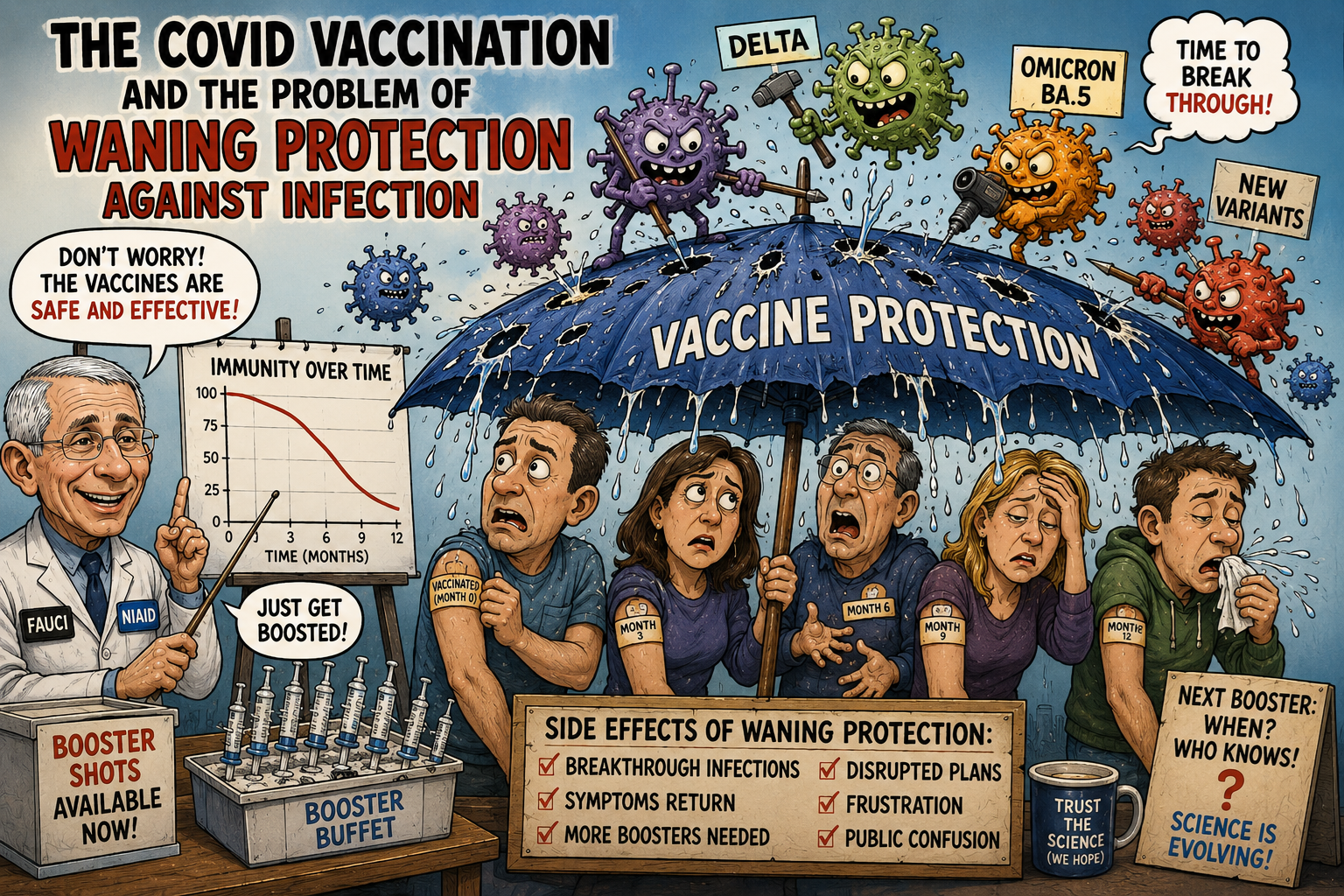
As SARS-CoV-2 evolved, protection against infection declined, breakthrough infections became increasingly common, and the duration of protection shortened. Booster doses produced temporary increases in protection, but those increases also waned. By the Omicron era, the principal measurable vaccine effect was increasingly concentrated on protection against severe outcomes rather than prevention of infection or transmission.
These findings are documented in clinical trials, observational studies and CDC surveillance.
Protection against infection declined over time
The initial clinical experience with the Pfizer-BioNTech and Moderna vaccines occurred before Omicron and against viruses substantially closer antigenically to the vaccine strains.
A large British study found that two doses of Pfizer-BioNTech vaccine initially produced high protection against SARS-CoV-2 infection, but that protection waned considerably after six months.
The emergence of Delta further demonstrated the problem. A study published in The New England Journal of Medicine found that two doses of Pfizer-BioNTech vaccine had an effectiveness of 88.0% against symptomatic Delta infection, compared with 93.7% against Alpha. Protection following a single dose was substantially lower.
The reduction became substantially more pronounced with Omicron.
A NEJM study of mRNA booster effectiveness found that boosters were highly effective against symptomatic Delta infection but less effective against symptomatic Omicron infection.
The trajectory is therefore measurable: effectiveness against infection was high against earlier strains, declined with time since vaccination, and declined further as antigenically different variants emerged.
Breakthrough infection became a central feature of the Omicron era
The term “breakthrough infection” initially described infections occurring despite vaccination. With Omicron, breakthrough infection became common enough that prevention of infection could no longer be characterized as a durable property of vaccination.
The World Health Organization currently explicitly acknowledges that vaccinated individuals can become infected and develop COVID-19.
CDC surveillance likewise treats waning protection and the emergence of new variants as major factors requiring continual reassessment of vaccine effectiveness.
A CDC-associated population study published in 2024 illustrates the changing relationship between vaccination and infection. In that analysis, SARS-CoV-2 infection occurred in 24.3% of people with zero doses, 31.4% with one dose, 27.5% with two doses and 27.5% with three doses. The study was observational and involved important differences among the groups, so the figures cannot be interpreted as a randomized comparison. They nevertheless demonstrate that vaccination status did not eliminate infection.
Vaccination did not create sterilizing immunity
One of the most important distinctions in evaluating COVID vaccines is the difference between preventing severe disease and preventing infection.
A vaccine can reduce the probability of hospitalization without preventing an infected person from acquiring and transmitting the virus.
The available evidence increasingly demonstrated this distinction during the Omicron period.
A CDC study examining household transmission found that secondary attack rates remained substantial among vaccinated contacts. Contacts with three doses had a household secondary attack rate of 30.9%, compared with 49.6% among contacts with zero or one dose. Among recently vaccinated contacts, the rate was 32.4%.
Thus, vaccination reduced—but did not eliminate—the probability of transmission in that study.
The evidence does not support describing COVID vaccination as a mechanism that reliably prevents an infected vaccinated person from transmitting SARS-CoV-2.
The problem of waning immunity
Waning protection is one of the most consistent findings across COVID-vaccine studies.
The phenomenon is particularly apparent when protection against infection is measured rather than protection against severe disease.
A CDC-associated analysis of bivalent vaccination found overall effectiveness of 34.1% against COVID-19. Effectiveness was approximately 54.8% during the first 7–59 days but fell to 21.6% after 60 days or more.
The decline was not confined to protection against mild infection.
CDC’s analysis of additional 2024–2025 vaccination reported that effectiveness against critical illness began at approximately 67% and declined to about 40% four to six months after vaccination, with point estimates indicating additional waning at six to ten months.
These data describe a recurring pattern:
Protection rises after vaccination, reaches a relatively high level, and then declines with time.
Boosters restored protection temporarily
Booster doses were introduced partly in response to waning immunity.
The available evidence shows that boosters increased protection against infection, particularly shortly after administration.
A fourth dose of Pfizer-BioNTech vaccine, for example, reduced the short-term risk of COVID-19-related outcomes among people who had already received a third dose at least four months earlier.
Three doses also provided greater protection against Omicron infection than two doses in some studies.
The limitation was duration.
The increase in protection following a booster was not permanent. Protection against infection again declined as time passed.
This created a recurring cycle:
vaccination → increased protection → waning protection → breakthrough infections → booster → renewed protection → further waning.
The epidemiological data therefore do not demonstrate a vaccination strategy capable of producing permanent protection against infection.
Variant evolution further reduced protection against infection
The original vaccines were developed against the ancestral virus.
SARS-CoV-2 subsequently accumulated mutations, particularly in the spike protein targeted by the vaccines.
The Delta variant produced measurable reductions in vaccine effectiveness against infection. Omicron produced a substantially greater antigenic challenge.
The NEJM literature documents this progression: vaccine effectiveness remained substantial against severe disease while effectiveness against infection and symptomatic disease diminished as variants changed.
This distinction became increasingly important because transmission depends primarily on infection and viral replication in the respiratory tract—not simply on whether an infected individual subsequently develops severe disease.
The evidence concerning transmission
The question of transmission requires precision.
COVID vaccines did reduce transmission risk under some circumstances, particularly during periods when vaccine-induced protection against infection was relatively strong.
But the effect was incomplete and time-dependent.
The CDC household-transmission study cited above found substantially lower secondary attack rates among vaccinated contacts, but transmission remained common.
The ability of vaccinated people to become infected and transmit the virus became especially apparent during Omicron.
Consequently, vaccination status could not reliably identify whether an individual was infectious.
A vaccinated individual with a positive SARS-CoV-2 test could still transmit infection to another person.
Booster frequency and declining effectiveness
The continuing need for additional doses illustrates another characteristic of COVID vaccination: protection against infection has not been durable.
WHO’s early 2021 statement concerning boosters explicitly said that evidence concerning widespread booster requirements was at that time limited and inconclusive, while emphasizing the importance of monitoring waning effectiveness.
By later years, periodic vaccination had become an established component of COVID policy because immunity declines relatively quickly after vaccination or infection. WHO currently describes immunity as declining relatively quickly within approximately six months.
This represents a fundamentally different pattern from vaccines for diseases in which vaccination can provide prolonged protection against infection and transmission.
COVID vaccination has instead required periodic updating and revaccination because both immunity and the circulating virus change.
Effectiveness differed according to the outcome being measured
An important finding throughout the literature is that “vaccine effectiveness” is not one number.
It depends upon the outcome.
For example:
| Outcome | Observed pattern |
|---|---|
| Infection | Substantial early protection, followed by waning |
| Symptomatic disease | Protection declined with variant evolution and time |
| Breakthrough infection | Increasingly common with Omicron |
| Transmission | Reduced in some studies but not eliminated |
| Hospitalization | Greater and more persistent protection than against infection |
| Critical illness | Protection persisted longer but also waned |
| Death | Protection against COVID-associated death generally exceeded protection against infection |
The distinction is critical when interpreting statements that a vaccine was “effective.”
A vaccine may be effective against hospitalization while having substantially lower effectiveness against infection.
The CDC’s 2024–2025 evidence review, for example, reported a pooled vaccine effectiveness estimate of 28% against COVID-associated death across three studies, illustrating that estimates of protection against severe outcomes can themselves vary substantially according to study design and population.
The changing meaning of “vaccine effectiveness”
Early COVID-vaccine trials were designed around symptomatic laboratory-confirmed COVID-19 and related endpoints.
As SARS-CoV-2 evolved, vaccine effectiveness became increasingly dependent on:
- the variant circulating at the time;
- time since the most recent dose;
- previous infection;
- number of previous doses;
- age;
- underlying medical conditions;
- vaccine formulation; and
- the outcome being measured.
Consequently, a single percentage cannot accurately describe COVID-vaccine effectiveness across the entire pandemic.
A reported effectiveness of 90% in one setting cannot be assumed to apply to an Omicron infection months after vaccination.
The CDC explicitly monitors vaccine effectiveness for precisely these reasons, including waning protection and emergence of new variants.
What the longitudinal record shows
Across successive variants, the pattern is remarkably consistent.
First: the original vaccines produced substantial protection against infection and symptomatic disease during the early phase of the pandemic.
Second: protection against infection declined with time.
Third: Delta reduced effectiveness against infection compared with earlier variants.
Fourth: Omicron produced substantially more breakthrough infections.
Fifth: booster doses temporarily increased protection.
Sixth: booster-derived protection against infection subsequently waned.
Seventh: vaccination did not prevent all vaccinated individuals from becoming infected.
Eighth: vaccinated infected individuals remained capable of transmitting SARS-CoV-2.
Ninth: protection against severe outcomes generally persisted longer than protection against infection.
Tenth: the continuing evolution of SARS-CoV-2 required repeated reformulation and periodic vaccination.
These findings are documented in CDC surveillance, randomized trials and observational epidemiological studies.
Conclusion
The longitudinal evidence shows that COVID vaccination did not provide durable sterilizing immunity against SARS-CoV-2.
Protection against infection was strongest shortly after vaccination and declined rapidly with time. The emergence of Delta and particularly Omicron reduced protection against infection and symptomatic disease and made vaccination problematic. Booster doses temporarily restored protection, but that protection also waned. Breakthrough infections became common, and vaccinated infected individuals remained capable of transmitting SARS-CoV-2.
The measurable performance of COVID vaccination therefore changed substantially over the course of the pandemic.
The central empirical finding is straightforward:
COVID vaccination reduced the risk of infection during certain periods and against certain variants, but it did not permanently prevent infection, did not eliminate breakthrough infection, and did not reliably prevent transmission of SARS-CoV-2.
The evidence further shows that protection against severe outcomes was postulated to be greater and longer-lasting than protection against infection but needs further research to determine outcomes. That distinction is essential when arguing the actual performance of COVID vaccines over time.
This analysis concerns vaccine effectiveness against infection and transmission. It does not address the separate question of vaccine safety or the magnitude of protection against hospitalization and death except where necessary to distinguish those outcomes from infection and transmission.