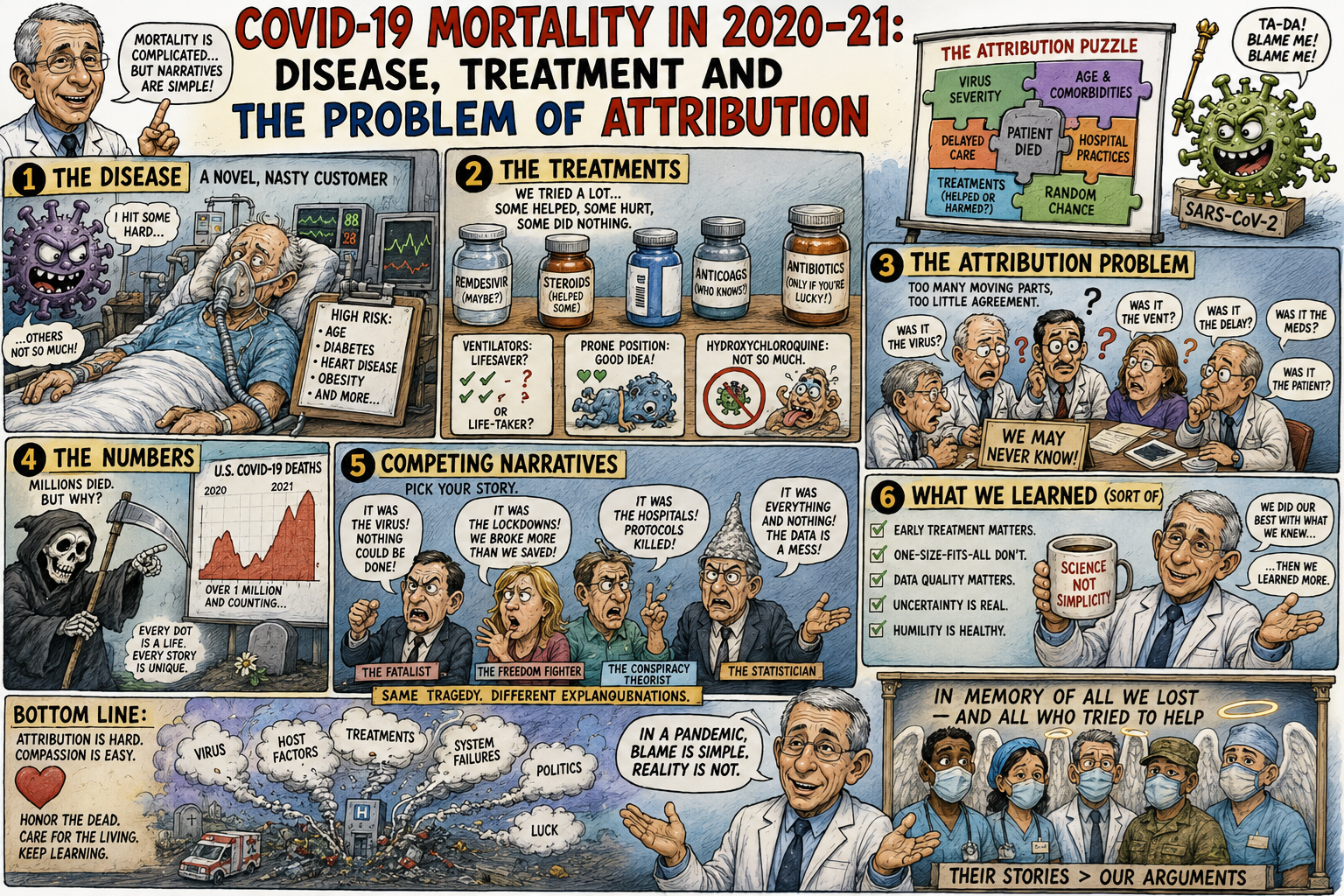
John Murphy, CEO The COVID-19 Long haul Foundation
The crucial distinction: a COVID death is not the same thing as a COVID-positive death
There is an important misconception about CDC mortality statistics.
A person was not counted as a COVID death merely because a laboratory test was positive.
CDC’s National Center for Health Statistics uses death certificates. COVID-19 is coded U07.1 when the certifier reports COVID-19 as a cause or contributing cause of death. The underlying cause is separately determined according to the ICD rules governing the sequence of conditions leading to death.
That distinction is important.
The death certificate contains:
Part I: the causal chain leading to death
Part II: other significant conditions contributing to death
The CDC’s coding manual defines the underlying cause as the disease or injury that initiated the chain of events leading ultimately to death.
Thus, a patient could have:
COVID-19 → viral pneumonia → acute respiratory distress syndrome → respiratory failure → death
and COVID-19 would appropriately be the underlying cause.
Alternatively:
metastatic cancer → respiratory failure → death
with COVID-19 listed as a contributing condition.
Those are epidemiologically different deaths.
How many deaths actually had COVID as the underlying cause?
This is one of the most useful ways of addressing the question.
CDC reports that COVID-19 was listed as the underlying cause in approximately 91% of COVID-associated deaths in 2020 and 90% in 2021. The percentage subsequently declined as COVID increasingly appeared as a contributing rather than initiating condition.
For 2021, for example, CDC recorded:
460,513 deaths with COVID-19 as an underlying or contributing cause
but:
415,399 deaths with COVID-19 as the underlying cause.
Thus, roughly 90% of the COVID-associated deaths in 2021 had COVID as the underlying cause.
That finding substantially weakens the argument that the enormous early mortality count was simply the result of counting people who happened to test positive while dying from something else.
But it does not answer the treatment question.
Could treatment have contributed to some deaths?
Absolutely.
That is biologically and clinically plausible.
A treatment can simultaneously be:
appropriate for some patients, harmful for others, and improperly applied in still others.
Mechanical ventilation is an excellent example.
Invasive mechanical ventilation is not intrinsically a cause of death. It is a life-support intervention used because a patient is already experiencing severe respiratory failure.
But mechanical ventilation can cause complications, including:
- ventilator-induced lung injury;
- barotrauma;
- volutrauma;
- oxygen toxicity;
- ventilator-associated pneumonia;
- hemodynamic compromise;
- sedation-related complications;
- thromboembolic complications;
- diaphragm dysfunction; and
- prolonged ICU-associated weakness.
Consequently, the question is not:
“Did ventilators kill COVID patients?”
The scientifically meaningful question is:
“How many patients were exposed to potentially harmful ventilation strategies that increased mortality beyond the mortality produced by the underlying disease?”
There is no reliable national number answering that question.
Why the early ventilator mortality numbers were so alarming
Early in 2020, physicians were treating a previously unknown respiratory disease.
Mechanical ventilation was commonly regarded as the appropriate treatment for patients progressing to severe hypoxemic respiratory failure.
Early observational reports produced extraordinarily high mortality among mechanically ventilated patients.
Reports from New York and other early epicenters described mortality approaching or exceeding 70% in some mechanically ventilated cohorts.
Those numbers generated an understandable concern:
Was mechanical ventilation itself contributing substantially to mortality?
There was legitimate debate about this issue.
Physicians subsequently emphasized that COVID respiratory failure could involve heterogeneous phenotypes and that patients should not necessarily be intubated according to a rigid protocol.
But there is a critical statistical problem:
Patients placed on ventilators were the sickest patients.
Therefore:
ventilator → death
does not establish
ventilator → caused death.
This is classic confounding by indication.
The patients receiving mechanical ventilation were already those with the most severe respiratory failure.
The evidence that ventilation itself could cause injury
The concern was not imaginary.
Mechanical ventilation can produce lung injury when excessive pressures or volumes are applied.
This was already well established in conventional ARDS before COVID.
The COVID pandemic therefore did not create the concept of ventilator-induced lung injury.
What changed was the scale of the problem.
Hospitals were suddenly treating enormous numbers of patients with profound hypoxemia.
Early in the pandemic, clinicians were learning:
- when to intubate;
- how aggressively to ventilate;
- what tidal volumes to use;
- what PEEP levels were appropriate;
- how much sedation was necessary;
- when to prone patients;
- whether high-flow oxygen was preferable;
- when to use noninvasive ventilation;
- when ECMO should be considered.
The WHO’s May 2020 clinical-management guidance explicitly evolved as clinicians accumulated experience with severe COVID, including respiratory support, critical care and reporting of deaths.
This evolution is important evidence that early clinical management was not static.
Did doctors subsequently stop using ventilators?
No.
That description is too strong.
What changed was how and when mechanical ventilation was used.
The treatment pathway increasingly emphasized:
supplemental oxygen → high-flow nasal oxygen/noninvasive support → prone positioning → careful assessment → invasive ventilation when necessary
rather than reflexive early intubation of every patient with worsening oxygenation.
At the same time, clinicians became substantially better at ventilator management.
That means the decline in mortality among ventilated patients cannot legitimately be attributed to simply “stopping ventilators.”
Several changes occurred simultaneously.
The largest therapeutic turning point: dexamethasone
One of the strongest pieces of evidence that treatment changed COVID mortality comes from the RECOVERY trial.
In June 2020, investigators reported that dexamethasone reduced mortality among hospitalized COVID patients requiring oxygen or mechanical ventilation.
Among patients receiving invasive mechanical ventilation, dexamethasone reduced deaths by approximately one-third.
Among patients receiving oxygen without invasive mechanical ventilation, mortality was reduced by approximately one-fifth.
Importantly, there was no benefit among patients who did not require respiratory support.
This was not a death-certificate inference.
It was randomized clinical-trial evidence.
Therefore, part of the reduction in mortality after the first wave can be attributed to better evidence-based treatment, independently of changes in ventilation practice.
Prone positioning was another major change
Prone positioning had long been used in severe ARDS.
COVID dramatically expanded its use.
The physiological rationale is straightforward: turning patients onto their stomach can improve ventilation-perfusion matching and reduce regional lung stress.
The improvement in oxygenation was often dramatic.
Later randomized evidence in severe COVID supported awake prone positioning in appropriately selected patients receiving noninvasive respiratory support.
Again, this means the subsequent decline in mortality cannot reasonably be attributed to one intervention alone.
Clinical management improved on multiple fronts.
Anticoagulation and thrombosis
COVID also turned out to be a disease associated with substantial thrombo-inflammatory pathology.
Pulmonary microvascular thrombosis, venous thromboembolism and systemic coagulation abnormalities became important components of severe disease.
Treatment strategies consequently evolved.
The National Institutes of Health and other organizations developed increasingly sophisticated approaches to anticoagulation according to disease severity and bleeding risk.
This represented another major change from the earliest months of the pandemic.
Remdesivir and later therapies
Remdesivir subsequently demonstrated a modest shortening of recovery time in hospitalized patients in randomized trials.
Later, monoclonal antibodies and oral antivirals became important for selected patients in the outpatient setting.
Paxlovid eventually became one of the most important treatments for high-risk outpatients.
Consequently, a patient infected in 2020 was not receiving the same therapeutic environment as a similarly ill patient in 2022 or 2023.
That makes crude comparisons of mortality across years problematic.
How much of the early mortality was treatment-related?
This is where the evidence reaches its limit.
There is no CDC database that identifies the cause of death as:
“COVID disease”
versus
“COVID + inappropriate mechanical ventilation”
versus
“COVID + delayed intubation”
versus
“COVID + inappropriate medication.”
The death certificate does not contain that level of causal attribution.
CDC’s mortality system records diseases and conditions reported by the certifying physician and then applies ICD coding rules.
Consequently, it would be scientifically unjustified to say, for example:
“20% of 2020 COVID deaths were caused by ventilators.”
There is no national dataset establishing that percentage.
But we can investigate the question indirectly
A much better approach is to examine mortality among comparable patients receiving different respiratory strategies.
That requires patient-level datasets containing:
- age;
- sex;
- comorbidities;
- oxygen saturation;
- respiratory rate;
- PaO₂/FiO₂;
- severity scores;
- ICU admission;
- mechanical ventilation;
- timing of intubation;
- ventilator settings;
- proning;
- corticosteroids;
- anticoagulation;
- antiviral therapy;
- ECMO;
- duration of ventilation;
- hospital capacity;
- and final outcome.
Those datasets exist in various research cohorts.
They are much more informative than CPT codes.
CPT codes are not the appropriate mortality instrument
I agree with the underlying methodological point in your question.
CPT codes should not be used to determine whether COVID caused death.
CPT codes primarily describe medical services and procedures.
For mortality analysis, the relevant sources are:
1. Death certificates
The most important national source.
2. ICD-10 underlying and multiple-cause coding
This identifies diseases and conditions involved in the death.
3. Hospital electronic medical records
These provide clinical circumstances unavailable from death certificates.
4. ICU databases
These provide ventilation, oxygenation and treatment variables.
5. Laboratory data
These help establish SARS-CoV-2 infection.
6. Excess-mortality analysis
This provides an independent estimate of deaths beyond expected mortality.
Together, these approaches are far superior to simply counting billing codes.
What does excess mortality tell us?
This is an important independent check.
If COVID deaths were grossly overstated because hospitals were labeling unrelated deaths as COVID, one would expect the number of reported COVID deaths to substantially exceed the total number of excess deaths.
Instead, the U.S. experienced an enormous increase in total mortality during the pandemic.
CDC’s excess-death methodology explicitly distinguishes COVID deaths from deaths in which COVID contributed to another underlying cause.
This does not prove that every individual death attributed to COVID was caused exclusively by SARS-CoV-2.
It does demonstrate that the United States experienced a very large population-level mortality excess coincident with the pandemic.
That makes the hypothesis that the early COVID mortality numbers were predominantly artifacts of coding considerably less plausible.
But excess deaths cannot tell us how many were caused by treatment
This is equally important.
Excess mortality cannot distinguish:
virus → death
from
virus → hospitalization → treatment complication → death.
Nor can it distinguish:
COVID → death
from
COVID → healthcare disruption → delayed treatment of another disease → death.
Therefore, excess mortality confirms that something extraordinary happened but does not establish the precise causal pathway for every death.
The strongest evidence against the “ventilators caused the epidemic mortality” hypothesis
There is an especially important observation.
Mortality declined dramatically even though mechanical ventilation remained necessary for the sickest patients.
If ventilation itself had been the dominant cause of COVID mortality, one would expect mortality to collapse only as invasive ventilation was largely abandoned.
That did not happen.
Instead, mortality improved as:
- patient selection improved;
- respiratory-support strategies improved;
- ventilator management improved;
- proning became routine;
- corticosteroids became standard;
- thrombosis was recognized;
- antiviral therapy became available;
- ICU experience accumulated;
- and vaccination and prior immunity changed the population’s susceptibility.
Thus, the evidence supports a multifactorial explanation rather than a single “ventilator deaths” explanation.
A more defensible interpretation of the early mortality
The evidence supports the following model:
Early 2020
Novel virus + no population immunity + delayed recognition + limited treatment knowledge + overwhelmed hospitals + severe respiratory failure + evolving ventilation practices
↓
Very high mortality
Later 2020
Improved respiratory management + prone positioning + corticosteroids + anticoagulation + accumulated ICU experience
↓
Lower mortality
2021–2022
Vaccination + previous infection + improved therapeutics + better critical-care management + changing variants
↓
Further decline in mortality
This model is consistent with the epidemiological and clinical evidence.
There nevertheless was a genuine learning curve
It would be equally wrong to pretend that medicine knew exactly what it was doing in March 2020.
It did not.
Clinicians were confronted with an entirely new disease.
Some early practices were subsequently abandoned or modified.
Examples included:
- routine use of hydroxychloroquine;
- routine use of azithromycin;
- excessive reliance on early intubation in some settings;
- inadequate recognition of thrombotic disease;
- insufficient use of prone positioning;
- failure to recognize the importance of corticosteroids in severe disease;
- and evolving approaches to oxygen therapy.
That is not evidence of medical incompetence.
It is evidence of medicine operating under extraordinary uncertainty.
But it does mean that some patients undoubtedly experienced treatment-related complications during the learning process.
The question is how many.
What would a rigorous answer to your question require?
To determine the number of deaths attributable to treatment rather than COVID itself, I would recommend a much more sophisticated analysis than a CPT-code review.
We would construct a mortality attribution framework using:
A. NCHS multiple-cause death certificates
Separate:
COVID underlying cause
from
COVID contributing cause
and examine the complete chain of causes.
B. Hospital-level clinical data
Identify:
- COVID-positive patients;
- oxygen requirement;
- ICU admission;
- intubation;
- time from admission to intubation;
- ventilator duration;
- ARDS severity;
- prone positioning;
- corticosteroids;
- anticoagulation;
- remdesivir;
- ECMO;
- complications.
C. Compare early and late cohorts
For example:
March–April 2020
versus
May–December 2020
versus
2021
versus
2022.
D. Risk-adjust the cohorts
Otherwise, we would make the classic mistake of comparing the sickest ventilated patients with less severely ill patients.
E. Analyze mortality according to respiratory-support strategy
For example:
high-flow oxygen
versus
noninvasive ventilation
versus
invasive ventilation
versus
ECMO.
F. Analyze timing
Especially:
intubation at admission
versus
later intubation after noninvasive support.
G. Examine hospital strain
A hospital operating at 110% ICU capacity is not equivalent to a hospital with abundant ICU resources.
H. Compare with non-COVID ARDS
This provides an essential control.
What the evidence presently permits us to conclude
There is strong evidence that COVID itself caused substantial mortality during 2020–21.
CDC’s death-certificate system is not simply a test-counting database. Approximately 90% of COVID-associated deaths in 2020–21 had COVID recorded as the underlying cause.
There is also strong evidence that early treatment evolved substantially.
There is credible evidence that some early respiratory-management strategies could cause harm if improperly applied, particularly excessive mechanical-ventilation pressures or volumes.
There is strong evidence that treatment improvements—including corticosteroids and improved respiratory management—reduced mortality.
But there is no scientifically defensible national estimate of how many COVID deaths were actually caused by inappropriate ventilator treatment rather than by SARS-CoV-2 infection itself.
And there is an important distinction between saying:
“Some COVID patients were probably harmed by early treatment practices.”
and saying:
“Most early COVID deaths were caused by ventilators.”
The first proposition is consistent with the evidence.
The second is not established by the available data.
The most important finding
The decline in COVID mortality after the first wave should not be attributed to a single explanation.
It was the product of a rapidly changing medical environment:
better diagnosis + better ICU management + less harmful ventilation strategies + prone positioning + corticosteroids + anticoagulation + antivirals + accumulated immunity + vaccination + changing viral variants + improved hospital capacity.
That is the explanation most consistent with the available clinical and mortality evidence.