John Murphy, CEO The COVID-19 Long haul Foundation
Abstract
Objective
To examine the evidence concerning serious adverse events and deaths occurring after COVID-19 vaccination, with particular attention to messenger RNA (mRNA) vaccines; to distinguish spontaneous safety reports from demonstrated causal associations; to review evidence from US and international pharmacovigilance systems, including the Vaccine Adverse Event Reporting System (VAERS), Vaccine Safety Datalink (VSD), FDA Biologics Effectiveness and Safety (BEST), Centers for Medicare & Medicaid Services data, Department of Defense (DoD) and Veterans Affairs (VA) databases, and selected international surveillance systems; and to identify current research priorities for determining causality and long-term consequences.
Design
Narrative synthesis of governmental surveillance reports, regulatory assessments, population-based registry studies, self-controlled case series, cohort studies, systematic reviews, clinical investigations and mechanistic studies available through September 2026.
Main findings
COVID-19 vaccination has been followed by a large number of adverse-event reports worldwide. In the United States, 19,417 domestic reports of death following COVID-19 vaccination had been submitted to VAERS by 30 May 2025. This number should be interpreted as potential vaccine-caused deaths because reporting is based on temporal association and, during the emergency authorization period, healthcare providers were required to report deaths following vaccination irrespective of whether vaccination was believed to be causal.
At the same time, passive surveillance has identified genuine safety signals that were subsequently confirmed by active epidemiological studies. These include myocarditis and pericarditis after mRNA vaccination and thrombosis with thrombocytopenia syndrome (TTS) after adenoviral-vector vaccination. The FDA’s 2025 labeling revision estimated approximately 8 cases of myocarditis and/or pericarditis per million mRNA doses among people aged 6 months through 64 years and approximately 27 per million among males aged 12–24 years during days 1–7 after the 2023–24 formulation.
The DoD’s analysis of active-component service members found a statistically significant increase in myocarditis and pericarditis during the 21 days following vaccination, with adjusted rate ratios of 2.6 and 2.0 respectively, while SARS-CoV-2 infection was associated with substantially larger increases. The same analysis found no increased incidence of acute myocardial infarction, acute kidney injury or chronic kidney disease following vaccination.
Evidence for vaccine-associated mortality is weaker than evidence for myocarditis or TTS. Large self-controlled analyses have demonstrated increased some short-term all-cause mortality following vaccination. A 2026 Norwegian population study involving 4.65 million adults found lower all-cause mortality among vaccinated individuals after adjustment, while a 2026 Canadian study involving nearly 6.4 million healthy people aged 12–50 years found no signal association between COVID-19 vaccination and sudden cardiac death.
The principal unresolved scientific questions concern the biological mechanisms of vaccine-associated myocarditis, the significance of persistent cardiac magnetic-resonance abnormalities, the possibility of rarer delayed adverse events, susceptible genetic or immunological subgroups, and the long-term clinical consequences of documented vaccine-associated injury.
Conclusions
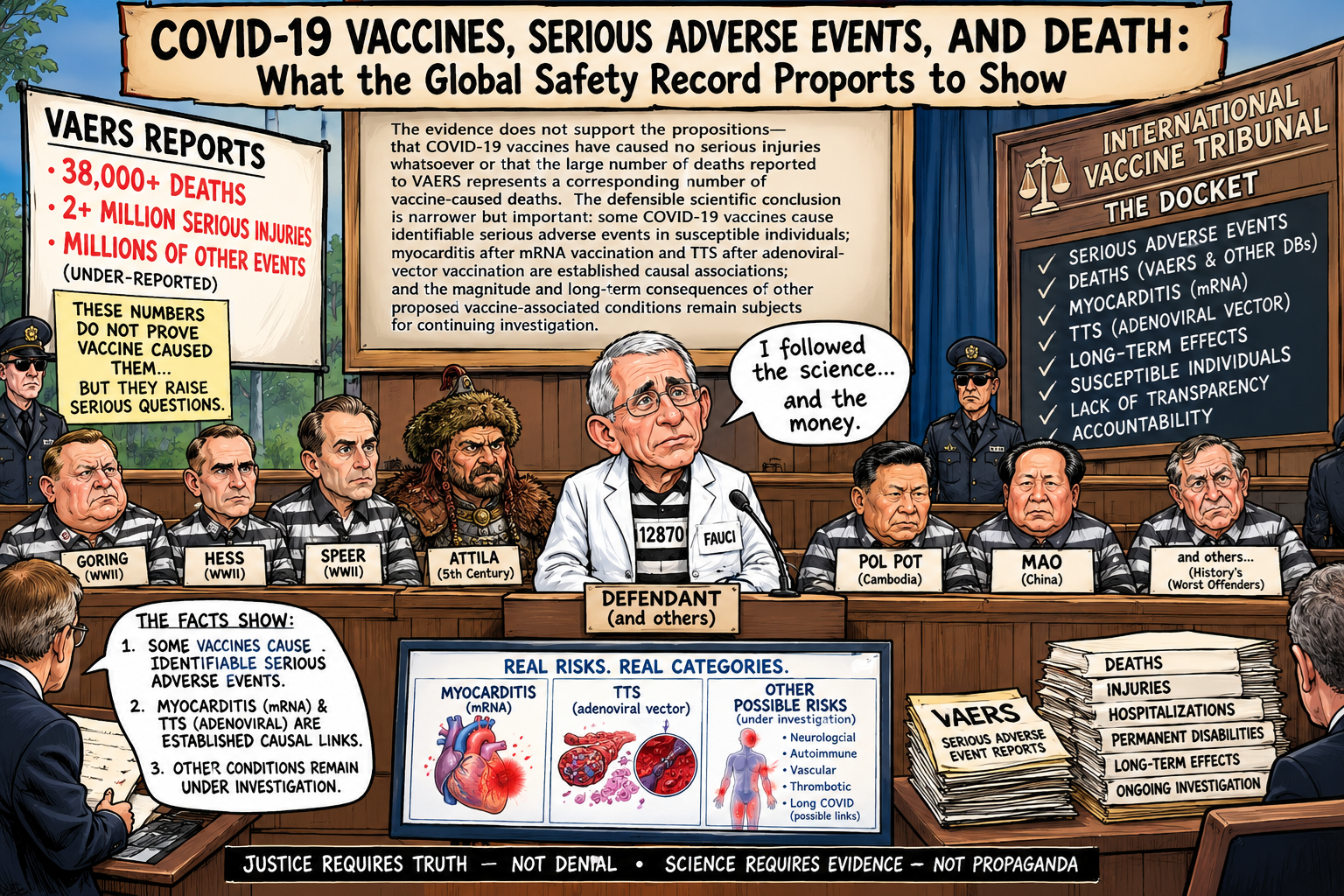
The evidence does not support extreme propositions—that COVID-19 vaccines have caused no serious injuries whatsoever or that the large number of deaths reported to VAERS represents a corresponding number of vaccine-caused deaths. The defensible scientific conclusion is narrower but important: some COVID-19 vaccines cause identifiable serious adverse events in susceptible individuals; myocarditis after mRNA vaccination and TTS after adenoviral-vector vaccination are established causal associations; and the magnitude and long-term consequences of other proposed vaccine-associated conditions remain subjects for continuing investigation.
Introduction
The COVID-19 vaccination campaign was one of the largest medical interventions in modern history.
Within months of the emergence of SARS-CoV-2, vaccines based on technologies that had never previously been deployed on anything approaching this scale were administered to hundreds of millions of people. The speed was extraordinary. So was the public-health pressure under which the vaccines were developed, authorised, manufactured and distributed.
The scale of the intervention created a corresponding obligation.
A medical intervention administered to hundreds of millions of people will inevitably produce some adverse events by coincidence alone. Conversely, even an adverse event occurring only a few times per million doses can produce thousands of cases when the denominator is enormous.
The central epidemiological problem is therefore not counting events.
It is determining which events were caused by vaccination, which were coincidental, which were precipitated by vaccination in predisposed individuals, and which remain uncertain.
This distinction became obscured during the pandemic.
Critics sometimes treated every VAERS report as proof of vaccine injury. Defenders sometimes responded as though a temporal association had virtually no evidentiary value. Neither position is scientifically satisfactory.
The appropriate approach is pharmacovigilance: identify signals, quantify risk, validate diagnoses, compare exposed and unexposed populations, establish temporal patterns, examine biological plausibility and, whenever possible, reproduce the association in independent datasets.
That process has already demonstrated that at least some vaccine-associated injuries are real.
The remaining question is how large the problem is, how long the consequences persist and whether other associations presently regarded as uncertain will eventually achieve causal confirmation.
VAERS: An enormous signal-detection system, not a mortality registry
VAERS is jointly administered by the CDC and FDA and is designed primarily as an early-warning system. It accepts reports from healthcare professionals, manufacturers, patients and others.
Its principal strength is sensitivity.
Its principal weakness is specificity.
A VAERS report establishes that an adverse event occurred after vaccination—not that vaccination caused it.
The distinction is particularly important for mortality.
As of 30 May 2025, 19,417 domestic deaths had been reported to VAERS following COVID-19 vaccination. During the emergency-use period, however, healthcare providers were subject to requirements to report deaths after COVID-19 vaccination regardless of whether they believed the vaccine caused the death. CDC explicitly states that VAERS generally cannot establish causality.
Thus:
19,417 reports of death after vaccination ≠ 19,417 vaccine-caused deaths.
But the opposite proposition is equally problematic:
The inability of VAERS to establish causality does not mean that its signals are medically meaningless.
Indeed, VAERS helped identify myocarditis and TTS, which were subsequently evaluated using more rigorous epidemiological and clinical systems.
In May 2025, CDC and FDA expanded public access to VAERS data to include secondary reports associated with the same patient, vaccine and dose. The agencies specifically warned that the additional records do not represent additional adverse events but previously unavailable reports concerning already reported events.
That change illustrates another difficulty: the apparent number of reports can change as the database architecture changes.
Any publication using VAERS must therefore report the precise extraction date, case definition, vaccine product, reporting period and denominator.
Myocarditis: the clearest causal association with mRNA vaccination
The most firmly established serious adverse event associated with mRNA COVID-19 vaccination is myocarditis and, to a lesser extent, pericarditis.
The signal emerged rapidly during the vaccination campaign.
CDC subsequently concluded that evidence from multiple US and international systems supports a causal association between mRNA vaccination and myocarditis/pericarditis.
The risk is strongly age- and sex-dependent.
It is greatest among adolescent and young adult males, particularly following the second dose.
The 2025 FDA labeling revision provides an unusually useful contemporary estimate. During days 1–7 after the 2023–24 mRNA vaccine formulation, the estimated incidence was approximately:
| Population | Myocarditis/pericarditis |
|---|---|
| Ages 6 months–64 years | ~8 per million doses |
| Males 12–24 years | ~27 per million doses |
The risk is considerably higher in certain subgroups and after particular doses.
A Nordic study involving 23.1 million residents found that among males aged 16–24 years, the excess myocarditis risk after the second dose was approximately 5.55 per 100,000 vaccinees for BNT162b2 and 18.39 per 100,000 for mRNA-1273.
A 2026 nationwide Norwegian validation study linked national registries with individual medical records. Among 4.1 million vaccinated individuals receiving 10.9 million doses, 177 of 349 reviewed potential cases were validated as vaccine-associated myocarditis. Seven patients required intensive care and two older patients died.
This is what causality looks like when a passive signal survives increasingly rigorous investigation.
It begins with reports.
It proceeds through statistical disproportionality.
It appears in multiple countries.
It is concentrated in a biologically coherent demographic group.
It occurs preferentially within a plausible temporal window.
It is reproduced using active surveillance.
And clinicians can identify a characteristic clinical syndrome.
That is considerably stronger evidence than simply counting VAERS reports.
But what happens to the heart afterward?
This question remains incompletely answered.
The acute clinical course of vaccine-associated myocarditis is often favorable. Many patients improve rapidly with conventional treatment.
But “clinically improved” is not synonymous with “biologically normal.”
The FDA’s 2025 labeling revision was prompted partly by a study of approximately 300 people who developed myocarditis after mRNA vaccination. Some patients reported cardiac symptoms approximately three months later, and abnormal cardiac MRI findings remained common at approximately five months. The prognostic significance of these abnormalities remains uncertain.
That uncertainty is important.
Cardiac MRI abnormalities can represent residual myocardial injury, inflammation or fibrosis. Whether these findings translate into increased arrhythmia, heart failure or premature cardiovascular mortality decades later is not yet established.
The FDA now requires manufacturers to conduct studies specifically addressing long-term cardiac outcomes among people who develop myocarditis after mRNA vaccination.
This is an appropriate example of a question that should remain open rather than being prematurely answered in either direction.
The Department of Defense: an unusually informative natural experiment
The military provides an important population for vaccine-safety research because service members are relatively young, medically screened and extensively documented.
The DoD examined cardiac and renal conditions among active-component personnel from 2019 through 2022.
The resulting report found:
- myocarditis increased after recent vaccination;
- pericarditis increased after recent vaccination;
- acute myocardial infarction did not significantly increase after vaccination;
- acute kidney injury did not increase;
- chronic kidney disease did not increase.
After adjustment, recent vaccination was associated with a rate ratio of 2.6 for myocarditis and 2.0 for pericarditis. Recent SARS-CoV-2 infection produced considerably larger associations: 10.4 for myocarditis and 6.1 for pericarditis.
The DoD report itself cautioned that these associations could not automatically be interpreted as causal and called for continued surveillance and case validation.
This is a useful lesson in epidemiology.
The same exposure can simultaneously have a real adverse effect and a favorable overall comparative profile for a particular disease outcome.
The existence of vaccine-associated myocarditis does not establish that vaccination caused widespread cardiovascular disease.
Nor does evidence that infection produces greater cardiovascular risk invalidate the vaccine-associated myocarditis signal.
Both propositions can be true.
Thrombosis and thrombocytopenia: a second proven vaccine-associated injury
Adenoviral-vector vaccines produced another important safety signal: thrombosis with thrombocytopenia syndrome.
Unlike mRNA-associated myocarditis, TTS was principally associated with adenoviral-vector vaccines such as Janssen.
By August 2021, CDC and FDA had identified 54 TTS cases after approximately 14.1 million Janssen doses—approximately 3.8 cases per million doses. Eight patients died, corresponding to approximately 0.6 deaths per million doses.
The syndrome was subsequently recognised internationally as a vaccine-associated thrombotic disorder.
The lesson was profound.
Pharmacovigilance worked.
A rare adverse event was detected, clinically characterized and incorporated into vaccine policy.
The existence of TTS also demonstrates why post-marketing surveillance remains indispensable even after regulatory authorization.
What about deaths?
Here the evidence becomes considerably more complicated.
There are three fundamentally different propositions:
- People died after receiving COVID-19 vaccines.
- Vaccination caused some individual deaths.
- Vaccination caused a large increase in population-level mortality.
The first proposition is indisputable.
The second is established for at least some rare adverse events, most clearly TTS and potentially fatal myocarditis.
The third has not been established by high-quality population studies.
This distinction matters.
A systematic review of published autopsy cases reported 28 deaths considered by its authors to be causally associated with vaccine-induced myocarditis. The cases were biologically concerning, with a median of only three days between the final vaccination and death.
However, this literature has important limitations, including case selection and publication bias. An autopsy series assembled from cases already suspected of being vaccine-related cannot estimate population incidence.
At the population level, stronger designs have generally not demonstrated increased all-cause mortality attributable to vaccination.
A 2024 self-controlled case-series study using deaths from eight Vaccine Safety Datalink organizations found no increased mortality following primary-series vaccination.
An even larger 2026 analysis involving 188,948 deaths among US Medicare beneficiaries aged 65 and older found relative incidence estimates for non-COVID mortality below 1 during the first 28 days after vaccination for Pfizer, Moderna and Janssen.
A Norwegian population study encompassing 4,645,910 adults and 132,963 deaths during 2021–23 likewise found lower adjusted mortality among vaccinated people.
And a 2026 Ontario case-control study involving nearly 6.4 million healthy people aged 12–50 found no evidence that COVID-19 vaccination increased sudden cardiac death.
These studies do not prove that vaccination never causes death.
They demonstrate something more precise: a large increase in population-wide mortality attributable to COVID-19 vaccination has not been demonstrated by these major population-based analyses.
Compensation claims provide another window
The US Countermeasures Injury Compensation Program (CICP) provides a particularly interesting source of information because it applies a much higher evidentiary threshold than VAERS.
As of 1 August 2026, 14,169 COVID-19-related CICP claims had been filed. Of these, 11,104 alleged injuries or deaths associated with COVID-19 vaccines.
At that point:
- 6,379 COVID-19 claims remained pending;
- 7,790 decisions had been issued;
- 112 claims had been found eligible for compensation;
- 62 had been compensated;
- 7,678 had been denied.
The CICP’s eligible cases include vaccine-associated myocarditis, myopericarditis, TTS/VITT and GBS.
The CICP numbers should not be interpreted as an estimate of the total number of vaccine injuries. Its evidentiary standard is unusually demanding, claims may be incomplete, and the program is administratively distinct from conventional vaccine-injury compensation.
Nevertheless, it provides an important counterpoint to the enormous numerator in VAERS.
A spontaneous report and a government determination of compensable injury are not equivalent pieces of evidence.
International surveillance largely reproduces the same picture
The signal is not uniquely American.
Canada’s pharmacovigilance program reported 488 deaths following COVID-19 vaccination through 5 January 2024. After medical review, four were classified as consistent with a causal association, 77 as indeterminate, 109 as unlikely to be related and the remainder as unclassifiable because of insufficient information.
Sweden provides another useful example.
More than 26 million COVID-19 vaccine doses were administered between December 2020 and May 2023, during which 456 suspected adverse drug reactions with fatal outcomes were reported. After clinical causality assessment, only 10 deaths—approximately 0.1 per 100,000 vaccinated persons—were judged consistent with causal association. Most reported deaths occurred in elderly people with substantial pre-existing disease.
European regulators have similarly reported no evidence of a population-wide increase in deaths caused by COVID-19 vaccination.
These international findings do not eliminate the possibility of rare fatal vaccine reactions.
They do, however, make claims of hundreds of thousands of vaccine-caused deaths scientifically difficult to sustain.
Other adverse events: signals, associations and unresolved questions
The scientific literature contains numerous proposed associations.
They should not all be placed in the same evidentiary category.
Neurological disease
Guillain-Barré syndrome became an important concern particularly with the Janssen vaccine. CDC identified approximately 100 VAERS reports after Janssen vaccination during the first months of deployment, although VSD did not identify a definitive signal during that period.
Neurological conditions continue to be studied using active surveillance, electronic health records and self-controlled designs.
Ischaemic stroke
VSD identified a statistical signal for ischemic stroke among adults aged 50 years and older during the 2023–24 vaccine season. CDC described the evidence as inconclusive because the signal was not consistently reproduced across datasets and formulations. A follow-up study was initiated.
This is exactly how a safety signal should be handled: neither dismissed nor declared causal before confirmation.
Tinnitus
VAERS contains reports of tinnitus after COVID-19 vaccination, but a CDC/FDA-linked analysis using VAERS and VSD found no disproportionate reporting signal and VSD rates similar to those observed following influenza vaccination.
Menstrual changes
Menstrual disturbances became an important patient-reported issue.
A 2024 systematic review found evidence for temporary changes in cycle length and flow. Another 2025 meta-analysis involving more than 1.9 million participants reported a 19% relative increase in risk of increased cycle length. However, a separate comparative meta-analysis found no statistically significant overall difference in adverse menstrual events and emphasized heterogeneity and bias.
The appropriate conclusion is that menstrual changes are plausible and supported by substantial evidence, but the magnitude, duration and clinical importance require continued study.
Kidney injury
Acute kidney injury has been reported after vaccination, including biopsy-documented renal disorders.
Yet a large N3C analysis of nearly 3 million vaccinated individuals found an absolute AKI risk of 0.66% following vaccination compared with 4.88% following SARS-CoV-2 infection. After adjustment, infection carried a much greater risk.
Again, an event can occur after vaccination without vaccination being the dominant cause.
The controversy over “vaccine injury” and Long COVID
One of the most difficult questions concerns patients who develop persistent multisystem symptoms after vaccination.
Reports include:
- fatigue;
- cognitive dysfunction;
- dysautonomia;
- tachycardia;
- neuropathy;
- tinnitus;
- exercise intolerance;
- sleep disturbance;
- headache;
- gastrointestinal symptoms;
- pain syndromes;
- autoimmune manifestations.
The existence of such reports is not itself proof of a vaccine-induced syndrome.
But neither should these patients automatically be dismissed.
The appropriate scientific question is whether there exists a reproducible biological phenotype distinguishable from background disease, post-viral illness, Long COVID following undiagnosed infection, functional disorders or other causes.
That question remains incompletely answered.
A major difficulty is that many vaccinated individuals were also infected with SARS-CoV-2. Infection itself can cause remarkably prolonged neurological, cardiovascular, metabolic and immunological abnormalities.
Therefore, any serious investigation must distinguish:
vaccination → illness
from
infection → illness
and from
infection + vaccination → illness.
Failure to make that distinction can generate profoundly misleading conclusions in either direction.
The question of infectivity
Another controversy deserves precise treatment.
mRNA vaccines do not contain live SARS-CoV-2 and cannot give a recipient COVID-19 infection. CDC’s technical description is unequivocal on this point.
Consequently, there is no scientifically established mechanism whereby an mRNA vaccine makes a person “infectious” in the sense of shedding vaccine virus.
That proposition should not be confused with another, very different observation:
mRNA vaccination did not provide permanent sterilizing immunity against SARS-CoV-2.
The original vaccines produced substantial protection against symptomatic infection with early variants, but effectiveness against infection declined with time and fell substantially as Omicron and subsequent variants emerged.
A meta-analysis found that vaccine effectiveness against infection declined from approximately 83% during the first month following the original series to approximately 22% by five months or longer, whereas protection against severe disease remained considerably higher.
A BMJ analysis of the VISION network found that during Omicron, three-dose effectiveness against hospitalization was approximately 89% initially but declined to 66% at four to five months.
A later systematic review involving more than 56 million Europeans found primary-series effectiveness against Omicron infection of only about 26%, compared with 77% for pre-Omicron variants; protection against severe disease was considerably more durable.
Thus the historical claim that vaccination provided durable protection against infection and transmission proved untenable as viral evolution proceeded.
But it is equally inaccurate to infer that vaccination made people infectious.
The scientifically supportable conclusion is:
mRNA vaccines did not produce vaccine-virus infectiousness, but neither did they provide durable sterilizing immunity against an evolving SARS-CoV-2 virus.
The major controversies
The pandemic generated a number of controversies that remain legitimate subjects for retrospective scientific examination.
1. Duration of protection
The initial efficacy estimates were obtained under circumstances very different from those prevailing after Omicron emerged. Protection against infection declined substantially with time and variant evolution.
2. Transmission
The vaccines were initially discussed publicly in terms that sometimes blurred protection against severe disease with prevention of infection and transmission.
Those are different endpoints.
3. Myocarditis
The causal association was ultimately acknowledged, but the magnitude of risk varies enormously by age, sex, product and dose.
4. Long-term cardiac consequences
Persistent MRI abnormalities following vaccine-associated myocarditis have been documented, but their prognostic significance remains unknown.
5. TTS
The Janssen experience demonstrated that a vaccine could produce a rare but potentially fatal thrombotic syndrome and that post-marketing surveillance could identify it.
6. VAERS interpretation
The enormous number of reports generated public concern, but the reports cannot be interpreted as confirmed causal injuries.
7. Transparency
The public release of safety data is indispensable. The 2025 expansion of VAERS access improved transparency, but investigators continue to distinguish public raw reports from corrected and clinically adjudicated government datasets.
8. Pregnancy and menstruation
Menstrual effects were not adequately characterized in the original vaccine trials and became a major post-marketing research issue. Subsequent observational studies have provided evidence for temporary changes but have not established major effects on fertility or miscarriage.
9. The sudden-death controversy
Large population studies have not supported an increase in sudden cardiac death among healthy young people attributable to vaccination.
10. Natural immunity
The assumption that infection or vaccination would provide permanent sterilizing immunity proved incorrect for an evolving coronavirus.
11. Mandates and informed consent
A separate ethical question concerns whether policies requiring vaccination should have incorporated more explicit age-, sex- and risk-stratified assessments once myocarditis became recognized.
This is not principally a biological question.
It is a question of medical ethics, proportionality and informed consent.
How should causality now be investigated?
The next phase of vaccine safety research should move well beyond passive reporting.
1. Self-controlled case-series analysis
Individuals serve as their own controls.
This reduces confounding from stable characteristics such as genetics, sex and chronic disease.
The approach has already been used extensively for mortality and myocarditis analyses.
2. Large linked cohort studies
Vaccination records should be linked to:
- electronic medical records;
- hospitalization data;
- pharmacy records;
- laboratory results;
- death certificates;
- imaging;
- pathology;
- insurance claims;
- genomic information.
FDA’s BEST system is explicitly designed for this type of post-market surveillance.
3. Autopsy studies
Sudden unexplained death deserves systematic post-mortem investigation.
Autopsy can distinguish myocarditis, myocardial infarction, pulmonary embolism, cerebral hemorrhage and unrelated causes that may otherwise be grouped together.
4. Cardiac MRI
Patients with vaccine-associated myocarditis should receive longitudinal assessment where clinically appropriate.
The crucial question is whether residual MRI abnormalities predict later arrhythmia, cardiomyopathy or heart failure.
5. Immunological phenotyping
Researchers should investigate:
- autoantibodies;
- T-cell activation;
- cytokine signatures;
- complement activation;
- innate immune activation;
- molecular mimicry;
- genetic susceptibility;
- sex-hormone effects.
6. Lipid nanoparticle research
The biological mechanism of myocarditis remains incompletely understood.
Emerging work is investigating whether the lipid nanoparticle delivery system itself contributes to inflammatory injury, rather than attributing all effects exclusively to the encoded spike antigen.
These hypotheses remain experimental and should not be confused with established mechanisms.
7. Molecular pathology
Future investigations should determine where vaccine-derived mRNA, lipid components and antigen are located after administration, how long relevant biological components persist in different tissues and whether persistence differs among individuals who develop adverse events.
8. Genetic susceptibility
Genome-wide and targeted sequencing may eventually identify people predisposed to vaccine-associated myocarditis or other immune-mediated adverse events.
9. Lot-level surveillance
Researchers should examine whether adverse-event rates differ systematically among manufacturing lots after accounting for age, sex, dose and geographic distribution.
A reproducible lot effect would be highly informative.
10. International replication
A signal appearing simultaneously in:
- the United States;
- Canada;
- the United Kingdom;
- Sweden;
- Norway;
- Denmark;
- Finland;
- Australia;
- Japan;
is substantially more credible than a signal confined to one passive database.
The global pharmacovigilance architecture makes such comparisons possible.
The regulatory system should embrace uncertainty rather than fear it
The history of COVID-19 vaccine safety illustrates a fundamental principle of medicine:
Safety is not a binary property.
No biological intervention is completely risk-free.
The proper question is:
What is the magnitude of risk, in whom does it occur, how severe is it, how long does it last, and can susceptible individuals be identified?
The current evidence provides reasonably strong answers for some questions.
Myocarditis following mRNA vaccination is real.
TTS following certain adenoviral-vector vaccines is real.
Severe allergic reactions can occur.
Most acute vaccine reactions are transient.
A large population-wide mortality catastrophe attributable to COVID-19 vaccination has not been demonstrated by major population studies.
But other questions remain genuinely unresolved.
The long-term significance of myocardial MRI abnormalities is one.
The biological basis of vaccine-associated myocarditis is another.
The possibility of rare immune-mediated syndromes deserves continued investigation.
So does the identification of genetic and immunological susceptibility.
And patients who report persistent symptoms after vaccination deserve systematic clinical evaluation rather than automatic acceptance or rejection of their causal interpretation.
The ethical lesson
Perhaps the greatest failure during the pandemic was not that scientists initially got every question right.
They could not have.
It was that scientific uncertainty was sometimes communicated as certainty.
Public confidence in medicine depends on a different bargain.
Physicians and public-health institutions should be able to say:
“We know this.”
“We do not yet know this.”
“This signal is real, but causality has not been demonstrated.”
“This adverse event has been demonstrated to be caused by the vaccine.”
“This risk appears concentrated in this demographic.”
“This benefit is established for this outcome but not for that one.”
Such statements are not signs of scientific weakness.
They are the language of mature science.
The alternative is dangerous.
If institutions dismiss legitimate adverse-event signals, patients may conclude that the medical establishment is unwilling to acknowledge harm.
If critics convert every temporal association into proof of causality, patients may conclude that the entire safety-monitoring system is fraudulent.
Neither conclusion is justified.
Conclusion
The COVID-19 vaccination campaign created an unprecedented natural experiment in pharmacovigilance.
Hundreds of millions of people received vaccines based on technologies whose deployment was accelerated by a global emergency. The subsequent safety record contains both reassuring findings and genuine warnings.
The reassuring findings are substantial: large population studies have not demonstrated an increase in all-cause mortality attributable to vaccination, and several highly publicized claims of widespread sudden death have not survived rigorous epidemiological examination.
The warnings are equally real.
mRNA vaccination can cause myocarditis and pericarditis.
The risk is concentrated particularly among young males and after certain doses.
Adenoviral-vector vaccines caused TTS, including fatal cases.
Some patients experience persistent cardiac abnormalities following vaccine-associated myocarditis.
Other proposed adverse effects remain under active investigation.
The appropriate response is therefore neither blanket reassurance nor blanket condemnation.
It is better science.
The next generation of vaccine-safety research should integrate pharmacovigilance reports with individual medical records, longitudinal imaging, pathology, immunology, genetics, genomics and mortality data. It should be sufficiently independent and transparent that investigators with opposing hypotheses can examine the same underlying evidence.
Most importantly, the system should be designed to discover inconvenient findings.
A safety-monitoring system that can only confirm the prevailing expectation is not a safety-monitoring system.
The ultimate test of the COVID-19 vaccine programme will not be whether every vaccine was declared “safe” or “unsafe.”
It will be whether medicine was willing to discover, quantify, disclose and respond honestly to the risks—however rare—of an intervention administered on a historic scale.
That is the standard that patients are entitled to expect.
And it is the standard that modern evidence-based medicine should demand.