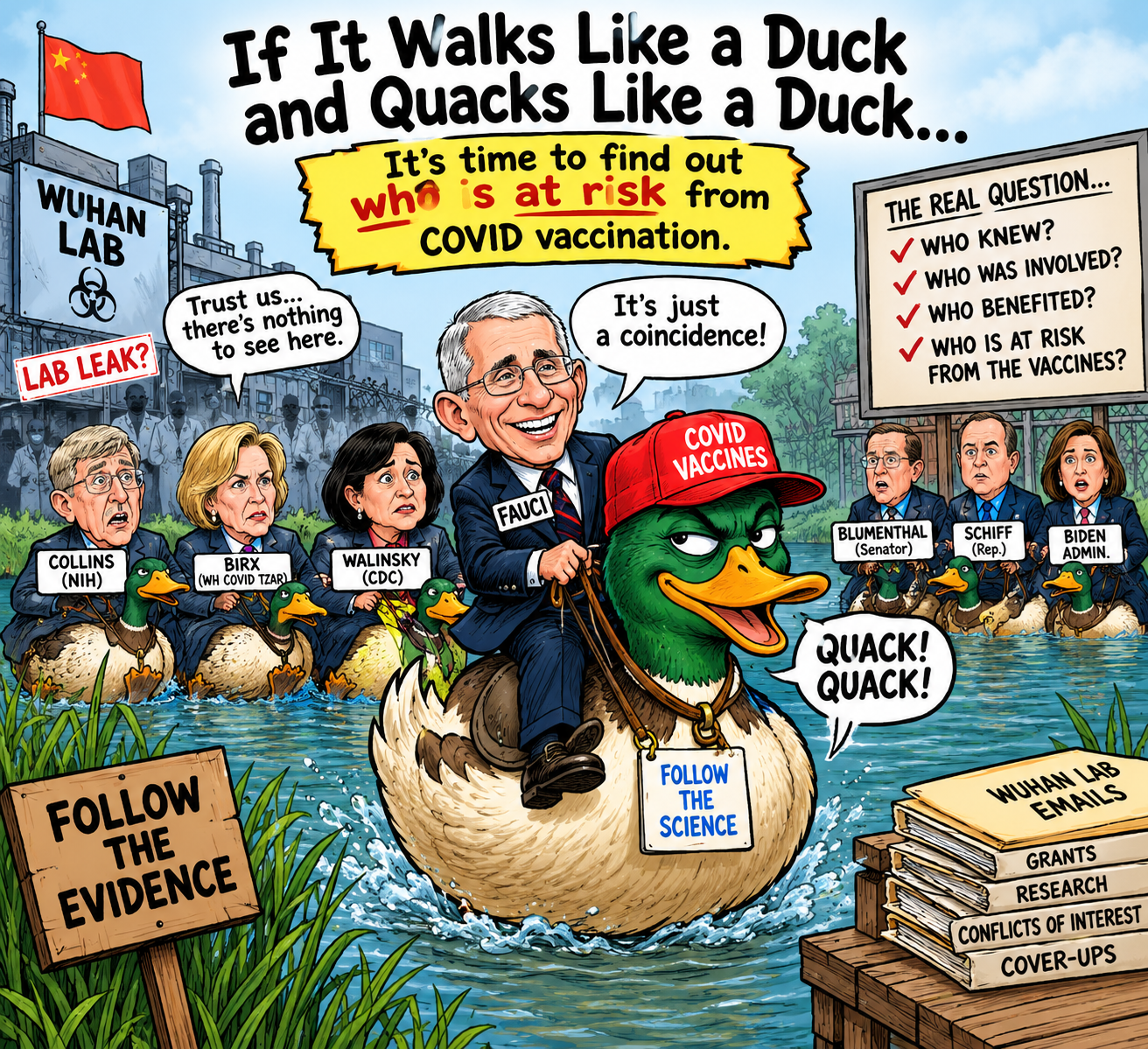
It’s time to find out who is at risk from COVID vaccination
John Murphy, CEO The COVID-19 Long haul Foundation
There is an old rule of common sense: If it walks like a duck and quacks like a duck, it is probably a duck.
Medicine is supposed to be more sophisticated than common sense. It is also supposed to be more honest.
That means acknowledging something that should no longer be controversial: COVID-19 vaccines are not risk-free for every person.
The important question is no longer whether adverse reactions exist. They do.
The important questions are:
Who is susceptible? Why are they susceptible? Can we identify them before vaccination? And why, after five years of unprecedented vaccination, have we not made individualized risk prediction a much higher research priority?
The Centers for Disease Control and Prevention itself now acknowledges a causal association between mRNA COVID-19 vaccines and myocarditis and pericarditis. The agency notes that the problem occurs most often in adolescent and young adult males, particularly within seven days after a second mRNA dose.
That is not an internet rumor.
It is not an anecdote.
It is not a conspiracy theory.
It is an adverse effect recognized by the principal U.S. public-health agency.
And it should change the way we think about vaccine safety.
The vaccine-safety question has become more sophisticated
The original public-health debate was framed too crudely:
Are vaccines safe or unsafe?
That is the wrong question.
Almost every medicine has a distribution of risk.
A drug can be extraordinarily beneficial to 99.9% of its users while producing catastrophic toxicity in a genetically or biologically susceptible minority.
Penicillin can cause anaphylaxis.
Chemotherapy can cause cardiomyopathy.
NSAIDs can cause renal injury.
Statins can produce severe muscle toxicity in susceptible patients.
The existence of those adverse reactions does not make the medicines universally “dangerous.”
It makes them heterogeneous in their effects.
COVID vaccines should be approached the same way.
The real scientific problem is therefore not:
“Are vaccines safe?”
It is:
“Safe for whom, under what circumstances, with which product, at what dose, at what interval, and with what biological susceptibility?”
That is a much more interesting question.
And it is one medicine should be able to answer.
Myocarditis changed the conversation
The clearest example is myocarditis.
Early in the vaccine rollout, reports accumulated of otherwise healthy adolescent and young adult males developing chest pain, elevated cardiac troponin and MRI evidence of myocardial inflammation shortly after mRNA vaccination.
Eventually the signal became impossible to dismiss.
CDC now explicitly states that multiple vaccine-safety systems in the United States and internationally support a causal relationship between mRNA vaccination and myocarditis/pericarditis.
The epidemiology is striking.
In early Vaccine Safety Datalink analyses, the rate of confirmed myocarditis among males aged 18–39 during the seven days after a second Pfizer dose was approximately nine times the comparison-period rate.
CDC’s early VAERS analysis found the highest reporting rates in adolescent and young adult males. Among males 12–17, the reported rate after a second mRNA dose was approximately 62.8 cases per million doses; among males 18–24 it was approximately 50.5 per million.
The Moderna product also produced a measurable signal. In one VSD analysis, males 18–39 had approximately 65.7 myocarditis/myopericarditis cases per million second doses during the seven-day risk interval.
Those numbers are small.
But “small” is not synonymous with “irrelevant.”
For an individual 17-year-old boy, a one-in-tens-of-thousands or one-in-twenty-thousands risk is not an abstraction if he happens to be the one who develops myocardial injury.
Children deserve special attention
This is where the vaccine-risk discussion becomes especially nuanced.
The myocarditis signal is not distributed evenly throughout childhood.
It is concentrated particularly in adolescent and young adult males.
CDC’s more recent surveillance indicates that myocarditis following vaccination is uncommon in younger children, with no statistical signal detected in Vaccine Safety Datalink data and no confirmed VAERS or VSD cases reported in children under five in the cited analysis.
That observation is important for two reasons.
First, it demonstrates that age matters.
Second, it demonstrates that biology matters.
If a vaccine produced identical cardiac risk in every human being, there would be little reason for such a dramatic age- and sex-specific pattern.
The existence of the pattern is itself a clue.
The next scientific step should be to discover what creates it.
“Most recovered” is not the end of the story
The usual response to vaccine-associated myocarditis is reassuring:
Most patients recover.
That is true.
CDC’s follow-up information indicates that approximately 83% of adolescents and young adults identified in one surveillance cohort were considered fully or probably recovered within 90 days, and at least 90% had recovered by one year. There were no known deaths or cardiac transplants in that cohort.
That is reassuring.
But there is another finding that deserves attention.
Among patients who underwent cardiac MRI approximately one year later, late gadolinium enhancement was frequently present. CDC notes that the clinical significance of this residual imaging finding remains uncertain.
That uncertainty is precisely why long-term surveillance matters.
Myocarditis is not a headache.
It is injury to cardiac muscle.
The question for cardiology should therefore not merely be whether a teenager feels better three months later.
It should be:
What does the myocardium look like 5, 10 and 20 years later?
Myocarditis is only one piece of the puzzle
The adverse-event spectrum is considerably broader than myocarditis.
Depending on vaccine platform, age, sex and individual susceptibility, published literature and pharmacovigilance systems have identified or investigated associations involving:
- myocarditis;
- pericarditis;
- anaphylaxis;
- thrombosis with thrombocytopenia syndrome;
- cerebral venous sinus thrombosis;
- Guillain-Barré syndrome;
- immune thrombocytopenia;
- neurologic inflammatory syndromes;
- demyelinating disease;
- transverse myelitis;
- encephalitis;
- neuropathy;
- Bell’s palsy;
- renal inflammatory disease;
- glomerulonephritis;
- minimal-change disease;
- ANCA-associated vasculitis;
- thrombotic microangiopathy;
- acute kidney injury;
- dermatologic immune disorders;
- ocular inflammatory disease;
- hematologic abnormalities;
- and other autoimmune or inflammatory conditions.
A systematic review of immune-mediated adverse events identified thrombotic, neurological, cardiac, ocular, dermatological, renal and hematological events among published post-vaccination reports. Importantly, the authors also emphasized that much of this literature consisted of case reports and retrospective series rather than controlled epidemiological studies.
That distinction is crucial.
A reported event is not automatically a vaccine-caused event.
But the reverse is also true:
The absence of definitive proof for every individual report does not justify ignoring the signals.
That is what pharmacovigilance is for.
The lesson of VITT
The most dramatic example may be vaccine-induced immune thrombotic thrombocytopenia, or VITT.
After adenoviral-vector vaccines, investigators identified a syndrome characterized by:
- thrombocytopenia;
- markedly elevated D-dimer;
- thrombosis;
- anti-PF4 antibodies;
- and an unusual tendency toward thrombosis in cerebral and abdominal veins.
The World Health Organization characterized thrombosis with thrombocytopenia syndrome as a very rare but serious adverse event associated with AstraZeneca and Janssen vaccines. WHO estimated approximately two cases per 100,000 after a first AstraZeneca dose, with a substantially lower risk following a second dose.
This was not merely a statistical association.
Pathologists eventually examined the bodies.
They found the thrombi.
They examined the platelets.
They examined the vessel walls.
They studied complement.
They studied neutrophil extracellular traps.
They identified a biologically coherent mechanism.
The lesson is profound:
When the clinical signal is strong enough, pathology can eventually tell us what the epidemiology is trying to say.
The same principle applies to neurological disease
Guillain-Barré syndrome has been reported following vaccination, particularly with adenoviral-vector products. WHO acknowledged the signal while emphasizing that GBS has many causes and that causal attribution requires careful investigation.
Other neurological syndromes reported after vaccination include:
- transverse myelitis;
- ADEM;
- encephalitis;
- neuropathy;
- cranial neuropathies;
- seizures;
- cerebrovascular events.
Again, these categories should not be treated as though they have identical levels of evidence.
Some have stronger epidemiological support than others.
Some have pathology.
Some have only case reports.
That is exactly why the scientific response should be better research, rather than either blanket dismissal or blanket attribution.
The kidney may provide another warning
The renal literature is especially interesting because kidney disease can be measured objectively.
Published reports describe:
- minimal-change disease;
- IgA nephropathy;
- ANCA-associated glomerulonephritis;
- membranous nephropathy;
- acute interstitial nephritis;
- thrombotic microangiopathy;
- acute kidney injury.
Renal biopsies in reported cases have sometimes demonstrated dramatic tissue abnormalities.
But here again, causality is much less certain than in vaccine-associated myocarditis or VITT.
A kidney biopsy showing glomerulonephritis after vaccination does not prove that the vaccine caused it.
It does, however, provide a biological phenotype that can be investigated.
That is the point.
VAERS is a smoke detector, not a courtroom
Critics of vaccine-safety arguments correctly point out that VAERS cannot establish causality.
They are right.
VAERS is a passive reporting system.
A report means:
something happened after vaccination.
It does not necessarily mean:
the vaccine caused it.
CDC itself explains that VAERS signals generally require investigation in stronger systems such as the Vaccine Safety Datalink.
But dismissing VAERS because it cannot establish causality would be like removing a smoke detector because it cannot prove which electrical wire started the fire.
Its purpose is different.
It tells investigators:
Look here.
That is extraordinarily valuable.
The epidemiological hierarchy matters
We should therefore rank evidence.
Level 1: Temporal association
The illness occurred after vaccination.
Useful.
Not proof.
Level 2: Biological plausibility
There is a plausible mechanism.
More persuasive.
Still not proof.
Level 3: Disproportional reporting
The event occurs more often than expected in surveillance systems.
Stronger.
Still subject to bias.
Level 4: Controlled epidemiology
The incidence is demonstrably higher during a defined post-vaccination risk window.
Much stronger.
Level 5: Pathology
The affected tissue contains a characteristic lesion.
Stronger still.
Level 6: Mechanistic pathology
Histology, immunology, molecular biology and clinical findings converge on a mechanism.
Very strong.
Level 7: Reproducibility
Independent investigators repeatedly find the same association.
That is the gold standard.
Myocarditis has moved far up this ladder.
VITT has moved even further.
Other proposed vaccine-associated diseases remain at lower levels.
This is how science should work.
But what about deaths?
This is where public discussion frequently goes off the rails.
A death reported to VAERS after vaccination is not proof that the vaccine caused the death.
Millions of people are vaccinated.
People suffer heart attacks, strokes, cancers, infections and accidents every day.
Some will inevitably occur shortly after vaccination.
The denominator matters.
The background rate matters.
The patient’s age matters.
The underlying disease burden matters.
The timing matters.
Autopsy matters.
But neither should deaths temporally associated with vaccination simply disappear into a spreadsheet.
A death that occurs shortly after vaccination deserves the same disciplined investigation we would demand after an unexpected death following any other medical intervention.
The unanswered question: Why these people?
Here is the most important scientific question of all.
Why does one young man develop myocarditis while millions of others do not?
Why does one person develop VITT?
Why does one person develop GBS?
Why does one person develop an inflammatory kidney disease?
Why does another person experience nothing more than a sore arm?
The obvious answer is:
host susceptibility.
That susceptibility could involve several layers.
Genetics
Potential genetic contributors include:
- HLA variation;
- innate immune signaling genes;
- interferon pathways;
- complement genes;
- coagulation genes;
- platelet biology;
- endothelial-response genes;
- inflammatory cytokine pathways.
But it would be premature to claim that any particular genetic test can currently predict COVID-vaccine injury in an individual.
It cannot.
That is precisely the research opportunity.
Prior immune history
Previous exposure to:
- SARS-CoV-2;
- other coronaviruses;
- adenoviruses;
- autoimmune antigens;
could potentially alter the immune response to vaccination.
The immune system is not a blank slate.
Every vaccination occurs in an immunological context.
Sex
The myocarditis signal provides perhaps the clearest example.
Young males are substantially more susceptible to post-mRNA-vaccine myocarditis than females.
That alone should motivate biological investigation.
Hormonal signaling, immune response, myocardial receptor biology and genetic differences may all deserve investigation.
Age
Risk is not constant across the lifespan.
The dramatic concentration of myocarditis in adolescent and young adult males demonstrates this.
The absence of a comparable signal in very young children in the cited VSD analysis further emphasizes the importance of age-dependent susceptibility.
Dose and interval
Risk is also related to vaccination schedule.
Myocarditis has been observed most frequently after the second mRNA dose.
CDC notes that longer intervals between doses have been associated with lower myocarditis rates.
This is a remarkable epidemiological clue.
It means that the exposure itself is not the only variable.
Dose timing changes biological risk.
Vaccine platform matters
This is another reason “the vaccine” is too crude a phrase.
mRNA vaccines and adenoviral-vector vaccines do not produce identical adverse-event profiles.
mRNA vaccines are strongly associated with the myocarditis signal.
Adenoviral-vector vaccines produced the most important VITT signal.
WHO has explicitly distinguished these adverse-event patterns.
Different technologies produce different biological exposures.
Different biological exposures produce different risks.
That is not anti-vaccine.
It is pharmacology.
What should a pre-vaccination risk test look like?
This is where the debate should go next.
Imagine that before administering another COVID vaccine, a clinician could obtain a small panel:
Genetic susceptibility
- HLA profile;
- immune-regulatory variants;
- complement variants;
- thrombosis-related variants.
Immune phenotype
- baseline inflammatory profile;
- autoantibodies;
- prior SARS-CoV-2 immune status;
- relevant immune-cell signatures.
Cardiac phenotype
- previous myocarditis;
- baseline ECG when clinically indicated;
- troponin in selected high-risk patients;
- possibly cardiac MRI in individuals with unexplained previous cardiac symptoms.
Hematologic phenotype
- platelet count;
- coagulation profile;
- PF4 antibodies where clinically appropriate.
Clinical history
- previous vaccine reaction;
- autoimmune disease;
- prior myocarditis;
- prior thrombosis;
- unexplained neurological disease.
The objective would not be to create a test that says:
“You cannot receive a vaccine.”
The objective would be to develop a test that says:
“Your risk appears unusually high; discuss an alternative strategy.”
That is precision medicine.
We already do this for other medicines
Oncology routinely tests tumors before selecting therapy.
Cardiology measures biomarkers and genetic risk.
Psychiatry increasingly studies pharmacogenomics.
Hematology tests for thrombophilia.
Infectious disease medicine uses molecular diagnostics to select therapy.
Why should immunization be permanently exempt from precision medicine?
The answer should not be:
“Because vaccines are different.”
Vaccines are biological interventions.
Biological interventions can produce heterogeneous responses.
Therefore biological susceptibility should be studied.
What should NOT be done
We should not create a commercial “COVID vaccine injury test” tomorrow and pretend it has been validated.
There is currently no clinically validated universal test that can reliably identify every person who will experience a serious COVID-vaccine adverse event.
Anyone claiming otherwise is getting ahead of the evidence.
Nor should clinicians order enormous panels indiscriminately.
A useful risk test must eventually satisfy four criteria:
- validated predictive performance;
- reproducibility;
- clinical utility;
- demonstrated improvement in outcomes.
Without those characteristics, testing becomes expensive medical theater.
The research program practically writes itself
The United States has an extraordinary opportunity.
Take:
- people who developed vaccine-associated myocarditis;
- people with VITT;
- people with GBS;
- people with biopsy-confirmed renal disease;
- people with neurological inflammatory disease;
and compare them with matched vaccinated controls who experienced no significant adverse event.
Then examine:
- whole-genome sequencing;
- HLA;
- transcriptomics;
- proteomics;
- autoantibodies;
- cytokines;
- complement;
- platelet activation;
- endothelial biomarkers;
- previous SARS-CoV-2 infection;
- vaccine platform;
- dose;
- interval;
- age;
- sex;
- ancestry;
- comorbidities.
Then replicate the findings independently.
That is how susceptibility biomarkers are discovered.
The CDC has already provided the conceptual model
The agency’s current guidance acknowledges that myocarditis or pericarditis occurring within three weeks of a COVID-19 vaccine dose is a precaution to further vaccination and that additional doses should generally be avoided.
That is an extraordinary policy statement when viewed historically.
It means medicine has already accepted a fundamental proposition:
For some people, the risk profile of additional vaccination is different from that of the general population.
Once that principle is accepted, the next question is obvious:
Can we identify those people before the injury occurs?
The argument for better science is not an argument against vaccination
This distinction matters.
COVID vaccines have prevented enormous numbers of severe infections and deaths, and for many people the benefits clearly exceed the risks.
CDC continues to recommend COVID vaccination and reports that hundreds of millions of Americans have received COVID vaccines.
The existence of rare serious adverse reactions does not erase those benefits.
But neither do the benefits erase the adverse reactions.
Both propositions can be true simultaneously.
A medicine can be:
highly beneficial to society
and
dangerous to a susceptible minority.
There is no contradiction.
The next generation of vaccine policy should be individualized
The pandemic taught us an important lesson about population medicine.
When a pathogen threatens millions of people, public-health authorities naturally think in terms of averages:
average risk;
average benefit;
average hospitalization rate;
average mortality;
average vaccine effectiveness.
But patients are not averages.
They are individuals.
One patient may have almost no risk from vaccination.
Another may have a substantially higher risk.
The goal of modern medicine should be to distinguish the two.
If it walks like a duck…
The evidence now tells us several things with increasing clarity.
There is a causal relationship between mRNA COVID vaccination and myocarditis/pericarditis.
There is a rare but serious thrombotic syndrome associated with certain adenoviral-vector vaccines.
GBS has been reported after vaccination, with particularly important safety signals involving adenoviral-vector products.
A broad range of neurological, renal, hematologic, ocular and inflammatory conditions have been reported in temporal association with vaccination, although the evidence for causality varies enormously among these conditions.
And the risk of some recognized adverse effects varies dramatically according to:
- age;
- sex;
- vaccine platform;
- dose;
- dose interval;
- and probably biological susceptibility.
Those facts do not justify saying:
“COVID vaccines are dangerous.”
Nor do they justify saying:
“COVID vaccines are perfectly safe.”
They justify something much more scientifically interesting:
Some people appear to be unusually susceptible to particular vaccine-associated adverse events, and we should identify them before exposing them to additional risk.
That should be an uncontroversial goal.
A final challenge to medicine
The question is not whether vaccines should continue to exist.
Of course they should.
The question is whether, in 2026, medicine is satisfied with giving a powerful biological intervention to millions of people while knowing that certain subgroups have markedly different adverse-event risks and knowing comparatively little about the biological characteristics that distinguish those individuals.
We should not be satisfied.
The next breakthrough in vaccine safety may not be another vaccine.
It may be a test.
A blood test.
A genetic test.
An immune profile.
A cardiac biomarker.
A platelet assay.
A combination of these.
Something that tells a physician:
This patient is unusually vulnerable.
And if such a test could prevent even a small number of cases of myocarditis, thrombosis, neurological injury, renal disease or other serious adverse events, it would be one of the most useful achievements to emerge from the COVID-vaccine era.
The proper response to a safety signal is neither panic nor denial.
It is investigation.
If it walks like a duck and quacks like a duck, don’t shout at the duck. Study it.
And then figure out which ducks are most likely to get sick.