John Murphy, CEO The COVID-19 Long haul Foundation
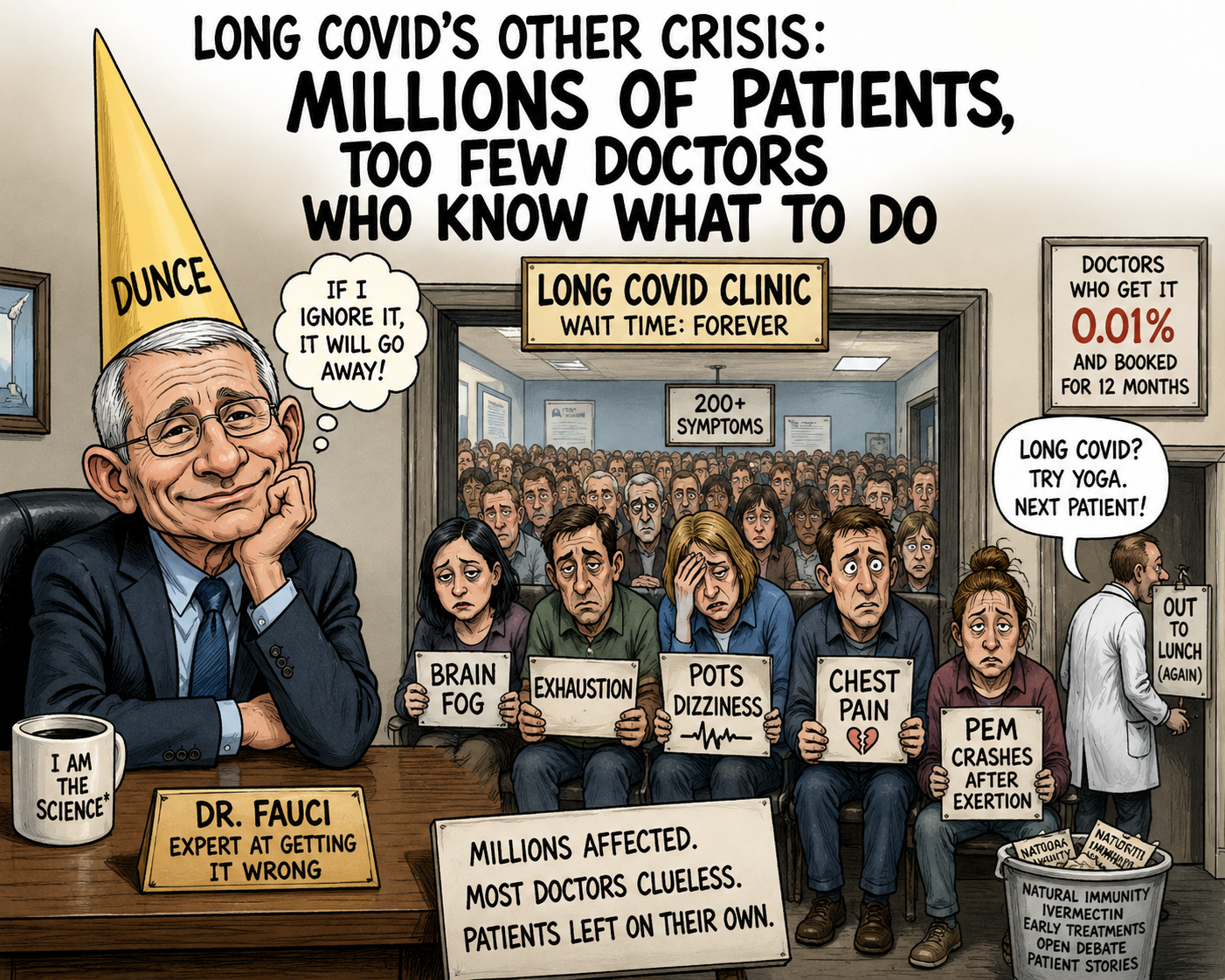
America spent billions studying Long COVID. Yet for many patients, finding a physician who understands the disease remains almost as difficult as finding a cure.
There is a cruel paradox at the center of America’s Long COVID crisis.
The disease is no longer mysterious in the sense that it was in 2020. Researchers have identified biological abnormalities involving the immune system, nervous system, cardiovascular system, blood vessels, metabolism, lungs and other organs. Sophisticated studies have demonstrated that SARS-CoV-2 can leave patients with persistent physiological abnormalities long after the acute infection has disappeared.
And yet, for many Americans who actually have the disease, medicine can still feel as though it is operating in 2020.
A patient walks into a doctor’s office exhausted, cognitively impaired, dizzy, short of breath, unable to tolerate exercise, suffering from abnormal heart rates, insomnia, neuropathic pain or gastrointestinal problems. Conventional laboratory tests may be unrevealing. There may be no single biomarker that announces, “This is Long COVID.”
The physician orders another routine blood panel.
Perhaps a cardiologist is consulted. Then a neurologist. Then a pulmonologist. Then a psychiatrist.
The patient is sent from specialist to specialist, while nobody assumes responsibility for the whole disease.
This is not merely frustrating.
It is a failure of medical organization.
The Centers for Disease Control and Prevention now acknowledges more than 200 symptoms associated with Long COVID and explicitly recognizes that the condition can be difficult to explain or diagnose, can require comprehensive care and can produce disability.
Mount Sinai’s Long COVID program is even more candid: there are still no definitive diagnostic tests, validated biomarkers or universally accepted treatments.
That leaves patients caught between a disease that modern research increasingly demonstrates is biological and a health-care system that frequently remains organized around diseases that can be identified by a single test, treated by a single specialty and billed under a familiar diagnosis.
A disease too large for the ordinary doctor’s office
Long COVID is not one disease.
That may be the single most important fact missing from the ordinary clinical encounter.
Researchers increasingly regard it as a collection of biological phenotypes or “endotypes.” Some patients appear to have persistent viral material or reservoirs. Others exhibit immune dysregulation or autoimmunity. Some develop autonomic dysfunction. Others have vascular abnormalities, metabolic disturbances, mitochondrial dysfunction, neurological injury, pulmonary abnormalities or combinations of these mechanisms.
Yale researchers have described several plausible mechanisms, including viral persistence, immune abnormalities, reactivation of latent viruses and autoimmunity. Yale’s Long COVID research program explicitly describes Long COVID as a condition likely composed of multiple endotypes rather than one uniform disease.
New evidence has made the picture still more compelling.
In 2026, researchers at Yale and Mount Sinai reported evidence that antibodies from some Long COVID patients can target tissues in the brain and nervous system. The affected biological pathways include those involved in pain, memory, balance, sensory processing and autonomic control—mechanisms capable of producing symptoms such as brain fog, dizziness, burning pain, numbness and fatigue.
This is no longer a credible story of millions of people simply “not recovering.”
It is a story of a complex post-infectious disease whose biology is gradually becoming visible.
The epidemiology is enormous
The number of Americans affected is difficult to state precisely because different studies use different definitions and because Long COVID has no single diagnostic test.
The World Health Organization estimates that approximately 6% of people who have had COVID develop post-COVID condition under its current estimates, while earlier WHO estimates placed the proportion substantially higher, at approximately 10% to 20%. The difference illustrates how dependent prevalence estimates are on definitions, populations and timing.
In the United States, CDC surveillance has found that millions of adults have experienced Long COVID. A CDC analysis of 2022 Behavioral Risk Factor Surveillance System data found that 6.4% of U.S. adults reported ever having experienced Long COVID. State estimates ranged from 1.9% to 10.6%.
NIH reported in 2024 that approximately one in nine U.S. adults who had experienced COVID continued to experience Long COVID.
The enormous variation between estimates should not be interpreted as evidence that Long COVID is insignificant. It demonstrates the opposite: America still does not have a sufficiently precise surveillance system for a disease affecting potentially millions of people.
And the spectrum is extraordinarily broad.
A large RECOVER analysis found that among participants meeting its research definition of Long COVID, 85.8% reported fatigue, 87.4% post-exertional malaise, 65.8% dizziness, 63.8% brain fog, 59.3% gastrointestinal symptoms and 58.0% palpitations.
Those numbers are not estimates of every American with Long COVID; they describe a selected research cohort. But they demonstrate something physicians encounter every day: the patient may present with an astonishing constellation of symptoms rather than a conventional single-organ disease.
The disease does not respect medical specialties
The cardiovascular burden can include tachycardia, palpitations, dysautonomia, endothelial dysfunction and other abnormalities.
The neurological burden can include cognitive impairment, headaches, dizziness, neuropathic symptoms, sensory abnormalities and sleep disorders.
The pulmonary burden can include persistent dyspnea and impaired exercise tolerance.
The gastrointestinal system may become involved.
The endocrine and metabolic systems may change.
Mental-health symptoms can coexist with—and sometimes be consequences of—physical disease.
Kidney, coagulation, musculoskeletal and other systems can also be affected.
A massive Veterans Affairs study published in Nature Medicine, involving 138,818 people with SARS-CoV-2 infection and almost 6 million controls, identified increased risks across multiple organ systems. Among people who had not been hospitalized for acute COVID, there were approximately 70.8 incident PASC events per 1,000 people over two years.
Three-year follow-up continued to demonstrate excess disease burden across cardiovascular, neurological, mental-health, coagulation, pulmonary and gastrointestinal systems, among others.
This creates an obvious problem.
A neurologist may understand neuropathy but not dysautonomia.
A cardiologist may understand arrhythmia but not post-exertional malaise.
A pulmonologist may understand impaired diffusion but not brain fog.
A psychiatrist may encounter anxiety and depression but not recognize that these can coexist with demonstrable physiological abnormalities.
The patient becomes the coordinator of his or her own disease.
That is unacceptable for a condition affecting millions.
Where the expertise actually exists
There are centers in the United States where Long COVID is taken seriously as a biological and multidisciplinary disease.
Mount Sinai Health System established what it describes as the first Long COVID Care Center in the United States in May 2020. Its program combines clinical care with research and participates in NIH RECOVER research.
Stanford Medicine operates a multidisciplinary Post-Acute COVID-19 Syndrome clinic involving internal medicine, infectious disease, pulmonology, neurology, cardiology, rheumatology, otolaryngology and behavioral health.
Yale School of Medicine has become one of the leading centers for Long COVID immunology. Akiko Iwasaki’s laboratory has investigated immune abnormalities, viral persistence, autoimmunity and biomarkers, while Yale’s LISTEN study collects clinical information and biological specimens from affected patients.
Northwestern Medicine operates a Comprehensive COVID-19 Center designed to coordinate multiple specialties rather than forcing patients to navigate the system independently.
These institutions are not necessarily offering cures. They are important because they recognize the fundamental problem: Long COVID requires integration.
The country needs many more such centers.
America has spent enormous sums—and still has no approved cure
This failure cannot reasonably be attributed to an absence of federal funding.
Congress initially appropriated $1.15 billion for NIH Long COVID research. An additional $662 million was subsequently allocated or reallocated for RECOVER research, bringing the major federal commitment to roughly $1.8 billion.
RECOVER has assembled more than 40,000 research participants, enormous biorepositories and extensive electronic-health-record resources. Its clinical-trial program has tested multiple interventions.
Yet NIH itself acknowledges the central problem: there are still no approved therapies specifically for Long COVID.
Stanford similarly states that Long COVID has no known cure.
This is perhaps the most important distinction between research progress and clinical progress.
The science is moving.
The patient sitting in the examination room is often not.
The uncomfortable question of institutional failure
It is tempting to describe this as a government “cover-up.”
That accusation requires caution.
There is not sufficient evidence to establish that the U.S. government, medical associations and the medical profession collectively conspired to conceal Long COVID, suppress its treatment or deliberately mislead the public.
There is, however, ample evidence for a less dramatic but still troubling conclusion:
The institutions responsible for protecting patients were not prepared for the long-term consequences of COVID-19 and were slow to develop a coherent clinical response.
Even NIH acknowledged early in the pandemic that some patients had gone more than a year without answers or treatment and that some had faced skepticism about whether their symptoms were real.
That should never have happened.
Nor should it still be happening.
The more legitimate question is not whether there was one enormous conspiracy.
It is whether institutional incentives, professional silos, political pressure, fear of controversy and the desire to maintain simple public-health narratives collectively discouraged inconvenient questions.
That question deserves investigation rather than dismissal.
The origins question remains unresolved
The same principle applies to the origin of SARS-CoV-2.
It is legitimate to demand transparency without pretending that the scientific question has been settled.
The origin of the pandemic remains unresolved. U.S. intelligence assessments have differed. Some agencies have favored a natural zoonotic origin, while at least one agency has assessed a laboratory-related origin with moderate confidence; other agencies have remained unable to decide.
Congressional investigations have subsequently raised additional questions about laboratory research, Chinese transparency and the handling of information by U.S. agencies.
That is evidence of an unresolved and politically charged investigation—not proof of a single established government cover-up.
But the public deserves the underlying records.
It deserves the scientific correspondence.
It deserves transparency concerning laboratory research, government grants, risk assessments and what officials knew and when they knew it.
A pandemic that produced millions of deaths and potentially millions of chronically ill people warrants nothing less.
Vaccines, masks and the problem of scientific absolutism
The most politically contentious part of the COVID story concerns vaccines, masks and alternative treatments.
Here again, the history is more complicated than either political camp generally admits.
COVID vaccines were never a guarantee against infection or indefinite protection from transmission. Their protection against infection waned, particularly as variants evolved.
But it is incorrect to conclude that vaccination therefore accomplished nothing.
A 2025 systematic review and meta-analysis involving more than 5.7 million participants found that vaccination before SARS-CoV-2 infection was associated with a moderate reduction in the risk of Long COVID; the pooled effectiveness against post-COVID condition was approximately 41% for at least one dose, although certainty varied and the evidence was observational rather than based entirely on randomized trials.
That is meaningful protection.
It is not sterilizing immunity.
Both statements can be true simultaneously.
Masks present a similarly complicated picture. A 2023 Cochrane review of randomized trials found that the available evidence did not establish a clear reduction in respiratory infection from community mask-wearing, while Cochrane subsequently emphasized that the review had been widely misinterpreted and that adherence and study design made the conclusions difficult to generalize.
The lesson should not be that “masks never worked.”
It should be that public-health interventions should be evaluated honestly, with their magnitude of benefit, limitations, context and uncertainties made explicit.
And then there was ivermectin
Ivermectin became a symbol of the political war over COVID science.
Some patients and physicians believed it deserved investigation. Others dismissed it as quackery.
The scientifically correct position was—and remains—simpler:
If a drug is biologically plausible and sufficiently safe, investigate it properly.
That does not mean declaring it a cure before the evidence exists.
And ivermectin actually was studied extensively.
The large PRINCIPLE randomized trial ultimately found that ivermectin produced only a small shortening of self-reported recovery—about two days—and did not produce clinically meaningful improvements in hospitalization, death or longer-term outcomes. The investigators concluded that additional trials in vaccinated community populations were unlikely to be warranted.
Consequently, the evidence does not support calling ivermectin a proven cure for COVID-19 or Long COVID.
But an important historical lesson remains.
Scientific disagreement should be resolved through randomized evidence, not ridicule, censorship or political tribalism.
A treatment should neither be promoted because it is politically fashionable nor suppressed merely because it is politically inconvenient.
The same standard should apply to vaccines, antivirals, immunomodulators, anticoagulants, rehabilitation, metabolic interventions and every experimental Long COVID therapy.
Natural immunity was also oversimplified
The notion that infection creates permanent protection was never biologically secure.
Immunity after infection can be substantial, but it changes with time, prior exposures, vaccination and viral evolution. Reinfection remains possible.
Likewise, the proposition that vaccination eliminates infection was never sustainable as variants evolved.
The better scientific formulation is considerably less satisfying politically:
Neither infection nor vaccination provides permanent, sterilizing immunity against an evolving coronavirus.
Both can nevertheless provide important protection against severe outcomes, and vaccination appears to reduce—but does not eliminate—the risk of Long COVID.
Science is rarely as binary as political messaging.
What physicians should be doing now
The central clinical problem has a practical solution.
Doctors do not need to know the precise molecular cause of every patient’s Long COVID before treating the patient seriously.
They need to recognize the syndrome.
They need to document the temporal relationship to SARS-CoV-2 infection.
They need to look systematically across organ systems.
They need to consider autonomic dysfunction, post-exertional malaise, sleep disorders, cognitive impairment, cardiovascular abnormalities, pulmonary disease, neurological disease, metabolic disturbances and other identifiable conditions.
They need to avoid assuming that normal routine laboratory tests equal normal physiology.
They need to know when exercise is helpful—and when aggressive exercise can worsen post-exertional malaise.
They need to coordinate specialists rather than simply generating referrals.
And they need to recognize that the absence of a definitive biomarker does not establish the absence of disease.
The CDC itself now recommends patient-centered management and emphasizes validating patients’ symptoms and connecting them with appropriate care.
That should be the minimum standard.
The prospect of a cure
There is finally reason for cautious optimism.
The recent research into autoimmunity is particularly important because it suggests that at least some patients may eventually be classified by biological mechanism and treated accordingly.
If researchers can identify which patients have autoantibodies damaging particular tissues, those patients may eventually become candidates for therapies already used to treat autoimmune disease.
Other patients may require entirely different strategies: antiviral treatment directed at persistent viral reservoirs, therapies targeting immune dysregulation, treatments for vascular dysfunction, autonomic therapies, metabolic interventions or combinations of these approaches.
The future may therefore not be a single “Long COVID drug.”
It may be something much more sophisticated:
Long COVID medicine based on biological subtypes.
One patient may have an autoimmune endotype.
Another may have persistent viral antigen.
Another may have autonomic dysfunction.
Another may have endothelial or microvascular abnormalities.
Another may have neurological injury.
Many may have several simultaneously.
That is how medicine ultimately conquers complicated diseases: not by forcing every patient into the same diagnostic box, but by discovering what is biologically different about each patient.
America’s unfinished obligation
The most disturbing fact about Long COVID is not that science has failed to find a cure.
Medicine has always needed time to understand new diseases.
The disturbing fact is that the distance between what researchers know and what ordinary patients receive remains enormous.
The United States has world-class investigators studying Long COVID.
It has enormous datasets.
It has sophisticated immunology.
It has neuroimaging.
It has molecular biology.
It has artificial intelligence and electronic medical records.
It has billions of dollars in research investment.
It has patients willing to participate in research.
What it lacks is enough physicians trained to translate that knowledge into clinical practice.
The solution is not another political argument about 2020.
It is a national clinical strategy for 2026 and beyond.
Medical schools should teach Long COVID.
Residency programs should teach it.
Continuing medical education should teach it.
Insurance companies should recognize multidisciplinary Long COVID care.
Academic centers should expand multidisciplinary clinics.
Federal research should concentrate increasingly on mechanism-based therapies and validated biomarkers.
Clinical trials should be faster, larger and designed around biologically defined patient groups.
And patients should no longer have to become medical researchers merely to persuade their doctors that something is wrong.
The pandemic may have ended as an emergency.
For millions of people, the disease did not end when the positive test disappeared.
They are still sick.
They are still looking for doctors.
And they are still waiting for medicine to catch up with the science.