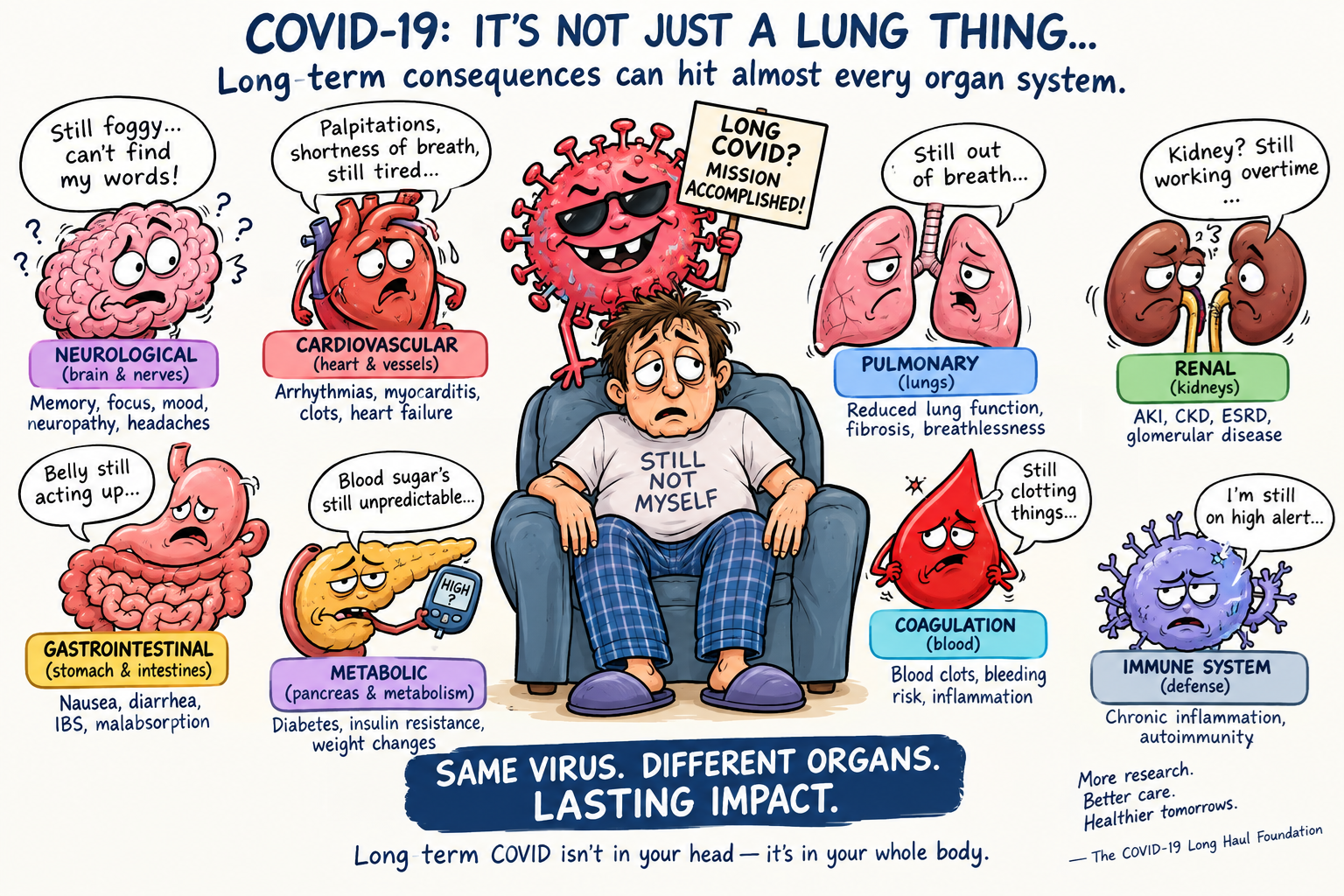
A cross-dataset analysis of persistent health loss, disability, and multisystem sequelae
John Murphy, CEO, The COVID-19 Long-haul Foundation
Manuscript type: Analysis / evidence synthesis
Data source note: This manuscript is a secondary synthesis of published aggregate data and public documentation. It does not claim independent patient-level access to restricted databases.
Summary
Background. The long-term consequences of SARS-CoV-2 infection extend beyond the acute respiratory illness, but the magnitude, duration, and distribution of post-acute organ-system injury remain incompletely understood. We examined whether convergent evidence from large longitudinal electronic-health-record cohorts, population biobanks, national surveys, and prospective clinical studies supports a model of persistent multisystem health loss after COVID-19.
Methods. We synthesised major public and published data sources, including US Veterans Health Administration cohorts, RECOVER/N3C and PCORnet datasets, UK Biobank, All of Us, national and prospective cohorts, and organ-specific studies. We extracted published cohort sizes, hazard ratios, excess burdens, disability-adjusted life years (DALYs), and follow-up duration. Secondary calculations were limited to arithmetic transformations of published aggregate values; no unpublished individual-level data were analysed.
Findings. Across large cohorts, SARS-CoV-2 infection was associated with excess risks in cardiovascular, neurological, renal, metabolic, gastrointestinal, pulmonary, coagulation, and other organ systems. In a 154,068-person US Veterans Affairs cohort, any neurological sequela had an adjusted hazard ratio of 1·42 (95% CI 1·38–1·47) and an estimated excess burden of 70·69 per 1,000 persons at 12 months. A separate 153,760-person cardiovascular cohort demonstrated increased risk across cerebrovascular disease, dysrhythmias, inflammatory heart disease, ischaemic heart disease, heart failure, and thromboembolic disease. At two years, cumulative PASC burden among previously hospitalised individuals reached 642·8 DALYs per 1,000 persons, with large contributions from cardiovascular, mental-health, neurological, coagulation/haematological, and kidney disorders. At three years, residual burden remained 9·6 DALYs per 1,000 among non-hospitalised participants and 90·0 per 1,000 among those initially hospitalised.
Interpretation. The available evidence supports Long COVID and post-acute sequelae of SARS-CoV-2 infection as a multisystem health condition rather than an isolated respiratory syndrome. Risk generally declines with time, but does not disappear, and the residual burden is disproportionately concentrated among people with severe acute disease. Future research should integrate organ-specific outcomes with symptom trajectories, reinfection, biological markers, treatment exposure, and functional outcomes over five or more years.
Research in context
Evidence before this study
Large VA, UK Biobank, RECOVER, N3C, PCORnet and prospective studies have independently reported post-acute cardiovascular, neurological, renal, metabolic, gastrointestinal and pulmonary consequences of SARS-CoV-2 infection. However, these datasets differ in population, case definition, outcome ascertainment, follow-up and acute disease severity. We therefore sought to place their quantitative findings on a common longitudinal framework rather than treating Long COVID as a single prevalence estimate.
Added value of this study
This analysis aligns the principal large datasets by cohort size, follow-up and outcome domain and demonstrates that the most important signal is not a single organ complication but persistent multisystem health loss. Published two-year DALY estimates show that cardiovascular, mental-health, neurological, coagulation/haematological and kidney outcomes account for large components of cumulative burden, while three-year data show measurable residual burden even after the risk of mortality has begun to converge in non-hospitalised patients.
Implications of all the available evidence
Post-COVID follow-up should not be organised solely around respiratory symptoms. Health systems should anticipate cardiovascular, neurological, renal, metabolic, gastrointestinal and functional consequences, particularly after severe acute infection. Research should move from isolated organ studies toward integrated longitudinal surveillance and intervention trials that test whether modifying specific biological or physiological pathways changes long-term outcomes.
Introduction
SARS-CoV-2 infection created an unusual epidemiological problem. An infection that begins as an acute respiratory illness can be followed by symptoms or newly diagnosed disease involving the nervous system, cardiovascular system, kidneys, gastrointestinal tract, endocrine metabolism, lungs and coagulation pathways. The clinical term Long COVID encompasses this heterogeneity, but the broader epidemiological literature often uses post-acute sequelae of SARS-CoV-2 infection (PASC) for coded outcomes in health records. The distinction matters because symptom-defined Long COVID and EHR-defined organ sequelae are related but not interchangeable constructs.
The decisive question is therefore not simply how many patients report persistent symptoms. It is whether infection produces measurable long-term excess disease, whether that excess persists after the first post-acute year, and whether the burden is distributed across organ systems in a reproducible manner.
Several large datasets now permit this question to be addressed. The VA national healthcare system provides unusually large matched cohorts; N3C, PCORnet and RECOVER provide much larger electronic-health-record populations; UK Biobank and All of Us contribute population-level phenotyping; and prospective cohorts provide detailed physiological measurements unavailable in routine records.
Methods
Data sources and eligibility
We included major publicly documented or published datasets that provided quantitative estimates of post-acute outcomes after SARS-CoV-2 infection. These included the US Veterans Health Administration national databases; RECOVER, N3C and PCORnet electronic-health-record programmes; UK Biobank; All of Us; prospective hospital and community cohorts; and organ-specific studies published in peer-reviewed journals. Studies were prioritised when they included a comparator population, longitudinal follow-up beyond 30 days, and quantitative estimates such as hazard ratios, incidence rates, excess burden, or DALYs.
The analysis is a structured evidence synthesis rather than a new individual-participant-data meta-analysis. Because definitions, covariate sets, outcome codes and follow-up intervals differ across datasets, formal pooling of effect estimates would risk creating a false precision. We therefore report estimates within their original study context and use secondary arithmetic only where the calculation is transparent and based solely on published aggregate data.
Analytical framework
We classified evidence into cardiovascular, neurological, renal, metabolic/endocrine, gastrointestinal, pulmonary, coagulation/haematological, and global health-loss domains. For burden estimates, we retained DALYs per 1,000 persons as reported by the source studies. For longitudinal interpretation, we distinguished relative risk (hazard ratio), absolute excess burden, cumulative burden, and residual burden in later years. These measures answer different questions and should not be substituted for one another.
Figure 1. Scale of major datasets used to study post-COVID outcomes. The populations are not directly comparable and are shown to illustrate the complementary roles of very large EHR datasets and deeply phenotyped prospective cohorts.
Results
Cardiovascular outcomes
One of the largest cardiovascular analyses used 153,760 COVID-19 survivors and 5,637,647 contemporary controls, with an additional 5,859,411 historical controls. Beyond 30 days after infection, incident cardiovascular disease was increased across cerebrovascular disorders, dysrhythmias, inflammatory heart disease, ischaemic heart disease, heart failure, other cardiac disorders, and thromboembolic disease. The associations were present even among people who had not been hospitalised and increased progressively with acute-care intensity. The cohort represented more than 12 million person-years of observation.
This pattern is important because it demonstrates that long-term cardiovascular risk cannot be reduced to the sequelae of critical illness alone. A substantial portion of the infected population never required hospitalisation, yet excess cardiovascular outcomes remained detectable.
Neurological outcomes
A companion VA study included 154,068 COVID-19 survivors, 5,638,795 contemporary controls, and 5,859,621 historical controls. At 12 months, the adjusted hazard ratio for any neurological sequela was 1·42 (95% CI 1·38–1·47), corresponding to an estimated excess burden of 70·69 (63·54–78·01) neurological outcomes per 1,000 persons. Outcomes included cerebrovascular disorders, cognition and memory disorders, peripheral neuropathies, episodic disorders, movement disorders, mental-health disorders, musculoskeletal disorders, sensory abnormalities, and encephalitis or encephalopathy.
The magnitude is clinically important because neurological risk was evident even after non-hospitalised acute disease. The result also illustrates why a narrow definition of Long COVID based on fatigue alone would underestimate the post-acute neurological phenotype.
Renal outcomes
Kidney outcomes provide some of the clearest evidence that post-COVID disease can extend beyond the first post-acute year. A 2026 national commercial-insurance study included 939,241 COVID-19 cases, 1,878,482 negative controls and 199,071 influenza cases. COVID-19 was associated with higher risks of acute kidney injury, chronic kidney disease, end-stage renal disease and glomerular disease than influenza. The effect on acute kidney injury was greatest soon after infection, whereas the association with chronic kidney disease remained evident over longer follow-up.
The use of influenza as an active comparator is particularly valuable because it reduces—but does not eliminate—bias arising from healthcare utilisation and acute infectious illness. The persistence of the CKD signal beyond the early period strengthens the argument that SARS-CoV-2 infection can be followed by durable renal health consequences.
Metabolic and endocrine outcomes
A Lancet Diabetes & Endocrinology cohort included 181,280 COVID-19 survivors and more than 4·1 million contemporary controls. The investigators reported a hazard ratio of 1·40 (95% CI 1·36–1·44) for incident diabetes after the first 30 days. Subsequent work has shown that some apparent post-COVID diabetes may be transient or affected by differences in laboratory surveillance, underscoring the need to distinguish persistent diabetes from transient dysglycaemia.
Nevertheless, the consistency of associations between infection and metabolic abnormalities across large datasets argues that glucose metabolism belongs within the long-term surveillance framework rather than being considered solely an acute complication.
Gastrointestinal outcomes
A 154,068-person VA cohort found increased one-year risks of gastrointestinal disorders including motility disorders, dyspepsia, gastro-oesophageal reflux disease, peptic ulcer disease, functional intestinal disorders, acute pancreatitis, and hepatic and biliary disorders. Associations were present in non-hospitalised patients and increased with acute disease severity.
The gastrointestinal findings are important because they broaden the concept of post-COVID disease beyond the organs most directly associated with respiratory infection. They also provide a plausible bridge to nutritional, metabolic and microbiome-mediated mechanisms.
Pulmonary outcomes
Pulmonary abnormalities are the most intuitive post-COVID sequelae, particularly after severe disease. In a cohort of 257 hospitalised survivors evaluated 3–5 months after discharge, reduced diffusing capacity was present in 36% and reduced maximal expiratory pressure in 24%. Critical illness was strongly associated with reduced diffusion capacity and reduced forced vital capacity.
These findings demonstrate that structural or physiological pulmonary impairment can persist after the acute phase, but they should not be extrapolated to all people with Long COVID. The largest population burden includes non-hospitalised individuals whose dominant problems may be neurological, autonomic, cardiovascular, metabolic or multisystem.
Two-year health loss
The most informative synthesis of long-term burden comes from the VA two-year analysis. Among previously hospitalised patients, cumulative PASC incidence reached 316·4 per 1,000 persons and cumulative health loss reached 642·8 DALYs per 1,000 persons at two years. Reported organ-system DALYs included 144·0 cardiovascular, 130·2 mental-health, 120·6 neurological, 90·8 coagulation/haematological, 65·0 kidney, 44·9 pulmonary, 23·8 fatigue, 19·5 gastrointestinal, 7·4 diabetes and 6·2 musculoskeletal DALYs per 1,000 persons.
These component estimates should not be arithmetically summed as independent mutually exclusive outcomes because organ-system categories and PASC burden metrics can overlap. Their value lies in demonstrating the distribution of health loss across systems. Cardiovascular, mental-health and neurological domains were each larger contributors than pulmonary disease alone.
Figure 2. Published two-year PASC DALY burden by organ system among previously hospitalised participants. Values are reported DALYs per 1,000 persons; categories should not be interpreted as mutually exclusive.
Three-year persistence
A subsequent VA analysis followed 135,161 infected people and 5,206,835 controls for three years. Among non-hospitalised patients, the excess risk of death was no longer present after the first year, but incident PASC risk continued to decline rather than disappearing and contributed 9·6 (95% CI 0·4–18·7) DALYs per 1,000 persons in the third year. Among hospitalised patients, mortality remained elevated in year three, with an incidence-rate ratio of 1·29 (95% CI 1·19–1·40), and residual PASC burden reached 90·0 (55·2–124·8) DALYs per 1,000 persons.
Figure 3. Residual third-year health-loss burden. Published DALY estimates from the three-year VA study.
Interpretation across data sources
The principal finding of this cross-dataset analysis is convergence. Although individual studies differ in design, the direction of evidence is remarkably consistent: SARS-CoV-2 infection is followed in a subset of patients by excess disease across multiple organ systems, and the excess risk generally declines but can remain measurable for years.
Equally important is the gradient by acute severity. Severe infection produces the largest absolute long-term burden, but non-hospitalised infection is not biologically or epidemiologically neutral. Cardiovascular and neurological risks have been observed after non-hospitalised disease, and gastrointestinal and metabolic consequences have similarly been detected outside hospital cohorts.
The resulting model is therefore neither ‘every infection causes chronic disease’ nor ‘only critically ill patients develop long-term consequences’. The evidence supports a risk continuum in which acute severity, host susceptibility, reinfection, biological response and subsequent disease processes interact.
Figure 4. Proposed longitudinal model linking infection, host susceptibility, biological injury, organ-specific sequelae and long-term health loss. Conceptual synthesis, not an empirically validated causal diagram.
Discussion
Four conclusions follow from the aggregate evidence. First, post-COVID health loss is multisystem. Cardiovascular and neurological disease are not isolated exceptions; kidney, metabolic, gastrointestinal, pulmonary and coagulation outcomes also show excess risk. Second, absolute burden matters as much as relative risk. A hazard ratio of 1·4 may represent very different public-health consequences depending on baseline incidence. Third, duration matters. The three-year data demonstrate that declining risk does not equal disappearance of burden. Fourth, severity modifies risk but does not define it: non-hospitalised individuals remain an important population for surveillance.
The findings also expose a major limitation of current surveillance. Administrative data identify coded disease but can miss disabling symptoms that do not generate a diagnosis. Conversely, symptom cohorts can capture substantial morbidity without establishing whether an organ-system lesion exists. The strongest future studies should link patient-reported outcomes, objective physiology, laboratory data, imaging, prescriptions, claims and EHR diagnoses within the same individuals.
Reinfection deserves particular attention. Large VA analyses show that repeated infection increases the cumulative risk of death and post-acute sequelae across organ systems. A patient with one infection and a patient with three infections should not be treated as equivalent exposures in longitudinal modelling. Reinfection should be modelled as a time-varying exposure rather than a binary baseline characteristic.
The most consequential policy implication is that post-COVID care should be organised around risk and trajectory rather than a single syndrome label. A patient with persistent dyspnoea may require a pulmonary pathway; another with orthostatic intolerance and cognitive dysfunction may require neurological and autonomic assessment; another may have renal or metabolic consequences. A single generic Long COVID clinic model cannot optimally address every biological phenotype.
Limitations
This study has important limitations. The datasets were not individually harmonised, and formal pooled estimates were therefore not attempted. Several large cohorts, particularly the VA studies, have demographic characteristics that limit generalisability. EHR studies are vulnerable to coding practices, healthcare access, ascertainment bias and changes in testing over time. Prospective symptom cohorts may over-represent people with substantial symptoms. The term Long COVID is not operationalised identically across datasets. Some reported outcomes may reflect consequences of severe acute illness, treatment exposure, pandemic-era healthcare disruption, or unmeasured confounding rather than direct viral effects. Finally, aggregate-data synthesis cannot establish patient-level causal pathways.
Conclusion
The evidence accumulated across the world’s largest clinical datasets now supports a clear conclusion: the long-term consequences of SARS-CoV-2 infection cannot be adequately represented by a single symptom score or a respiratory diagnosis. The post-acute burden is distributed across the cardiovascular, neurological, renal, metabolic, gastrointestinal, pulmonary and coagulation systems, with measurable health loss extending into the third year after infection.
The central scientific challenge is now to determine which patients are at risk, which organ systems are likely to be affected, how those trajectories evolve, and which interventions can prevent progression. The appropriate next generation of studies should therefore integrate longitudinal symptoms, objective physiology, biological measurements, EHR outcomes and repeated infection history over five or more years.
Long COVID should not be understood as a disease that simply follows COVID-19. It is better understood as a potential transition from an acute infectious event into a prolonged state of altered health—one whose probability, phenotype and duration vary substantially between individuals. The task of medicine is to identify that transition early, quantify its consequences, and determine whether it can be prevented or reversed.
Data availability
No new individual-level dataset was created. All quantitative results were derived from publicly reported aggregate data and published studies. Restricted datasets such as VA, N3C, RECOVER participant-level data, UK Biobank and All of Us are not represented as directly accessed individual-level datasets in this analysis. Public access varies by programme and requires the relevant governance or application process.
Funding
No external research funding was received for this secondary evidence synthesis.
Role of the funder
Not applicable.
Contributors
John Murphy conceived the analysis, interpreted the published evidence, drafted the manuscript, and approved the final version.
Declaration of interests
John Murphy is CEO of The COVID-19 Long-haul Foundation. The author declares no commercial financial interests related to the analyses presented here.
Ethics approval
Not applicable. No new human participants were enrolled and no identifiable participant-level data were accessed.
AI-use disclosure
Generative AI assistance was used for literature-search support, drafting, organisation, and language editing. All quantitative claims should be verified against the cited primary publications before submission. The author retains responsibility for the accuracy, interpretation, and final submitted manuscript.
References
1. Xie Y, Xu E, Bowe B, Al-Aly Z. Long-term cardiovascular outcomes of COVID-19. Nat Med. 2022;28:583-590. doi:10.1038/s41591-022-01689-3.
2. Xu E, Xie Y, Al-Aly Z. Long-term neurologic outcomes of COVID-19. Nat Med. 2022;28:2406-2415. doi:10.1038/s41591-022-02001-z.
3. Xu E, Xie Y, Al-Aly Z. Long-term gastrointestinal outcomes of COVID-19. Nat Commun. 2023;14:983. doi:10.1038/s41467-023-36223-7.
4. Xie Y, Al-Aly Z. Risks and burdens of incident diabetes in long COVID: a cohort study. Lancet Diabetes Endocrinol. 2022;10:311-321. doi:10.1016/S2213-8587(22)00044-4.
5. Xie Y, Al-Aly Z. Postacute sequelae of COVID-19 at 2 years. Nat Med. 2023;29:2347-2357. doi:10.1038/s41591-023-02521-2.
6. Cai M, Xie Y, Bowe B, et al. Three-year outcomes of post-acute sequelae of COVID-19. Nat Med. 2024;30:1564-1575. doi:10.1038/s41591-024-02987-8.
7. Zhang Y, Ghahramani N, Chinchilli VM, et al. The risk of kidney disease increases following SARS-CoV-2 infection compared to influenza. Commun Med. 2026;6:189.
8. Puntmann VO, Martin S, Nagel E, et al. Long-term cardiac pathology in individuals with mild initial COVID-19 illness. Nat Med. 2022.
9. Nalbandian A, Sehgal K, Gupta A, et al. Post-acute COVID-19 syndrome. Nat Med. 2021;27:601-615.
10. Bowe B, Xie Y, Al-Aly Z. Acute and postacute sequelae associated with SARS-CoV-2 reinfection. Nat Med. 2022;28:2398-2405.
11. Thaweethai T, Donohue SE, Martin JN, et al. Long COVID trajectories in the prospectively followed RECOVER-Adult US cohort. Nat Commun. 2025;16:9557.
12. RECOVER Initiative. RECOVER data and electronic health record resources. National Institutes of Health; 2025-2026.
13. O’Neil ST, Madlock-Brown C, Wilkins KJ, et al. Finding Long-COVID: temporal topic modeling of electronic health records from the N3C and RECOVER programs. NPJ Digit Med. 2024.
14. Al-Aly Z, Xie Y, Bowe B. High-dimensional characterization of post-acute sequelae of COVID-19. Nature. 2021;594:259-264.
15. Liew F, et al. Large-scale phenotyping of patients with long COVID post-hospitalization reveals mechanistic subtypes of disease. Nat Immunol. 2024.
16. Klein J, Wood J, Jaycox JR, et al. Distinguishing features of long COVID identified through immune profiling. Nature. 2023;623:139-148.
17. STROBE Statement. von Elm E, Altman DG, Egger M, et al. The Lancet. 2007;370:1453-1457.
Tables
| Domain | Principal source | Cohort | Key quantitative finding |
| Cardiovascular | VA | 153,760 COVID; 5,637,647 controls | Increased risk across cerebrovascular, rhythm, inflammatory, ischaemic, heart-failure and thromboembolic outcomes |
| Neurological | VA | 154,068 COVID; 5,638,795 controls | HR 1·42 for any neurological sequela; 70·69 excess/1,000 at 12 months |
| Kidney | MarketScan | 939,241 COVID; 199,071 influenza | Higher AKI, CKD, ESRD and glomerular disease risk than influenza |
| Diabetes | VA | 181,280 COVID; 4,118,441 contemporary controls | HR 1·40 for incident diabetes |
| Gastrointestinal | VA | 154,068 COVID; 5,638,795 controls | Higher risk of multiple GI, hepatic and biliary outcomes |
| Global burden, 2 years | VA | Hospitalised cohort | 642·8 DALYs/1,000; 316·4 PASC events/1,000 |
| Global burden, 3 years | VA | 135,161 COVID; 5,206,835 controls | 9·6 DALYs/1,000 in year 3 after non-hospitalised infection; 90·0/1,000 after hospitalisation |