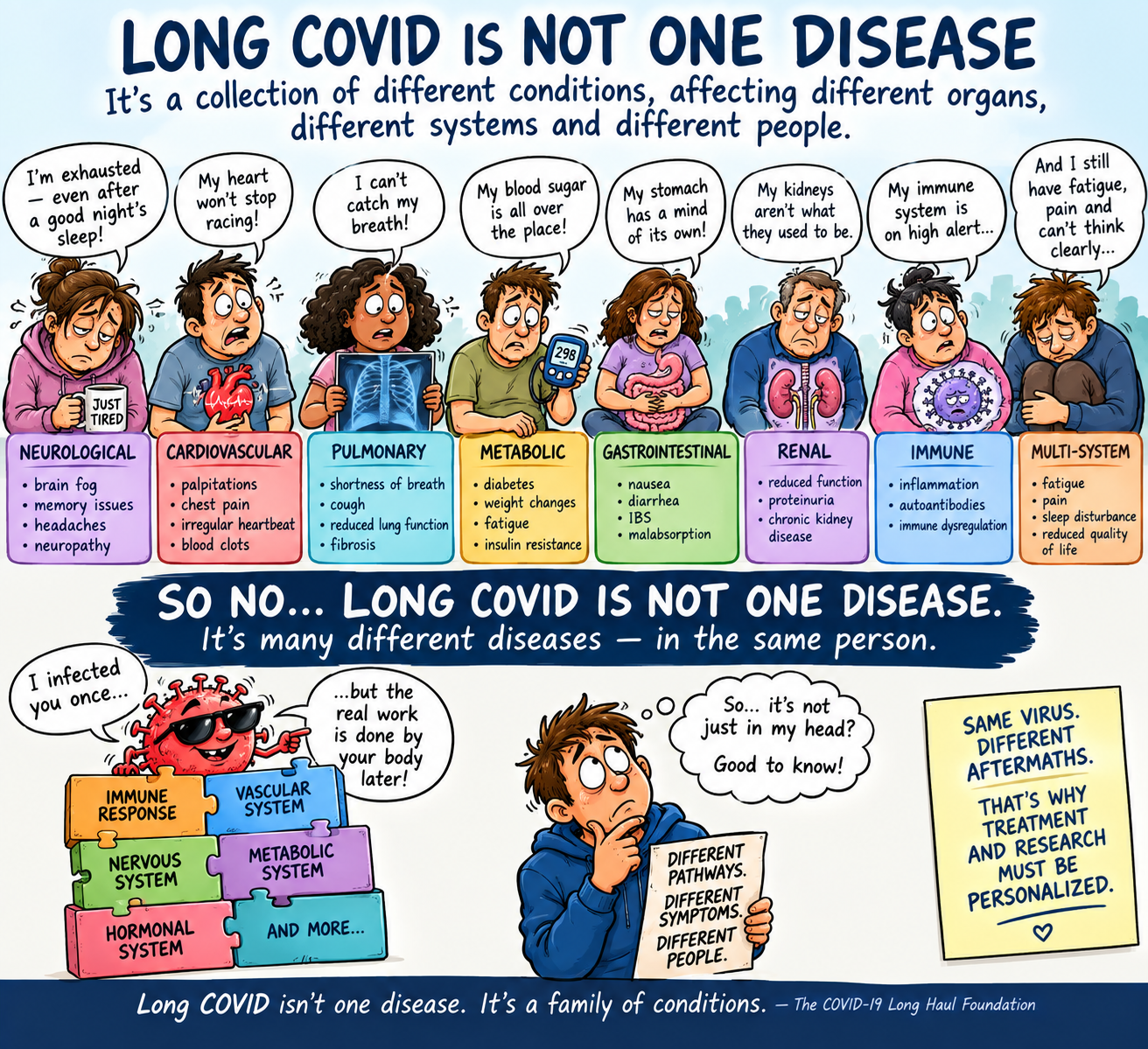
What millions of medical records reveal about the hidden phenotypes of a disease that can follow SARS-CoV-2 infection
John Murphy, CEO, The COVID-19 Long Haul Foundation
Abstract
Long COVID is increasingly recognized not as a single syndrome but as a heterogeneous collection of post-infectious disease states. The emerging question is therefore no longer simply how many people develop Long COVID, but whether patients can be reliably divided into biologically and clinically meaningful phenotypes—and whether those phenotypes predict who will recover, who will remain disabled and which treatments might work.
Analysis of large-scale government, electronic-health-record, prospective-cohort and academic datasets provides compelling evidence for heterogeneity. The NIH RECOVER program has identified five symptom-defined phenotypes among adults with Long COVID. The National COVID Cohort Collaborative (N3C) and RECOVER programs previously identified six clinically distinct clusters from electronic health records. A separate N3C/RECOVER temporal analysis encompassing more than 12 million patients identified hundreds of clinically coherent longitudinal patterns. Large United Kingdom studies have identified three broad symptom classes, while other prospective cohorts have identified three or four phenotypes. A 2026 systematic review encompassing 64 studies and approximately 2.43 million participants found that symptom co-occurrence and organ-system classification were the two dominant approaches to phenotyping.
Longitudinal data add another dimension. In one 24-month prospective analysis, approximately two thirds of participants followed a trajectory of relatively mild symptoms and faster resolution, whereas approximately one third entered a persistently elevated symptom trajectory. Older age, female sex, elevated body-mass index and multiple comorbidities increased the likelihood of persistent symptoms.
Taken together, these findings suggest that “Long COVID” is better regarded as an umbrella diagnosis encompassing partially overlapping clinical phenotypes that may have different biological mechanisms, prognoses and therapeutic requirements. The next stage of Long COVID research should therefore move beyond counting symptoms toward constructing validated longitudinal phenotypes that integrate clinical manifestations, objective biomarkers, organ injury, genetics, immune signatures, autonomic physiology, imaging and treatment response.
The disease hidden inside the diagnosis
Medicine often begins by naming a syndrome and ends by dividing it into diseases.
Pneumonia was once a broad clinical description. Cancer was once treated as a largely undifferentiated category. Autoimmune disease was once understood primarily through symptoms rather than molecular mechanisms. Progress came when physicians learned that apparently similar patients could have fundamentally different underlying disorders.
Long COVID may be approaching the same transition.
The World Health Organization defines post-COVID-19 condition as a syndrome that usually occurs about three months after SARS-CoV-2 infection, persists for at least two months and cannot be explained by another diagnosis. Symptoms may persist from the acute illness, appear after apparent recovery, fluctuate or relapse.¹ The 2024 National Academies definition is deliberately broader: Long COVID is an infection-associated chronic condition present for at least three months that may be continuous, relapsing and remitting or progressive and may affect one or more organ systems.²
That broad definition is useful clinically. It may be insufficient scientifically.
A patient whose principal problem is post-exertional malaise and cognitive dysfunction may have a very different disease process from a patient whose dominant problem is persistent cough and impaired pulmonary gas exchange. A patient with palpitations, orthostatic intolerance and autonomic dysfunction may share symptoms with the first two patients while possessing a different physiological abnormality.
Calling all three cases “Long COVID” identifies the common initiating infection. It does not necessarily identify the disease mechanism.
The central scientific question is therefore:
How many clinically meaningful forms of Long COVID exist, who develops them, and how do they evolve?
The answer emerging from millions of observations is increasingly clear: there is more than one.
A natural experiment in disease classification
The scale of Long COVID has created an unusual opportunity for medical epidemiology.
Researchers now have access to several fundamentally different kinds of evidence:
- population surveys that capture symptoms that never reach a physician;
- electronic health records that capture diagnoses, medications, laboratory testing and hospitalizations;
- prospective cohorts that repeatedly measure the same patients;
- biobanks containing DNA, proteins, metabolites and other biological specimens;
- medical-imaging repositories;
- wearable-device measurements;
- administrative claims;
- national mortality and hospitalization records; and
- clinical-trial datasets.
Each source observes a different part of the disease.
That distinction matters.
Self-reported surveys are particularly good at detecting fatigue, brain fog, post-exertional malaise and other symptoms that may never receive an ICD code. Electronic health records are excellent for detecting diagnoses, medications, laboratory abnormalities and healthcare utilization but systematically miss patients who do not seek care or whose physicians do not recognize or code Long COVID. OpenSAFELY research, for example, has demonstrated that clinically coded Long COVID represents only a fraction of the burden suggested by population surveys.³
Prospective cohorts can determine whether a symptom precedes or follows infection, something a cross-sectional survey cannot reliably establish.
Biobanks can ask a different question: whether apparently similar clinical phenotypes have different biological signatures.
The emerging phenotype literature is therefore not contradictory merely because studies identify different numbers of clusters.
It may instead be revealing different layers of the same disease architecture.
Five phenotypes emerge from the NIH RECOVER program
The most consequential U.S. effort to establish a standardized Long COVID phenotype is the NIH Researching COVID to Enhance Recovery program.
The 2024 RECOVER adult research index analyzed 13,647 participants enrolled at 83 sites in the United States and Puerto Rico. The study included participants with and without recognized previous SARS-CoV-2 infection and incorporated substantially more symptoms than the original RECOVER index.⁴
The resulting index identified five symptom subtypes among participants meeting the research threshold.
Phenotype 1: Altered smell and taste
This phenotype is characterized principally by disturbance of smell or taste.
The significance extends beyond sensory symptoms. Persistent olfactory dysfunction provides evidence that SARS-CoV-2 can produce a prolonged neurological or neuroepithelial consequence, and it may identify a biologically distinct subset of patients.
Phenotype 2: Respiratory disease
Chronic cough is the defining additional feature of this phenotype.
This group is particularly important because respiratory abnormalities can sometimes be investigated objectively through pulmonary-function testing, imaging and other physiological measurements.
Phenotype 3: Cognitive dysfunction
Brain fog distinguishes the third phenotype.
The phrase “brain fog” is clinically imprecise, but it encompasses a recognizable group of problems involving concentration, memory, processing and executive function. Objective neuropsychological testing, neuroimaging and physiological studies may ultimately determine whether this phenotype represents one disorder or several.
Phenotype 4: Cardiovascular/autonomic symptoms
Palpitations characterize the fourth phenotype.
Palpitations can arise from multiple mechanisms, including dysautonomia, abnormal autonomic regulation, inappropriate sinus tachycardia, orthostatic intolerance or other cardiovascular abnormalities. The symptom therefore identifies a clinical phenotype rather than a single mechanism.
Phenotype 5: Multisystem disease
The fifth phenotype is the most striking.
It combines post-exertional soreness, dizziness and gastrointestinal symptoms with the broader symptom burden characteristic of Long COVID.
Patients in this group reported worse quality of life, physical health and daily functioning than patients in the other phenotypes. Women were more likely than men to fall into phenotypes 4 and 5, whereas men were relatively more represented in phenotype 3. Hispanic and multiracial participants were more represented in phenotype 5. The phenotype was also more common among unvaccinated participants and people infected before Omicron circulation.⁴
These observations do not prove that vaccination or viral variant caused the phenotypic differences. They demonstrate that the composition of Long COVID populations changes with host characteristics, viral era and prior immunity.
That is an important distinction.
Figure 1. The five RECOVER phenotypes
The published analysis reported 300 participants in the subtype analysis:
| RECOVER subtype | Dominant characteristic | Participants |
|---|---|---|
| 1 | Smell/taste disturbance | 67 |
| 2 | Chronic cough | 38 |
| 3 | Brain fog | 62 |
| 4 | Palpitations | 76 |
| 5 | Post-exertional soreness/dizziness/GI symptoms | 54 |
The published component counts total 297 rather than 300, a small numerical discrepancy in the presentation of the subtype counts that should be retained transparently rather than silently corrected.⁴
More important than the precise percentages is the conceptual finding: the same diagnostic category contains recognizable symptom architectures.
The symptom burden is not simply “fatigue”
Fatigue is often presented as the defining symptom of Long COVID.
Large datasets suggest a more complicated picture.
Among RECOVER participants classified as having likely Long COVID, post-exertional malaise was reported by 87.4 percent and fatigue by 85.8 percent. Post-exertional soreness occurred in 75.0 percent of the subset in which it was measured, dizziness in 65.8 percent, brain fog in 63.8 percent, gastrointestinal symptoms in 59.3 percent and palpitations in 58.0 percent.⁴
These findings are important because they demonstrate that fatigue is embedded within a larger physiological syndrome.
The combination of post-exertional malaise, cognitive dysfunction, autonomic symptoms, gastrointestinal disturbances and sensory abnormalities is qualitatively different from ordinary fatigue.
The data therefore argue against treating Long COVID as a single fatigue disorder.
Figure 2. Most frequent symptoms in the RECOVER Long COVID population
The clustering of symptoms is itself informative. If fatigue were the disease, these other symptoms would be secondary complications. If Long COVID is a family of related disorders, these symptoms may instead constitute different expressions of distinct physiological systems.
Millions of electronic records tell a different story
The RECOVER approach begins with carefully collected symptoms.
Electronic health records begin somewhere else: with what actually happens to patients as they move through the healthcare system.
The N3C/RECOVER collaboration analyzed electronic health records at enormous scale and identified six distinct Long COVID clusters using clinical phenotype features and unsupervised clustering methods.⁵
The clusters included pulmonary, neuropsychiatric and cardiovascular patterns as well as broader multisystem phenotypes.
This matters because electronic health records are not simply another symptom questionnaire.
They capture diagnoses that patients may not recognize as related to Long COVID, medication use, laboratory testing, hospital encounters and the temporal sequence of healthcare events.
The broad severe multisystem cluster was associated with increased mortality, while demographic characteristics varied across clusters. The findings were also generalized across multiple healthcare centers.
The implication is powerful:
Long COVID phenotypes can emerge even when researchers do not begin with a preconceived list of Long COVID symptoms.
That makes the EHR evidence complementary to patient-reported research.
The temporal dimension changes the question
A major limitation of traditional cluster analysis is that it can produce a snapshot of disease.
Long COVID is not a snapshot.
It fluctuates.
The N3C/RECOVER temporal topic-modeling study analyzed more than 12 million patients across 63 clinical sites and more than 230 healthcare locations. More than 600 million condition diagnoses were examined, generating hundreds of clinically coherent longitudinal topics.⁶
The investigators found patterns that changed after SARS-CoV-2 infection and differed according to age, sex, pandemic wave and post-acute COVID status.
This approach reveals something that static clustering cannot:
the phenotype itself may change.
A patient may begin with respiratory disease and later develop cognitive symptoms. Another may have mild acute disease followed months later by autonomic dysfunction. A third may improve steadily and never enter a persistent syndrome.
The disease may therefore be represented more accurately as a trajectory through phenotype space than as membership in a permanent diagnostic box.
The United Kingdom finds three broad symptom architectures
The largest UK analyses provide another perspective.
Subramanian and colleagues studied approximately 384,000 SARS-CoV-2-infected people and more than 1.5 million comparison individuals. Among more than 50,000 infected participants with persistent symptoms, latent-class analysis identified three broad groups.⁷
Approximately 80 percent belonged to a broad pain/fatigue/rash phenotype.
Approximately 5.8 percent formed a predominantly respiratory phenotype characterized by cough, shortness of breath and phlegm.
Approximately 14.2 percent constituted a mental-health/cognitive phenotype involving depression, anxiety, insomnia and brain fog.
The proportions differ from RECOVER.
That is not necessarily a failure of replication.
It is evidence that phenotype boundaries depend on the population sampled, the symptoms measured, the duration of follow-up and the statistical method used.
Figure 3. Three broad phenotypes in the UK latent-class analysis
The contrast with RECOVER illustrates an important methodological principle: there is unlikely to be one universally correct number of Long COVID phenotypes.
Instead, there may be nested levels of classification.
How many phenotypes are there?
The question may be framed incorrectly.
If the brain fog phenotype can be subdivided into patients with measurable cognitive impairment and patients whose principal abnormality is sleep disruption, then two phenotypes may exist within one.
Likewise, the cardiovascular/autonomic group could potentially contain several endotypes:
- inappropriate sinus tachycardia;
- orthostatic intolerance;
- POTS-like physiology;
- endothelial dysfunction;
- impaired exercise capacity; or
- other cardiovascular abnormalities.
Clinical phenotypes describe what patients experience.
Endotypes attempt to describe why.
The distinction is fundamental.
A systematic review provides the larger map
The most comprehensive synthesis to date reinforces the heterogeneity.
A 2026 systematic review examined 47 cohort studies and 17 cross-sectional studies, representing approximately 2.43 million participants across 20 countries.⁸
The investigators found four major approaches to classification:
- symptom co-occurrence;
- organ-system involvement;
- severity stratification; and
- clinical or biological indicators.
Symptom co-occurrence was the most common approach.
Fatigue was the most frequently recurring cluster descriptor. Common symptom pairings included smell/taste disturbance, anxiety/depression and joint or muscle pain. Fatigue frequently co-occurred with pain, cognitive symptoms and dyspnea.
Among studies using organ-system classification, respiratory clusters had a pooled proportion of approximately 47 percent, neurological clusters approximately 31 percent and gastrointestinal clusters approximately 28 percent.
These numbers must not be interpreted as population prevalence. They describe proportions within particular organ-system classification studies.
That distinction illustrates a broader problem in Long COVID epidemiology: prevalence, phenotype frequency and symptom frequency are often inadvertently conflated.
Figure 4. What the systematic review says about Long COVID classification
The statistical diversity is itself a finding.
Different investigators are measuring different dimensions of a multidimensional disease.
Phenotype is only half the story
Suppose two patients have the same symptoms at month six.
One recovers by month twelve.
The other deteriorates.
At month six they belong to the same phenotype.
At month twenty-four they do not.
This is why longitudinal trajectory may be more informative than phenotype alone.
A 2025 analysis of 555 participants followed for up to 24 months identified two principal symptom trajectories.⁹
The first—376 participants, or 67.7 percent—was characterized by relatively mild symptoms and faster resolution.
The second—179 participants, or 32.3 percent—was characterized by elevated and persistent symptoms.
The second group was associated with older age, female sex, elevated body-mass index and multiple comorbidities.
The odds ratios reported for these predictors were approximately 1.86 for older age, 1.81 for female sex, 3.97 for elevated BMI and 2.67 for multiple comorbidities.
These are associations, not deterministic predictors.
Nevertheless, they demonstrate that Long COVID is not merely a collection of symptoms. It has trajectories.
Figure 5. Two-year trajectories
The existence of a persistent trajectory has a major implication for research.
The objective should not simply be to determine whether a person “has Long COVID.”
It should be to determine:
Which trajectory is this person entering?
Figure 6. Factors associated with the persistent trajectory
The particularly strong association with elevated BMI deserves additional investigation, as does the relationship between pre-existing disease burden and persistent symptoms.
Such variables could ultimately become part of a predictive model that identifies patients at elevated risk before disability becomes entrenched.
The phenotype changes with the pandemic
RECOVER provides another important clue.
The proportion meeting its 2024 Long COVID research threshold was approximately 33.8 percent among those infected before Omicron circulation compared with 12.7 percent among those infected during the Omicron period.⁴
Again, this does not establish that Omicron intrinsically produces less Long COVID.
Changes in immunity, vaccination, previous infection, testing behavior, treatment, clinical severity and viral characteristics occurred simultaneously.
But the observation is scientifically important.
If the phenotype distribution changes across viral eras, Long COVID cannot be understood entirely as a fixed consequence of SARS-CoV-2 infection.
It is the product of an interaction among:
virus × host × immunity × acute disease × treatment × time.
The biology begins to separate the phenotypes
The strongest evidence that clinical phenotypes may correspond to different biological processes comes from studies combining symptom clusters with laboratory measurements.
In a 2024 Nature Immunology study, researchers analyzed 368 plasma proteins in 657 participants at least three months after hospitalization. Of these, 426 had at least one Long COVID symptom and 233 had recovered.¹⁰
Long COVID was associated with elevated markers of myeloid inflammation and complement activation.
Certain proteins were associated with particular symptom groups.
IL-1R2, MATN2 and COLEC12 were associated with cardiorespiratory symptoms, fatigue and anxiety/depression.
MATN2, CSF3 and C1QA were associated with gastrointestinal symptoms.
C1QA was associated with cognitive impairment.
This does not mean that these proteins are established diagnostic biomarkers.
They are not.
But the pattern is exactly what would be expected if apparently similar clinical syndromes contain partially different biological processes.
Figure 7. From symptoms to mechanisms
A proposed longitudinal phenotype architecture
                  SARS-CoV-2 INFECTION
                           │
                           ▼
                 ┌────────────────────┐
                 │ Acute host response │
                 └─────────┬──────────┘
                           │
          ┌────────────────┼────────────────┐
          ▼                ▼                ▼
      Host factors     Viral factors    Acute severity
      genetics         variant           treatment
      age/sex          reinfection       hospitalization
      comorbidity      immunity
          │                │                │
          └────────────────┼────────────────┘
                           ▼
                POST-ACUTE BIOLOGICAL STATE
                           │
        ┌──────────────────┼──────────────────┐
        ▼                  ▼                  ▼
     Immune/            vascular/          metabolic/
     inflammatory       endothelial        mitochondrial
     abnormalities      dysfunction        dysfunction
        │                  │                  │
        └──────────────────┼──────────────────┘
                           ▼
                  CLINICAL PHENOTYPE
                           │
       ┌──────────┬────────┼────────┬──────────┐
       ▼          ▼        ▼        ▼          ▼
    sensory    pulmonary cognitive autonomic multisystem
       │          │        │        │          │
       └──────────┴────────┼────────┴──────────┘
                           ▼
                     TIME TRAJECTORY
                           │
             ┌─────────────┴─────────────┐
             ▼                           ▼
       Resolution /              persistent /
       improvement               relapsing disease
             │                           │
             └─────────────┬─────────────┘
                           ▼
                    FUNCTIONAL OUTCOME
This model is deliberately a hypothesis rather than a proven causal pathway. The available evidence supports the existence of clinical heterogeneity; it does not yet establish a one-to-one correspondence between each clinical phenotype and a unique biological mechanism.
Why the studies disagree—and why that may be useful
At first glance, the literature appears inconsistent.
One study identifies three phenotypes.
Another identifies four.
RECOVER identifies five.
N3C identifies six.
The systematic review finds dozens of different classification schemes.
There are several reasons.
First, different datasets measure different variables.
Second, different statistical methods generate different clusters.
Hierarchical clustering, k-means, latent-class analysis, topic modeling and machine-learning approaches do not necessarily partition the same population in the same manner.
Third, the definition of Long COVID differs.
Fourth, time since infection differs.
Fifth, viral variants and population immunity differ.
Sixth, hospitalized and nonhospitalized patients are fundamentally different populations.
Seventh, EHR phenotypes are shaped by healthcare utilization.
A patient cannot receive a diagnosis that was never recorded.
This creates an important distinction between:
disease phenotype
and
recorded phenotype.
OpenSAFELY illustrates the problem particularly well. A 2025 analysis of almost 18 million adults found that only 36,886 had a coded Long COVID diagnosis during the study period. The authors explicitly concluded that Long COVID was likely substantially under-recorded in routine EHRs.³
Thus, an EHR may underestimate disease while simultaneously providing enormous power for studying disease patterns among people who enter the healthcare system.
The data architecture needed for the next generation of research
No single database can answer the phenotype question.
The solution is a federated evidence architecture.
1. RECOVER
RECOVER provides carefully characterized prospective participants, repeated symptom measurements and increasingly sophisticated biological studies. It is particularly valuable for defining clinical phenotypes and testing interventions.
2. N3C
N3C supplies enormous EHR scale and allows investigators to identify patterns that may be invisible in smaller cohorts. Its greatest value is longitudinal breadth.
3. All of Us
The NIH All of Us Research Program has now surpassed 747,000 participants in its latest data release, including more than 535,000 whole-genome sequences and extensive EHR data.¹¹ The program also contains survey, physical-measurement and wearable information.
Its importance for Long COVID is the ability to connect phenotype with genetics and real-world longitudinal health information.
4. UK Biobank
UK Biobank supplies one of the world’s richest longitudinal biomedical datasets, including extensive genetic, biochemical, imaging and health-record information. By 2025 its imaging program had completed 100,000 whole-body imaging scans.¹²
This creates opportunities to examine whether Long COVID phenotypes correspond to measurable structural or physiological abnormalities.
5. OpenSAFELY
OpenSAFELY provides population-scale primary-care data linked with testing, vaccination, hospital and mortality information. Its principal value is representativeness and longitudinal healthcare observation.
6. National surveys
CDC surveillance integrates public-health surveys, EHRs, administrative claims and community cohorts.¹³ These data are essential because patients who never receive a Long COVID diagnosis still experience the disease.
7. Specialized cohorts
Smaller cohorts remain indispensable.
LIINC, Mount Sinai, Yale LISTEN, PHOSP-COVID, ISARIC and other deeply phenotyped cohorts can collect biological measurements that enormous EHR systems cannot.
The correct strategy is therefore not to choose the “best” database.
It is to connect complementary databases.
Figure 8. The ideal Long COVID research architecture
                 ┌─────────────────────┐
                 │ Population surveys  │
                 │ CDC / ONS / WHO     │
                 └──────────┬──────────┘
                            │
        ┌───────────────────┼────────────────────┐
        ▼                   ▼                    ▼
     EHRs/claims         Cohorts             Biobanks
   N3C / VA / CMS       RECOVER / ISARIC     All of Us
   OpenSAFELY           LIINC / LISTEN       UK Biobank
        │                   │                    │
        └───────────────────┼────────────────────┘
                            ▼
                  PHENOTYPE CLASSIFICATION
                            │
                            ▼
                 LONGITUDINAL TRAJECTORIES
                            │
             ┌──────────────┼──────────────┐
             ▼              ▼              ▼
          Recovery       Persistence     Relapse
             │              │              │
             └──────────────┼──────────────┘
                            ▼
                    BIOLOGICAL ENDOTYPE
                            │
        ┌───────────────────┼────────────────────┐
        ▼                   ▼                    ▼
      Immune              Vascular             Neural
      markers             markers              markers
        │                   │                    │
        └───────────────────┼────────────────────┘
                            ▼
                    TREATMENT RESPONSE
                            │
                            ▼
                  PRECISION LONG COVID CARE
The ultimate objective: phenotype-to-treatment matching
Phenotyping has little clinical value if it merely creates labels.
Its purpose should be prediction.
Imagine that a newly infected patient enters a clinical system.
Within the first months, the system records:
- age and sex;
- previous illnesses;
- acute COVID severity;
- vaccination and previous infection;
- viral variant;
- laboratory measurements;
- autonomic function;
- pulmonary function;
- cognition;
- sleep;
- exercise tolerance;
- gastrointestinal symptoms;
- neurological symptoms; and
- wearable-derived physiological data.
A validated model could then estimate the probability that the patient will enter one of several trajectories.
That would fundamentally change Long COVID medicine.
Instead of waiting two years to discover that a patient has become chronically disabled, physicians could identify high-risk trajectories early.
The same framework could eventually answer the therapeutic question:
Which intervention works for which phenotype, at what stage of disease?
That is the point at which Long COVID research would move from descriptive epidemiology to precision medicine.
Figure 9. The phenotype-to-treatment paradigm
             PATIENT WITH POST-COVID SYMPTOMS
                           │
                           ▼
                  MULTIDIMENSIONAL TESTING
                           │
       ┌──────────┬────────┼─────────┬───────────┐
       ▼          ▼        ▼         ▼           ▼
    Clinical   Cognitive  Cardiac  Pulmonary   Laboratory
    symptoms   testing    testing  testing     biomarkers
       │          │        │         │           │
       └──────────┴────────┼─────────┴───────────┘
                           ▼
                   PHENOTYPE ASSIGNMENT
                           │
                           ▼
                    BIOLOGICAL ENDOTYPE
                           │
                           ▼
                  PREDICTED TRAJECTORY
                           │
                ┌──────────┴──────────┐
                ▼                     ▼
            Recovery              Persistence
                │                     │
                ▼                     ▼
        Supportive care       Phenotype-specific
                              intervention
                                      │
                                      ▼
                              RESPONSE MONITORING
                                      │
                                      ▼
                              ADAPTIVE TREATMENT
What remains unresolved
The evidence for heterogeneity is strong.
The evidence for discrete biological diseases corresponding exactly to each clinical phenotype is not yet strong enough.
Several major questions remain.
Are the phenotypes stable?
A patient may move from one phenotype to another.
Are they mutually exclusive?
Probably not.
A patient may simultaneously have cognitive dysfunction, autonomic symptoms, gastrointestinal disturbance and post-exertional malaise.
Are they caused by different mechanisms?
Possibly—but this remains to be established.
Are there genetic predictors?
The necessary datasets now exist to investigate this question at unprecedented scale.
Can biomarkers distinguish phenotypes?
Early studies suggest that they may, but no biomarker currently establishes Long COVID conclusively.²
Can treatment response define phenotypes?
This may ultimately prove more useful than symptoms.
If one biological subgroup consistently responds to a particular therapy and another does not, treatment response becomes evidence supporting the existence of distinct disease mechanisms.
A new taxonomy for Long COVID
The evidence supports a hierarchical rather than a flat taxonomy.
At the highest level:
Long COVID
Below that:
clinical phenotype
Below that:
biological endotype
Below that:
individual trajectory
And finally:
treatment response.
This hierarchy could look like:
LONG COVID
     │
     ├── Sensory phenotype
     │       └── biological endotypes
     │
     ├── Pulmonary phenotype
     │       └── biological endotypes
     │
     ├── Cognitive/neurological phenotype
     │       └── biological endotypes
     │
     ├── Cardiovascular/autonomic phenotype
     │       └── biological endotypes
     │
     └── Multisystem phenotype
             └── biological endotypes
                     │
                     ▼
                 TRAJECTORY
          ┌──────────┼──────────┐
          ▼          ▼          ▼
      Resolving   Persistent   Relapsing
          │          │          │
          └──────────┼──────────┘
                     ▼
              FUNCTIONAL OUTCOME
This is not a proposed replacement for the NASEM clinical definition.
It is a proposed research architecture that can exist beneath that definition.
What the evidence now permits us to say
Several conclusions are increasingly difficult to dispute.
First, Long COVID is heterogeneous.
Second, the heterogeneity is observable using multiple independent methodological approaches.
Third, fatigue and post-exertional malaise are important but do not define the entire disease.
Fourth, pulmonary, neurological/cognitive, cardiovascular/autonomic, sensory and multisystem manifestations recur across independent datasets.
Fifth, demographic factors, acute disease severity, prior immunity, viral era and comorbidities influence phenotype distribution.
Sixth, phenotype and trajectory are not the same thing.
Seventh, electronic health records probably underestimate the number of affected individuals while providing extraordinary power to study disease patterns.
Eighth, biological studies increasingly suggest that clinical phenotypes may correspond to different underlying processes.
Ninth, no current phenotype classification is sufficiently validated to function as a definitive clinical taxonomy.
And tenth, the field now possesses enough data to move beyond simply describing Long COVID toward predicting its course.
The larger scientific question
The most consequential question about Long COVID may no longer be:
“What symptoms does Long COVID cause?”
That question has been answered repeatedly.
The more important question is:
“Why does SARS-CoV-2 produce persistent disease in some people, and why does the resulting disease look fundamentally different from one patient to another?”
Answering that question requires combining the strengths of databases that were originally built for different purposes.
Population surveys reveal the hidden burden.
Electronic health records reveal healthcare trajectories.
Prospective cohorts reveal temporal relationships.
Biobanks reveal molecular differences.
Imaging reveals structural consequences.
Wearables reveal physiological dynamics.
Clinical trials reveal therapeutic responsiveness.
Genomic datasets reveal susceptibility.
No single source can solve the problem.
Together, however, they provide something unprecedented: the possibility of constructing a multidimensional map of a chronic disease while it is still being defined.
Long COVID may ultimately prove to be less a single disease than a family of post-infectious disorders sharing a common initiating event.
If that hypothesis is correct, the future of Long COVID medicine will not be built around finding one universal treatment.
It will be built around determining which patient has which disease, why that disease developed, what trajectory it is likely to follow and which intervention has the highest probability of changing that trajectory.
That is the transition from syndrome to science.
And the enormous databases assembled during the COVID-19 pandemic may finally make it possible.
Footnotes
1. World Health Organization. A clinical case definition of post COVID-19 condition by a Delphi consensus. WHO, 2021. The WHO definition emphasizes persistence or new onset, fluctuation and relapse.
2. National Academies of Sciences, Engineering, and Medicine. A Long COVID Definition: A Chronic, Systemic Disease State with Profound Consequences. Washington, D.C.: National Academies Press; 2024. DOI: 10.17226/27768.
3. Wei Y, Horne EMF, Knight R, et al. Patient characteristics associated with clinically coded long COVID: an OpenSAFELY study using electronic health records. BJGP Open. 2025. DOI: 10.3399/BJGPO.2024.0140.
4. Geng LN, Erlandson KM, Hornig M, et al; RECOVER Consortium. 2024 Update of the RECOVER-Adult Long COVID Research Index. JAMA. 2025;333(8):694–700. DOI: 10.1001/jama.2024.24184.
5. Reese JT, Blau H, Casiraghi E, et al. Generalisable long COVID subtypes: findings from the NIH N3C and RECOVER programmes. eBioMedicine. 2023;87:104413.
6. O’Neil ST, Madlock-Brown C, Wilkins KJ, et al. Finding Long-COVID: temporal topic modeling of electronic health records from the N3C and RECOVER programs. npj Digital Medicine. 2024;7:296. DOI: 10.1038/s41746-024-01286-3.
7. Subramanian A, Nirantharakumar K, Hughes S, et al. Symptoms and risk factors for long COVID in non-hospitalized adults. Nature Medicine. 2022;28:1706–1714.
8. Wang B, Luo X, et al. Identifying subtypes of Long COVID: a systematic review. eClinicalMedicine. 2026;91:103705. DOI: 10.1016/j.eclinm.2025.103705.
9. Fischer A, et al. Trajectories of persisting COVID-19 symptoms up to 24 months: a prospective cohort analysis. BMC Infectious Diseases. 2025.
10. Liew F, et al. Large-scale phenotyping of patients with long COVID post-hospitalization reveals mechanistic subtypes of disease. Nature Immunology. 2024.
11. National Institutes of Health. All of Us Research Program. 2026 data release. The current release exceeds 747,000 participants and includes more than 535,000 whole-genome sequences.
12. UK Biobank. Imaging Project. 2025 milestone: 100,000 whole-body imaging scans.
13. U.S. Centers for Disease Control and Prevention. Tracking Long COVID. Updated March 9, 2026.
Selected References
- Geng LN, Erlandson KM, Hornig M, et al. 2024 Update of the RECOVER-Adult Long COVID Research Index. JAMA. 2025;333:694–700.
- Reese JT, Blau H, Casiraghi E, et al. Generalisable long COVID subtypes: findings from the NIH N3C and RECOVER programmes. eBioMedicine. 2023;87:104413.
- O’Neil ST, Madlock-Brown C, Wilkins KJ, et al. Finding Long-COVID: temporal topic modeling of electronic health records from the N3C and RECOVER programs. npj Digital Medicine. 2024;7:296.
- Subramanian A, Nirantharakumar K, Hughes S, et al. Symptoms and risk factors for long COVID in non-hospitalized adults. Nature Medicine. 2022;28:1706–1714.
- Wang B, Luo X, et al. Identifying subtypes of Long COVID: a systematic review. eClinicalMedicine. 2026;91:103705.
- Liew F, et al. Large-scale phenotyping of patients with long COVID post-hospitalization reveals mechanistic subtypes of disease. Nature Immunology. 2024.
- National Academies of Sciences, Engineering, and Medicine. A Long COVID Definition: A Chronic, Systemic Disease State with Profound Consequences. National Academies Press; 2024.
- World Health Organization. Post COVID-19 condition. WHO.
- Wei Y, Horne EMF, Knight R, et al. Patient characteristics associated with clinically coded long COVID. BJGP Open. 2025.
- National Institutes of Health. Researching COVID to Enhance Recovery (RECOVER).
- National Institutes of Health. All of Us Research Program.
- UK Biobank. UK Biobank Imaging Project.
- U.S. Centers for Disease Control and Prevention. Tracking Long COVID.