
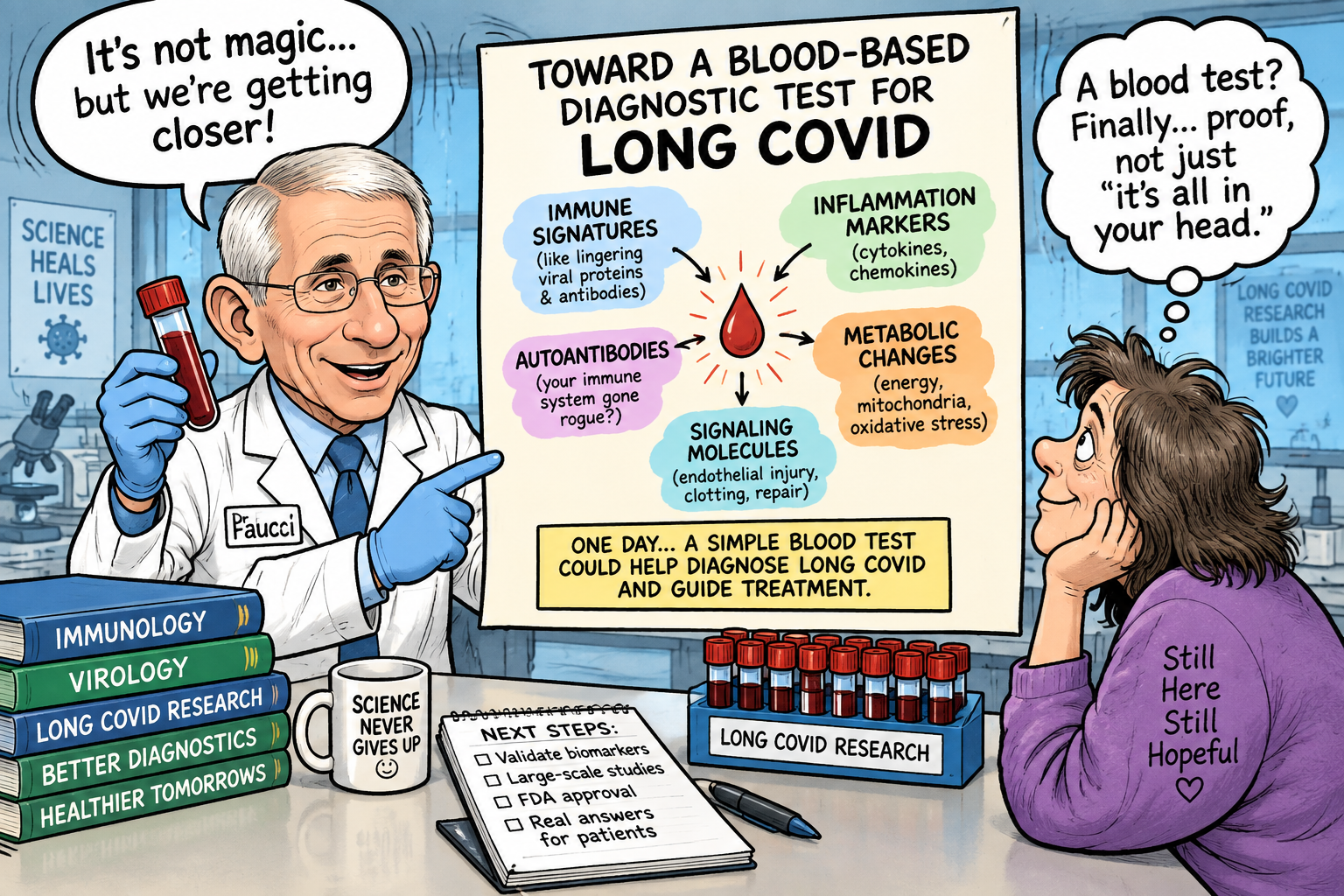
An Evidence Synthesis and Framework for a Multimarker Diagnostic Signature
John Murphy, M.D., M.P.H., D.P.H., COVID-19 Long-haul Foundation
Abstract
Objective
To determine whether currently available clinical, immunological, proteomic, metabolomic, vascular and serological evidence supports development of a blood-based diagnostic test for Long COVID and to identify the biomarker architecture most likely to achieve clinically useful diagnostic performance.
Design
Evidence synthesis of published and publicly accessible research encompassing systematic reviews, prospective and cross-sectional biomarker cohorts, NIH RECOVER studies, electronic health-record investigations, proteomic and metabolomic studies, immune-phenotyping studies, serological investigations, and emerging machine-learning diagnostic models. Particular emphasis was placed on studies that compared individuals with Long COVID with recovered SARS-CoV-2-infected controls rather than solely with healthy controls.
Main outcome measures
Candidate biomarkers, biological pathways, diagnostic discrimination, receiver operating characteristic performance where reported, reproducibility across cohorts, and suitability for translation into a clinically deployable blood test.
Results
The evidence demonstrates a remarkably large but fragmented biomarker landscape. A 2024 systematic review encompassing 46 studies and 4,415 participants identified 525 blood biomarkers associated with Long COVID, with abnormalities clustering into immunological/inflammatory, endothelial/vascular, and metabolic/clotting domains.^1 An earlier systematic review identified 113 significantly associated biomarkers across six biological categories.^2 NIH RECOVER analysis of more than 10,000 participants, however, found that routine clinical laboratory measurements did not meaningfully distinguish participants with PASC from those without PASC, demonstrating that conventional blood testing is inadequate for diagnosis.^3
Higher-dimensional approaches provide substantially more promising signals. Targeted proteomics has identified hundreds to thousands of differentially expressed proteins, while independent studies have identified candidate signatures involving immune, complement, coagulation, endothelial, metabolic and neurological pathways.^4–7 Prospective studies indicate that acute viral load, antibody responses, autoantibodies, EBV reactivation and other early biological variables may contain predictive information about subsequent Long COVID.^8,9 Emerging machine-learning studies demonstrate moderate predictive performance from clinical and immunological variables, while metabolomic models have reported stronger discrimination in selected datasets.^10,11 These results remain heterogeneous and cannot yet be regarded as clinically validated.
Conclusions
The evidence supports a multimarker blood-based diagnostic strategy, but not a single universal biomarker. The most plausible diagnostic architecture combines four biological axes—immune/inflammatory dysfunction, vascular/endothelial dysfunction, metabolic dysfunction and tissue-specific injury—with clinical phenotype and longitudinal information. Future development should use large, geographically diverse, prospectively recruited cohorts; pre-specified feature selection; blinded laboratory analysis; external validation; and comparison against recovered COVID-19 controls and clinically overlapping disorders. The ultimate objective should be a reproducible, inexpensive and phenotype-aware blood test that can distinguish Long COVID from normal recovery and relevant diagnostic mimics.
Introduction
Long COVID, also termed post-COVID-19 condition or post-acute sequelae of SARS-CoV-2 infection (PASC), has become one of the most consequential chronic consequences of the COVID-19 pandemic.
Its clinical manifestations are extraordinarily heterogeneous. Patients may experience fatigue, post-exertional malaise, cognitive dysfunction, dysautonomia, dyspnoea, chest pain, palpitations, sleep disturbance, neuropathic symptoms, gastrointestinal abnormalities, altered smell and taste, musculoskeletal pain and a wide range of organ-specific abnormalities.
The resulting diagnostic problem is fundamental.
There is currently no validated routine blood test that establishes the diagnosis of Long COVID.
The National Institutes of Health RECOVER programme examined 25 conventional blood and urine measurements in more than 10,000 adults. Routine laboratory measurements showed few meaningful differences between people with and without prior infection and, importantly, did not meaningfully differentiate infected participants with Long COVID from those without it.^3
This finding should not be interpreted as evidence that Long COVID lacks measurable biological abnormalities.
It demonstrates something considerably more specific:
The abnormalities are unlikely to be captured by conventional clinical laboratory testing alone.
This distinction creates the scientific opportunity.
The objective should no longer be to search indefinitely for a single abnormal laboratory value. Instead, investigators should determine whether the biological heterogeneity of Long COVID can be represented by a multidimensional molecular signature.
The central hypothesis
We propose the following hypothesis:
Long COVID can be identified objectively through a composite blood signature integrating immune dysregulation, endothelial and vascular injury, metabolic disturbance, tissue-specific injury and selected clinical phenotypic variables, with different molecular signatures corresponding to different Long COVID endotypes.
This hypothesis produces five testable propositions:
- no single biomarker will adequately diagnose all Long COVID;
- combinations of biomarkers will outperform individual biomarkers;
- biomarkers will perform differently across symptom phenotypes;
- recovered SARS-CoV-2-infected controls will be essential for validation;
- longitudinal measurements will outperform single time-point measurements for some phenotypes.
Methods
Evidence sources
The evidence synthesis incorporated major publicly accessible and published sources, including:
- PubMed/MEDLINE;
- PMC;
- Embase-indexed systematic reviews;
- Web of Science-derived studies represented in systematic reviews;
- NIH RECOVER publications;
- N3C and electronic-health-record studies;
- prospective immune-phenotyping cohorts;
- targeted and untargeted proteomic investigations;
- metabolomic studies;
- serological studies;
- autoantibody studies;
- published machine-learning diagnostic models;
- and recent systematic reviews through 2025–2026.
A 2024 systematic review searched Cochrane, Embase, PubMed and Web of Science through January 2024 and identified 46 eligible studies involving 4,415 participants and 525 candidate blood biomarkers.^1
A subsequent systematic review of autoantibodies searched PubMed/MEDLINE through June 2025 and identified 44 studies involving 7,571 participants, including 3,372 people with Long COVID.^12
A 2025 systematic review of omics investigations identified 29 eligible studies from 642 records and examined genomics, transcriptomics, proteomics, metabolomics and metagenomics across Long COVID phenotypes.^13
The present article is therefore an evidence synthesis rather than a new individual-participant-data meta-analysis. Published effect estimates and diagnostic performance measures are not pooled where underlying populations, endpoints and laboratory platforms were materially different.
Results
1. The biomarker landscape is enormous
The most striking finding is the sheer number of candidate biomarkers.
The 2024 systematic review identified 525 candidate blood biomarkers across 46 studies.^1
The earlier systematic review identified 113 significantly associated biomarkers from 28 studies involving 3,374 participants.^2
The increase is not necessarily evidence that Long COVID has become biologically more complicated. Rather, it demonstrates the expansion of experimental platforms and the heterogeneity of the disease.
The candidates cluster into three major biological systems:
Immune/inflammatory dysfunction
- cytokines;
- chemokines;
- autoantibodies;
- complement;
- immune-cell phenotypes.
Endothelial/vascular dysfunction
- endothelial proteins;
- coagulation factors;
- platelet pathways;
- vascular adhesion molecules;
- fibrinolytic markers.
Metabolic dysfunction
- amino acids;
- lipid metabolites;
- mitochondrial pathways;
- energy metabolism;
- oxidative stress markers.
The convergence of these three domains is more important than any individual molecule.
Figure 1. Candidate biomarker architecture
The figure should not be interpreted as demonstrating that 38 cytokines constitute a diagnostic panel. Rather, it illustrates the breadth of biological perturbation detected across published studies.^2
2. Conventional laboratory medicine has not solved the problem
The most important negative finding comes from RECOVER.
Erlandson and colleagues studied more than 10,000 adults enrolled at 83 sites and examined 25 standard blood and urine laboratory measurements.^3
Among participants with previous SARS-CoV-2 infection, standard measurements did not meaningfully distinguish individuals with Long COVID from those without it.
This result has profound implications.
Routine tests such as:
- complete blood count;
- basic metabolic measurements;
- HbA1c;
- urinalysis;
- albumin/creatinine ratio;
- and related standard clinical chemistry
are valuable for detecting specific organ disease and excluding alternative diagnoses, but they do not constitute a Long COVID diagnostic signature.
Therefore:
The diagnostic problem is not solved by ordering more conventional laboratory tests.
It requires measurement at a different biological resolution.
3. Inflammation is consistently implicated—but is not sufficiently specific
The earliest biomarker literature emphasized inflammatory markers.
The 2023 systematic review identified IL-6, CRP and TNF-α among the most repeatedly reported abnormalities.^2
However, these markers are not specific for Long COVID.
CRP rises in:
- bacterial infection;
- autoimmune disease;
- obesity;
- malignancy;
- cardiovascular disease;
- acute inflammation;
- and numerous other conditions.
The same limitation applies to IL-6 and TNF-α.
Thus, inflammatory markers are likely to be components of a diagnostic signature rather than standalone tests.
The more compelling finding is that inflammation intersects with other biological abnormalities.
Long COVID cohorts have demonstrated simultaneous abnormalities involving:
immune activation + endothelial dysfunction + coagulation + metabolic disturbance.
This multidomain pattern provides the conceptual basis for a multimarker assay.
4. Autoantibodies may provide a second diagnostic axis
Autoimmunity has emerged as another potentially important component.
A 2025 systematic review identified 44 studies involving 7,571 participants and reported associations between Long COVID and autoantibodies in 31 studies, or approximately 71% of the included studies.^12
Candidate autoantibody groups include:
- antinuclear antibodies;
- GPCR-directed antibodies;
- chemokine-directed antibodies;
- and other tissue-associated autoantibodies.
However, the same systematic review found substantial heterogeneity in:
- antibody targets;
- timing of sampling;
- assay methodology;
- Long COVID definitions;
- and clinical phenotypes.^12
This heterogeneity makes a universal autoantibody test unlikely.
It instead suggests that autoantibody profiles may identify subgroups.
That distinction is critical.
5. Anti-SARS-CoV-2 antibody levels may contain predictive information
The relationship between SARS-CoV-2 antibody titres and Long COVID has attracted considerable attention.
A 2025 systematic review included 58 studies encompassing 53,739 individuals and 7,812 people with Long COVID.^14
The evidence was heterogeneous, but many studies associated lower anti-spike antibody levels during acute infection with increased subsequent risk of Long COVID.
This finding is biologically plausible.
An inadequate early antibody response could permit:
greater viral replication → greater antigenic exposure → greater tissue dissemination → greater immune activation → greater probability of persistent disease.
However, antibody concentration depends strongly on:
- vaccination;
- previous infection;
- variant;
- timing of sampling;
- assay platform;
- age;
- immunosuppression;
- and disease severity.
Consequently, antibody titre should probably be interpreted as a component of a time-dependent predictive model, rather than as an isolated diagnostic value.
6. Viral load may be an early predictive biomarker
Perhaps the most important prospective observation concerns viral burden.
A machine-learning investigation using clinical, antibody and viral-load measurements at hospital admission found median AUROC values of approximately 0.64–0.66, with low antibody titres and high viral loads emerging as the strongest predictors of later Long COVID.^10
These performance values are not sufficient for clinical deployment.
They are, however, scientifically significant.
They demonstrate that biological information obtained during acute infection contains measurable information about subsequent chronic disease.
This supports the hypothesis that Long COVID is partly determined during the acute phase rather than appearing entirely de novo months later.
7. Proteomics may provide the molecular resolution that conventional testing lacks
Targeted proteomics has produced some of the most extensive candidate signatures.
One study examined 2,925 unique blood proteins and used machine learning to identify 119 proteins relevant to differentiating Long COVID from comparison groups.^4
Other studies have found abnormalities involving:
- complement;
- coagulation;
- platelet activation;
- endothelial pathways;
- inflammatory signalling;
- tissue injury;
- lipid metabolism;
- and neurological pathways.^5–7
A 2025 Nature Immunology study using geographically independent Swedish and UK cohorts identified a shared plasma signature linking breathlessness with inflammatory and apoptotic networks, including CCL3, CD40, IKBKG, IL-18 and IRAK1, together with pathways associated with lung injury and platelet activation.^7
The importance of these findings is not that any one protein is diagnostic.
It is that proteomic signatures can simultaneously interrogate multiple biological systems.
8. Metabolomics adds an independent biological dimension
Metabolomic studies provide another potential route toward diagnosis.
A 2025 machine-learning investigation reported an independent-testing AUROC of 0.8991 for recognition of PASC-associated metabolic features and attempted discrimination from ME/CFS, Lyme disease, POTS, IBS and fibromyalgia.^11
This result is promising but should be interpreted cautiously.
The model does not establish that a clinically validated Long COVID test has been created.
A diagnostic test must demonstrate:
- external validation;
- calibration;
- prospective performance;
- reproducibility across laboratories;
- robustness to vaccination status;
- variant independence;
- demographic fairness;
- and performance against clinically relevant mimics.
Nevertheless, the result supports the proposition that metabolic signatures may contain information not captured by routine laboratory testing.
9. Neurological Long COVID may require its own blood signature
A universal Long COVID test may ultimately prove inferior to phenotype-specific assays.
Neurological Long COVID provides a compelling example.
Candidate biomarkers include:
- neurofilament light chain;
- GFAP;
- endothelial markers;
- complement;
- inflammatory mediators;
- and tissue-specific proteins.
A 2025 study reported that a proteomic approach examining approximately 7,000 markers identified a small combination including C5a, TGF-β1 and gliomedin that differentiated neurological PASC from controls with reported high accuracy.^15
Such findings suggest a future architecture in which the first-stage test identifies Long COVID and a second-stage assay identifies the dominant biological phenotype.
10. The evidence points toward endotypes rather than one universal disease marker
The accumulated evidence can be organized into a conceptual matrix.
| Biological domain | Representative candidate signals | Potential phenotype |
|---|---|---|
| Immune | IL-6, TNF-α, chemokines, autoantibodies | systemic/inflammatory |
| Vascular | endothelial proteins, complement, coagulation factors | cardiopulmonary/autonomic |
| Metabolic | lipid and amino-acid metabolites | fatigue/PEM |
| Neurological | NfL, GFAP, gliomedin | cognitive/neurological |
| Viral | RNA, antigen, viral proteins | persistence-associated |
| Hormonal | cortisol and HPA-axis markers | fatigue/autonomic |
| Platelet/coagulation | fibrinogen, platelet activation | vascular |
| Clinical | fatigue, PEM, dysautonomia, brain fog | phenotypic classifier |
This provides a stronger conceptual model than the search for a single “Long COVID molecule.”
11. The diagnostic test should probably be hierarchical
A practical diagnostic system could consist of three layers.
Layer 1: Clinical phenotype
A standardized symptom and functional assessment.
Potential inputs:
- fatigue;
- post-exertional malaise;
- cognitive dysfunction;
- dysautonomia;
- dyspnoea;
- pain;
- sleep abnormalities;
- sensory abnormalities.
Layer 2: Core blood signature
A relatively inexpensive panel involving:
- selected inflammatory markers;
- endothelial markers;
- coagulation markers;
- metabolic markers;
- selected autoantibodies.
Layer 3: Phenotype-specific molecular assay
For patients with ambiguous cases:
- targeted proteomics;
- metabolomics;
- neurological markers;
- viral-antigen measurements;
- expanded autoantibody profiling.
This approach would prevent the diagnostic test from becoming prohibitively expensive.
Figure 2. Proposed architecture of a Long COVID blood test
SARS-CoV-2 infection
↓
Clinical phenotype
fatigue • PEM • brain fog • dyspnoea • dysautonomia • pain
↓
Core blood panel
Immune
↓
cytokines / chemokines / autoantibodies
Vascular
↓
endothelial / complement / coagulation
Metabolic
↓
lipids / amino acids / energy metabolism
Tissue injury
↓
neurological / cardiac / pulmonary proteins
↓
Multimarker algorithm
↓
Long COVID probability score
↓
Phenotype classification
Inflammatory | Autonomic | Neurological | Cardiopulmonary | Metabolic | Multisystem
↓
Clinical confirmation and exclusion of alternative diagnoses
This model is deliberately different from a single-biomarker diagnostic test. It reflects the evidence that Long COVID is biologically heterogeneous.
12. Why machine learning is particularly appropriate
The biomarker landscape is intrinsically high dimensional.
If 500 candidate biomarkers are available but only several hundred patients are studied, conventional regression can rapidly overfit.
Machine learning provides methods for:
- nonlinear interactions;
- feature selection;
- dimensionality reduction;
- ensemble classification;
- latent phenotype identification;
- and multimodal prediction.
But machine learning introduces its own hazards.
A model can achieve spectacular apparent accuracy while failing completely in a new population.
The minimum methodological standard should therefore include:
- training cohort;
- internal validation;
- locked test set;
- external validation cohort;
- prospective validation;
- calibration analysis;
- subgroup performance;
- comparison against clinical diagnosis;
- comparison against recovered COVID controls;
- comparison against clinically overlapping disorders.
A reported AUROC from a single small case-control cohort should therefore be regarded as hypothesis-generating, not diagnostic validation.
13. The recovered-COVID control is indispensable
One of the most important methodological conclusions from the evidence is that a healthy control is not sufficient.
Consider three groups:
A. Healthy never infected
B. SARS-CoV-2 infected and recovered
C. SARS-CoV-2 infected with Long COVID
A biomarker that differs between A and C may merely indicate previous infection.
The clinically useful biomarker is the one that distinguishes:
C from B.
This is precisely why the RECOVER findings are so important. Conventional laboratory measurements failed to provide a meaningful distinction between infected participants with and without PASC.^3
Future biomarker studies should therefore make the recovered-infected group the primary control, not an optional secondary comparator.
14. Diagnostic specificity must include other post-infectious diseases
A clinically useful test must also distinguish Long COVID from conditions with overlapping manifestations.
The most important comparator groups include:
- ME/CFS;
- POTS;
- fibromyalgia;
- post-viral fatigue syndromes;
- autoimmune disease;
- depression;
- sleep disorders;
- cardiopulmonary disease;
- thyroid disease;
- anaemia;
- and neurological disease.
This is especially important because fatigue and cognitive dysfunction are not disease-specific.
The emerging metabolomic literature is noteworthy precisely because some studies have attempted discrimination against several such conditions.^11
15. A proposed diagnostic score
A future clinical algorithm could take the general form:
P(Long COVID) = f(I, V, M, E, T, C)
where:
- I = immune/inflammatory signature;
- V = vascular/endothelial signature;
- M = metabolic signature;
- E = evidence of tissue injury;
- T = viral/antigenic signature;
- C = clinical phenotype.
The exact coefficients should not be predetermined from existing literature.
They should be learned in a large prospective dataset and then locked before external validation.
The final score should generate a probability rather than a binary declaration.
For example:
| Score | Interpretation |
|---|---|
| <10% | Long COVID unlikely |
| 10–30% | Indeterminate |
| 30–70% | Probable |
| >70% | Highly probable |
These thresholds are proposed research thresholds, not validated clinical cutoffs.
16. What would constitute a clinically valid test?
The field should establish a formal target product profile.
A clinically useful blood test should ideally demonstrate:
Sensitivity
High enough to avoid missing genuine Long COVID.
Specificity
High enough to prevent widespread false-positive diagnosis.
Positive predictive value
Demonstrated in real-world prevalence settings.
Negative predictive value
Demonstrated across different populations.
Reproducibility
Stable across:
- laboratories;
- instruments;
- countries;
- ethnic groups;
- sexes;
- ages.
Temporal stability
The result should not depend excessively on whether the patient is tested at month 3 versus month 9.
Variant robustness
Performance should remain useful across SARS-CoV-2 variants.
Vaccination robustness
The algorithm must account for vaccination-induced antibody differences.
Phenotype sensitivity
The test must not preferentially detect only one subtype of Long COVID.
17. Why no single biomarker is likely to succeed
The evidence increasingly argues against a universal single-molecule diagnostic.
A single molecule can change because of:
- infection;
- inflammation;
- obesity;
- ageing;
- cardiovascular disease;
- autoimmune disease;
- medication;
- stress;
- exercise;
- vaccination;
- or another unrelated condition.
Long COVID is itself heterogeneous.
Therefore, the diagnostic information may exist not in the absolute value of any individual biomarker but in the pattern formed by many biomarkers simultaneously.
In statistical terms, the disease signal may reside in the covariance structure.
This is precisely where machine learning and multimodal modeling become attractive.
18. The longitudinal dimension may be essential
Long COVID is not static.
A patient’s biological signature may evolve from:
acute viral replication
to
immune activation
to
vascular dysfunction
to
metabolic compensation
to
persistent tissue-specific abnormalities.
A single blood sample therefore provides only a snapshot.
The most powerful diagnostic system may ultimately combine:
one baseline sample + one longitudinal sample.
The change between measurements could itself become diagnostic.
For example:
Δ biomarker = biomarker at month 3 − biomarker at acute infection
may contain information that neither measurement possesses independently.
19. The case for a two-stage test
A realistic future clinical system could be:
Stage 1 — inexpensive screening
CBC + metabolic panel + CRP + selected vascular and immune markers + standardized symptom score.
Stage 2 — molecular confirmation
Targeted proteomics + metabolomics + autoantibody panel + viral antigen measurement.
Stage 3 — phenotype assignment
Neurological, autonomic, metabolic, cardiopulmonary or multisystem signature.
This approach is more realistic than attempting to place 500 biomarkers into routine primary-care blood testing.
20. The principal barriers
Five barriers currently prevent clinical translation.
1. Case-definition heterogeneity
Studies use different definitions of Long COVID.^16
2. Control-group heterogeneity
Some studies use healthy controls; others use recovered COVID controls.
3. Small sample sizes
Many omics studies remain relatively small.
4. Platform variation
Different laboratories measure different proteins using different assays.
5. Lack of external validation
This is perhaps the most important.
A biomarker becomes clinically meaningful only when it survives replication outside the population in which it was discovered.
Discussion
The evidence now supports a clear conclusion:
A blood test for Long COVID is scientifically plausible, but a validated universal biomarker has not yet been established.
The distinction matters.
The biomarker literature is not empty. Quite the opposite: hundreds of candidate markers have been reported.
The problem is that the literature contains too many candidates and too little validated convergence.
The 2024 systematic review identified 525 candidate biomarkers but concluded that no single biomarker was sufficiently associated with Long COVID prevalence to serve as a clinically useful diagnostic.^1
NIH RECOVER reached a complementary conclusion using more than 10,000 participants: conventional clinical laboratory measurements do not provide a reliable diagnostic distinction.^3
These findings should not discourage biomarker research.
They should redirect it.
The appropriate objective is not:
Find the Long COVID biomarker.
It is:
Find the smallest reproducible multimarker signature that distinguishes Long COVID from recovery and clinically relevant mimics.
A proposed definitive validation study
We propose a multicentre prospective study of at least 10,000 participants distributed approximately as follows:
- 3,000 healthy controls;
- 3,000 SARS-CoV-2-infected recovered controls;
- 3,000 Long COVID participants;
- 1,000 disease-mimic controls.
The Long COVID group should be stratified into predefined phenotypes:
- fatigue/PEM;
- neurological;
- autonomic;
- cardiopulmonary;
- gastrointestinal;
- multisystem.
Blood should be collected at standardized intervals.
Measurements
Clinical
- standardized symptom inventory;
- functional status;
- quality-of-life measures;
- autonomic testing.
Immune
- cytokines;
- chemokines;
- autoantibodies;
- immune-cell phenotyping.
Vascular
- complement;
- endothelial markers;
- coagulation;
- platelet activation.
Metabolic
- targeted metabolomics;
- lipidomics;
- mitochondrial/metabolic markers.
Proteomic
- broad plasma proteomics.
Viral
- antigen;
- RNA where measurable.
The analysis should use nested cross-validation, prespecified feature-selection rules and a completely independent external validation cohort.
Proposed primary endpoint
The primary endpoint should be:
The ability of a locked multimarker blood signature to distinguish clinically adjudicated Long COVID from SARS-CoV-2-infected recovered controls at ≥12 weeks after infection.
Secondary endpoints should include:
- phenotype discrimination;
- severity prediction;
- longitudinal recovery;
- differentiation from ME/CFS;
- differentiation from POTS;
- differentiation from fibromyalgia;
- and prediction of future persistence.
Figure 3. From hundreds of biomarkers to one clinical test
525+ published candidate biomarkers
↓
Independent replication
↓
Biological pathway clustering
↓
Feature reduction
↓
Immune + vascular + metabolic + tissue-injury domains
↓
Machine-learning integration
↓
External validation
↓
Locked diagnostic signature
↓
Long COVID probability
Phenotype
Severity
This is the crucial translational pathway: discovery → replication → reduction → validation → clinical deployment.
Clinical implications
A validated blood test would change Long COVID medicine fundamentally.
It could:
- shorten diagnostic delay;
- reduce diagnostic uncertainty;
- distinguish Long COVID from competing diagnoses;
- identify patients suitable for mechanism-specific trials;
- enable objective treatment-response measurement;
- identify biological subtypes;
- improve epidemiological surveillance;
- and provide an objective endpoint for clinical trials.
Perhaps most importantly, it could validate the biological reality of patients whose symptoms currently remain difficult to demonstrate using conventional laboratory medicine.
Limitations
This review has several limitations.
First, the biomarker literature is highly heterogeneous.
Second, many studies are cross-sectional and cannot establish whether a biomarker causes disease, results from disease, or merely correlates with it.
Third, many studies have relatively small sample sizes.
Fourth, analytical platforms vary considerably.
Fifth, Long COVID itself is heterogeneous, making a universal diagnostic signature difficult to identify.
Sixth, some promising machine-learning models have not undergone sufficiently large independent prospective validation.
Seventh, vaccination, reinfection and variant history can substantially alter immune and serological measurements.
Finally, the present article is an evidence synthesis rather than a new pooled individual-level analysis of restricted datasets.
Conclusions
The scientific literature has moved beyond the question of whether Long COVID produces measurable biological abnormalities.
It clearly does.
The more important question is whether those abnormalities can be organized into a reproducible diagnostic signature.
The current evidence provides substantial grounds for optimism.
Hundreds of blood biomarkers have been associated with Long COVID. Immune dysregulation, endothelial dysfunction, coagulation abnormalities, metabolic disturbance and tissue-specific injury recur across independent investigations.^1,2,4–7
At the same time, the failure of routine laboratory testing to distinguish Long COVID from recovery demonstrates that the clinically useful signal lies at a higher level of biological resolution.^3
Proteomics and metabolomics are beginning to provide that resolution.
The most promising strategy is therefore not the search for a solitary biomarker.
It is the construction of a multimarker, phenotype-aware blood signature.
Such a system would integrate four principal biological dimensions:
immune/inflammatory dysfunction
vascular/endothelial dysfunction
metabolic dysfunction
tissue-specific injury
with clinical phenotype, vaccination history, viral burden and longitudinal change.
The emerging evidence suggests that the molecular architecture of Long COVID may ultimately be more analogous to a syndrome of interacting biological networks than to a disease defined by one abnormal laboratory value.
The next decisive step is therefore validation.
The field now requires a large, prospective, multicentre study that deliberately compares Long COVID not merely with healthy people, but with people who had SARS-CoV-2 infection and recovered normally, as well as patients with clinically overlapping disorders.
If such a study produces a stable multimarker signature with high sensitivity, specificity, calibration and external reproducibility, the longstanding diagnostic problem of Long COVID could finally move from clinical inference to objective laboratory medicine.
Footnotes and References
1. Thomas C, Faghy MA, Chidley C, et al. Blood Biomarkers of Long COVID: A Systematic Review. Adv Ther. 2024;28:537–574. The review identified 46 studies involving 4,415 participants and 525 candidate blood biomarkers, grouped principally into immunological/inflammatory, endothelial/vascular and metabolic/clotting abnormalities.
2. Lai Y-J, Liu S-H, Manachevakul S, et al. Biomarkers in long COVID-19: A systematic review. Front Med. 2023;9:1085988. The review identified 113 significantly associated biomarkers among 28 studies, including cytokine/chemokine, biochemical, vascular, neurological and acute-phase markers.
3. Erlandson KM, Geng LN, Selvaggi CA, et al. Differentiation of Prior SARS-CoV-2 Infection and Postacute Sequelae by Standard Clinical Laboratory Measurements in the RECOVER Cohort. Ann Intern Med. 2024. doi:10.7326/M24-0737. More than 10,000 RECOVER participants were evaluated; routine laboratory measurements did not meaningfully distinguish PASC from prior infection without PASC.
4. Organ and cell-specific biomarkers of Long-COVID identified with targeted proteomics and machine learning. The study evaluated 2,925 unique blood proteins and identified 119 relevant proteins for distinguishing Long COVID in its study population.
5. Plasma proteome of Long-COVID patients indicates HIF-mediated vasculo-proliferative disease with impact on brain and heart function. J Transl Med. 2023. The investigation used approximately 3,072 protein biomarkers and identified immune, vascular and cellular abnormalities associated with Long COVID.
6. Proteomic and metabolomic profiling of plasma uncovers immune responses in patients with Long COVID-19. 2024/2025. The study identified differences involving coagulation, platelet, complement, GPCR and metabolic pathways in Long COVID compared with recovered controls.
7. Identification of soluble biomarkers that associate with distinct manifestations of long COVID. Nature Immunology. 2025;26:692–705. The study used independent Swedish and UK cohorts and identified shared plasma signatures involving inflammatory, apoptotic, lung-injury and platelet-activation pathways.
8. Su Y, Yuan D, Chen DG, et al. Multiple early factors anticipate post-acute COVID-19 sequelae. Cell. 2022;185:881–895.e20. The prospective multi-omic study identified autoantibodies, type 2 diabetes, EBV reactivation and SARS-CoV-2 RNAemia among early factors associated with PASC.
9. Klein J, Wood J, Jaycox JR, et al. Distinguishing features of Long COVID identified through immune profiling. Nature. 2023. The investigation demonstrated persistent immune perturbations involving cellular and humoral responses and other biological pathways in Long COVID.
10. Machine learning models predict Long COVID outcomes based on baseline clinical and immunologic factors. The study reported median AUROC values of approximately 0.64–0.66 and identified low antibody titres and high viral load among the strongest predictors.
11. Metabolomics-Based Machine Learning Diagnostics of Post-Acute Sequelae of SARS-CoV-2 Infection. 2025. The reported independent-testing AUROC was 0.8991 for the study’s metabolomic machine-learning task, with attempted differentiation from several PASC-similar diseases.
12. Autoantibodies in long COVID: a systematic review. 2025. Forty-four studies involving 7,571 participants were included; 31 reported associations between autoantibodies and Long COVID, although substantial heterogeneity was observed.
13. Baalbaki N, Slob EMA, Kazer SW, et al. The Omics Landscape of Long COVID—A Comprehensive Systematic Review to Advance Biomarker, Target and Drug Discovery. Allergy. 2025;80:932–948. The review identified 29 eligible omics studies from 642 records and examined genomic, transcriptomic, proteomic, metabolomic and metagenomic evidence.
14. Mink S, Wilhelm F, Cadamuro J, et al. Anti-SARS-CoV-2 Antibodies in Long-COVID—Markers of Protection or Elevated Risk? A Systematic Review. Rev Med Virol. 2025;35. The review included 58 studies involving 53,739 individuals and reported heterogeneous but potentially important associations between acute antibody levels and subsequent Long COVID.
15. Blood diagnostic biomarkers for neurologic manifestations of long COVID. Brain Behav Immun Health. 2025;49:101110. The study investigated approximately 7,000 proteomic markers and reported candidate combinations involving C5a, TGFβ1 and gliomedin.
16. Definition and measurement of post-COVID-19 conditions in real-world practice: a global systematic literature review. BMJ Open. 2024. The review of 291 publications demonstrated substantial heterogeneity in definitions, populations, follow-up intervals and outcome measurement for post-COVID conditions.
17. Zeraatkar D, Ling M, Kirsh S, et al. Interventions for the management of long covid (post-covid condition): living systematic review. BMJ. 2024;387. The review emphasizes the absence of established objective laboratory measures capable of predicting clinical benefit or replacing clinical assessment.
18. The central methodological principle of this manuscript is that a biomarker discovered in comparison with healthy controls cannot automatically be regarded as a diagnostic biomarker. Clinical translation requires demonstration that the marker or signature distinguishes Long COVID from recovered SARS-CoV-2 infection and clinically relevant mimics.