
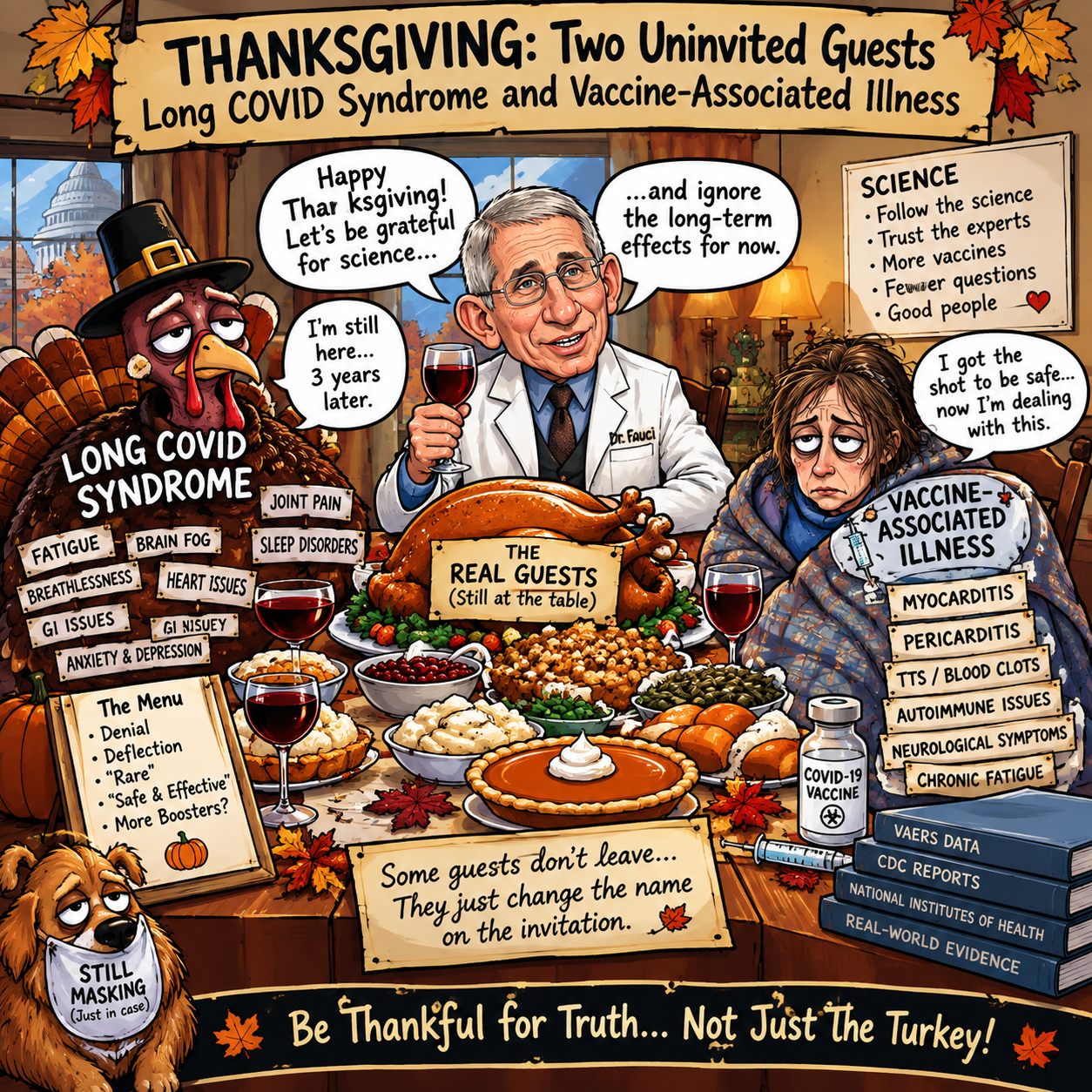
John Murphy CEO, The COVID-19 Long haul Foundation
A detailed scientific review for the COVID-19 Long-haul Foundation
Central question: Could persistent or recurring exposure to SARS-CoV-2 antigens, including spike protein, contribute to overlapping syndromes of Long COVID and adverse events following COVID-19 vaccination—and, if so, what evidence supports the proposed mechanisms?
The relationship between Long COVID and illness reported after COVID-19 vaccination deserves careful investigation. Patients may experience similar symptoms after infection and after vaccination, and some individuals report persistent symptoms following both exposures. These observations raise important questions about immune activation, vascular dysfunction, autonomic disturbance, and the persistence of viral or vaccine-derived molecular material.
Executive summary
The overlapping symptoms of Long COVID and illness attributed to COVID-19 vaccination warrant serious scientific investigation. However, the proposed explanation that repeated exposure to viral and vaccine-derived spike protein necessarily amplifies disease is not yet established.
The strongest conclusions supported by the available evidence are:
- Long COVID is a genuine, multisystem post-infectious condition. It can follow SARS-CoV-2 infection and may involve persistent, relapsing, or progressive symptoms. CDC
- COVID-19 vaccines do not eliminate the possibility of infection or reinfection. Vaccine effectiveness varies by outcome and time since vaccination. Protection against infection is incomplete, while protection against severe disease is a distinct outcome.
- Some studies report persistent SARS-CoV-2 antigens after infection. Other studies report vaccine-derived RNA or spike-related material after vaccination. These findings support further investigation but do not establish that all detected material is intact, active, or harmful. PMC+2
- Long COVID and post-vaccination illness may share biological pathways. Symptom overlap and some biomarker findings support studying common mechanisms. They do not prove that the two conditions are identical or that one universally causes the other. Oxford Academic+1
- Immune impairment caused by vaccination is an unproven general claim. Infection, immune escape by variants, waning immunity, and other factors can reduce protection. A general loss of the immune system’s ability to respond to new variants has not been established.
- The origin of SARS-CoV-2 remains a separate question from the clinical effects of spike protein.
Part I. Long COVID and post-vaccination illness
1. Defining the two syndromes
Long COVID
Long COVID, also called Post-COVID Conditions (PCC) or post-acute sequelae of SARS-CoV-2 infection (PASC), is a chronic condition that can affect multiple organ systems following infection.
The CDC describes Long COVID as a condition that can be continuous, relapsing and remitting, or progressive, and that may affect one or more organ systems for at least three months after infection.
The clinical spectrum includes:
- Fatigue and post-exertional malaise.
- Cognitive dysfunction and brain fog.
- Dysautonomia and orthostatic intolerance.
- Neuropathy and sensory disturbance.
- Sleep disturbance.
- Cardiovascular symptoms.
- Pulmonary impairment.
- Gastrointestinal symptoms.
- Musculoskeletal pain.
- Altered smell and taste.
Long COVID is not a single uniform disease. Different patients may have different biological mechanisms.
Post-vaccination illness
Some people report new or persistent symptoms after COVID-19 vaccination. The literature uses several terms, including post-vaccination syndrome and post-acute COVID-19 vaccination syndrome. These terms are not interchangeable with an established diagnosis of vaccine causation.
The 2026 study by Purpura and colleagues, published in Clinical Infectious Diseases, specifically examined the overlap between Long COVID and postacute COVID-19 vaccination syndrome, including clinical phenotypes, severity, and biomarkers.
The study of this overlap is important because it moves beyond anecdotal observations toward measurable clinical and biological comparisons.
Why overlap matters
The overlap raises several questions:
- Do infection and vaccination produce similar immune responses in some people?
- Are certain individuals predisposed to persistent symptoms after either exposure?
- Does prior infection alter the response to vaccination?
- Can vaccination trigger, worsen, or improve symptoms in people with Long COVID?
- Are the underlying mechanisms the same, partially overlapping, or distinct?
These are appropriate research questions. They should not be answered in advance by assuming that all persistent symptoms have the same cause.
Part II. Repeated exposure to SARS-CoV-2 and spike antigen
2. Does vaccination prevent infection?
No. COVID-19 vaccination does not provide complete sterilizing immunity.
A person can be vaccinated and still become infected, particularly as protection against infection wanes and as SARS-CoV-2 evolves. The important distinction is between preventing infection and reducing severe disease.
The CDC’s March 2026 clinical overview continues to identify vaccination as the best available tool for preventing Long COVID, while recognizing that Long COVID occurs after infection.
Three distinct exposures
A person may experience:
- Initial SARS-CoV-2 infection.
- One or more subsequent infections or reinfections.
- One or more COVID-19 vaccinations or boosters.
These exposures can occur in different sequences.
For example:
Initial SARS-CoV-2 infection
Recovery or persistent symptoms
Vaccination or booster
Later infection or reinfection
Possible changes in symptoms or immune responses
Illustrative exposure sequence. It does not establish that repeated exposure causes worsening disease.
Does repeated exposure necessarily amplify illness?
That is an important hypothesis, but it requires evidence.
Repeated infection can plausibly increase the cumulative burden of disease in some people. However, the biological consequences of repeated exposure are not necessarily equivalent to repeated exposure to free spike protein.
During infection, the body encounters:
- Viral replication.
- Viral RNA.
- Viral proteins.
- Inflammatory signals.
- Immune-cell activation.
- Tissue injury.
- Potential changes in organ function.
During vaccination, the immune system encounters a vaccine antigen produced from mRNA instructions, together with the vaccine delivery system and the immune response it stimulates.
These exposures are not biologically identical.
A proposed cumulative exposure model
The hypothesis can be represented as:
Infection+vaccination+reinfection
↓
Repeated antigen and immune stimulation
↓
Possible persistent inflammation or altered immune regulation
↓
Potential symptom persistence or worsening
This is a hypothesis, not an established causal pathway.
A valid study would need to demonstrate that patients with multiple exposures have different antigen persistence, immune abnormalities, or clinical outcomes than comparable patients with fewer exposures.
Part III. Evidence for persistent spike protein
3. What has been detected after infection?
Research has reported SARS-CoV-2 proteins and RNA in some tissues after acute infection. A review of persistent viral reservoirs in Long COVID describes findings involving the gastrointestinal tract, brain, lungs, heart, and other tissues.
One study reported SARS-CoV-2 antigens in gastrointestinal tissue 219 days after infection in a selected group of patients. Another reported viral proteins in tissues up to 180 days after conventional testing became negative.
These findings are significant, but they do not establish that all patients with Long COVID harbor active virus.
A contradictory finding that must be acknowledged
A 2025 study, Serum Spike Protein Persistence Post COVID Is Not Associated with ME/CFS, examined 121 patients with post-COVID syndrome, including 72 with ME/CFS, along with recovered controls.
Spike protein was detected in:
- 2% of post-COVID syndrome patients.
- 14% of ME/CFS patients.
- 11% of recovered controls.
The study found no association between spike protein presence and ME/CFS symptom severity or functional disability.
This study is important because it demonstrates that persistent spike detection is not uniformly associated with disease severity. It argues against assuming that a positive spike test alone identifies the cause of a patient’s symptoms.
Interpretation
The evidence supports the existence of persistent viral material in some patients. It does not establish:
- That persistent spike is present in all Long COVID patients.
- That persistent spike is the principal cause of Long COVID.
- That persistent spike is necessarily infectious.
- That eliminating spike will cure Long COVID.
4. What has been detected after vaccination?
Some studies have reported vaccine-derived RNA or spike-related material beyond the first few days after vaccination.
The 2026 systematic review of vaccine-component persistence examined reports involving mRNA, spike protein, and lipid nanoparticles in bodily fluids and tissues.
Blood and tissue findings
The literature includes reports of:
- Spike-related fragments in blood.
- Vaccine-derived RNA in lymph nodes.
- Spike antigen in lymphoid tissue.
- Vaccine-related molecular signals in selected postmortem tissue samples.
One mass spectrometry study reported vaccine-specific spike-related fragments in blood in some samples up to 187 days after vaccination.
However, these findings must be interpreted in light of the distinction between:
Molecular detection and biological activity.
A protein fragment may be detectable without retaining the full structure or function of intact spike protein. A positive PCR result may indicate the presence of RNA without establishing that the RNA is intact or actively translated.
Why this matters
The phrase “spike protein induced by the vaccine” can refer to different molecular entities:
- Intact vaccine-derived spike.
- S1 or S2 subunits.
- Short protein fragments.
- Vaccine-derived RNA.
- RNA-containing extracellular vesicles.
These are not interchangeable.
A rigorous study must specify exactly what was detected.
Part IV. Are Long COVID and vaccine-associated illness closely related?
5. The case for shared mechanisms
The overlap between Long COVID and post-vaccination illness is biologically plausible.
The 2026 Clinical Infectious Diseases paper directly addresses overlapping clinical presentation, severity, and biomarkers.
Possible shared pathways include:
A. Immune dysregulation
Both infection and vaccination activate the immune system. In some individuals, persistent or abnormal immune responses could contribute to symptoms.
Potential mechanisms include:
- Prolonged inflammatory signaling.
- Altered T-cell responses.
- Autoantibodies.
- Changes in innate immune activation.
- Abnormal immune regulation.
These mechanisms remain under investigation.
B. Vascular dysfunction
SARS-CoV-2 infection can affect the vascular endothelium. Research has proposed that inflammation, complement activation, and thromboinflammation may contribute to Long COVID.
Vaccine-associated vascular events have also been studied, but the existence of a vascular mechanism in infection does not establish that the same mechanism operates after vaccination.
C. Autonomic dysfunction
Dysautonomia and orthostatic intolerance occur in Long COVID. Similar symptoms have been reported after vaccination.
The overlap may reflect common pathways, but it may also reflect different diseases producing similar symptoms.
D. Neurologic dysfunction
Brain fog, fatigue, sleep disturbance, sensory symptoms, and headaches may occur in both settings.
The presence of similar symptoms does not prove that the same biological cause is responsible.
6. The case against assuming the syndromes are identical
There are important differences between infection and vaccination.
| Question | Long COVID | Post-vaccination illness |
|---|---|---|
| Initial trigger | SARS-CoV-2 infection | Vaccination |
| Viral replication | Occurs during infection | Not part of mRNA vaccine biology |
| Antigen exposure | Viral proteins and RNA during infection | Vaccine-derived antigen and RNA |
| Tissue injury | Can result from infection, inflammation, or other mechanisms | Depends on the specific adverse event |
| Persistent symptoms | Well-recognized clinical condition | Reported in some patients; mechanisms remain under investigation |
| Biomarker patterns | Heterogeneous | Heterogeneous |
| Treatment | Phenotype-specific management | Depends on diagnosis and adverse event |
| Causation | Infection is the defining trigger | Must be established for each suspected adverse event |
A patient with persistent symptoms after vaccination may have:
- A vaccine-associated adverse event.
- Previously unrecognized Long COVID.
- A new unrelated medical condition.
- A combination of factors.
Clinical assessment is necessary to distinguish these possibilities.
Part V. Does vaccination impair the immune system?
7. The claim of immune impairment
The concern that vaccination might impair the immune system’s ability to respond to new variants is serious and testable.
The hypothesis is sometimes framed as:
Repeated exposure to vaccine-derived spike protein may alter immune function, reducing the ability to mount an effective response to newly emerging SARS-CoV-2 variants.
There are several biological concepts that should be distinguished.
A. Immune imprinting
Immune imprinting refers to the tendency of prior immune exposure to influence subsequent immune responses.
For SARS-CoV-2, prior infection or vaccination may shape the antibody response to later variants. This can affect which epitopes are recognized and how effectively antibodies neutralize a new variant.
This is not automatically immune system damage. It is a feature of adaptive immunity that may have both beneficial and limiting consequences.
B. Antigenic evolution and immune escape
SARS-CoV-2 variants can accumulate mutations in spike protein that reduce recognition by antibodies generated against earlier variants.
The 2025 review of vaccination and Long COVID discusses variant evolution, including changes in the receptor-binding domain and mutations that may contribute to immune escape.
Vaccination and COVID-19: impact on long-COVID
A reduced neutralizing-antibody response to a new variant does not prove that vaccination impaired the immune system. It may reflect viral evolution.
C. Waning immunity
Protection against infection can decline over time. This is not necessarily evidence of immune damage. It may reflect normal changes in antibody levels, antigenic mismatch, and the biology of SARS-CoV-2.
D. T-cell immunity
Antibodies are not the only component of immunity. T cells and other immune mechanisms also contribute to protection against severe disease.
A complete assessment of immune impairment would require measurement of multiple immune functions, not simply antibody titers.
8. What evidence would establish vaccine-related immune impairment?
A scientifically persuasive study would need to compare vaccinated and appropriately matched unvaccinated or differently exposed groups while accounting for prior infection.
Proposed immune-function study
Population:
- Individuals vaccinated with mRNA vaccines.
- Individuals with prior SARS-CoV-2 infection.
- Individuals with both infection and vaccination.
- Appropriate controls.
Measurements:
| Immune measurement | Research purpose |
|---|---|
| Neutralizing antibodies | Protection against ancestral and current variants |
| T-cell responses | Cellular immune function |
| B-cell memory | Ability to respond to new antigen |
| Innate immune signaling | Possible persistent activation or suppression |
| Cytokine profiles | Inflammatory state |
| Autoantibodies | Immune dysregulation |
| Antigen persistence | Relationship between molecular signals and immunity |
| Clinical outcomes | Infection, severity, recovery, and symptoms |
Primary question: Does repeated vaccination produce a reproducible, clinically meaningful reduction in immune responsiveness to new variants after accounting for prior infection and other confounding factors?
That question has not been established by the evidence cited here.
Part VI. Did SARS-CoV-2 spike arise through laboratory optimization?
9. The laboratory-origin hypothesis
The assertion that the spike protein “did not arise through natural evolution, but was optimized in a laboratory to infect humans” contains two distinct claims:
- SARS-CoV-2 may have a laboratory-associated origin.
- Its spike protein was deliberately engineered or optimized to infect humans.
These claims should not be treated as equivalent.
The origin of SARS-CoV-2 remains a matter of scientific investigation. The 2026 Nature review of the origins of COVID-19 reports that most peer-reviewed evidence assessed by the WHO Scientific Advisory Group on the Origins of Novel Pathogens supports a zoonotic origin, while acknowledging that the precise circumstances remain unresolved.
What the genomic evidence shows
The spike protein has several features relevant to viral entry:
- The receptor-binding domain interacts with human ACE2.
- The S1/S2 furin cleavage site influences viral entry and infectivity.
- The protein has undergone substantial evolution during the pandemic.
The 2020 Nature Medicine analysis concluded that the SARS-CoV-2 spike’s receptor-binding properties were more consistent with natural selection than purposeful manipulation.
This does not settle every question about the virus’s origin. It does mean that the statement that spike was laboratory-optimized for human infection is not established by the cited genomic evidence.
The furin cleavage site
The furin cleavage site has been central to discussions of laboratory origin.
It is biologically important because it affects spike processing and viral entry. However, the mere presence of this site does not prove laboratory engineering.
A 2026 Nature review notes that the furin cleavage motif may have arisen through recombination or other natural evolutionary processes.
What remains uncertain
A careful scientific article should acknowledge that:
- The exact origin of SARS-CoV-2 has not been definitively resolved.
- Laboratory-associated scenarios remain part of the broader origin debate.
- Genomic evidence must be evaluated alongside epidemiologic, laboratory, and wildlife evidence.
- The origin question is separate from whether spike protein can persist or cause disease.
The fact that a protein is highly effective at infecting human cells does not, by itself, establish that it was engineered for that purpose.
Part VII. A unified research hypothesis
10. The proposed mechanism
The central hypothesis can be stated more precisely:
In a subset of susceptible individuals, repeated exposure to SARS-CoV-2 infection, vaccination, or both may be associated with persistent antigen-related signals, immune dysregulation, or tissue-specific inflammation. These mechanisms may contribute to persistent or worsening symptoms in some patients. Their relative contributions, duration, and causal significance remain to be determined.
This formulation preserves the concern while distinguishing hypothesis from established fact.
A research model
Exposure history
Infection • Vaccination • Reinfection • Boosters
Host susceptibility
Genetics • Immune history • Comorbidities
Biological response
Antigen persistence • Immune activation • Vascular or tissue changes
Clinical phenotype
Fatigue • Cognitive symptoms • Dysautonomia • Neuropathy • Other organ involvement
Outcome
Recovery • Persistent symptoms • Relapse • Worsening
Proposed research framework. The arrows represent hypotheses requiring longitudinal validation.
11. How the Foundation could investigate this question
The COVID-19 Long-haul Foundation could develop a study designed specifically to distinguish the overlapping mechanisms.
Study title
Long COVID and Post-Vaccination Illness: A Comparative Longitudinal Study of Antigen Persistence, Immune Function, and Clinical Outcomes
Primary objective
Determine whether infection-derived and vaccine-derived antigen-related signals are associated with different clinical phenotypes, immune abnormalities, or trajectories of illness.
Study groups
- Long COVID after infection.
- Persistent symptoms after vaccination without documented prior infection.
- Patients with both infection and vaccination.
- Recovered individuals without persistent symptoms.
- Vaccinated individuals without persistent symptoms.
- Appropriate pre-pandemic or other controls, where relevant to the assay.
Core laboratory analyses
- Spike protein and S1 antigen.
- Nucleoprotein to help identify infection-related exposure.
- Vaccine-specific RNA sequences.
- Neutralizing antibodies.
- T-cell responses.
- Autoantibodies.
- Cytokines and inflammatory markers.
- Endothelial function.
- Relevant organ-specific biomarkers.
Clinical analyses
- Fatigue and post-exertional malaise.
- Cognitive function.
- Sleep.
- Autonomic function.
- Neuropathy.
- Cardiovascular symptoms.
- Renal function.
- Pulmonary function.
- Symptom severity and duration.
- Exposure history.
Essential methodological requirements
Blinding: Laboratory personnel should be blinded to clinical status where possible.
Assay validation: Tests must distinguish infection-derived from vaccine-derived material and must include positive and negative controls.
Longitudinal follow-up: Repeated measurements are necessary to establish persistence.
Causal analysis: Exposure history, prior infection, age, comorbidities, and other confounders must be considered.
Clinical endpoints: Molecular findings should be related to validated clinical outcomes.
Independent replication: Important findings should be reproduced by independent laboratories.
Part VIII. Clinical implications
12. What patients and clinicians should understand
Patients reporting persistent symptoms after infection or vaccination deserve careful clinical evaluation. The overlap between Long COVID and post-vaccination illness should not be dismissed simply because mechanisms remain uncertain.
At the same time, the presence of persistent symptoms does not establish a specific molecular cause.
Important principles
- Persistent symptoms are real and should be evaluated.
- A spike-related laboratory finding should not automatically be interpreted as proof of disease causation.
- Long COVID and vaccine-associated adverse events require clinical differentiation.
- Immune impairment should be demonstrated through validated immune-function studies.
- The origin of SARS-CoV-2 should not be used as a substitute for clinical evidence.
- Treatments should be based on a defined diagnosis and a favorable benefit–risk assessment.
A caution about unvalidated testing
At present, a positive blood test for spike protein or a spike-related fragment is not, by itself, a validated diagnostic test for Long COVID or vaccine injury.
A clinical study should not equate the detection of a molecule with a definitive diagnosis.
Part IX. Final scientific assessment
13. What is established, plausible, and unproven?
| Proposition | Scientific assessment |
|---|---|
| Long COVID is a genuine chronic post-infectious condition | Established |
| Vaccination does not completely prevent infection or reinfection | Established |
| Some viral antigens persist after infection | Supported by multiple studies |
| Some vaccine-derived molecular signals persist beyond the first days | Reported in studies; significance varies |
| Long COVID and post-vaccination illness may share mechanisms | Plausible and under investigation |
| Repeated exposure necessarily amplifies illness | Unproven |
| Vaccination generally impairs the immune system’s response to new variants | Unproven |
| SARS-CoV-2 spike was deliberately laboratory-optimized to infect humans | Not established by current genomic evidence |
| Persistent spike is the universal cause of Long COVID | Unproven |
| Eliminating spike will cure Long COVID | Unproven |
Conclusion
Long COVID and illness reported after COVID-19 vaccination represent important areas of clinical and scientific investigation. The overlap between symptoms, immune responses, and possible antigen persistence raises legitimate questions about shared mechanisms.
There is evidence that SARS-CoV-2 antigens can persist after infection and that vaccine-derived molecular material can sometimes be detected beyond the initial post-vaccination period. These findings justify additional research into the duration, tissue distribution, biological activity, and clinical significance of such material.
However, the available evidence does not establish that repeated exposure to viral and vaccine-derived spike protein necessarily amplifies illness. Nor does it establish that COVID-19 vaccination causes general immune impairment or that the SARS-CoV-2 spike protein was laboratory-optimized to infect humans.
The most productive scientific approach is to investigate these possibilities through carefully designed comparative studies.
The key question is not simply:
“Is spike protein present?”
It is:
“In which patients, in which tissues, for how long, in what form, with what biological activity, and with what measurable clinical consequences?”
Answering that question will require longitudinal molecular testing, immune profiling, clinical phenotyping, independent replication, and appropriately designed intervention studies.
For the COVID-19 Long-haul Foundation, this research agenda could help distinguish persistent molecular signals from clinically meaningful disease mechanisms—and provide a stronger scientific foundation for understanding, diagnosing, and treating patients whose symptoms continue long after COVID-19.
References
- Purpura L, Heisler T, Sobieszczyk ME, et al. Overlapping Clinical Presentation of Long COVID and Postacute COVID-19 Vaccination Syndrome: Phenotypes, Severity, and Biomarkers. Clinical Infectious Diseases. 2026;82(5):e923–e931. Read the article .
- SARS-CoV-2 Spike Protein and Long COVID—Part 1: Impact of Spike Protein in Pathophysiological Mechanisms of Long COVID Syndrome. 2025. Read the review .
- Insights into Persistent SARS-CoV-2 Reservoirs in Chronic Long COVID. 2025. Read the review .
- Serum Spike Protein Persistence Post COVID Is Not Associated with ME/CFS. 2025. Read the study .
- The Persistence of COVID-19 Vaccine Artifacts in Bodily Fluids and Tissues: A Systematic Review. 2026. Read the systematic review .
- Vaccination after developing long COVID: Impact on clinical presentation, viral persistence, and immune responses. International Journal of Infectious Diseases. 2023;136:136–145. Read the study .
- Andersen KG, Rambaut A, Lipkin WI, Holmes EC, Garry RF. The proximal origin of SARS-CoV-2. Nature Medicine. 2020;26:450–452. Read the article .
- COVID’s origins: what we do and don’t know. Nature. 2026. Read the article .
- Vaccination and COVID-19: impact on long-COVID. Frontiers in Immunology. 2025. Read the review .
- CDC. Clinical Overview of Long COVID. Updated March 9, 2026. Read the CDC overview .