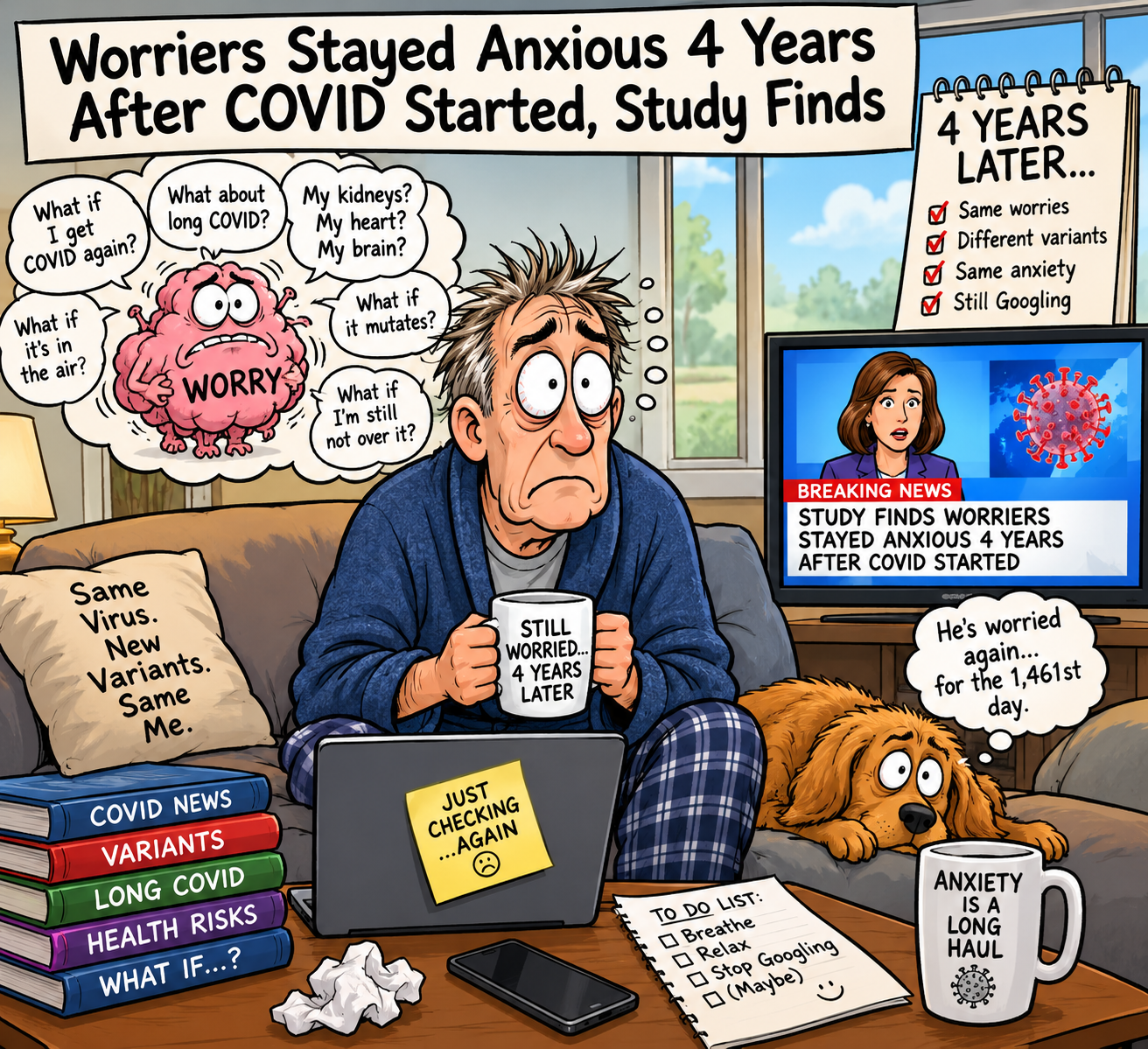
- Adults high in fear for their health, a trait tied to worry, saw distress rise far more than calmer peers when COVID hit.
- That gap narrowed over time but was still there in early 2024.
- Four other personality traits showed much weaker links, and neuroticism’s link looked similar across age groups.
- Most high-neuroticism adults stayed below clinical distress levels, so the authors favor check-ins over blanket treatment.
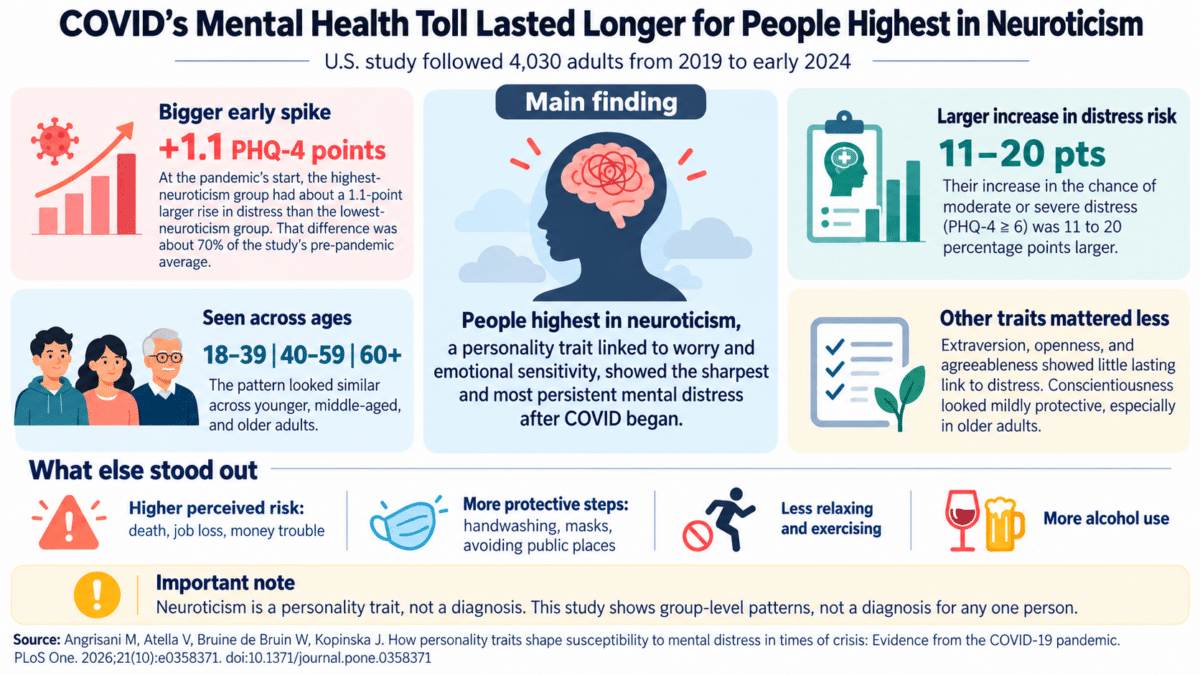
Four years after COVID-19 arrived, one group of Americans still hadn’t bounced back to where they started. People who score high on neuroticism, a personality trait tied to worry and emotional sensitivity, saw their mental distress climb far more than their calmer peers when the pandemic hit, and a gap between the two groups was still there in early 2024.
Published in PLOS One, the study followed thousands of American adults from 2019 through early 2024, about five years in all, and checked how their symptoms shifted alongside their personalities. In the pandemic’s early phases, the most neurotic quarter of participants saw their scores on a 12-point distress scale rise about 1.1 points more than the least neurotic quarter did. That extra jump equaled roughly 70 percent of the whole group’s average score before the pandemic.
Four other major traits, extraversion, openness, agreeableness, and conscientiousness, showed far weaker or less consistent links to how people’s mental health held up. Being outgoing, curious, kind, or organized did far less to predict who struggled. Neuroticism stood out by a wide margin in this study.
COVID Mental Health Study Surveyed 4,030 Americans Through 2024
Data came from the Understanding America Study, a University of Southern California survey panel of about 14,000 U.S. adults. Households are recruited from a list covering nearly all U.S. addresses, and anyone without internet or a tablet gets one, so the panel stays representative of the country.
A COVID survey ran in 34 rounds between March 2020 and mid-2023, joined by surveys from before the pandemic and from early 2024. After incomplete responses were removed, 4,030 adults and more than 106,000 survey responses remained.
Distress came from a four-question check-in, the PHQ-4, that asks how often people feel down, lose interest in things, feel nervous, or can’t stop worrying. Each answer is rated from 0 to 3 for how often a symptom showed up over the past two weeks, so a one-point rise is roughly one answer moving up a single notch. Scores run from 0 to 12, and a 6 or higher signals moderate or severe symptoms of depression or anxiety. A 44-question personality test, taken before the pandemic, sorted people by neuroticism. Researchers split participants into four equal groups and compared the top with the bottom, accounting for factors such as age, gender, and income.
High Neuroticism Linked to Biggest COVID Mental Health Spike
Across everyone studied, distress jumped in March 2020, eased, and stayed above 2019 levels through early 2024. Research the authors cite shows distress was already climbing in the years before COVID, so the pandemic may not explain all of that lingering rise.
Within that overall pattern, the most neurotic group fared worst. Their early gap over the least neurotic group shrank in later months but never closed, and a similar split showed up in how many people crossed the 6-point line.
Highly conscientious, organized people came closest to a protective edge, reporting modestly lower distress. That advantage mostly vanished when the question became who crossed the 6-point line.
Earlier research found younger adults fared worse than older ones during the pandemic. Here, the neuroticism pattern looked broadly similar in adults 18 to 39, 40 to 59, and 60 and older. In each age group, the more neurotic adults saw distress spike at the start and only partly recover. Conscientiousness was the exception, with its protective link clearest among adults 60 and older.
Higher Neuroticism Came With Greater COVID Fears, Less Exercise, More Alcohol
Extra survey questions offer clues, though they show links rather than causes. People higher in neuroticism rated their own chances of dying from COVID, losing a job, or running out of money as higher, and those worries peaked when infections surged, then faded only gradually through late 2022 and beyond. They were also more likely to report handwashing, mask wearing, and avoiding public places, at least through fall 2021, when the survey stopped asking. Avoiding crowds appeared tied largely to those fears, while handwashing and masking were not explained by fear alone.
Coping habits differed, too. Participants reported how many days in the past week they relaxed, exercised, or drank alcohol, and higher-neuroticism people relaxed and exercised less often and drank alcohol more often. A mind busy rehearsing worst-case scenarios may leave little room for unwinding, though the study cannot confirm that link.
Most High-Neuroticism Adults Stayed Below Clinical Distress Levels During COVID
Most high-neuroticism participants did not reach clinical thresholds for distress during the pandemic, according to the authors, who describe elevated neuroticism as “a risk factor, not a determinant.” A high score is linked to more distress without guaranteeing it. Broad preventive therapy for everyone who scores high on the trait would be inappropriate, they say. They favor checking in with people after a crisis begins and saving intensive treatment for those whose distress persists.
After the next crisis, worry-prone adults are a group worth checking in on. The study cannot prove personality itself caused the gap, so a check-in, not a label, is the fair takeaway.