John Murphy, CEO The COVID-19 Long haul Foundation
Abstract
The Vaccine Adverse Event Reporting System (VAERS) is a U.S. passive surveillance system jointly administered by the Centers for Disease Control and Prevention (CDC) and the Food and Drug Administration (FDA). It collects reports of health events occurring after vaccination, regardless of whether the reporter believes the vaccine caused the event. This article provides a descriptive analysis of reported adverse events following COVID-19 vaccination, including deaths, hospitalizations, emergency-department visits, permanent disabilities and selected serious adverse events.
The analysis is based on publicly available VAERS data and federal descriptions of the database. The currently available VAERS datasets were updated July 3, 2026 and contain reports processed through June 26, 2026. Beginning in May 2025, the public dataset was expanded to include secondary reports from additional reporters concerning the same patient, vaccine and dose combination. These additional records represent additional reports of previously reported events rather than additional adverse events.
The findings demonstrate a very large number of reported adverse events following COVID-19 vaccination, particularly during 2021 and 2022. The reports include deaths, hospitalizations, emergency visits, neurological events, cardiovascular events, thrombotic events and other conditions. However, VAERS is a passive surveillance system and cannot, by itself, establish that vaccination caused any particular reported outcome. Consequently, the results presented here are descriptive findings concerning reports, not estimates of vaccine-attributable morbidity or mortality.
1. Introduction
COVID-19 vaccines were introduced in the United States in December 2020. Because the vaccines were administered to hundreds of millions of people, federal authorities substantially expanded vaccine-safety surveillance.
VAERS was one component of that surveillance system. It is designed primarily as an early-warning system capable of detecting unusual or unexpected patterns that require further investigation. Anyone—including patients, family members, healthcare professionals and vaccine manufacturers—may submit a report. Healthcare providers and manufacturers have additional mandatory reporting requirements for specified events.
A fundamental characteristic of VAERS is that a report records an event following vaccination, not necessarily an event caused by vaccination.
This distinction is essential when interpreting mortality and morbidity statistics.
2. Scope of the Available Data
The federal VAERS dataset currently provides downloadable records by year as well as an all-years dataset. The July 3, 2026 release states that the data had been processed through June 26, 2026.
The public data contain three principal files:
- VAERS case/report information;
- VAERS symptom information; and
- VAERS vaccine information.
The records can therefore be analyzed at the report level, symptom level and vaccine-product level.
A major change occurred in May 2025. Before that date, the public files generally contained the initial or primary report for a patient-vaccine-dose combination. The expanded dataset also contains secondary reports submitted by additional reporters concerning the same event. Federal officials explicitly state that these additional records should not be interpreted as additional adverse events.
Accordingly, comparisons between analyses performed before and after May 2025 require particular care.
3. Overall Reporting Volume
The COVID-19 vaccination program generated an unprecedented volume of VAERS reporting.
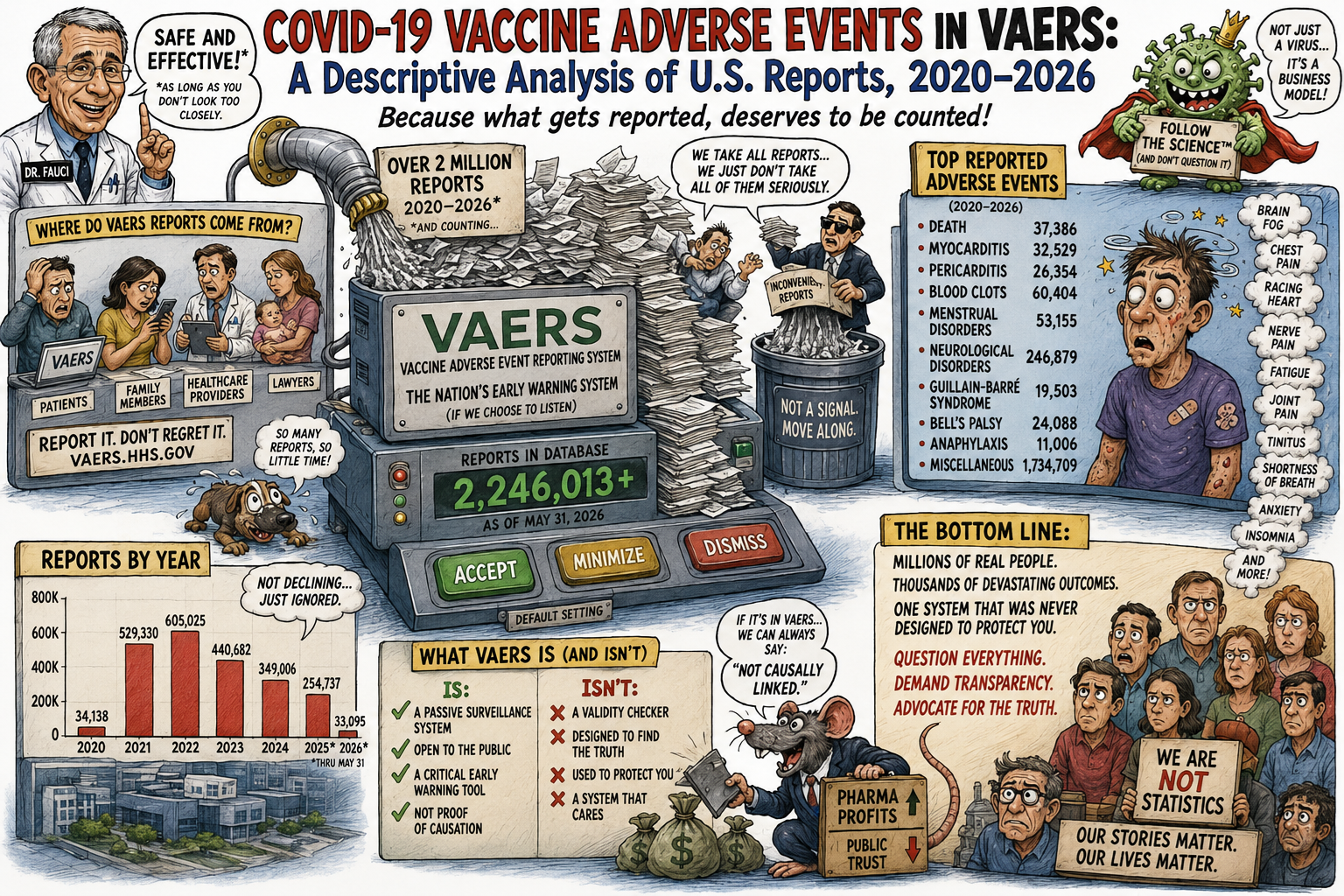
CDC’s surveillance manual reports approximately 49,137 U.S. VAERS reports from all vaccines in 2020 and approximately 752,660 in 2021. The increase occurred in the setting of the extraordinary number of COVID-19 vaccine doses administered during the pandemic. Between December 2020 and May 11, 2023, more than 676 million COVID-19 vaccine doses had been administered in the United States.
The annual pattern is therefore characterized by:
- very low COVID-vaccine reporting in 2020 because vaccination began late in that year;
- a major increase in 2021;
- continued high reporting in 2022;
- declining reporting as COVID vaccination rates decreased; and
- substantially lower annual reporting in 2024–2026.
A third-party analysis of the downloadable VAERS data illustrates this temporal pattern, reporting approximately 757,747 COVID-vaccine-associated reports in 2021, 221,580 in 2022, 54,720 in 2023, 20,246 in 2024 and 10,644 in 2025. Its 2026 count was 500 at the time of its latest quarterly update. These figures should be regarded as a secondary analysis rather than an official CDC summary, particularly because reporting and processing are ongoing.
4. Death Reports
Death is classified by VAERS as a serious adverse event.
The most frequently cited federal analysis covering the initial COVID-vaccine period found 19,476 preliminary reports of death among people who had received a COVID-19 vaccine through March 1, 2023. During that period, more than 672 million COVID-19 vaccine doses had been administered in the United States. The corresponding crude proportion was approximately 0.0029% of administered doses.
This figure represents reports of deaths following vaccination, rather than confirmed vaccine-caused deaths.
Federal regulations require reporting of specified deaths after vaccination even when the reporter is uncertain whether the vaccine caused the death. Furthermore, people receiving vaccination are not removed from the normal background risk of myocardial infarction, stroke, cancer, infection, accidents, suicide, chronic disease and other causes of death.
Consequently, the numerical question
How many people died after receiving a COVID-19 vaccine?
is answerable from VAERS.
The substantially different question
How many people died because of a COVID-19 vaccine?
cannot be answered from the VAERS count alone.
5. Hospitalizations and Other Serious Outcomes
VAERS defines serious reports to include:
- death;
- hospitalization;
- prolongation of hospitalization;
- life-threatening illness;
- permanent disability; and
- congenital abnormalities.
A secondary analysis of VAERS data through 2026 reports approximately 122,692 hospitalization reports, 148,059 emergency-department visits and 26,268 disability reports associated with the COVID-19 vaccine product category across the full period represented in its dataset. It also reports 26,537 death reports.
These numbers illustrate the magnitude of the reporting database but should not be interpreted as numbers of confirmed vaccine injuries.
There are several reasons.
First, one report can contain multiple adverse events.
Second, multiple reports can concern the same underlying event.
Third, the same individual can experience multiple health events.
Fourth, the reporting system accepts events regardless of whether the vaccine is believed to have caused them.
Finally, the public database contains both verified and unverified information.
6. Cardiovascular Findings
Cardiovascular events constitute an important component of COVID-vaccine safety surveillance.
The most clearly established cardiovascular safety signal is myocarditis and pericarditis following mRNA vaccination.
CDC surveillance identified the highest myocarditis reporting rates among adolescent and young adult males, particularly following the second mRNA dose. Historical VAERS-based analyses reported rates of approximately:
- 70.7 cases per million Pfizer-BioNTech doses among males aged 12–15;
- 105.9 per million among males aged 16–17; and
- approximately 52–56 per million among males aged 18–24, depending on vaccine product.
Subsequent analyses using the Vaccine Safety Datalink confirmed an increased risk of myocarditis after mRNA COVID-19 vaccination, with the highest incidence among adolescent and young adult males.
VAERS was therefore important in detecting the signal, but VAERS alone was insufficient to establish the incidence or causal magnitude of the association.
A 2026 analysis of VAERS records examining cardiac arrhythmias after COVID vaccination further demonstrates continuing scientific investigation of cardiovascular reports in the database.
7. Thrombotic Events
A second major safety signal involved thrombosis with thrombocytopenia syndrome (TTS), particularly following the Janssen/Johnson & Johnson vaccine.
VAERS played a direct role in identifying this signal.
In April 2021, six initial reports of TTS prompted federal health authorities to recommend a temporary pause in administration of the Janssen vaccine while the cases were evaluated. Subsequent surveillance established an association between the vaccine and TTS.
CDC currently estimates the incidence at approximately four cases per million Janssen doses overall, with higher rates among women aged 30–49.
The Janssen vaccine was subsequently withdrawn from the U.S. market.
This episode illustrates the intended function of VAERS: detection of a potentially rare adverse-event cluster followed by epidemiological and clinical investigation.
8. Guillain-Barré Syndrome
Guillain-Barré syndrome (GBS) was another safety signal associated primarily with the Janssen vaccine.
CDC reported higher-than-expected GBS reporting following Janssen vaccination but not following mRNA vaccination.
The finding demonstrates why raw VAERS totals must be supplemented with vaccine-specific analysis.
Combining Pfizer-BioNTech, Moderna, Janssen and later Novavax reports into one aggregate number can obscure important differences between vaccine platforms.
9. Neurological and Other Reported Conditions
VAERS contains reports involving a wide range of neurological, cardiovascular, respiratory, gastrointestinal, dermatologic, hematologic and musculoskeletal conditions.
Among the frequently reported symptoms in early COVID-vaccine surveillance were:
- headache;
- fatigue;
- dizziness;
- fever;
- injection-site reactions;
- nausea; and
- muscle pain.
During the first month of U.S. COVID vaccination, CDC identified 6,994 VAERS reports among approximately 13.8 million administered doses. Of those, 6,354 were classified as nonserious and 640 as serious. Headache, fatigue and dizziness were among the most frequently reported symptoms.
The distribution of symptoms changed as the vaccination campaign expanded and different vaccine products, age groups and doses were introduced.
10. Pediatric Reports
Pediatric VAERS reports require separate analysis because background disease rates, vaccination schedules and exposure patterns differ substantially from those of adults.
Deaths following pediatric vaccination are reported to VAERS when they meet reporting requirements, but the presence of a death report does not establish causality.
Federal review of pediatric death reports has therefore relied on medical records, death certificates, autopsy information and other clinical evidence rather than simply counting VAERS entries. Recent federal analyses have emphasized this distinction when evaluating claims concerning pediatric mortality.
11. Sex and Age Patterns
The VAERS database demonstrates substantial differences by age and sex for particular adverse events.
The strongest example is myocarditis after mRNA vaccination, where reporting and confirmed incidence have been highest among adolescent and young adult males, particularly after dose two.
Other adverse-event categories show different demographic patterns.
A recent systematic analysis of VAERS records through 2024 found that females accounted for a greater proportion of several sensory and other adverse-event categories, while males showed greater representation for some cardiovascular categories.
These patterns demonstrate why aggregate national totals are insufficient for determining individual risk.
12. Vaccine-Specific Differences
COVID-19 vaccines cannot appropriately be treated as one homogeneous exposure.
The principal U.S. products included:
- Pfizer-BioNTech mRNA vaccine;
- Moderna mRNA vaccine;
- Janssen viral-vector vaccine; and
- Novavax protein-based vaccine.
The safety profiles differed.
Myocarditis was predominantly associated with mRNA vaccines and was particularly concentrated among younger males.
TTS and GBS were principally associated with the Janssen vaccine.
The identification of these differences is one of the reasons VAERS analyses generally require stratification by product, dose, age and sex.
13. The Denominator Problem
A VAERS report count is not equivalent to an incidence rate.
For example, 10,000 reports could represent:
- 10,000 events among 10 million doses; or
- 10,000 events among 500 million doses.
Those situations would represent radically different rates.
During the COVID-19 vaccination program, reliable information on the number of administered doses made rate calculations possible in some circumstances. Federal investigators therefore combined VAERS reporting with vaccination-administration data and other surveillance systems.
For most vaccine-adverse-event questions, however, VAERS itself does not provide a complete denominator or an unvaccinated comparison population.
14. Underreporting and Overreporting
VAERS has two apparently contradictory characteristics.
It can underreport adverse events because reporting is passive.
At the same time, it can contain reports of events that are not caused by vaccination.
Underreporting occurs because not every adverse event is recognized, reported to a healthcare provider, recognized as potentially vaccine-associated, or submitted to VAERS.
Overrepresentation of coincidental events occurs because people experience illness continuously, including during periods when they are being vaccinated.
Reporting can also increase following publicity concerning a particular adverse event. CDC specifically identifies media attention and public awareness as factors that can change VAERS reporting patterns.
15. Duplicate and Secondary Reports
The 2025 expansion of the public VAERS dataset is particularly important for longitudinal analyses.
A patient may have a report submitted by:
- the patient;
- a physician;
- a hospital;
- a vaccine manufacturer; or
- another reporting source.
Those reports may describe the same event.
Federal officials therefore distinguish primary and secondary reports and have emphasized that additional records added in the expanded dataset do not necessarily represent additional adverse events.
Any analysis combining pre-May-2025 and post-May-2025 datasets must account for this methodological change.
16. What VAERS Can Establish
VAERS can establish that:
- A health event was reported after vaccination.
- The event occurred sufficiently close to vaccination for the reporter to submit it.
- Particular vaccines and adverse-event categories are represented in the reporting system.
- Reporting patterns can reveal potential safety signals.
- Some signals can subsequently be confirmed using other surveillance systems.
VAERS successfully contributed to identification of COVID-vaccine safety signals involving TTS, GBS and myocarditis.
17. What VAERS Cannot Establish
VAERS alone cannot establish:
- That a vaccine caused a particular death.
- That a vaccine caused a particular hospitalization.
- The true incidence of most adverse events.
- The relative risk compared with an unvaccinated population.
- The attributable fraction of deaths.
- Whether a reported illness would have occurred without vaccination.
- Whether a particular vaccine is safer than another solely from raw report totals.
CDC and FDA explicitly state that VAERS reports alone cannot establish causality. Reports may contain incomplete, inaccurate, coincidental or unverifiable information.
18. Importance of Complementary Surveillance Systems
For this reason, VAERS is only one component of the U.S. vaccine-safety system.
Potential signals are investigated using additional sources, including:
- Vaccine Safety Datalink (VSD);
- Clinical Immunization Safety Assessment Project;
- electronic health records;
- death certificates;
- medical records;
- hospital records;
- epidemiological studies;
- self-controlled case-series analyses; and
- other federal and international databases.
CDC describes VAERS as an early-warning system whose signals generally require confirmation through other systems.
This distinction is particularly important for mortality analysis.
19. Summary of Descriptive Findings
The available VAERS data demonstrate several clear findings.
First, COVID-19 vaccination generated an exceptionally large number of adverse-event reports, concentrated overwhelmingly in 2021 and 2022.
Second, thousands of reports involved death, hospitalization, disability and other serious outcomes.
Third, cardiovascular, neurological, thrombotic and inflammatory conditions appear prominently among serious reports.
Fourth, specific safety signals have been identified through VAERS and subsequently confirmed or evaluated using independent epidemiological systems.
Fifth, the magnitude of reported events varies substantially according to age, sex, vaccine product and dose.
Sixth, the number of death reports is substantially different from the number of deaths established through clinical investigation to have been caused by vaccination.
Seventh, the VAERS database has undergone an important methodological expansion since May 2025, requiring caution when comparing newer and older public datasets.
Eighth, VAERS is fundamentally a passive reporting system and therefore cannot by itself provide a valid estimate of vaccine-attributable morbidity or mortality.
20. Conclusion
The complete VAERS record provides a large and detailed body of information concerning health events occurring after COVID-19 vaccination in the United States.
The database contains reports involving millions of individual symptoms and substantial numbers of serious events, including deaths, hospitalizations, disabilities, cardiovascular conditions, neurological disorders and thrombotic events. Several specific safety signals identified through VAERS were subsequently investigated and confirmed or characterized using other epidemiological systems.
At the same time, the database cannot be interpreted as a registry of vaccine-caused injuries or deaths.
The scientifically appropriate description of the mortality data is therefore:
VAERS contains reports of deaths occurring after COVID-19 vaccination. The number of such reports is a factual property of the database. Determining how many of those deaths were caused or contributed to by vaccination requires individual clinical investigation and epidemiological comparison and cannot be determined from the raw VAERS count alone.
The same principle applies to hospitalization, disability and other morbidity outcomes.
VAERS is most appropriately understood as a national signal-detection system. Its principal scientific value lies not simply in the number of reports, but in identifying patterns that can subsequently be evaluated through controlled epidemiological and clinical studies.
Data Sources
The principal federal sources for this analysis are the CDC VAERS information pages, the HHS VAERS downloadable datasets, CDC’s VAERS interpretation guide, CDC’s Vaccine Safety Datalink and CDC’s published COVID-19 vaccine safety analyses. The current VAERS downloadable datasets were updated July 3, 2026 and contain records processed through June 26, 2026.