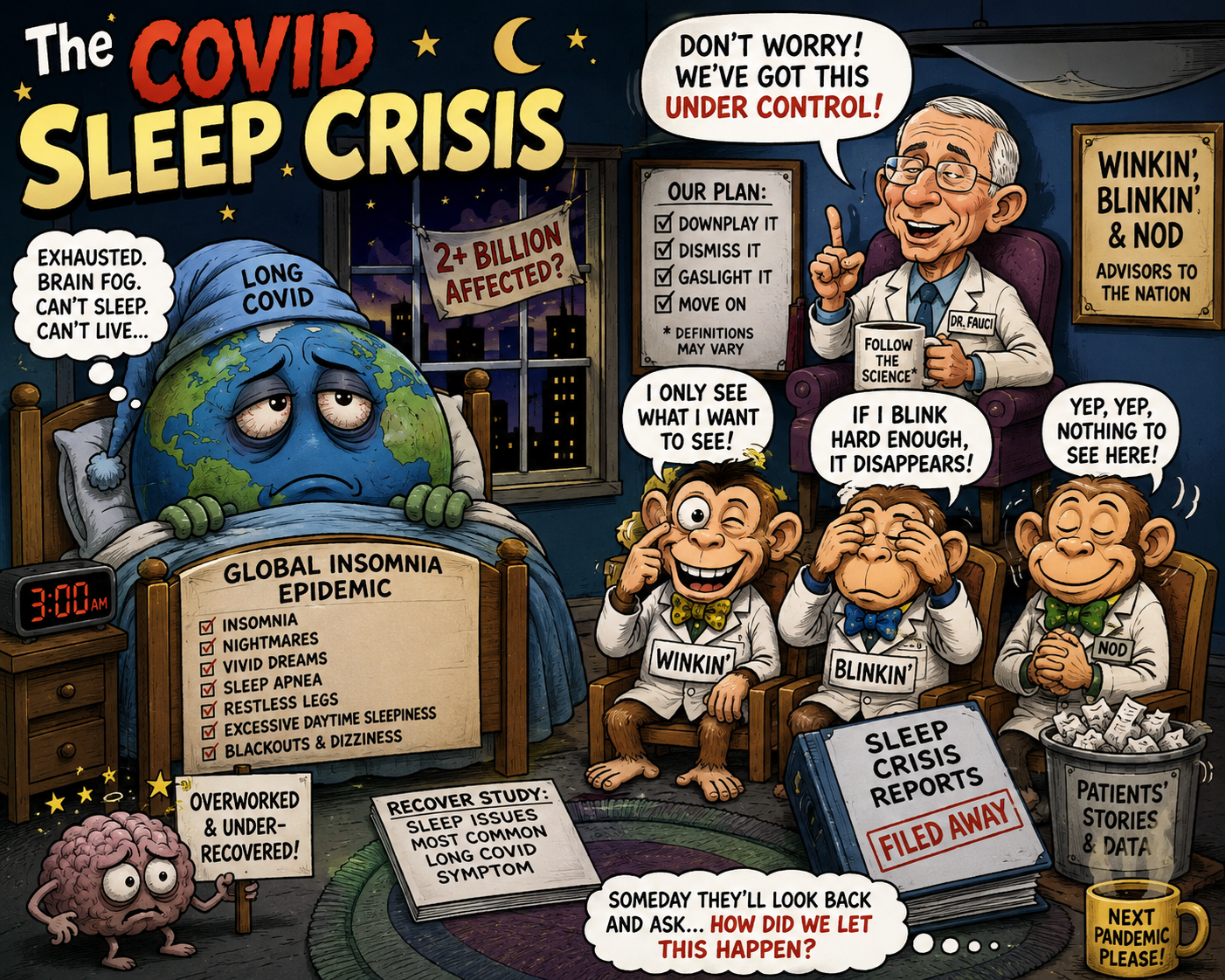
For millions of people, COVID didn’t just steal their energy. It changed the way they sleep.
By John Murphy, CEO The COVID Long haul Foundation
At 3 a.m., the house is silent.
But inside your body, something is happening that you cannot explain.
Your heart suddenly pounds. You are wide awake. Your mind is racing, although you aren’t particularly anxious. You fall asleep again—but only for an hour. Then you wake up.
Again.
And again.
Or perhaps your experience is the opposite. You sleep ten, twelve, even sixteen hours and wake feeling as though someone has drained the battery from your body.
You are exhausted.
Your brain is foggy.
You want to sleep again.
For many people who developed Long COVID, this isn’t an occasional bad night. It can continue for months or years.
And increasingly, scientists are finding that these experiences are not imaginary, unusual or simply a matter of poor “sleep hygiene.”
COVID can profoundly disturb the biology of sleep.
“I slept 12 hours—and then another six”
Consider the experience of Eleanor, whose Long COVID story has been publicly published by the patient-support organization Positively COVID.
At the height of her illness, she wrote that she was sleeping 12 hours at night and another six hours during the day.
She had become so debilitated that she moved in with her parents because she could no longer stand long enough to brush her teeth.
Her description of the accompanying illness is particularly revealing: overwhelming fatigue, dizziness, striking changes in the color of her hands and feet and severe cognitive problems.
She described her brain fog as being on “autopilot”—having conversations while feeling that she wasn’t really present in them.
This is not the picture most people have of insomnia.
It is something potentially more complicated:
the brain can demand enormous amounts of sleep and still fail to produce restorative sleep.
Another patient went in the opposite direction
One Long COVID patient described the experience in almost exactly the opposite terms.
Three months after a severe COVID infection, the person reported losing the ability to sleep normally.
For three consecutive days, there was essentially no sleep.
Eventually medication was required.
The patient described simultaneous episodes of rapid heartbeat and powerful physical “surges” that felt like anxiety even though the person did not feel psychologically anxious.
That distinction is worth considering.
What feels like anxiety may sometimes be an autonomic event.
The body may be generating a surge of sympathetic nervous-system activity—raising heart rate and arousal precisely when the brain is supposed to be descending into sleep.
This is one reason researchers have become interested in the relationship between Long COVID, dysautonomia and sleep.
“My brain won’t turn off”
Another patient described a bizarre oscillation between extremes.
After recovering substantially from Long COVID, a reinfection brought the sleep problems back.
One night the person fell asleep around 4 a.m. and managed only five hours of sleep.
The next night, the person slept 16 hours.
And still didn’t feel refreshed.
The patient described the sensation simply as:
“my brain won’t turn off.”
That phrase appears repeatedly in accounts from Long COVID patients.
It is striking because it captures something conventional definitions of insomnia don’t always convey.
The patient isn’t necessarily saying:
“I’m worried about something.”
They’re saying:
“My body is exhausted, but whatever controls sleep will not let me stay asleep.”
Four years of broken sleep
Another publicly posted account describes a person who has lived with Long COVID for four years.
Sleep had become extraordinarily fragmented.
The person reported sleeping for approximately an hour, waking, sleeping for perhaps another 45 minutes, waking again, and repeating the cycle.
A formal sleep study reportedly found only about 1½ hours of actual sleep during the night.
The patient was relieved not to have sleep apnea—but that didn’t solve the mystery.
The sleep remained fragmented and non-restorative.
This illustrates an important point.
A negative sleep-apnea test does not mean:
“Nothing is wrong with your sleep.”
It means that one important explanation has been investigated and apparently not found.
There are many other possibilities.
A teenager who could not wake up
The phenomenon isn’t restricted to older adults.
Researchers have described a 13-year-old girl who developed severe hypersomnolence after a relatively mild COVID infection.
Before COVID, she had no significant sleep problem.
After infection, she developed insomnia, a major shift in her circadian rhythm, difficulty waking, brain fog and headaches.
Her sleep duration was frequently 12 hours or more in a 24-hour period.
She had difficulty getting out of bed, missed school and sometimes had to leave school early because of sleepiness and headaches.
Formal testing subsequently found persistent hypersomnolence despite apparently adequate sleep during the overnight study.
This is important because it demonstrates why simply telling someone to “get more sleep” can be meaningless.
She was already getting enormous amounts of sleep.
The problem was that the sleep was not functioning normally.
The doctors who became patients
Perhaps the most compelling evidence comes from physicians themselves.
In a published account of two doctors who developed Long COVID, one physician described how the initial illness gave way to palpitations and insomnia.
The problem was not simply difficulty falling asleep.
The physician would fall asleep and then wake during the night with a pounding heart, sometimes remaining unable to fall back asleep for more than an hour.
Physical exertion made things worse, producing profound delayed exhaustion.
The physician described the experience as having a battery that had been completely drained.
This type of first-person account is particularly powerful because physicians are accustomed to thinking in diagnostic categories.
Yet here, the physician became the patient—and encountered a syndrome that did not fit neatly into familiar categories.
Some patients experience both extremes
Perhaps the strangest pattern is the oscillation between insomnia and hypersomnia.
A patient may go from almost no sleep to extraordinarily long periods of sleep.
Another person reported going through episodes of both insomnia and hypersomnia, sometimes sleeping 16 hours after a night of very little sleep.
That pattern raises an intriguing possibility:
Maybe Long COVID isn’t simply “causing insomnia.”
Maybe in some people it is disturbing the sleep-wake regulatory system itself.
The biology of a broken sleep-wake system
Sleep isn’t merely rest.
It is an active biological state controlled by an intricate network involving the hypothalamus, thalamus, brainstem, cortex, autonomic nervous system, hormones, neurotransmitters and circadian clocks.
COVID can potentially affect several of those systems.
Researchers have now documented a remarkably broad spectrum of post-COVID sleep disorders.
In a sleep-clinic study of 42 patients with post-acute COVID syndrome, researchers identified:
- obstructive sleep apnea;
- chronic insomnia;
- primary hypersomnia;
- REM sleep behavior disorder;
- newly developed circadian phase delay.
Seven patients met criteria for idiopathic hypersomnia and two for narcolepsy type 2. The investigators concluded that persistent severe sleep complaints following COVID warrant comprehensive clinical sleep evaluation.
That is a remarkable finding.
The problem isn’t one disorder.
It is an entire spectrum of sleep-wake abnormalities.
When the brain’s clock changes
Our bodies possess an internal timing system that coordinates sleep with daylight, hormones, temperature, metabolism and behavior.
COVID may disrupt that timing system.
One patient described falling asleep easily and sleeping normally during the first part of the night—but experiencing chaos during the second half.
The reported symptoms included repeated adrenaline-like jolts, sudden increases in breathing and heart rate, sleepwalking, sleep talking, disturbing dreams and repeated awakenings.
The description sounds almost like the nervous system is repeatedly hitting an emergency reset button.
Whether that particular patient’s symptoms were caused by Long COVID cannot be established from a self-report.
But the phenomenon is biologically plausible enough to warrant investigation—and similar symptoms have now appeared in clinical sleep research.
A possible clue deep inside the brain
One published case report offers an especially intriguing clue.
A 41-year-old woman reportedly developed complete insomnia lasting three weeks after COVID-19.
A conventional MRI was normal.
But SPECT brain imaging demonstrated reduced blood flow in both thalami.
The thalamus is deeply involved in regulating consciousness, arousal and sleep.
Follow-up imaging showed persistent abnormalities over time, although the pattern changed.
This is a single case, not proof of a general mechanism.
But it raises an extraordinary question:
Could COVID-associated sleep disorders sometimes reflect measurable changes in brain physiology even when conventional MRI appears normal?
That question deserves considerably more research.
The sleep-apnea trap
There is another reason patients with Long COVID should not assume that every sleep problem is caused by the infection.
Sleep apnea is common.
It can produce daytime sleepiness, cognitive impairment, headaches, poor concentration and profound fatigue.
Those symptoms overlap almost perfectly with Long COVID.
A person can therefore have both.
And some patients report developing sleep apnea after COVID.
That makes objective sleep testing particularly important when symptoms are severe.
A patient may spend ten hours in bed but experience dozens of respiratory or arousal events every hour.
The result is technically “ten hours in bed.”
Biologically, it may be something very different.
The mystery of “unrefreshing sleep”
Perhaps the most common phrase in patient accounts is not insomnia.
It is:
“I slept, but I didn’t sleep.”
A 2025 review of Long COVID sleep disorders describes a range of problems including insomnia, hypersomnolence, sleep apnea, circadian disturbances and other abnormalities. The authors emphasize that the mechanisms are likely heterogeneous.
This may explain why sleep medications don’t necessarily solve the problem.
If the underlying problem involves circadian disruption, autonomic activation, sleep apnea, central hypersomnia or abnormal sleep architecture, simply inducing unconsciousness is not necessarily equivalent to producing normal restorative sleep.
The vicious cycle
And then something else happens.
Poor sleep makes everything else worse.
Brain fog worsens.
Pain becomes harder to tolerate.
Mood changes.
Reaction time slows.
Memory becomes less reliable.
Physical activity becomes more difficult.
Fatigue increases.
And because the person feels exhausted, they spend more time sleeping during the day.
Which can further destabilize the body’s circadian rhythm.
The cycle becomes:
COVID → disrupted sleep → cognitive dysfunction and fatigue → daytime sleeping → circadian disruption → poorer nighttime sleep → greater fatigue.
Breaking that cycle may require treating the sleep disorder itself—not simply telling the patient to wait for Long COVID to disappear.
Science is beginning to catch up with the stories
The patient stories are compelling.
But anecdotes alone cannot establish causation.
Fortunately, the emerging scientific literature is beginning to provide independent support.
In one prospective cohort, approximately one-quarter of patients with Long COVID reported sleep-related symptoms; insomnia was considerably more common than excessive sleepiness. Objective testing identified central hypersomnia and narcolepsy in a subset of patients with excessive sleepiness.
Another study of 530 post-COVID patients identified four cases of central hypersomnia after carefully excluding alternative explanations. Three met criteria for idiopathic hypersomnia and one for type 2 narcolepsy.
These are small numbers.
But they are important numbers.
They demonstrate that excessive sleepiness after COVID can sometimes correspond to a diagnosable neurological sleep disorder.
The question doctors should ask
Perhaps the most important change is a simple one.
When a Long COVID patient says:
“I can’t sleep,”
the next question should not simply be:
“How much caffeine are you drinking?”
And when someone says:
“I sleep twelve hours and I’m still exhausted,”
the response shouldn’t simply be:
“You need to exercise more.”
The clinician should ask:
What kind of sleep problem is this?
Is it insomnia?
Sleep apnea?
Central hypersomnia?
A circadian disorder?
Periodic limb movements?
REM sleep behavior disorder?
Autonomic arousals?
Medication-related sleep disruption?
Or some combination?
The bedroom may become a laboratory
This may ultimately be one of the most productive directions in Long COVID research.
Instead of relying exclusively on questionnaires, investigators can measure sleep objectively.
Polysomnography can examine brain waves, breathing, oxygenation, heart rhythm and muscle activity.
Actigraphy can track sleep-wake cycles over extended periods.
Wearable devices can provide additional information about heart rate and movement.
Researchers can combine those measurements with neurological testing, autonomic measurements, inflammatory markers and other biological data.
The goal would be to determine whether distinct sleep signatures correspond to distinct forms of Long COVID.
If they do, sleep could become more than something to treat.
It could become a window into the disease itself.
Listen to the people who cannot sleep
There is a tendency in medicine to distrust symptoms that are difficult to measure.
Sleep presents a special problem because the patient is unconscious when much of the disease is occurring.
But the stories are remarkably consistent.
One patient sleeps 16 hours and remains exhausted.
Another cannot sleep for three days.
Another wakes every hour.
Another experiences pounding heartbeats in the middle of the night.
Another develops a profoundly delayed sleep schedule.
Another acts out dreams.
Another cannot wake up for school.
Another spends years trying to remember what normal sleep felt like.
These aren’t identical disorders.
But taken together, they tell us something.
COVID appears to have disturbed sleep in a substantial number of people—and in some patients, the disturbance can become a persistent neurological problem.
The science is still developing.
The mechanisms remain uncertain.
And Long COVID is almost certainly not one disease with one biological explanation.
But the patient stories have already established something that should be difficult to ignore:
For some people, COVID didn’t simply make them tired.
It changed the machinery that determines when they sleep, how they sleep—and whether sleep restores them at all.
And sometimes, the first place to look for what COVID did to the brain isn’t the doctor’s office.
It’s the bedroom.