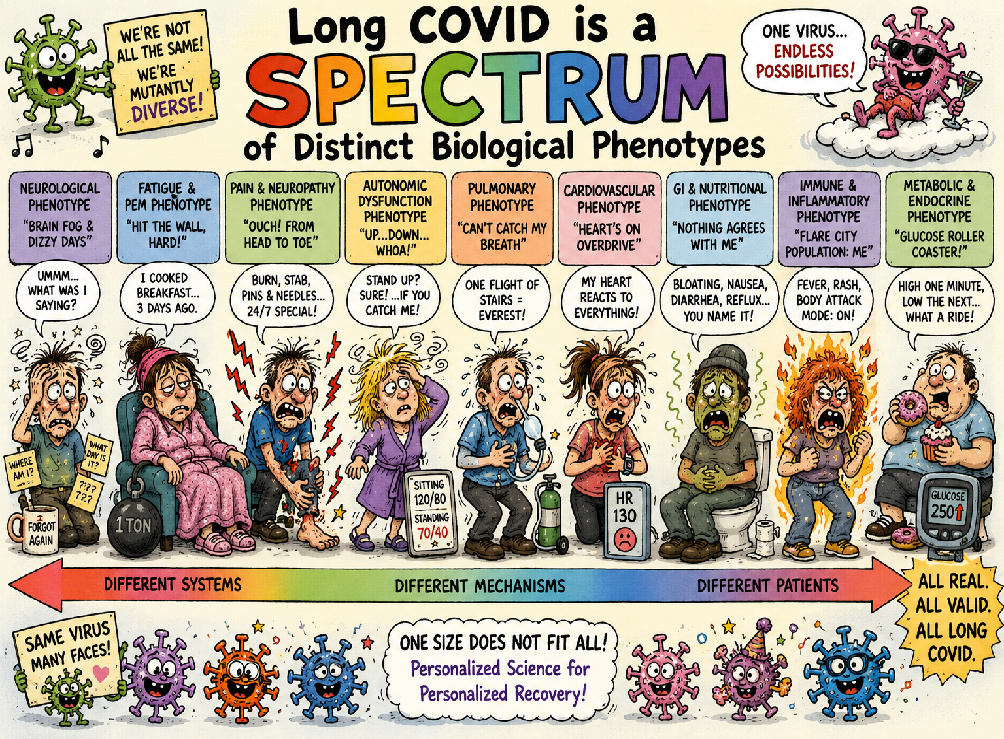
A mechanistic synthesis of the emerging phenotype-based model of post-acute sequelae of SARS-CoV-2 infection
John Murphy, CEO The COVID-19 Long haul Foundation
Abstract
Long COVID, or post-acute sequelae of SARS-CoV-2 infection (PASC), is increasingly understood not as a single postviral syndrome but as a heterogeneous collection of biological phenotypes arising from partially overlapping mechanisms. The clinical spectrum encompasses cardiopulmonary disease, neurocognitive dysfunction, post-exertional malaise and fatigue, autonomic dysfunction, gastrointestinal disturbance, neuropathic syndromes, thromboinflammatory and vascular abnormalities, metabolic dysfunction and multisystem inflammatory disease. Large-scale phenotyping has demonstrated that these manifestations cluster non-randomly, providing evidence for biologically meaningful subtypes rather than an undifferentiated symptom complex.
The emerging phenotype model is supported by convergent evidence from clinical epidemiology, proteomics, immunology, metabolomics, autonomic physiology, tissue pathology and human genetics. A 2024 Nature Immunology study of patients recovering from hospitalization identified mechanistically distinct clinical groups, including cardiopulmonary, fatigue, cognitive, gastrointestinal and anxiety/depression phenotypes. These phenotypes exhibited distinct combinations of myeloid inflammation, complement activation and tissue-specific immune abnormalities. A 2023 Nature Medicine analysis using machine learning similarly identified four reproducible clinical subphenotypes encompassing cardiac–renal, respiratory–sleep–mood, musculoskeletal–neurological and digestive–respiratory disease.
The biological architecture appears to be multidimensional. Persistent viral antigen or tissue reservoirs, immune dysregulation, autoimmunity, endothelial injury, microvascular dysfunction, autonomic impairment, latent-virus reactivation, altered microbiota and metabolic or mitochondrial dysfunction may each predominate in different patients. A 2026 Communications Medicine synthesis emphasizes this heterogeneity and the need for subtype-specific biomarkers and therapies.
Genetic studies provide further evidence that susceptibility is biologically structured. Genome-wide association analyses have identified loci associated with Long COVID, including a signal involving FOXP4, a gene implicated in immune and epithelial biology, while earlier studies identified associations involving immune regulation and viral-response pathways. These findings do not establish deterministic genetic causation but suggest that host genomic architecture modifies the probability and phenotype of persistent disease.
The central proposition of this review is that Long COVID should increasingly be conceptualized as a postinfectious systems disorder comprising multiple partially overlapping endotypes. The clinical phenotype observed in an individual patient may represent the downstream consequence of one dominant mechanism or, more commonly, several interacting mechanisms. Such a framework has direct implications for diagnosis, biomarker development, clinical trials and therapeutic precision.
Introduction
The first conception of COVID-19 was dominated by acute viral pneumonia.
That conception is now obsolete.
SARS-CoV-2 infection can initiate a prolonged disease process affecting virtually every major physiological system. The resulting condition—Long COVID—is characterized by remarkable heterogeneity in symptoms, organ involvement, severity and temporal course.
Fatigue may dominate one patient’s illness.
Orthostatic tachycardia may dominate another.
A third may develop persistent dyspnoea and impaired pulmonary diffusion.
A fourth may experience neuropathic pain and sensory loss.
Another may develop cognitive dysfunction, gastrointestinal disease or post-exertional malaise.
Still another may experience several of these manifestations simultaneously.
This diversity has historically complicated diagnosis and research.
It also created a fundamental conceptual problem:
Can a disease with hundreds of symptoms and multiple organ systems truly be considered one disease?
Increasingly, the answer appears to be yes at the etiological level, but no at the mechanistic level.
SARS-CoV-2 infection can initiate Long COVID, but the biological pathways that maintain disease appear to diverge.
This distinction is central.
Long COVID may therefore represent an etiologically unified but mechanistically heterogeneous postinfectious disorder.
I. From Syndrome to Phenotype
The term “phenotype” refers to the observable expression of disease.
An endotype, by contrast, describes a subgroup defined by an underlying biological mechanism.
This distinction is particularly important in Long COVID.
For example:
POTS is a phenotype.
The underlying mechanism might be:
- autonomic small-fiber injury;
- hypovolaemia;
- excessive sympathetic activation;
- endothelial dysfunction;
- autoantibodies affecting adrenergic receptors;
- or a combination.
Thus:
one phenotype ≠ one mechanism.
Conversely:
one mechanism may produce several phenotypes.
For example, endothelial dysfunction could contribute simultaneously to:
- orthostatic intolerance;
- cerebral hypoperfusion;
- exercise intolerance;
- dyspnoea;
- fatigue.
This explains why simple symptom-based classification has limited biological precision.
II. Evidence That Long COVID Contains Distinct Phenotypes
One of the strongest demonstrations came from Liew and colleagues, who conducted large-scale phenotyping of patients following hospitalization for COVID-19. Their analysis identified distinct groups involving cardiopulmonary disease, fatigue, anxiety/depression, cognitive dysfunction and gastrointestinal symptoms. Importantly, these clinical groups were associated with different molecular signatures, including patterns of myeloid inflammation and complement activation.
This finding is important because it moves the concept of phenotyping beyond statistical clustering.
The groups were not merely different collections of symptoms.
They exhibited different biological characteristics.
A separate machine-learning analysis of electronic health records identified four reproducible PASC subphenotypes:
- cardiac and renal;
- respiratory, sleep and mood;
- musculoskeletal and neurological;
- digestive and respiratory.
The first phenotype was associated with older age, male sex and greater severity of the acute infection.
The convergence of independent clustering strategies is compelling.
It suggests that Long COVID contains reproducible clinical architecture.
III. The Principal Long-COVID Phenotypes
A clinically useful framework can be organized into several overlapping phenotypes.
1. Cardiovascular–autonomic
Characterized by:
- POTS;
- inappropriate sinus tachycardia;
- orthostatic intolerance;
- palpitations;
- exercise intolerance;
- blood-pressure instability.
2. Neurocognitive
Characterized by:
- brain fog;
- memory impairment;
- impaired executive function;
- attention deficits;
- headache;
- sensory disturbance.
3. Fatigue–post-exertional
Characterized by:
- profound fatigue;
- reduced exercise capacity;
- post-exertional malaise;
- sleep disturbance;
- impaired recovery following physical or cognitive exertion.
4. Respiratory–pulmonary
Characterized by:
- dyspnoea;
- cough;
- impaired diffusion;
- abnormal ventilation;
- air trapping;
- pulmonary vascular abnormalities.
5. Neuropathic
Characterized by:
- paresthesias;
- burning pain;
- numbness;
- dysautonomia;
- small-fiber abnormalities.
6. Gastrointestinal
Characterized by:
- nausea;
- altered appetite;
- abdominal pain;
- reflux;
- constipation or diarrhoea;
- altered motility.
7. Vascular–thromboinflammatory
Characterized by:
- endothelial dysfunction;
- platelet activation;
- coagulation abnormalities;
- microvascular abnormalities.
8. Metabolic–bioenergetic
Characterized by:
- exercise intolerance;
- abnormal substrate utilization;
- mitochondrial dysfunction;
- altered lactate handling;
- impaired skeletal-muscle energetics.
9. Multisystem inflammatory
Characterized by simultaneous abnormalities across:
- immune;
- vascular;
- neurological;
- metabolic;
- gastrointestinal systems.
These categories overlap extensively.
The objective is therefore not to place every patient into a single box but to identify their dominant biological architecture.
IV. Phenotype I: Cardiovascular and Autonomic Long COVID
The cardiovascular-autonomic phenotype is among the most clearly defined.
Patients may develop:
- POTS;
- inappropriate sinus tachycardia;
- orthostatic hypotension;
- impaired baroreflexes;
- venous pooling;
- reduced stroke volume;
- cerebral hypoperfusion.
The underlying physiology is often a failure to maintain cardiovascular homeostasis during upright posture.
The normal response to standing requires:
venous pooling → baroreceptor activation → sympathetic vasoconstriction → preservation of cerebral perfusion.
In susceptible patients, this response may become inadequate.
The result is:
reduced venous return → reduced stroke volume → compensatory tachycardia → cerebral hypoperfusion.
This phenotype provides a physiological explanation for the striking combination of:
tachycardia + dizziness + fatigue + brain fog.
V. Phenotype II: Neurocognitive Long COVID
The neurocognitive phenotype is characterized by:
- impaired attention;
- working-memory dysfunction;
- executive dysfunction;
- slowed information processing;
- word-finding difficulty;
- memory disturbance.
Neuroinflammatory mechanisms are increasingly implicated.
Recent reviews have highlighted evidence for:
- microglial activation;
- astrocytic abnormalities;
- blood–brain-barrier dysfunction;
- persistent cytokine signaling;
- altered neural networks.
A 2026 Nature-family review specifically describes emerging evidence linking persistent neuroinflammation with microglial and astrocytic activation and blood–brain-barrier abnormalities.
However, neurocognitive Long COVID should not automatically be interpreted as direct neuronal infection.
The pathology may instead arise from immune–vascular–metabolic disturbance affecting neural networks.
VI. Phenotype III: Fatigue and Post-Exertional Malaise
Fatigue is among the most characteristic manifestations of Long COVID.
But “fatigue” is not a single physiological phenomenon.
Patients may experience:
- sleepiness;
- muscle fatigability;
- central cognitive fatigue;
- autonomic exhaustion;
- reduced cardiopulmonary reserve;
- PEM.
PEM is particularly distinctive.
The patient may perform an apparently modest activity and subsequently experience deterioration hours later or the following day.
The physiological model increasingly incorporates interactions among:
- autonomic dysfunction;
- mitochondrial metabolism;
- immune activation;
- endothelial dysfunction;
- skeletal-muscle energetics.
This phenotype overlaps strongly with ME/CFS.
The overlap is clinically meaningful but does not establish that Long COVID and ME/CFS are identical disorders.
VII. Phenotype IV: Respiratory–Pulmonary Long COVID
Respiratory Long COVID can occur after both severe and relatively mild acute infection.
Potential abnormalities include:
- impaired diffusion;
- small-airway dysfunction;
- air trapping;
- abnormal ventilation;
- pulmonary vascular abnormalities.
Persistent dyspnoea therefore does not necessarily imply persistent pneumonia.
A patient can have substantial exertional respiratory limitation despite relatively unremarkable conventional imaging.
The mechanisms may include:
airway dysfunction + vascular dysfunction + autonomic dysregulation + abnormal respiratory control.
This explains why pulmonary function testing, cardiopulmonary exercise testing and imaging may provide complementary rather than redundant information.
VIII. Phenotype V: Neuropathic Long COVID
Small-fiber neuropathy represents one of the most intriguing pathological phenotypes.
Small sensory and autonomic fibres are particularly vulnerable to:
- immune-mediated injury;
- inflammatory signaling;
- metabolic stress;
- microvascular compromise.
Patients may develop:
- burning pain;
- electric sensations;
- numbness;
- temperature abnormalities;
- sweating disturbance;
- orthostatic intolerance.
Skin biopsy can demonstrate reduced intraepidermal nerve-fiber density, although autonomic abnormalities can sometimes occur despite preserved conventional somatic fibre density.
This distinction reinforces the importance of examining autonomic fibres separately from somatic sensory fibres.
IX. Phenotype VI: Gastrointestinal Long COVID
Gastrointestinal manifestations include:
- nausea;
- anorexia;
- abdominal pain;
- reflux;
- constipation;
- diarrhoea;
- altered motility.
Several mechanisms may coexist:
- intestinal immune activation;
- altered microbiota;
- epithelial dysfunction;
- autonomic dysregulation;
- altered enteroendocrine signaling;
- persistent viral antigen.
The gastrointestinal tract is particularly interesting because it represents both a major immune organ and a large reservoir of neural and endocrine signaling.
Thus gastrointestinal Long COVID may be a gut–immune–brain disorder rather than simply a residual gastrointestinal infection.
X. Phenotype VII: Vascular and Thromboinflammatory Long COVID
SARS-CoV-2 can cause profound endothelial activation during acute infection.
In a subset of patients, abnormalities may persist.
Potential mechanisms include:
- endothelial activation;
- platelet hyperreactivity;
- complement activation;
- altered coagulation;
- impaired nitric-oxide signaling;
- microvascular dysfunction.
These abnormalities may contribute to:
- fatigue;
- exercise intolerance;
- neurological symptoms;
- dyspnoea;
- autonomic dysfunction.
Importantly, the existence of endothelial abnormalities does not establish that circulating “microclots” are the universal cause of Long COVID.
The evidence supports vascular pathology as a plausible component of selected phenotypes, not a complete explanation of the disease.
XI. Phenotype VIII: Metabolic and Bioenergetic Long COVID
The metabolic phenotype is increasingly difficult to ignore.
Patients can have profound functional impairment despite relatively modest abnormalities in conventional laboratory tests.
Potential abnormalities include:
- impaired oxidative phosphorylation;
- altered fatty-acid metabolism;
- abnormal glycolytic flux;
- impaired mitochondrial signaling;
- altered lactate kinetics;
- reduced metabolic flexibility.
These mechanisms may converge on a common physiological endpoint:
inability to generate sufficient ATP efficiently during increased demand.
This could contribute to:
- fatigue;
- exercise intolerance;
- muscle weakness;
- PEM.
XII. Phenotype IX: Multisystem Inflammatory Long COVID
Some patients do not fit neatly into one organ-specific phenotype.
They exhibit simultaneous:
- fatigue;
- neurological symptoms;
- gastrointestinal abnormalities;
- vascular dysfunction;
- autonomic instability;
- inflammatory abnormalities.
This may represent the closest approximation to a generalized Long-COVID syndrome.
The 2024 Nature Immunology phenotyping study is particularly informative because several clinical groups demonstrated myeloid inflammation and complement activation, while tissue-specific immune disturbances appeared to differentiate symptom domains.
This suggests a model of:
systemic immune dysregulation + tissue-specific vulnerability.
XIII. Etiology: One Virus, Multiple Pathways
The initiating event remains SARS-CoV-2 infection.
But the persistence of disease probably requires additional processes.
At least six major mechanisms are currently supported to varying degrees:
- persistent viral antigen or tissue reservoirs;
- immune dysregulation;
- autoimmunity;
- latent-virus reactivation;
- vascular/endothelial dysfunction;
- autonomic and neuroimmune dysfunction.
Alteration of the microbiome and metabolic systems may provide additional mechanisms or amplifiers.
This multifactorial model is consistent with current reviews in the Nature portfolio.
XIV. Viral Persistence
Persistent viral RNA, protein or antigen has been detected in multiple tissues in some patients following acute infection.
Potential sites include:
- gastrointestinal tract;
- lymphoid tissue;
- lung;
- nervous-system-associated compartments.
The critical unresolved question is whether these reservoirs are:
causal, contributory, or merely residual.
A reservoir that remains biologically active could continuously stimulate the immune system.
This would create a potential sequence:
persistent antigen → chronic immune stimulation → endothelial/autonomic injury → persistent symptoms.
But the evidence does not support the proposition that persistent replication occurs uniformly in Long COVID.
XV. Immune Dysregulation
Long COVID has been associated with persistent alterations in:
- T-cell populations;
- B-cell responses;
- cytokine signaling;
- complement;
- myeloid-cell function;
- innate immune pathways.
The Nature Immunology phenotyping study is particularly significant because myeloid inflammation and complement activation were associated with several clinical phenotypes six months after hospitalization.
The implication is that immune dysregulation is not simply a generic consequence of chronic illness.
It may form part of the disease biology.
XVI. Autoimmunity
Autoimmune mechanisms remain attractive because Long COVID resembles several established postinfectious autoimmune diseases.
Candidate mechanisms include:
- molecular mimicry;
- autoreactive B cells;
- receptor-directed antibodies;
- immune-complex formation;
- altered regulatory T-cell function.
GPCR autoantibodies are particularly interesting in autonomic phenotypes because adrenergic and muscarinic receptors regulate cardiovascular and visceral physiology.
Yet antibody detection alone cannot establish causality.
The field requires functional assays and interventional trials.
XVII. Latent-Virus Reactivation
SARS-CoV-2 infection can alter immune surveillance.
This may permit reactivation of latent viruses such as:
- Epstein–Barr virus;
- human herpesvirus-6;
- other herpesviruses.
The possibility is important because viral reactivation could generate an additional inflammatory stimulus after SARS-CoV-2 itself has declined.
This provides a potential explanation for patients whose symptoms emerge weeks or months after apparently successful recovery.
The mechanism may therefore be:
SARS-CoV-2 → immune perturbation → latent-virus reactivation → secondary immune injury.
This remains an active area of investigation rather than a universal explanation.
XVIII. Endothelial and Microvascular Pathology
The vascular endothelium is a central integrator of:
- coagulation;
- inflammation;
- vascular tone;
- leukocyte trafficking;
- tissue perfusion.
Persistent endothelial activation could therefore generate symptoms across multiple organ systems.
This is especially relevant to phenotypes involving:
- brain;
- heart;
- lung;
- skeletal muscle.
A microvascular mechanism could explain why tissue dysfunction sometimes exceeds what would be predicted from conventional structural imaging.
XIX. The Genomic Architecture of Long COVID
Genomic studies are beginning to demonstrate that susceptibility to Long COVID is not entirely stochastic.
A large genome-wide association study published in Nature Genetics used standardized case definitions across multiple cohorts and identified genetic associations with Long COVID.
Earlier work had identified an association involving FOXP4, a gene with roles in epithelial and immune biology. The mechanistic-subtype study noted that this association was consistent with pathways involving neutrophilic inflammation and immune-cell function.
The genetic architecture should therefore be understood as probabilistic rather than deterministic.
A risk allele does not “cause” Long COVID.
Instead:
genome + viral exposure + acute disease + immune response + environmental factors → phenotype.
XX. Why Genetics Matters
Genetic variation could influence:
- viral clearance;
- antigen presentation;
- innate immune activation;
- interferon responses;
- autoimmunity;
- endothelial biology;
- autonomic signaling;
- tissue repair.
The same SARS-CoV-2 infection may therefore produce radically different biological trajectories in different hosts.
This concept is consistent with modern systems-genetics principles in which phenotypes arise from interactions among genetic variants, regulatory networks and environmental exposures rather than isolated genes.
XXI. Epigenomic Reprogramming
The genome does not operate as a static blueprint.
SARS-CoV-2 infection can alter:
- chromatin accessibility;
- DNA methylation;
- histone modifications;
- transcription-factor networks.
Persistent epigenomic changes could theoretically maintain abnormal immune or metabolic states after the acute infection has resolved.
This is particularly relevant to a disease that can persist without evidence of continuously high systemic viral burden.
The hypothesis remains biologically plausible but requires longitudinal tissue-level confirmation.
XXII. Transcriptomics
Transcriptomic studies offer a means of identifying the cellular programs active in specific phenotypes.
Potential signals include:
- interferon responses;
- complement activation;
- myeloid activation;
- mitochondrial stress;
- endothelial signaling;
- inflammatory transcription.
The important methodological transition is from asking:
“What biomarkers distinguish Long COVID from healthy controls?”
to:
“What molecular program distinguishes one Long-COVID phenotype from another?”
The latter question is more likely to produce therapeutically actionable information.
XXIII. Proteomics
Proteomics has become particularly informative because proteins provide a closer representation of active physiology than DNA sequence alone.
Large-scale proteomic investigations have identified abnormalities involving:
- complement;
- coagulation;
- inflammatory proteins;
- metabolic pathways.
A 2026 Communications Medicine review notes that analyses of more than 6,500 proteins at multiple post-infection time points have identified transient complement abnormalities that tend to normalize in people who recover, supporting the possibility that persistent biological signatures can distinguish ongoing disease from recovery.
XXIV. Phenotype and Tissue Specificity
One of the most important emerging concepts is tissue-specific disease biology.
A systemic immune disturbance may affect different tissues differently.
For example:
brain
→ neuroinflammation and altered neural signaling.
vascular system
→ endothelial dysfunction.
peripheral nerves
→ small-fiber injury.
skeletal muscle
→ metabolic dysfunction.
gut
→ epithelial and microbial disturbance.
Thus, two patients can have the same initiating infection but develop completely different persistent diseases.
XXV. The Physiology of Phenotypic Convergence
Although mechanisms differ, many phenotypes converge upon a small number of physiological failures:
Impaired oxygen delivery
Impaired perfusion
Impaired autonomic regulation
Impaired cellular energy production
Abnormal immune signaling
Abnormal neural information processing
These shared endpoints explain why apparently unrelated diseases can produce similar symptoms.
Fatigue, for example, can emerge from:
- mitochondrial dysfunction;
- autonomic dysfunction;
- anaemia;
- inflammatory signaling;
- cerebral hypoperfusion;
- sleep disruption.
The symptom is therefore not the mechanism.
XXVI. Clinical Trajectories
Long COVID does not follow a single clinical course.
Several trajectories are increasingly recognizable.
Immediate persistence
Symptoms never completely disappear after acute COVID-19.
Delayed onset
The patient initially recovers and develops symptoms weeks later.
Relapsing–remitting
Symptoms fluctuate substantially.
Progressive multisystem disease
New organ systems become involved over time.
Partial recovery
Some phenotypes resolve while others persist.
Chronic stable disease
Symptoms remain relatively constant for years.
Phenotypic transformation
A patient initially develops respiratory disease and later develops autonomic, neurological or metabolic manifestations.
The last trajectory is particularly important.
It suggests that Long COVID can be dynamic rather than static.
XXVII. Why Phenotypes Can Change Over Time
The dominant mechanism may evolve.
An illustrative sequence might be:
acute SARS-CoV-2
↓
persistent inflammation
↓
endothelial dysfunction
↓
autonomic dysfunction
↓
exercise intolerance
↓
metabolic dysfunction
↓
post-exertional malaise.
Alternatively:
acute infection
↓
immune dysregulation
↓
EBV reactivation
↓
secondary inflammatory syndrome
↓
fatigue and cognitive dysfunction.
These are hypotheses rather than established universal trajectories.
But they provide a conceptual framework for longitudinal disease.
XXVIII. The Importance of Time
A biomarker measured six months after infection may not reveal what happened at month one.
Similarly, a patient’s phenotype at year three may represent the downstream consequence of a biological process that occurred during the first weeks of infection.
Longitudinal sampling is therefore essential.
The ideal study would obtain:
baseline pre-infection data
→
acute infection
→
4 weeks
→
3 months
→
6 months
→
12 months
→
24 months.
This would allow investigators to distinguish:
- predisposition;
- acute response;
- failure of resolution;
- persistence;
- recovery.
XXIX. Clinical Implications of Phenotyping
The phenotype model has immediate clinical value.
A patient with:
orthostatic tachycardia
should not undergo exactly the same evaluation as a patient with:
isolated pulmonary diffusion impairment.
Likewise, a patient with:
neuropathic pain and autonomic symptoms
requires a different physiological investigation from one with:
predominantly gastrointestinal symptoms.
Phenotyping therefore provides a rational method for directing diagnostic resources.
XXX. Implications for Clinical Trials
The heterogeneity of Long COVID may partly explain why nonspecific clinical trials have produced disappointing results.
If a drug targets:
autoimmunity
but only 20% of participants have autoimmune disease,
the overall trial effect may be diluted.
Similarly:
antiviral therapy
may fail if persistent viral antigen is present in only a subset.
And:
autonomic treatment
may have little effect on patients whose primary pathology is metabolic.
The solution is not necessarily more drugs.
It is better patient selection.
XXXI. The Future: Mechanism-Based Endotypes
The next generation of Long-COVID trials should recruit patients according to biological phenotype.
For example:
| Endotype | Potential biomarkers | Therapeutic concept |
|---|---|---|
| Viral-persistence | tissue antigen, viral RNA/protein | antiviral |
| Autoimmune | functional autoantibodies, immune repertoire | immunomodulation |
| Autonomic | tilt testing, HRV, catecholamines | autonomic therapy |
| Neuropathic | skin biopsy, autonomic testing | neuroimmune treatment |
| Vascular | endothelial/platelet biomarkers | vascular therapy |
| Metabolic | metabolomics, CPET | metabolic intervention |
| Neuroinflammatory | imaging, CSF, immune markers | neuroimmune therapy |
This framework represents a major departure from treating Long COVID as a single disease entity.
XXXII. A Unified Systems Model
The emerging model can be represented as:
SARS-CoV-2 infection
↓
host susceptibility
↓
acute immune and vascular response
↓
failure of biological resolution in susceptible individuals
↓
divergence into interacting pathological pathways
↓
viral persistence / autoimmunity / immune dysregulation / vascular injury / autonomic dysfunction / metabolic dysfunction / neural dysfunction
↓
phenotypic expression
↓
cardiovascular / neurological / respiratory / gastrointestinal / neuropathic / metabolic / multisystem disease
↓
dynamic clinical trajectory.
This model accommodates both commonality and heterogeneity.
XXXIII. The Central Biological Question
The most important question is no longer:
“What causes Long COVID?”
That question presumes one mechanism.
The more scientifically useful question is:
“What mechanisms cause each Long-COVID phenotype, and which mechanisms coexist within individual patients?”
This distinction could fundamentally change the field.
XXXIV. Conclusions
The accumulating evidence supports a fundamental reclassification of Long COVID.
It should not be regarded as a single homogeneous postviral syndrome.
It is better understood as an etiologically related family of persistent post-SARS-CoV-2 phenotypes produced by interacting immunological, vascular, neurological, autonomic, metabolic and tissue-specific mechanisms.
Three observations are particularly important.
First, independent large-scale analyses have repeatedly identified reproducible clinical clusters rather than random collections of symptoms.
Second, molecular studies increasingly demonstrate that these phenotypes possess distinct biological signatures, including differences in myeloid inflammation, complement activation and tissue-specific immune responses.
Third, human genetic studies demonstrate that susceptibility to Long COVID has a measurable genomic component, although the currently identified variants explain only a fraction of individual risk.
The implications are profound.
The appropriate unit of investigation should increasingly become not simply Long COVID, but:
the biologically defined Long-COVID endotype.
The future diagnostic architecture may therefore resemble:
clinical phenotype
physiological phenotype
immune phenotype
genomic phenotype
metabolic phenotype
tissue phenotype
=
individualized Long-COVID endotype.
Such a framework could explain why one patient develops POTS, another pulmonary disease, another neuropathy, another ME/CFS-like PEM, and another a multisystem inflammatory disorder after what may have been clinically indistinguishable SARS-CoV-2 infections.
It also offers the most plausible route toward effective treatment.
The central challenge for the coming decade is therefore not simply to discover another biomarker of Long COVID.
It is to determine which biological mechanism is operating in which patient, at what stage of disease, and whether that mechanism remains therapeutically reversible.
That is the transition from describing Long COVID to understanding it.
Numbered References
- Liew F, Efstathiou C, Fontanella S, et al. Large-scale phenotyping of patients with long COVID post-hospitalization reveals mechanistic subtypes of disease. Nature Immunology. 2024;25:607–621. doi:10.1038/s41590-024-01778-0.
- Machine learning identifies long COVID patterns from electronic health records. Nature Medicine. 2023;29:47–48. The underlying analysis identified four reproducible clinical PASC subphenotypes involving cardiac/renal, respiratory/sleep/mood, musculoskeletal/neurological and digestive/respiratory manifestations.
- Davis HE, McCorkell L, Vogel JM, Topol EJ. Long COVID: major findings, mechanisms and recommendations. Nature Reviews Microbiology. 2023;21:133–146.
- Altmann DM, Whettlock EM, Liu S, Arachchillage DJ, et al. The immunology of long COVID. Nature Reviews Immunology. 2023;23:618–634.
- Faghy MA, Wüst RCI, Altmann DM, et al. Current status and future perspectives on the mechanistic and pathophysiological understanding of long COVID. Communications Medicine. 2026.
- Mehandru S, Merad M. Pathological sequelae of long-haul COVID. Nature Immunology. 2022;23:194–202.
- Li J, Zhou Y, Ma J, et al. The long-term health outcomes, pathophysiological mechanisms and multidisciplinary management of long COVID. Signal Transduction and Targeted Therapy. 2023;8:416.
- Martins D, Beckman D, Loggia M, Costanza A, et al. Understanding neuroinflammation in post-COVID-19 syndrome: biological mechanisms, diagnostic biomarkers, and therapeutic prospects. Translational Psychiatry. 2026.
- Long COVID Host Genetics Initiative. Genome-wide association study of long COVID. Nature Genetics. 2025.
- Su Y, Yuan D, Chen DG, et al. Multiple early factors anticipate post-acute COVID-19 sequelae. Cell. 2022;185:881–895.e20. This longitudinal multi-omic study identified early immunological, viral and host factors associated with subsequent PASC.
- Wong AK, Sealfon RSG, Theesfeld CL, Troyanskaya OG. Decoding disease: from genomes to networks to phenotypes. Nature Reviews Genetics. 2021;22:774–790.