Six years after the pandemic began, researchers are no longer asking whether patients are sick. They are trying to understand why the virus seems to leave behind such radically different diseases.
John Murphy, CEO The COVID-19 Long haul Foundation
For years, the argument over Long COVID seemed to have two sides.
On one side were millions of people who knew something had changed after an infection with SARS-CoV-2. They described exhaustion that could make ordinary activity feel impossible, minds that seemed to move through fog, hearts that raced after standing, strange neurological sensations, disturbed sleep, gastrointestinal problems and an unsettling phenomenon in which physical exertion could make them substantially worse hours or even days later.
On the other side was a medical system accustomed to diseases that could be named, measured and located.
A blood test. An abnormal scan. A damaged organ. A pathogen that could be cultured.
Long COVID did not always cooperate.
That made the question seem deceptively simple: Was the disease biological, or was something else going on?
That question has become increasingly difficult to defend.
The scientific literature now contains evidence of persistent immune activation, altered metabolism, vascular abnormalities, autonomic dysfunction, neurological changes and, in some patients, evidence suggesting that SARS-CoV-2 or its components can remain in tissues after the acute infection. A 2026 review in Communications Medicine describes Long COVID as a heterogeneous condition in which viral persistence, immune dysregulation, autonomic dysfunction and microvascular pathology are among the principal mechanisms under investigation.
And then, this summer, came a finding that added another layer to the puzzle.
Researchers studying 1,154 people hospitalized with COVID-19 followed patients longitudinally and used an unusually broad collection of molecular measurements—viral transcripts, immune-cell profiles, cytokines, proteins and metabolites. They found evidence that several viruses normally capable of remaining quietly inside the human body can reactivate during COVID-19. Some of that reactivation persisted into convalescence, and reactivation of anelloviruses was associated with Long COVID.
The study did not prove that those viruses cause Long COVID.
But it changed the question.
Perhaps the problem isn’t that scientists have failed to find the cause.
Perhaps they have been looking for a singular cause of a disease that does not have one.
The patient who cannot stand
Consider what happens when a healthy person stands.
Gravity immediately pulls blood toward the legs and abdomen. The autonomic nervous system detects the change and rapidly constricts blood vessels while increasing the heart rate. The result is a remarkable physiological adjustment: enough blood continues reaching the brain to keep the person upright and conscious.
Now imagine that this system becomes unreliable.
The heart accelerates dramatically. Blood pressure may fluctuate. The person becomes dizzy, weak, short of breath or cognitively impaired.
For some people with Long COVID, standing itself becomes a physiological challenge.
Postural orthostatic tachycardia syndrome, or POTS, has consequently become one of the most recognizable manifestations of post-COVID autonomic dysfunction.
But an important qualification is emerging.
Not everyone with Long COVID and orthostatic symptoms has POTS.
That distinction matters because it illustrates a larger problem with the disease. The label “Long COVID” may encompass several physiological disorders that overlap clinically without being identical biologically.
The autonomic nervous system may be one piece of the puzzle rather than the puzzle itself.
The patient who becomes sick from exercise
Then there is another patient.
Exercise should ordinarily produce adaptation: muscles consume energy, mitochondria increase ATP production, cardiovascular output rises and, after recovery, the body returns to baseline.
For some patients with Long COVID, the response appears profoundly different.
They describe post-exertional malaise—a delayed worsening after physical, cognitive or emotional exertion.
This has directed researchers toward metabolism.
Mitochondria are not merely cellular batteries. They are central regulators of energy production, redox balance, cellular signaling and immune function.
Recent studies continue to find abnormalities in mitochondrial and metabolic pathways in people with Long COVID. A 2026 study published in Molecular Psychiatry, for example, found differences in circulating mitochondrial DNA measures in patients with PASC and associations with cognitive performance and inflammatory markers. The investigators emphasized that the findings require further study rather than constituting proof of a mitochondrial cause.
Another 2026 study found coordinated changes in immune, antiviral, mitochondrial and apoptosis-related gene expression in people with Long COVID and reported associations with symptom burden. Again, the authors characterize the findings as exploratory and call for longitudinal and functional studies.
The emerging picture is intriguing.
It is also easy to overstate.
There is not yet evidence that mitochondrial dysfunction explains every case of Long COVID—or even every case of Long-COVID fatigue.
But it offers one possible explanation for a question that has otherwise proved extraordinarily difficult:
Why can a person feel profoundly exhausted when conventional tests appear relatively normal?
The immune system that does not quite reset
Perhaps the strongest evidence for persistent biology comes from the immune system itself.
A study published in Nature Immunology followed patients and controls using immunological, virological, transcriptomic and proteomic measurements. The Long-COVID group showed persistent immune activation and pro-inflammatory responses more than 180 days after the initial infection. Researchers found changes involving JAK-STAT signaling, interleukin-6, complement, metabolism and T-cell exhaustion.
The significance is subtle.
It does not mean that Long COVID is simply “chronic inflammation.”
Inflammation is a normal component of the immune response. The important question is whether the immune system has returned to an appropriate resting state—or whether infection has left behind an abnormal equilibrium.
The latter possibility could help explain why several other systems become involved.
The immune system communicates with blood vessels.
It communicates with the nervous system.
It communicates with metabolism.
And it responds to viruses.
A disturbance in one system therefore has the potential to propagate through the others.
The virus that may not be entirely gone
One of the most consequential ideas in Long-COVID research is viral persistence.
Researchers have reported SARS-CoV-2 RNA, proteins or other viral material in tissues after acute infection. The gastrointestinal tract has been one of the most intensively studied possible reservoirs, although finding viral material does not by itself establish that it is replicating or causing symptoms.
This distinction is crucial.
There is a difference between:
a virus that remains infectious and replicates continuously
and
viral remnants that continue to stimulate the immune system.
The second possibility could be biologically important even if there is no conventional chronic infection.
The proposed sequence would be something like this:
viral persistence → continued antigenic stimulation → immune activation → tissue dysfunction → symptoms.
But there is another possibility.
The immune system itself may become abnormal first.
And that brings the story back to viruses that were never SARS-CoV-2 in the first place.
The viruses that were already there
Humans carry viruses.
Some are acquired early in life and remain indefinitely. Herpesviruses are the most familiar example. Others, including anelloviruses, are widespread and can persist without producing obvious illness.
Most of the time, the immune system keeps these viruses under control.
Then comes a severe physiological stress.
The question is what happens next.
The new Nature study examined 1,154 hospitalized COVID-19 patients over time and found substantial reactivation of viruses from the Herpesviridae and Anelloviridae families. The investigators integrated viral measurements with immune-cell phenotyping, cytokines, transcriptomics, proteomics and metabolomics. They found that reactivation correlated with disease severity, systemic inflammation and clinical outcomes, and that some reactivation persisted into convalescence.
The findings are striking precisely because they complicate the traditional picture.
COVID-19 may not simply be:
SARS-CoV-2 enters → immune system responds → SARS-CoV-2 disappears → patient recovers.
It may sometimes be:
SARS-CoV-2 enters → immune system is profoundly perturbed → other viruses change their behavior → immune and metabolic systems remain altered → recovery fails to proceed normally.
That remains a hypothesis.
The researchers themselves emphasize that their observations do not establish causation.
But it is an unusually testable hypothesis.
And that may be what makes it important.
The blood-vessel hypothesis
Another group of researchers has been looking somewhere entirely different: the endothelium.
Every blood vessel is lined by a thin layer of endothelial cells. They regulate permeability, coagulation, inflammation and vascular tone.
If those cells malfunction, the consequences can extend throughout the body.
A 2026 review proposed that viral infection could induce persistent endothelial dysfunction or senescence, creating a state characterized by inflammatory signaling, oxidative stress, procoagulant activity and impaired tissue repair. The authors propose that such changes could affect the blood-brain barrier, skeletal muscle and other tissues.
This remains a hypothesis, not a settled explanation.
But it has an attractive feature: vascular dysfunction could connect organs that otherwise seem unrelated.
The brain depends on blood flow.
Muscles depend on blood flow.
The kidneys depend on blood flow.
The gastrointestinal tract depends on blood flow.
And the autonomic nervous system regulates the vessels.
The vascular hypothesis therefore provides another possible bridge between the seemingly disconnected symptoms of Long COVID.
The nervous system enters the story
Neurologists have their own collection of clues.
Brain fog.
Headaches.
Sleep disturbances.
Altered sensation.
Neuropathic pain.
Dysautonomia.
Fatigue.
A 2026 review in Nature Reviews Neurology describes Long COVID as a heterogeneous condition with substantial neurological involvement and discusses immune dysregulation, microvascular dysfunction, neuroinflammation, latent herpesvirus reactivation and structural and functional brain changes among the mechanisms under investigation.
One particularly intriguing possibility involves the smallest peripheral nerve fibers.
These fibers regulate pain, temperature, sweating and vascular tone.
If they malfunction, the result might not simply be numbness or burning pain.
It could be a failure of cardiovascular regulation.
That would provide a possible biological connection between two symptoms that patients frequently experience together:
neuropathy and orthostatic intolerance.
It would also help explain why Long COVID sometimes looks simultaneously like a neurological disease and a cardiovascular one.
The mistake may be looking for one disease
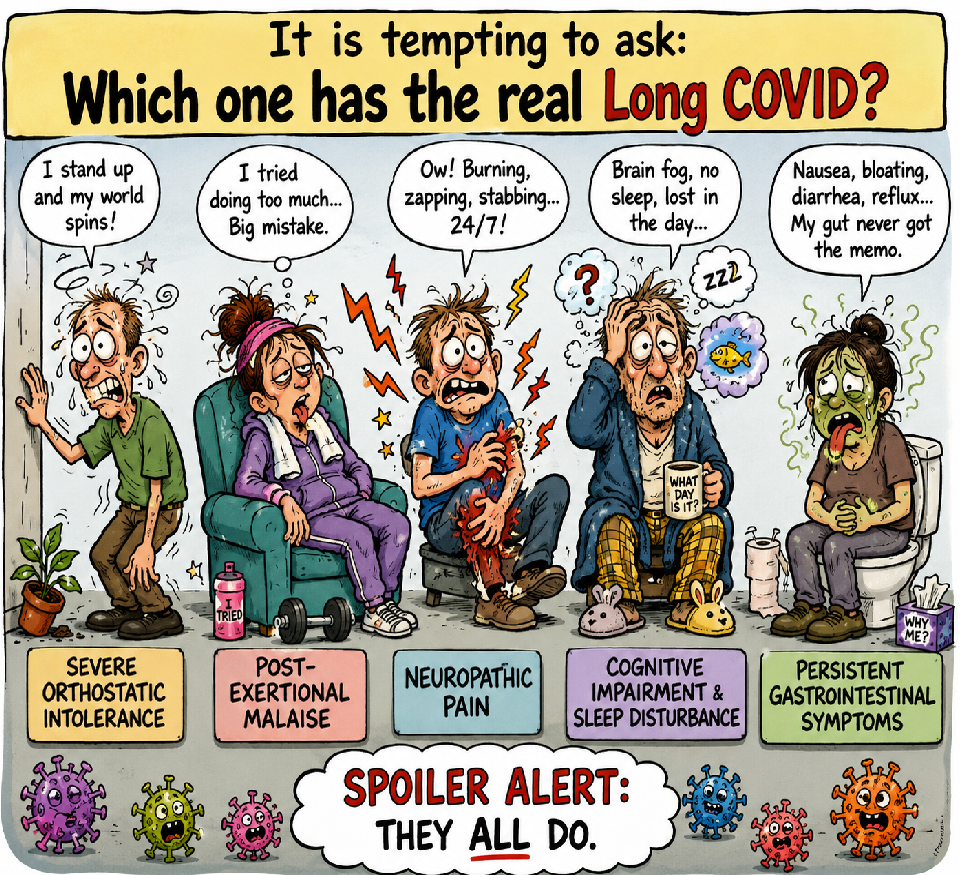
Imagine five patients sitting in the same clinic.
All have Long COVID.
One has severe orthostatic intolerance.
Another has post-exertional malaise.
A third has neuropathic pain.
A fourth has cognitive impairment and sleep disturbance.
A fifth has persistent gastrointestinal symptoms.
It is tempting to ask:
Which one has the real Long COVID?
The more useful question may be:
What biological process is dominant in each patient?
That is a very different way of thinking about disease.
Cancer researchers long ago learned that tumors with the same anatomical location can have very different molecular characteristics.
Inflammatory diseases can have multiple endotypes.
Asthma is not one biological disease.
Heart failure is not one biological disease.
Why should a postviral syndrome necessarily be different?
The emerging model
The simplest version of the old Long-COVID model was:
infection → chronic symptoms.
The emerging model looks more like a network.
SARS-CoV-2 infection
↓
viral persistence and/or tissue injury
↓
immune dysregulation
↓
vascular, autonomic, neurological and metabolic disturbance
↓
altered tissue physiology
↓
secondary viral reactivation and additional immune signaling
↓
persistent disease
The arrows may run in both directions.
Inflammation can alter metabolism.
Metabolic dysfunction can influence immune cells.
Immune dysfunction can permit viral reactivation.
Viral reactivation can stimulate immunity.
Vascular dysfunction can affect the nervous system.
Autonomic dysfunction can alter vascular regulation.
The result is not a single straight line.
It is a network.
What this means for treatment
This emerging view also explains one of the great frustrations of Long-COVID medicine.
If patients have different biological diseases hiding beneath the same diagnostic label, then a treatment that works for one subgroup may fail spectacularly in another.
An antiviral might help a patient whose illness is driven by persistent viral replication or antigenic stimulation.
It might do little for someone whose dominant problem is autonomic dysfunction.
An immunomodulatory drug might help one immune phenotype and be useless—or harmful—in another.
A treatment aimed at mitochondrial metabolism might conceivably help patients with metabolic dysfunction while doing nothing for patients whose principal abnormality lies elsewhere.
The future therefore may not be a single “Long COVID drug.”
It may be phenotype-specific treatment.
Before that becomes possible, however, medicine needs something it currently lacks:
reliable biological markers that tell clinicians which patient belongs to which group.
The question that comes next
This is where the science stands in an uncomfortable but productive place.
Long COVID is no longer mysterious in the sense that scientists have no idea what might be happening.
Quite the opposite.
There are almost too many ideas.
Persistent SARS-CoV-2.
Immune dysregulation.
Autoimmunity.
Endothelial dysfunction.
Microvascular abnormalities.
Autonomic dysfunction.
Small-fiber injury.
Neuroinflammation.
Mitochondrial dysfunction.
Metabolic reprogramming.
Gut-brain interactions.
Viral reactivation.
Genetic susceptibility.
The challenge is no longer generating hypotheses.
It is determining which ones are causal, which are consequences, which coexist, and which matter for which patients.
That distinction will determine whether Long COVID becomes a tractable medical problem or remains an enormous collection of overlapping symptoms.
From dismissal to precision medicine
The history of Long COVID has therefore undergone a remarkable reversal.
At first, patients had to persuade doctors that something was wrong.
Then researchers had to demonstrate that biological abnormalities existed.
Now scientists are faced with a more difficult task: determining how those abnormalities fit together.
The answer may not be a single mechanism.
It may be a set of interacting biological pathways triggered by one infection and shaped by the individual host.
For some patients, viral persistence may be central.
For others, immune dysregulation.
For others, autonomic or small-fiber dysfunction.
For others, metabolic failure.
And for some, the acute infection may destabilize the normally quiet relationship between the immune system and viruses that have lived inside the body for years.
That possibility is one of the most intriguing developments in the field.
It also suggests a different way of thinking about the disease.
The question that defined the first years of Long COVID was:
“Is this real?”
The science has largely answered that.
The question now is harder:
“Which Long COVID does this patient have?”
If researchers can answer that question, the word long may eventually cease to describe an indefinite period of suffering and instead become a temporary stage in a disease whose biology—and treatment—can finally be understood.