Laurent Chouchana 1,∗, Laure-Hélène Preta 1, Mylène Tisseyre 1, et. al., PMCID: PMC7907730 PMID: 33647327
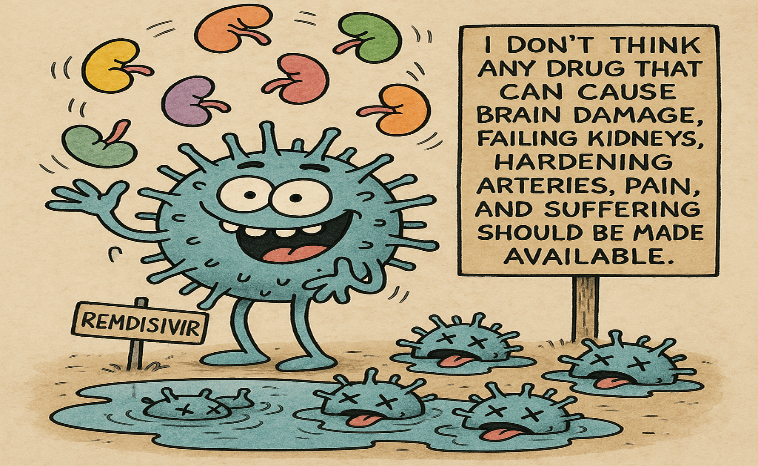
Remdesivir is a novel adenosine-like nucleotide analogue, representing the first drug approved for coronavirus disease 2019 (COVID-19), albeit an uncertain clinical relevance. In clinical trials and case series, acute kidney injury (AKI), including renal replacement, has been frequently reported.1 , 2 Although causality is debatable, kidney injuries, especially proximal tubular epithelial cell necrosis, have also been observed in animal studies during remdesivir development.
To provide additional data, we performed a pharmacovigilance analysis on the World Health Organization global database of individual case safety reports, VigiBase (https://www.who-umc.org/vigibase/vigibase/). This database gathers spontaneous reports of suspected adverse drug reactions from >130 countries, which makes it a powerful tool to perform disproportionality analyses.3 This approach, based on a case–noncase method, estimates whether an adverse event is differentially reported for a specific drug compared with other drugs.
Among 1,565,117 reports registered from January 1st until August 30th, 2020, 5532 concerned COVID-19 patients and have been included in this study. Of them, 434 (7.8%) cases were related to kidney disorders, including 327 (5.9%) reported with remdesivir. In remdesivir kidney disorder cases, 217 (66.3%) patients were male, with a median age of 65 (interquartile range, 55–73) years (Supplementary Table S1). Remdesivir was discontinued early after kidney disorder onset, with a median treatment duration of 3 (interquartile range, 1–4) days. In the vast majority of cases (316 [96.6%]), no other drug was suspected in the onset of kidney disorders. Reactions were serious in 301 (92.0%) cases, with a fatal outcome for 15 (4.6%) patients. They were mainly AKI in 295 (90.2%) cases and tubular necrosis in 8 (2.4%) cases.
Compared with the use of chloroquine, hydroxychloroquine, dexamethasone, sarilumab, or tocilizumab, the use of remdesivir was associated with an increased reporting of kidney disorders (reporting odds ratio, 7.2; 95% confidence interval, 5.7–9.0) (Table 1 ).
Table 1.
Reporting of kidney disorders in remdesivir users among COVID-19 patients, and their RORs within the WHO global pharmacovigilance database
| Type of analysis | Kidney disorder casesa | Noncasesb | ROR (95% CI) |
|---|---|---|---|
| Primary analysis | |||
| Remdesivir users | 327 | 1526 | 7.2 (5.7–9.0) |
| Other drug users | 107 | 3572 | 1 (Reference) |
| Sensitivity analysis restricted to severe to critical COVID-19 patients | |||
| Remdesivir users | 327 | 1526 | 3.7 (2.6–5.4) |
| Dexamethasone, sarilumab, or tocilizumab users | 34 | 591 | 1 (Reference) |
| Sensitivity analysis restricted to serious kidney disordersc | |||
| Remdesivir users | 301 | 1552 | 6.9 (5.4–8.7) |
| Other drug users | 101 | 3578 | 1 (Reference) |
| Sensitivity analysis restricted to kidney disorders not including concomitant nephrotoxic drugsd | |||
| Remdesivir users | 242 | 1611 | 6.1 (4.8–7.9) |
| Other drug users | 88 | 3591 | 1 (Reference) |
CI, confidence interval; COVID-19, coronavirus disease 2019; ROR, reporting odds ratio; WHO, World Health Organization.
The case–noncase approach is similar to case-control method but for purpose of pharmacovigilance studies. Disproportionality in adverse drug reaction reporting between groups is expressed using RORs and their 95% CIs. ROR is a ratio similar in concept to the odds ratio in case-control studies and corresponds to the exposure odds among reported cases of kidney disorders over the exposure odds among reported noncases. An ROR >1 suggests that kidney disorders are more frequently reported in remdesivir users compared with other drug users (i.e., chloroquine, hydroxychloroquine, dexamethasone, lopinavir/ritonavir, sarilumab, or tocilizumab users) among patients with COVID-19 (list of terms is provided in the Supplementary Data). Reports with remdesivir that also included any other drug mentioned above were further excluded (corresponding to 806 reports). To assess the robustness of the main analysis, we performed several sensitivity analyses. First, to take into account clinical patient status and intensive care unit settings, we further restricted the analysis to drugs specifically used in severe to critical COVID-19 patients (i.e., dexamethasone, sarilumab, or tocilizumab). Second, we restricted the analysis to (i) serious kidney disorder cases only and (ii) kidney disorder cases that did not include known concomitant nephrotoxic drugs. In sensitivity analyses, nonserious cases and cases including concomitant nephrotoxic drugs were considered as noncases.
a
Kidney disorder cases were individual case safety reports containing any reaction belonging to the kidney system as system organ class, according to the Medical Dictionary for Regulatory Activities (https://www.meddra.org/).
b
Noncases were reports containing any other reaction.
c
Serious cases were defined, according to the WHO, as the occurrence of death, life-threatening adverse event, inpatient hospitalization or prolongation of an existing hospitalization, significant disability, or requirement of intervention to prevent any of these.
d
List of concomitant or suspected nephrotoxic drugs is in the Supplementary Data.
The retrospective design of our pharmacovigilance analysis has several limitations, especially underreporting and residual confounders, including the role of COVID-19 in AKI occurrence. Nevertheless, sensitivity analyses showed similar results, especially when excluding other nephrotoxic drugs or when comparing with only drugs used in severe to critical COVID-19.
Our findings, based on postmarketing real-life data from >5000 COVID-19 patients, support that kidney disorders, almost exclusively AKI, represent a serious, early, and potentially fatal adverse drug reaction of remdesivir. These results are consistent with findings from another group.4 Physicians should be aware of this potential risk and perform close kidney monitoring when prescribing remdesivir. Further data are needed to confirm that safety signal.