BY JAY BHATTACHARYA The writer is director of the National Institutes of Health.
The U.S. Department of Health and Human Services’ decision to wind down its MRNA vaccine development activities marks a necessary pivot in how we steward public health innovations in vaccines. The right path requires us to consider the inherent strengths and weaknesses of a technology as well as any alternatives, along with public attitudes and experience with the technology.
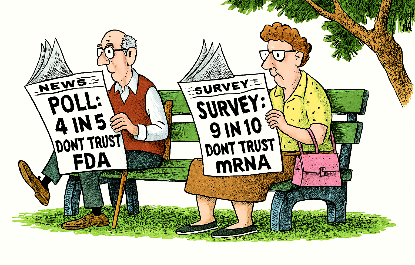
The MRNA platform is promising technology. I do not dispute its potential. In the future, it may yet deliver breakthroughs in treating diseases such as cancer, and HHS is continuing to invest in ongoing research on applications in oncology and other complex diseases. But as a vaccine intended for broad public use, especially during a public health emergency, the platform has failed a crucial test: earning public trust. No matter how elegant the science, a platform that lacks credibility among the people it seeks to protect cannot fulfill its public health mission.
It is critical to understand the development of the MRNA coronavirus vaccines in the context of the very successful Operation Warp Speed launched during the first Trump administration. Operation Warp Speed represented a paradigm shift in how the government should invest in new technologies and solutions and embrace strategic investments in publicprivate partnerships, innovation in trial design and removal of bureaucratic red tape to allow parallel rather than sequential vaccine development. It produced a new vaccine in record time and also helped develop a successful monoclonal antibody.
Unfortunately, the Biden administration did not manage public trust in the coronavirus vaccines, largely because it chose a strategy of mandates rather than a risk-based approach and did not properly acknowledge Americans’ growing concerns regarding safety and effectiveness.
Consider the data: In a late 2024 Pew Research Center survey, 60 percent of American adults reported no intention of getting an updated coronavirus MRNA vaccine despite the Centers for Disease Control and Prevention’s advice that nearly all adults receive yet another dose. As of late April 2025 (the latest data publicly reported by the CDC), only 13 percent of children between the ages of six months and 17 years had received an updated coronavirus vaccine, even though the Biden-era CDC had placed the vaccine on the childhood immunization schedule.
In 2021, the Biden administration’s HHS spent nearly a billion dollars on a campaign supporting the coronavirus vaccine, the most expensive pharmaceutical advertising campaign in history. The government spent the money on a vast number of TV, radio and internet spots, which misinformed the American public that the vaccine would protect them from contracting and spreading covid. Nevertheless, just a few years later, less than half the U.S. adult population will heed the CDC’S guidance.
Some outlets have blamed the poor coronavirus MRNA vaccine uptake on poor messaging or “anti-vax” counter-messaging. But the Biden administration made suppression of speech — and a mandate for all on the vaccine — into a priority.
The failure was thus not a communications problem. It is a trust problem due to the Biden administration’s scientific overreach, public pressure and, frankly, arrogance.
In addition to the trust problem, the MRNA technology has special biological features that make it different from other vaccines in that it (ideally) instructs our cells to produce proteins that subsequently invoke an immune response. To do so with complete confidence about vaccine safety and efficacy requires an exact understanding of dosage, biodistribution and offtarget effects. Unfortunately, we fall short on all three. We lack clarity on how much antigen each MRNA molecule produces, where in the body the MRNA product winds up, how long it stays in the body, and whether unintended proteins are created. From a regulatory perspective, getting approval for a vaccine with such inherent uncertainties should be difficult.
Still, I do not believe the MRNA vaccines caused either mass harm on the one hand or saved 14 million lives on the other. Those estimates swing wildly based on speculative modeling, not concrete evidence. A recent modeling study concluded that the global coronavirus vaccination campaign saved 2.5 million lives from 2020 to 2024, mainly among the elderly. The scientific controversy over the vaccine’s effect on mortality rages on.
Science isn’t propaganda. It’s humility. And when public health officials stopped communicating with humility, we lost much of the public, an absolute necessity for any vaccine platform.
I am not here to litigate the past. I am here to chart a better path forward. That is why the NIH, under the leadership of HHS Secretary Robert F. Kennedy Jr., is investing in new vaccine technologies — based on whole-virus inactivated vaccines, which offer a broader immune response and have a longer track record of safety and public acceptance. We are continuing the Operation Warp Speed model of investing in technology with the most potential to help Americans.
We will move forward with scientific rigor, transparency and humility. At the NIH, we will fund promising research based not on hype, but on evidence. And I will continue to use my platform to communicate candidly in public conversations where debate and disagreement are welcomed.
We are entering a new era of public health, grounded not in wishful thinking or performative consensus, but in open inquiry and respect for the American people’s intelligence. The only way to rebuild trust is to earn it — one honest conversation at a time.