John Murphy. The COVID Long-haul Foundation
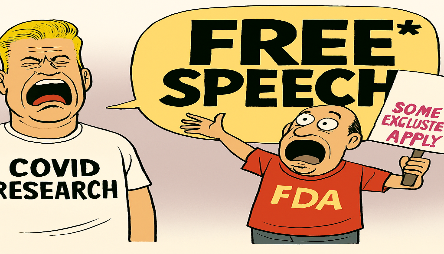
It’s revealing how quickly self-proclaimed defenders of free speech abandon their principles once they gain institutional power. For years, a cohort of COVID contrarians claimed they were victims of censorship under the Biden administration—allegations that were ultimately dismissed by the Supreme Court in Murthy v. Missouri. Now, some of those same voices hold key positions in federal health agencies under Trump, and their actions suggest a very different relationship with free expression.
The YouTube Takedown
Dr. Vinay Prasad, now the FDA’s top vaccine regulator, recently filed copyright complaints that led to the deletion of a YouTube channel run by Dr. Jonathan Howard, a neurologist and psychiatrist. Howard’s channel had quietly amassed a library of over 350 clips documenting public statements by prominent medical figures—many of whom now wield significant influence over national health policy.
Howard’s goal was straightforward: preserve the public record. As he wrote in Science-Based Medicine, “We need to remember their prior pronouncements to judge their current credibility.” His channel wasn’t monetized, had just 256 subscribers, and featured short clips used for commentary and critique—classic fair use.
But Prasad objected. According to The Guardian, he demanded the removal of six videos featuring himself. YouTube complied, citing copyright infringement, and deleted the entire channel.
Hypocrisy in Action
This move is especially striking given Prasad’s long-standing posture as a free speech advocate. He and others—like Jay Bhattacharya, now head of the NIH—spent years claiming they were censored for their views. Yet when faced with criticism, they’ve turned to legal mechanisms to silence dissent.
Howard, in contrast, responded with restraint and satire. He refused to dramatize the takedown, noting that his channel’s reach was modest and joking that its deletion was “really funny and pathetic” given Prasad’s apparent sensitivity. More importantly, Howard pointed out the selective nature of Prasad’s enforcement: anti-vaccine accounts have freely shared the same clips without consequence. The issue wasn’t copyright—it was viewpoint.
Copyright as a Censorship Tool
This is a textbook example of using copyright law to suppress criticism. Howard’s use of the clips—embedded in commentary and critique—falls squarely within fair use. He’s already begun reuploading content with added commentary to strengthen that legal position.
But the legal technicalities obscure the deeper issue: the weaponization of copyright by government officials to silence private citizens. It’s a tactic cloaked in legitimacy but rooted in censorship.
A Broader Pattern
This isn’t an isolated incident. Bhattacharya and RFK Jr.—now Secretary of Health and Human Services—have both filed lawsuits alleging censorship, despite their content merely being fact-checked or deprioritized by algorithms. Now in power, they’re actively suppressing dissent.
Howard sees the irony clearly: “Americans do not need our government’s permission to remember their words.” His new channel will continue documenting public statements, this time with added commentary to ensure legal protection.
The Takeaway
The loudest voices decrying censorship often become its most enthusiastic practitioners once they hold power. The case of Dr. Prasad illustrates how quickly “free speech” rhetoric can give way to silencing critics—especially when those critics are preserving inconvenient truths.
Howard’s project remains vital. The public deserves transparency from those shaping health policy. And if officials fear scrutiny of their own words, perhaps the problem isn’t the scrutiny—it’s the words themselves.